


66 days to wire a habit into autopilot. 43% of your day already running on it. 23 labs and 2,000 participants quietly killing the willpower-as-fuel myth. 12,000 diary entries proving small wins beat big breakthroughs. A 60% spike in amygdala reactivity after one bad night of sleep. None of these findings will fit on a motivational poster; and that’s exactly why the posters keep lying to you.
A 1971 experiment involving puzzles that tested whether paying people for tasks harmed their motivation. A 2016 meta-analysis that eliminated twenty years of “willpower” research. The results of a famous 1960s marshmallow test that used 2018 data to determine the cause of delayed gratification was based on the family’s socioeconomic context and not the individual child’s brain function. Approximately 43% of each day is spent performing routine behaviors automatically, and not due to the level of motivation. A best-seller that changed the way we perceive the role of dopamine and turned it into a villain it never was. None of these scientific findings were trending on social media feeds promoting hustle culture; therefore, why the misinformation regarding motivation has persisted for this length of time.
You have been informed that motivation is a form of personal weakness. That discipline is the solution. That waking up at 5 AM changes your brain. That willpower is a muscle that needs to be trained. That you need to want it more. That you need to detox your dopamine, eliminate distractions, create the manifestation of an end result, and grind more. The multi-billion-dollar motivational industry that was developed to provide solutions to these issues is primarily based upon assumptions derived from outdated science.
This piece is an examination of twelve false statements regarding motivation. Each myth is associated with a specific named study, researcher, or peer-reviewed publication. The objective is to provide you with an evidence-based guide to understand what current research indicates regarding motivation psychology; thereby providing you with a method to evaluate if the information presented in future motivational posts (e.g., “5 brutal habits of high achievers”) align with scientific fact.
The industry selling you a broken product
When entering a typical bookstore today, opening any “personal development” feed on TikTok, or attending a corporate off-site, you are typically met with the same message: motivation is a state of mind you create; discipline is a virtue you develop; and any failure to achieve performance goals is ultimately a reflection of your lack of commitment. These types of messages have become so widespread throughout our culture that they have shifted from being merely claims to being descriptions of reality.
However, there are researchers who are focused on studying motivation who spend years developing and collecting data using controlled experimentation, longitudinal research, and meta-analytic methods. Collectively, they have produced many decades’ worth of findings that contradict virtually every statement on the above list. For example, Edward Deci and Richard Ryan demonstrated that paying individuals for completing tasks they enjoy doing often causes them to cease doing such activities. Wendy Wood conducted research at USC and found that nearly half of all daily behaviors occur without regard to an individual’s current motivation. Roy Baumeister’s “willpower as a muscle” theory was one of the most widely referenced findings in psychology; however, subsequent large-scale replication efforts failed to confirm the original findings, thus raising serious questions concerning the validity of this theoretical framework.
Behavioral science tends to focus on disproving popular notions that are promoted by the self-improvement industry. Often times, the difference between what has been established by behavioral science for several decades and what readers believe is substantial. The twelve pieces included here are an effort to bridge this gap; one verifiable myth at a time.
1. Lie #1; “Motivation Is the First Step. Just Get Motivated.”

You’ve likely heard some variation of this theme since your adult life began. Get motivated first; then you’ll act. Find your purpose; then you’ll pursue it. Visualize your success; then you’ll work toward achieving it. The sequence is treated as self-evident. Motivate yourself and then you will behave accordingly.
The research has reversed this sequence.
B.J. Fogg, the Stanford behavior scientist who developed the Behavior Design Lab, has codified this reversal into what is now referred to as the Fogg Behavior Model. Fogg stated that in order for any behavior to occur, three variables must come together at the exact same time: motivation, ability, and a prompt. Should motivation be present yet ability be absent or no trigger arrive, then nothing occurs. Additionally, if motivation fluctuates (as it generally does), then the factor you adjust is not “get more motivated.” Rather it is either “make the behavior simpler,” or “better design the prompt.” In Fogg’s model, motivation is defined as the least stable and least manipulable element in the formula.
This matter is relevant because essentially the entire self-help industry has been promoting motivation as something that can be manipulated for many years. The literature does not support this premise. Wendy Wood at USC has documented that approximately 43% of daily activity occurs in repetitive contexts without regard to an individual’s consciousness or intentionality. Much of human behavior is determined by habitual responses triggered by existing context rather than intentional thought processes. Your home provides contextual cues; your phone provides prompts; your workplace generates patterns. The “motivation to act” you have pursued for almost half your day is largely irrelevant to what you do.
The Vibe List’s take: stop considering motivation as a starting line. It is a co-pilot, not a pilot. Individuals consistently creating productive output do not find themselves motivated to produce most days; they have created an environment that allows them to produce work as easily as possible. The motivation develops sometime in the process of completing the task.
2. Lie #2; “Discipline Trumps Motivation Every Time.”

If you listen to any productivity podcast, you will undoubtedly hear it within thirty seconds: “motivation is unpredictable. Discipline is the answer.” At first glance, it seems like sage advice. However, there is some unpleasantness involved.
The truth is even more disconcerting. Those who exhibit “discipline” rarely rely solely on self-imposed coercion. Based on Wendy Wood’s habit research, what appears as discipline from the outside perspective is usually nothing more than an effectively constructed array of contextually generated routine behaviors. When viewing a marathoner training prior to dawn, you’re not witnessing willpower in action. What you see is twenty months of repeated behavior in similar contexts (similar shoes, identical alarm clock ringing time, same course route) that have formed automatic habits requiring little to no additional cognitive energy for execution than would be required to avoid executing said habits.
The “discipline trumps motivation” slogan also presumes that willpower is one’s only alternative to relying upon mood fluctuations as determinants of action. There are alternatives to both discipline and mood dependency; namely environmental design. Environmental design has been shown by decades of research to be far more effective than either motivation or willpower in determining behavior.
B.J. Fogg’s entire body of work centered around his theory of Tiny Habits has demonstrated that when designing the proper environment (including anchors), and making behavior small enough (thus reducing reliance upon motivation), willpower becomes unnecessary as a virtue.
The cultural emphasis upon discipline has another unintended consequence: moralization of failure. If discipline is the solution and you fail to execute, then it logically follows that you are lacking in character. The research does not indicate this interpretation of failure.
The research suggests that you may have created a behavior that is overly complex or infrequent or insufficiently linked to an existing context in your daily life. Neither characteristic constitutes a deficiency in character.
The Vibe List’s take: while “Discipline Beats Motivation” is theoretically correct (in the same manner “running beats standing still”), without context it represents an empty mantra. The correct hierarchical structure is: environment > habit > discipline > motivation. Anybody selling you the lower rung on this ladder as representing the highest rung is selling you a harder problem than you are attempting to resolve.
3. Lie #3; “Rewards Increase Motivation.”

By 1971, Carnegie Mellon graduate student Edward Deci published a study which would profoundly alter America’s prevailing views about human motivation. The study, entitled Effects of Externally Mediated Rewards on Intrinsic Motivation, appeared in the Journal of Personality and Social Psychology and utilized college students as subjects in an experimental setting. During the second session, students were provided with $1 for each Soma puzzle completed. An untreated group did not receive compensation.
Deci discovered during an apparently inconsequential “free choice period”; i.e., those moments between sessions when participants were allowed unfettered access to their puzzle and a pile of magazines; that uncompensated students continued to engage in puzzle completion for enjoyment. Paid students ceased engaging in puzzle completion once monetary incentive ended.
Monetary incentives did not increase their motivation levels; instead they substituted their motivation with payment for engagement in puzzle completion.
This phenomenon became known as the overjustification effect and was further substantiated by Lepper, Greene & Nisbett’s (Stanford University) 1973 study examining preschoolers’ behavior while engaged in creative activity utilizing felt-tip markers with which they were familiar (and presumably enjoyed). Lepper and colleagues divided children into three groups. Some received an unexpected “Good Player” award after demonstrating creativity using felt-tip markers. Other students received an anticipated award after demonstrating creativity using felt-tip markers; while others received no awards or recognition.
Days later, researchers returned and observed which children chose to continue demonstrating creativity using felt-tip markers during periods characterized as free play (i.e., without constraints or expectations); the children receiving anticipated awards exhibited significantly less interest in continuing creative expression using felt-tip markers compared to either of the remaining two groups. Awards conditioned children to associate creativity using felt-tip markers with potential rewards rather than expressing creativity for its inherent value.
Edward Deci and his collaborator Richard Ryan eventually synthesized these findings into the currently accepted framework known as Self-Determination Theory; one of the most thoroughly researched frameworks regarding psychological motivation.
Their 1999 meta-analysis comprising 128 studies published in Psychological Bulletin indicated that tangible rewards, specifically those deemed expected, contingent and/or dependent upon successful completion of desired behavior(s), have a consistent tendency to diminish intrinsic motivation for such behaviors.
These findings represent numerous applications within everyday life; including bonuses tied to completion of novels, rewards tied to reaching certain milestones (e.g., rings earned via use of smartwatches), streaks maintained through use of apps for meditation practices; etc.
Each example has been proven under controlled conditions to potentially condition individuals away from developing motivations for participating in activities based on intrinsic reasons towards developing extrinsic motivations based upon obtaining rewards.
The Vibe List’s take: rewards work (for tasks that individuals would otherwise not engage in); however, rewarding activities that individuals inherently enjoy doing may slowly erode the primary motivators driving participation in those activities (the only source that may sustainably motivate participation).
The most highly motivated individuals you know do not utilize optimal reward structures; rather they have successfully removed barriers in their environment allowing them to easily participate in productive output creation.
4. Lie #4; “Willpower Is a Muscle. If You Train It, You Will Have More.”

There was a major scientific narrative about self-control that lasted approximately 15 years. The idea that willpower is like a muscle came from social psychologist Roy Baumeister and his colleagues. In 1998, they conducted an influential experiment in the Journal of Personality and Social Psychology. Participants who were hungry went into a room where there were fresh-baked chocolate chip cookies and a bowl of radishes. Half of the participants were told to only eat radishes and therefore resist eating the cookies. The remaining participants had no such restriction. Afterward, both groups were provided with an impossible geometric puzzle. The radish eaters, who presumably used up all of their willpower fighting the cookies, quit the puzzle in approximately half the amount of time as the unrestricted participants. Baumeister termed this occurrence ego depletion. This model of ego depletion was one of the most referenced studies in psychology.
Then, it fell apart.
A 2016 pre-registered multi-lab replication effort with over 2,100 participants in 23 different laboratories was unable to support the claim that ego depletion exists. The impact of this study was so great that Michael Inzlicht, a University of Toronto psychologist who authored many papers supporting the ego depletion model, stated that he believed that the original ego depletion model was severely compromised and that while previous research claimed that the effects were “reliable,” “robust,” and “large”; the newer data indicated that the results were none of these characteristics. An updated meta-analysis in 2018 published on PubMed Central found that effect sizes were near zero once publication bias was corrected for. Another study published in 2023 found that even the supposedly moderating effect of “a willpower mindset” did not exist according to new evidence.
It does not mean that self-control is a myth. What it means is that the particular version of “limited fuel tank” model of self-control; particularly the version that became standard fare in personal development material; stating that individuals should “train their willpower muscles” using methods such as cold showers and difficult practices; is supported by weak data.
Therefore, if we look at more modern research regarding self-control; self-control appears to operate as more of a combination of attention, motivation orientation, and environment rather than as a limited resource or “tank”. Individuals who appear to have high levels of willpower often attempt to avoid having to utilize it in order to maintain the illusion of willpower. Therefore, they do not have a depleted “willpower tank.” Rather than competing against a “depletion tank”, they simply are avoiding engaging in activities that require self-control.
The Vibe List’s take: Those who have spent their lives pointing fingers at a depleted “willpower muscle” after failing at 9 PM may now realize that they have blamed an entity that the field of psychology is currently questioning. You are not running on empty. You are operating in an environment that has been designed to sabotage you with a mental model designed to make you point to yourself as the source of your failures.
5. Lie #5; “If You Wanted It Enough, You Would Already Have It.”

This is perhaps one of the most frequently shared ideas in motivational literature and also potentially one of the most quietly damaging ideas. It manifests in graduation addresses, startup mythology, self-help blog posts, your uncle’s Facebook post, etc. Essentially, this idea states that the primary variable determining an individual’s success is their level of desire. Want it more. Desire more intensely. Put more skin in the game.
Research views this idea as comparable to claiming that speed is the only relevant factor distinguishing someone who travels to a destination they have never visited before from someone who has traveled to the same destination numerous times.
There are two primary ways to debunk this notion. Firstly, Wendy Wood found in her work that nearly half of daily behaviors occur automatically due to environmental influences; meaning individuals you compare yourself to are not going to want it more during the 43% of their day that operates on autopilot since no one wants anything during this window. Secondly, B.J. Fogg’s Behavior Model illustrates clearly that motivation represents only one-third of three necessary elements for producing desired behavior. The other two components are ability (how easily is the behavior performed), and prompts (is the cue present at the appropriate moment); each are equally important. An individual possessing extremely high motivation but very low ability combined with no applicable prompts will produce virtually nothing. Conversely, an individual possessing little motivation yet possessing high ability along with a sufficient prompt will produce consistently.
The second collapse is arguably even more severe. In 2018, researchers Tyler Watts, Greg Duncan, and Haonan Quan published a conceptual replication of the famous 1960s Marshmallow Test in Psychological Science; an experiment designed to demonstrate that children capable of delaying immediate gratification grow into successful adults. Watts et al. utilized significantly larger and more diverse samples than Mischel’s original sample size. Their result; reported by Vox and The Atlantic; effectively destroyed roughly half of the classic story surrounding this topic: once socioeconomic status was statistically controlled for, the predictive power of a child’s ability to want something more aggressively essentially disappeared. The patience exhibited by Mischel’s subjects was viewed within the larger replication as primarily indicative of having access to a stable home environment and reliable parents.
In essence, children who were aware that additional marshmallows would eventually be available waited longer for them. Children who understood that the availability of future marshmallows was unreliable did not wait longer for them. There was no statistical difference in the degree of “motivation” between either group.
The Vibe List’s take: Telling others to “if you really want it badly enough” is analogous to telling children fairy tales about wishing upon stars so long as they believe hard enough. Motivation is one variable among at least three (ability, context/resources) influencing why individuals achieve their goals or do not achieve them; context and resources have far greater influence than any burnout-driven desire framework will acknowledge.
6. Lie #6: “Waking Up at 5 AM and Your Life Will Change.”

The 5 AM Club is a brand name; however, from a perspective of the physical and biological sciences pertaining to sleep and circadian rhythms, it is largely a branding campaign cloaked in pseudo-scientific jargon.
Peer-reviewed literature on sleep has produced clear conclusions. The Sleep Foundation and collective agreement from circadian scientists provide that establishing regularity in waking patterns synchronizes a person’s roughly 24-hour internal circadian rhythm; not necessarily waking at an early hour. Two people who establish consistent wake-up times (one at 5 AM and another at 7:30 AM) are providing similar signals to their suprachiasmatic nuclei. The former is merely completing this activity sooner than the latter; and likely worse depending on the participant’s chronotype.
Perhaps even more critically; Matthew Walker and his laboratory team at UC Berkeley found in an fMRI study conducted in 2007, that sleep-deprived participants exhibited approximately 60% increased amygdala reactivity than well-rested participants when viewing negative stimuli, and experienced significant disruptions to prefrontal cortex; amygdala circuitry associated with emotional regulation. If 5 AM equates to receiving only six hours of sleep per night as opposed to eight hours of sleep per night for your unique chronotype; you have not enhanced your morning. You have diminished your decision-making capabilities, worsened your mood state, and exacerbated your impulse control for the remainder of your day.
Additionally, The 5 AM Club brand name relies on a form of selection bias that distorts its application potential. The CEOs and athletes that receive coverage for their early rising schedules typically possess scheduling flexibility (e.g., light morning meetings), prepared meals courtesy of their household staffs, no childcare responsibilities during peak morning hours, and complete schedule autonomy. A registered nurse working 12 consecutive hours does not enhance her life by establishing an early rising schedule; she degrades it.
As previously mentioned, “wake up at 5 AM” generalizes poorly because it was never intended to generalize broadly in the first instance.
The Vibe List’s take: Establishing regular wake-up times regardless of whether those wake-ups occur at 5 AM or 10 AM or anywhere else is determined solely by your unique chronotype. Therefore, establishing regular wake-up times is a chronotype-based issue; not a moralistic/achievement-based issue. The 5 AM club brand name generates revenue successfully because it provides an impressionally clean and replicable formulaic approach to addressing sleep; whereas in reality it is merely a marketing convention masquerading as a sleep-related recommendation.
7. Lie #7: “Dopamine Detoxes Will Restore Your Drive.”

Anna Lembke; a Stanford psychiatrist and head of Stanford’s Addiction Clinic; released her book titled Dopamine Nation in 2021 which generated tremendous cultural attention. Lembke posited that repeated exposure to high-stimulus behaviors (i.e., social media, highly processed foods, pornography, excessive video watching) shifts the brain’s subjective experience towards chronic discomfort thereby necessitating extended durations without these behaviors to reset one’s pain-pleasure sensitivity balance. Although Lembke’s clinical observations based upon her extensive experience with patients may be valid; her clinical insights have value. However, when Lembke’s clinical concepts were disseminated via social media platforms they quickly devolved into a trend known as “dopamine detoxes.”
Individuals began posting videos depicting themselves spending 24 hours alone in a dark room accomplishing absolutely nothing. Courses were developed around it. By definition, Lembke’s clinical concept was transformed into a 24-hour gimmick whose biological/neuroscientific rationale lacked substantially more credibility than any marketing claims made.
Daniel L. Smail wrote in Psychology Today that one of the greatest misinterpretations concerning dopamine in popular motivation literature is that dopamine is viewed as a binary ‘happiness chemical’. According to Smail: “Dopamine does not create happiness or determine well-being…it reports back on how rewarding your experiences have been.” Thus, dopamine acts as a signaling molecule, not an imaginary happiness reservoir which can be drained or refilled.
Much like many areas within motivation; neurobiology exhibits substantial complexity beyond what is represented by detox-related literature.
Andrew Huberman; a researcher from Stanford University and author of an extremely popular podcast; has extensively discussed on his podcast numerous strategies for improving an individual’s baseline dopamine system and enhancing motivation/driver-related functions; emphasizing on multiple occasions that what is crucial is not whether or not you have depleted some hypothetical dopamine tank but rather whether your baseline levels of dopamine exceed your peak levels. Repeatedly consuming massive amounts of artificial spikes from sources such as short-form video clips, sugar-rich foods or compulsive browsing does indeed lower your comparative baseline over time; however, the solution is not merely abstaining from consumption for 24 hours. The solution involves decreasing artificially stimulated spikes and reintegrating slower earned rewards (e.g., productive labor/work; physical exertion/exercise; genuine interpersonal interactions/conversations; quality sleep).
The Hartford Hospital research on cognitive overload supports this overarching theme: frequent switching between tasks/stimuli reduces motivation over time; again, however, this pattern is steady not episodic (i.e., detox).
Another problem with what detox marketing excludes: anhedonia (the inability to experience pleasure) is a documented symptom of clinical depression and several other disorders; thus a person suffering from anhedonia is not low on dopamine because they consumed too much Instagram content. Anhedonic individuals require assistance from mental health professionals; not 24-hour silent retreats.
Confusing these two populations is detrimental.
The Vibe List’s take: Dopamine detoxes advertised online represent essentially digitally-based fasting products promoted using vocabulary related to neuroscience lacking legitimacy to describe either process accurately. While Anna Lembke’s clinical insight regarding constant high-stimulation behavior causing chronic discomfort is legitimate; Anna Lembke’s clinical insight has been taken out-of-context by marketers selling detox products on social media platforms.
8. Lie #8; “Set Big, Inspiring, Visualizable Goals.”
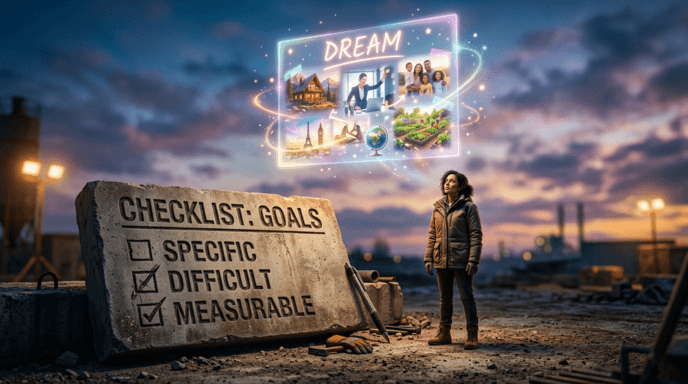
Vision boards. Dream boards. “Manifest your goals.” Ten-year visions. “If you can see it, you can be it.”
But the actual goal-setting research, conducted over more than four decades by Edwin Locke and Gary Latham and summarized in their theory paper on goal setting, produced findings that contradict these statements. Through hundreds of experiments in laboratories and fields spanning multiple industries and cultures, Locke and Latham determined that specific, difficult goals would lead to better performance than encouraging people to “just do their best”. The effect sizes in their meta-analyses were moderate to strong; in fact, some of the largest effects in organizational psychology.
Specific refers to measurable, bounded, and clearly defined behaviors. Difficult refers to sufficient challenge to necessitate a focus of effort; not impossible; nor vague. For example, “run a marathon by Oct 15th by completing a 16-week training program with a peak of 45 miles/week”, is the type of goal that Locke and Latham’s research supports. On the other hand, “be my best self in 2026”, is the type of goal that it does not.
As stated earlier, the “vision board” mythology contradicts this approach. Vision boards encourage emotional connection to an imagined future outcome as opposed to clear definition of a specific goal based on a behaviorally measurable objective with a timeline. Furthermore, research on what has come to be referred to as “fantasy realization” demonstrates that vivid mental imagery of successful outcomes without any consideration of the obstacles necessary to obtain them may decrease the amount of effort one puts toward achieving the goal; because one’s brain partially treats the fantasy as having already occurred.
The empirically supported alternative to this is what NYU social psychologist Peter Gollwitzer calls implementation intentions. Gollwitzer and Paschal Sheeran used a meta-analysis of 94 studies with over 8,000 participants to demonstrate that specifying “if-then” plans for desired actions resulted in a medium-to-strong effect size on goal attainment; one of the strongest interventions identified within the applied psychology literature. “When it is 7 AM on weekdays, I will put on running shoes and go outside”, represents dramatically more effective action planning than any vision board.
The Vibe List’s take: large inspiring goals serve as emotional triggers, not as instructional guides for action. The scientific community resolved this issue decades ago: specificity and difficulty are drivers of performance; and “if-then” planning is superior to imagery. The vision board is not where the actual work occurs; the calendar is.
9. Lie #9; “Successful People Are Simply More Disciplined Children Grown Up.”

The Stanford marshmallow test is perhaps the most widely referenced study in popular psychology. Originally run by Walter Mischel at Stanford in the late 1960s, he placed preschool-aged children in a room containing a single marshmallow. He informed them that they could either eat it immediately or delay eating it for 15 minutes and receive a second marshmallow. Some children delayed; some did not. Mischel followed up years later and found that children who were able to delay longer tended to have better life outcomes (e.g., SAT scores, body mass index, social competence).
However, this finding became cultural shorthand for a relatively easy and comforting story. Adults who were successful were simply more patient children. Adults who were unsuccessful were simply less patient children. The implication was that motivation and self-control were essentially inherent traits that either existed or did not exist.
That comfortable narrative was destroyed in 2018. Tyler Watts, Greg Duncan, and Haonan Quan published a conceptual replication of Mischel’s study using data from approximately 918 children, representing a sample more than 10 times larger than Mischel’s sample and representing a significantly greater diversity in socio-economic status. While they replicated Mischel’s finding that delay of gratification at age 4 predicted adolescent outcomes; however once they accounted for family background and home environment differences between the children, virtually all of the predictive power associated with the children’s “self control” disappeared. Essentially the vast majority of the predictive signal came from economic stability and home conditions rather than from anything internally characteristic of the children. As reported by The Atlantic, “the new study finds limited support for the idea that being able to delay gratification leads to better outcomes.”
This finding fits within a general trend in motivation psychology; i.e., characteristics we perceive as indicative of character are frequently manifestations of the environment. Children raised with dependable adults learn that there is indeed a second marshmallow. Children raised in unstable homes learn that there is only one bird in the bush; i.e., the first one.
Furthermore, this finding has implications for our understanding of adult motivation. If a significant proportion of what appears to be adult self-discipline is simply residual from a stable childhood (i.e., not something an individual generated through grit and self-discipline at age 23), then the culturally presented narrative regarding “what disciplined kids grow up to do,” begins to appear less like guidance and more like condemnation directed at individuals whose early developmental environments did not provide for them.
The Vibe List’s take: much of what we observe as adult discipline may simply represent the lingering presence of a stable childhood. This should not preclude an individual from developing agency; the same research identifies ways to modify these patterns through intentional changes to the environment and through deliberate practice. However, the judgmental lecture regarding what “disciplined kids grow up to do,” should be terminated. The marshmallow was never the total picture.
10. Lie #10; “Mindset Is Everything. Believe, and You’ll Achieve.”

Stanford psychologist Carol Dweck is responsible for coining the terms growth mindset and fixed mindset. Dweck has done very valuable work. Dweck’s research has established that students who believe their abilities can grow through effort will engage more with challenges; will recover faster from setbacks; and will improve performance over time relative to students who believe their abilities cannot grow through effort. Additionally, subsequent neuroscience research indicates that participants exhibiting growth mindsets exhibited increased error positivity on EEG and greater overall electrical activity while correcting errors over 480 trials.
The problem here is not Dweck. Rather it is what happened to her work upon leaving her lab.
Upon entering the popular self-help realm, Dweck’s work became reduced to a slogan: “believe in yourself, and you’ll achieve.” All nuance concerning specific skills, context and the role of supporting environments were lost.
School posters espoused this notion. Corporate training programs incorporated this concept into their curricula. Personal development influencers built entire careers around this concept. And unfortunately for both the educators involved and the practitioners attempting to implement this concept in classrooms and organizations alike, the empirical record for this version of “growth mindset,” is weak at best. Multiple replication attempts and meta-analyses since 2018 have identified that typical growth-mindset classroom interventions produce only minimal effect sizes (small) at best and inconsistent results depending upon population studied; with several recent meta-analyses identifying no measurable benefits from such interventions.
Dweck has acknowledged in her published work that her research was far too simplistic to imply merely praising effort versus ability is sufficient. Specifically she identified that type of feedback received (positive/negative); the domain of skill studied; and whether or not an individual experienced a supportive environment are highly influential variables.
The more profound issue here is that “mindset is everything,” is nothing short of an optical illusion. This phrase redirects attention away from failures toward one’s internal motivations (“you just weren’t motivated enough”); ignores relevant externalities (skill level; available resources; opportunity; networks; chance); and creates a self-contained loop relating solely to motivation that implies every result is ultimately a product of one’s internal state.
Conversely; Dweck’s actual research (and her own published research); treat mindset as merely one variable among many others. A student experiencing a growth mindset yet lacking quality teaching staff; suitable materials; a stable home environment will perform worse than another student with similar growth mindset but possessing these variables. A founder believing strongly in his/her product will still fail in an unresponsive marketplace. Patients maintaining optimistic attitudes during chemotherapy are not more likely to experience survival success than patients without optimistic attitudes controlling for clinical variables. Belief provides energy; it is not the source of motion.
The Vibe List’s take: believing your capabilities can develop is empirically validated; i.e., believing that believing will lead to outcomes is not.
11. Lie #11; “You Need a Major Breakthrough to Get Your Motivation Going Again.”

The cinematographic version of motivation follows this format: you reach bottom; you have a major epiphany; there is musical buildup; you wake up the next morning transformed; you utilize your renewed motivation to compound your success. The formula for every motivational montage ever created approximates zero longitudinal studies.
Empirical versions differ dramatically from the aforementioned description. Teresa Amabile (Harvard Business School) and Steven Kramer (independent researcher) analyzed approximately 12,000 daily journal entries from 238 employees across 26 projects in seven firms for years. Their conclusion (as discussed at Harvard Business Review and further elaborated in their book The Progress Principle) is compelling: among all events capable of increasing an employee’s “inner work life” (their emotions/motivation/perceptions) on any given day; making progress in meaningful work was by far the greatest contributor. Not breakthroughs. Not promotions. Not bonuses. Simple demonstrable forward momentum in meaningful work; regardless of magnitude.
Amabile and Kramer call this phenomenon The Progress Principle. They report that days when individuals achieved minor successes on issues they considered important, their reports of motivation were notably higher than on days when setback dominated their experiences; regardless of magnitude of success or failure on those days. Further they indicate that days characterized by minor setbacks negatively impacted motivation disproportionately to days characterized by minor successes; suggesting that protecting against inconsequential setbacks (i.e., administrative barriers/frustrations/broken tools/vague directions etc.) may be equally as important as creating opportunities for minor victories.
B.J. Fogg’s Tiny Habits model confirms this finding; behavior change rarely initiates with dramatic overhaul; it usually originates with an extremely minimal behavior requiring little to no motivation; e.g., flossing one tooth; doing one push-up; writing one sentence; tied to an existing routine. The motivation develops gradually due to continued doing vs prior expectations.
Finally this model corresponds with Phillippa Lally’s original research from University College London published in European Journal of Social Psychology in 2010 documenting that habit formation takes approximately 66 days (with range: 18–254); not one subject broke through but instead persisted.
The Vibe List’s take: the motivational montage represents purely artistic conventions unrelated to behavioral patterns; the true impetus behind persistent motivation relates directly to incremental repeated observably quantifiable progression toward objectives that truly matter to you; if you continue awaiting an event or breakthrough which will motivate you once again; you are misunderstanding how the process functions.
12. Lie #12: “Motivation Is Internal.”

The last and perhaps most destructive lie is the one that connects all of the prior eleven. The most commonly framed idea is that motivation is primarily an internal event. Your passion. Your purpose. Your drive. Your accountability. You are either motivated (or not); therefore, look internally. Therefore, your level of motivation is based upon your internal characteristics.
Taken collectively, the research supports this perspective as being only partially true at best.
According to Edward Deci and Richard Ryan’s Self-Determination Theory, motivation exists in direct proportion to three basic social-environmental factors: autonomy (the belief you have a choice regarding the things you do), competence (the confidence that you will be able to successfully accomplish the task you choose), and relatedness (the knowledge that there are individuals who are supportive of you and whom you care about). Remove any of these, and motivation rapidly disappears. For example, remove autonomy (e.g., continually provide someone with assignments they cannot complete), remove competence (e.g., consistently create tasks that are beyond someone’s abilities), and remove relatedness (e.g., isolate someone from supportive relationships); and motivation quickly disappears. These three are not internal; they are relationship-based and situational.
In a 2025 article in Psychology Today, the author wrote: “behavior almost never fails because people lack interest. Behavior usually fails because the system around them quietly costs more to perform the correct behavior than it does to continue with the incorrect behavior. Thus, behavior failure is not a result of individual deficiency; it is a result of systemic dysfunction. And this insight has enormous implications for building motivation.”
Additionally, Wendy Wood’s habit research shows us that many successful habits are formed within contexts we think of as external. In other words, the contexts in which we reliably exhibit positive habits; such as going to the same gym at the same time, using the same kitchen to prepare our meals before leaving for work, sitting at the same desk during work hours; serve as external support systems. Those who seem highly self-motivated have generally created stronger supporting structures for themselves. Many people who may appear unmotivated are actually performing in environments intended to discourage performance.
Therefore, while this does not negate the role of personal agency in creating positive habits, it does relocate that agency. Rather than asking ourselves how we can increase our desire for something (which is difficult to sustain), we should focus on redesigning the systems in which we operate so that the behavior we wish to display becomes the most likely option. This represents a significantly more manageable challenge than the traditional approach.
As stated earlier, this pattern explains many of the successful approaches used in the field of mental health, such as the ideas presented in Vibe List’s post on how everyday habits can silently destroy your mental health and why people make certain choices.
The Vibe List states: “motivation isn’t something you spark independently in a room. It is a flow that travels throughout the systems, schedules and relationships you’ve developed or inherited. Instead of questioning yourself to discover how to motivate yourself more, stop analyzing yourself and begin analyzing your surroundings.”
Thus, the structural version of the question has now replaced the internal version as the location of potential leverage.
The overarching pattern behind each of the twelve lies
When reading each of the twelve previously described lies consecutively, one overarching pattern emerges. Each of these lies relocates motivation from being influenced by environmental/behavioral factors to being a reflection of your character. Additionally, each of these lies ignore decades’ worth of findings by researchers showing that motivation is strongly affected by factors such as environment/context/socioeconomic status/ability/prompt/support/relatedness/daily routines etc.; and by the reality that nearly half of what you do on a daily basis occurs without conscious thought. The advice business sells this version because it scales. One book/course/mantra fits everybody. The structural version does not scale because it requires asking difficult questions about your life; specifically your living arrangements; your relationships; your schedule; and/or the obstacles imposed by your environment on the behaviors you claim you want to perform.
This represents the real opportunity for change; not more desire; not more grit; not another 5 AM alarm call. Change your environment so that it becomes more conducive to producing the behaviors you keep saying you want to produce than it is to not producing them.
Because this represents why the most motivated people you know rarely sound like motivational speakers. They have stopped relying on internal fires because they realized that internal fires are unreliable. They have identified that they can rely on a system they have built that works even when they are tired; when they are sad; when they are uninterested; when they feel nothing. The motivation comes from the structure; has always come from the structure. The lies you have been sold for 30+ years exist mainly because selling a structure is harder than selling a tagline.
Next time someone offers you an inspirational quote stating that you merely need to want it more; remember the Soma puzzle in 1971. Remember the radish eaters whose results did not replicate. Remember the marshmallows whose predictive value disappeared when researchers controlled for the type of home children lived in. Remember Wendy Wood’s 43%. Remember the diary entries that showed that small daily progress beats every success story ever written. Science has been telling you a different story than what has been promoted by quotes and slogans for decades. Now is finally a good time to start listening to it.
Find one behavior; one ridiculously small behavior; and attach it to a context you already pass through every day. Do not wait until you are ready; you will get ready while doing it.
This is essentially what the research actually indicates about motivation; everything else is marketing.
Quick Reference: The Science of Motivation in One Table
| # | The Lie | Lead Researcher(s) | What the Evidence Actually Shows |
|---|---|---|---|
| 1 | You need to feel motivated before you act | B.J. Fogg; Wendy Wood | Behavior depends on motivation, ability, and prompt converging; roughly 43% of daily behavior is habitual. |
| 2 | Discipline beats motivation | Wood; Fogg | Environment outranks habit, discipline, and motivation; “disciplined” people typically have engineered contexts. |
| 3 | Rewards are the best driver | Deci (1971); Lepper, Greene & Nisbett (1973); Deci, Koestner & Ryan (1999) | Tangible expected rewards undermine intrinsic motivation across 128 studies analyzed in the 1999 meta-analysis. |
| 4 | Willpower is a muscle that depletes | Baumeister (1998); Hagger et al. (2016); Carter et al. (2015) | Ego-depletion failed to replicate across 23 labs and more than 2,000 participants; corrected effect size near zero. |
| 5 | If you wanted it, you’d have it | Mischel; Watts, Duncan & Quan (2018) | After controlling for socioeconomic context, the marshmallow test’s predictive power was substantially reduced (n ≈ 918). |
| 6 | 5 AM wake-ups rewire the brain | Walker; Yoo et al. (2007); National Sleep Foundation | Consistency matters more than earliness; one night of short sleep raised amygdala reactivity by approximately 60%. |
| 7 | Dopamine detox resets motivation | Anna Lembke; Andrew Huberman | Lembke’s 30-day clinical framework is supported; popular 24-hour social-media versions oversimplify the science. |
| 8 | Big inspiring vision sustains motivation | Locke & Latham; Gollwitzer & Sheeran (2006) | Specific difficult goals win across more than 1,000 studies; if-then plans show medium-to-large effects (94 studies, ~8,000 participants). |
| 9 | Disciplined kids become successful adults | Watts, Duncan & Quan (2018) | Childhood self-control predictions weaken substantially once SES and home environment are controlled for. |
| 10 | Mindset is everything | Mueller & Dweck (1998); Yeager et al. (2019) | Modest, conditional effects; growth-mindset interventions work best in supportive structural contexts. |
| 11 | Big breakthroughs sustain motivation | Teresa Amabile & Steven Kramer | Small visible daily progress is the largest day-to-day motivational driver across roughly 12,000 diary entries. |
| 12 | Motivation comes from within | Deci & Ryan; Wendy Wood | Two of the three Self-Determination Theory needs are external; durable behavior depends on context, cues, and friction. |
Frequently Asked Questions {#faqs}
Q: What does research actually say is most likely to produce long-term motivation?
The primary finding that has emerged across Self-Determination Theory, B.J. Fogg’s behavioral model, and Wendy Wood’s habit research is that sustaining motivation is overwhelmingly a function of both environmental/behavioral design elements and small repeated progress; not internal feelings. Reduce your target behavior down to something smaller than feels reasonable; reduce it further by anchoring it to an existing routine; ensure your target meets one of three requirements outlined in Self-Determination Theory (autonomy, competence or relatedness); and utilize implementation intentions (“if X, then Y”) to establish a connection between intent and action. Gollwitzer & Sheeran reported large-medium sized effects for if-then planning in their 2006 meta-analytic review of 94 studies and over 8,000 participants; representing one of the larger effect sizes seen in applied psychology.
Q: Is willpower real or not?
Self-control is real. However, Roy Baumeister’s 1998 limited-fuel-tank model of self-control has largely been discredited. A 2016 multi-laboratory preregistration involving over 2,100 participants failed to replicate Baumeister’s original findings and a 2018 meta-analytic update yielded virtually zero effect sizes after correcting for publication bias. Individuals who appear to possess strong self-control tend to stay away from situations that require self-control; they do not out-grit these situations.
That is a structural finding; not a characterization of an individual’s character.
Q: What are the major problems with using reward-based motivation?
Edward Deci demonstrated in his 1971 study and subsequently Deci et al.’s 1999 meta-analytic review of 128 studies that providing individuals with tangible-expectable-contingent rewards reliably diminishes their intrinsic motivations to engage in activities that they would otherwise have performed on their own volition. This represents an over-justification effect. While rewards remain effective in motivating participation in mundane/unpleasant tasks; for any activity you currently find meaningful, attaching an external reward likely reduces your authentic reasons for engaging in that activity over time. The Lepper et al. 1973 marker study at Stanford extended this finding to demonstrate similar patterns among children.
Q: Are dopamine detoxes based on scientific findings?
Partially. Anna Lembke’sDopamine Nation provides a scientifically-supported clinical rationale for demonstrating how habitual high-stimulation behavior can alter an individual’s subjective pain-pleasure threshold and that periods of abstention can be beneficial for some people. Social media content that promotes “24-hour dopamine detox” takes this relatively valid clinical argument and transforms it into a gimmick whose scientific backing is questionable relative to the hype surrounding it. Psychology Today has correctly pointed out that dopamine is a signaling molecule responding to anticipated reward; not a “happiness chemical” that can be drained/refilled in a weekend getaway.
Q: Can waking up at 5 AM really rewire your brain?
There is no peer-reviewed evidence indicating that 5 AM possesses any special neurological advantage compared to other early/mid-day wake times. Consistency of wake-time as per recommendations by The Sleep Foundation and consensus opinions regarding circadian rhythm regulation suggest that establishing a consistent wake-time will synchronize an individual’s internal clock; regardless of whether it is 5 AM or mid-day. Matthew Walker’s 2007 fMRI study at UC Berkeley indicated that chronic short-sleep duration resulted in approximately 60% increased reactivity of the amygdala; resulting in altered emotional control processes. Therefore, if 5 AM causes you to sleep less than required according to your chronotype; you have negatively impacted your motivation mechanisms; not enhanced them.
Q: If nearly half of my behavior is automatic… then am I still responsible for the outcomes?
The finding from Wendy Wood that nearly half of an individual’s behavior operates on autopilot does not eliminate personal agency entirely. It simply shifts it. The most important decisions relating to motivation are not “how can I generate more internal desire?”; but “how can I modify my environment/schedule/relationships to produce behaviors I have committed myself to performing as naturally as possible?”
Although this represents a shift toward structural motivation (vs. emotional motivation), it still involves making choices about how to create a favorable context for producing desired behaviors.
Q: What is the most undervalued motivation finding from the literature?
The progress principle; documented by Teresa Amabile and Steven Kramer at Harvard Business School through an examination of approximately 12,000 daily journal entries by employees in various organizations; clearly states that out of all possible events that might potentially enhance an employee’s motivation on any particular day; observable progress toward accomplishing meaningful work is arguably the single greatest motivator. Breakthroughs/bonuses/wins are great motivators… but making progress toward meaningful objectives (however small) produces greater motivation than anything else.
Additionally, Amabile and Kramer found that setbacks were disproportionately detrimental to employee motivation, which suggests that protecting employees from unnecessary friction (broken equipment/vague directives/administrative hurdles) may represent at least equal importance in enhancing employee productivity as designing ways for employees to achieve successes.
Q: How much time does it take for structural changes like these to start working?
Phillippa Lally and colleagues at UCL provided one of the strongest answers available via their 2010 study published in European Journal of Social Psychology regarding how long it typically takes for automatic habits to form; 66 days (range = 18–254 days) with respect to both complexity of target behavior and consistency with which the behavior was exhibited within established routines.
While easy behaviors associated with consistent contexts develop into automatic habits within roughly 2–3 weeks; behaviors requiring more effort/concentration and/or behaviors tied to inconsistent contexts may require anywhere from several months up to over a year to develop into automatic habits. Both endpoints represent normative expectations; neither endpoint constitutes an evaluation of an individual’s character.
Disclaimer: This article is for informational purposes only and does not constitute professional medical, psychological, or financial advice. If you are experiencing significant difficulty with motivation, mood, or daily functioning, consult a qualified mental health professional.


