



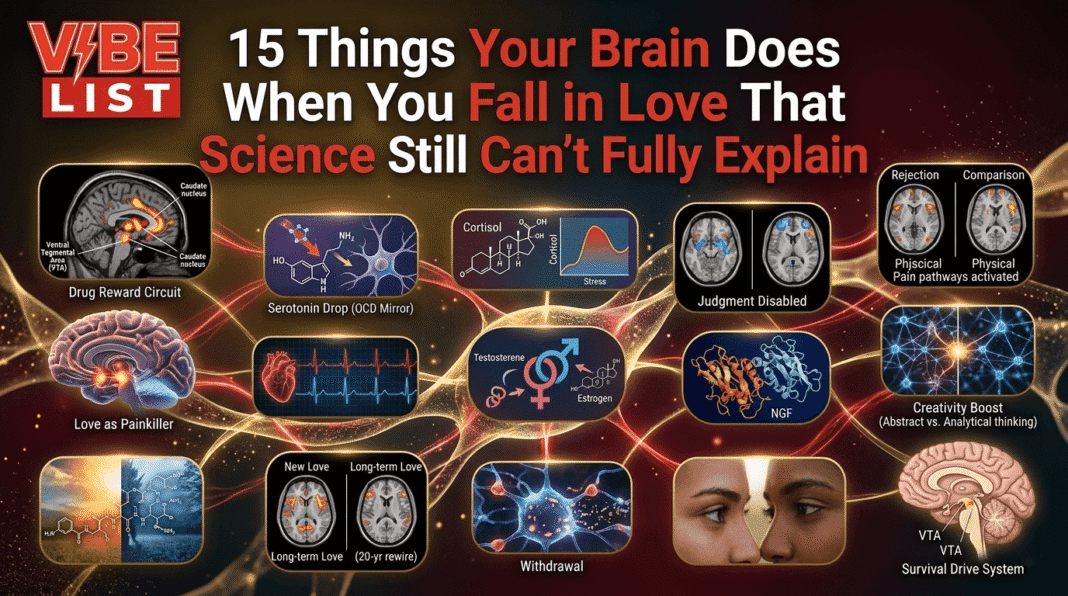
Twelve brain regions firing at once. Serotonin levels indistinguishable from an OCD patient’s. A cortisol spike your body reads as a survival threat. A four-minute gaze that bonds two strangers so deeply one pair married six months later. A reward-circuit activation so powerful it doubles as a painkiller. Two hearts synchronizing in a silent room without a single word or touch. None of it is poetry. It is fMRI-verified, blood-tested neuroscience; and your brain runs the entire program before you decide whether to text them back.
This content is for informational purposes only and does not constitute professional medical or psychological advice. Consult a qualified professional for personalized guidance.
Love is often described in poetry, songs, and stories, yet beneath the emotion lies a complex biological system that science is still working to fully understand. From dopamine surges that mirror addictive substances to measurable changes in brain chemistry, falling in love is not just a feeling, it is a full neurological event. In this article, we break down 15 scientifically backed ways love reshapes your brain, revealing what truly happens beneath the surface when emotion takes control.
1. Brain Regions Involved in Romantic Attachment Overlap Those Involved in Active Drug Use {#1-brain-regions-involved-in-romantic-attachment-overlap-those-involved-in-active-drug-use}
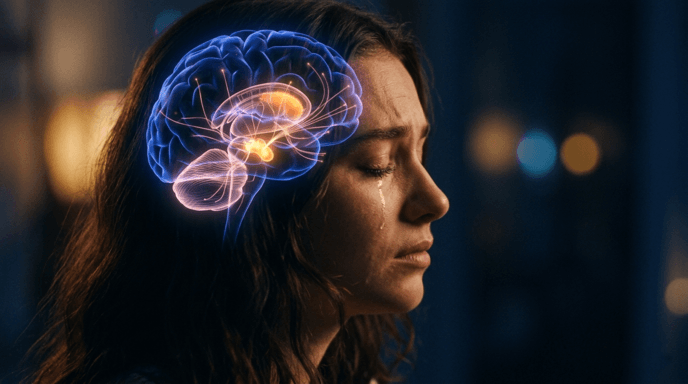
Helen Fisher (a biological anthropologist at Rutgers) scanned the brains of people who reported being “intensely” in love. When participants viewed images of their romantic partners, fMRI scans revealed that the subcortical dopamine regions—the ventral tegmental area and caudate nucleus—activated in patterns resembling those observed during cocaine use. Stephanie Cacioppo (neuroscientist at U of Chicago) extended this work and identified 12 distinct brain regions that communicate with each other during romantic love. These regions release a combination of dopamine, oxytocin, and adrenaline and elicit what Cacioppo called a “sense of purpose.”
Harvard Medical School researchers put it this way: “Dopamine activates the reward circuit, helping to make love a pleasurable experience similar to the euphoria associated with use of cocaine or alcohol.”
A meta-analytic review of fMRI studies on romantic love found considerable overlap between brain activation patterns during intense romantic attachment and those observed during active substance abuse. The parallel is not metaphoric; it is anatomical.
Vibe List take: Love isn’t just a drug. Your brain treats love as a survival-relevant reward—as important as food, water, and shelter. That doesn’t diminish the system’s primary function. It evolved for bonding. The rest is a side effect. If you’re curious about what healthy bonding actually looks like in practice, our breakdown of the green flags that actually matter in dating is worth a read.
2. Serotonin Drops During Early Love Mirror OCD-Level Changes {#2-serotonin-drops-during-early-love-mirror-ocd-level-changes}
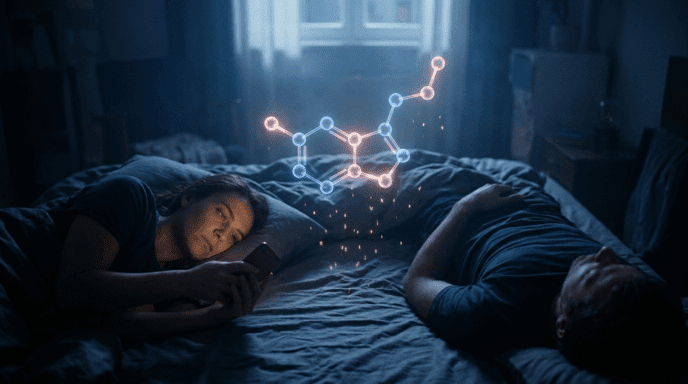
In 1999, Donatella Marazziti (psychiatrist at University of Pisa) ran a study that became one of the most cited in the neuroscience of love. She collected blood samples from three groups of 20: people who had recently fallen in love (within six months), unmedicated OCD patients, and healthy controls. She analyzed the platelet serotonin transporter density—a blood-based marker of serotonin function—in all three groups. The study, published in Psychological Medicine, produced a striking finding. Newly-in-love participants showed serotonin transporter densities statistically equivalent to those of the OCD group—and both groups showed lower levels than the healthy controls. Marazziti concluded that early-stage romantic love shares serotonin transporter changes with OCD.
Marazziti’s explanation for a universal symptom of infatuation—an inability to stop thinking about someone—offers insight into what happens neurochemically. According to Cacioppo, this low serotonin is precisely why “people in the early stages of love can become obsessed with small details, spending hours debating about a text to or from their beloved.”
Marazziti’s study carries a practical implication. The obsessive phase of new love represents a temporary alteration in brain chemistry. The obsessive behavior does not indicate long-term personality traits in either partner. Rather, it indicates that the individual’s serotonin profile temporarily mirrors that seen in OCD.
The Vibe List take: If you have spent 40 minutes analyzing the punctuation in a text message, your serotonin is acting as Marazziti predicted it would. These lowered serotonin profiles tend to normalize within 12 to 24 months. Unfortunately, 12 to 24 months is a long time to obsess over someone’s emoji usage.
3. Falling in Love Generates a Quantifiable Stress Response {#3-falling-in-love-generates-a-quantifiable-stress-response}
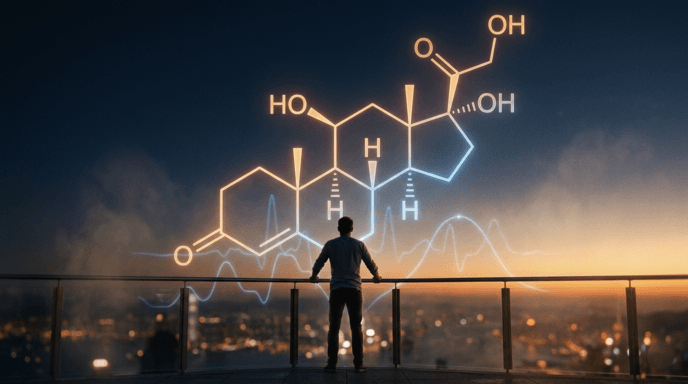
Love elicits exhilaration, but neurochemically, it also generates stress. Marazziti’s team ran a follow-up study published in Psychoneuroendocrinology in 2004 measuring hormone levels in 24 people who had recently fallen in love versus 24 healthy controls. The love group showed significantly higher cortisol—the body’s principal stress hormone.
Physiologically, this is logical. Your body responds to a new social connection as if it were a high-stakes survival situation. From an evolutionary standpoint, pair-bonding carried real risks to reproductive success and resource access. Therefore, the cortisol increase during early love reflects your body mobilizing resources to manage “the ‘crisis’ at hand,” as the Harvard Medical School researchers stated.
Cortisol levels return to normal over time. In Marazziti’s study, when the same participants were tested again 12 to 24 months later, all hormonal differences had dissipated. The system self-corrects as soon as the initial bonding period stabilizes.
The Vibe List take: The butterflies you experience are not excitement—they represent cortisol spiking because your body reads the new partner as both potential reward and potential threat. Although it may feel thrilling, it is merely dopamine and cortisol firing simultaneously—it does not mean you are stress-free.
4. Love Physiologically Disables Your Critical Judgment {#4-love-physiologically-disables-your-critical-judgment}

“Love is blind” is more than a figure of speech. fMRI research confirms it happens at a neural level.
Bartels and Zeki (University College London) published an fMRI study in 2000 titled “Functional anatomy of romantic love” (NeuroReport). They published a follow-up comparative study in 2004 titled “The neural correlates of maternal and romantic love” (NeuroImage). They identified which brain regions deactivate when we see someone we love—the amygdala (the threat-detection center) and the prefrontal cortex (regions tied to social evaluation). Bartels and Zeki concluded that human attachment operates via a “push-pull mechanism” that reduces social distance by lowering activity in networks used for social evaluation. A subsequent meta-analysis published in 2022 supported these conclusions across numerous studies, confirming that romantic and maternal attachment alike deactivate the amygdala and mesial prefrontal cortex.
Your brain suppresses its ability to assess your new partner by deactivating neural pathways used to detect deception, identify social threats, and judge character objectively.
These findings have direct implications for relationship decisions. The moment you feel most certain about a new partner is the moment your brain is least equipped to evaluate them.
Your friends telling you that you’re not seeing clearly may be describing your neurological state more accurately than they realize.
The Vibe List take: Your friends aren’t envious; your mom isn’t being overbearing. When they say you seem different, or that you’re overlooking things you’d normally notice—they are likely seeing your prefrontal cortex being overridden by your reward system.
Once your relationship stabilizes, your prefrontal cortex should regain its capacity for objective judgment. The issue remains what decisions you made before that recovery.
5. Rejection Activates the Same Neural Pathways as Physical Pain {#5-rejection-activates-the-same-neural-pathways-as-physical-pain}
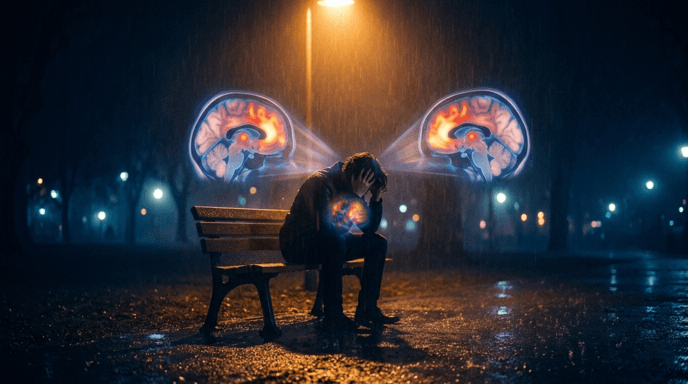
Ethan Kross (social psychologist at University of Michigan) published a landmark paper titled “Social rejection shares somatosensory representations with physical pain.” His paper appeared in Proceedings of the National Academy of Sciences in 2011. Kross recruited forty people who had recently undergone an unwanted romantic breakup and reported feeling intensely rejected. He asked them to perform two activities while undergoing fMRI scanning: view pictures of their ex-partners while recalling their rejection; receive a painful heat stimulus on their forearm. Next he compared brain activity generated by each task.
He found that both social rejection and physical pain activated overlapping affective brain regions including the dorsal anterior cingulate cortex and the anterior insula. Furthermore, he found activation in regions that encode physical pain sensation, such as the secondary somatosensory cortex and the dorsal posterior insula.
A meta-analysis of over 500 previous fMRI studies confirmed that activation in these regions was highly predictive of physical pain processing (positive predictive value up to 88%). Kross stated: “We found that powerfully inducing feelings of social rejection activate regions of the brain that are involved in physical pain sensation, which are rarely activated in neuroimaging studies of emotion.”
This is concrete anatomical evidence for why rejection “hurts.” Your brain uses many of the same neural circuits when processing rejection from a lost romantic bond as when processing a burn on your arm. For a deeper look at the science behind why breakups cause so much damage, see our guide to the psychology of heartbreak.
The Vibe List take: Nearly every language on earth uses pain vocabulary to describe both physical injury and heartbreak. Kross’s findings demonstrate why physical and emotional pain from rejection feel the same.
6. Looking At Someone You Love Is Like Taking An Analgesic {#6-looking-at-someone-you-love-is-like-taking-an-analgesic}
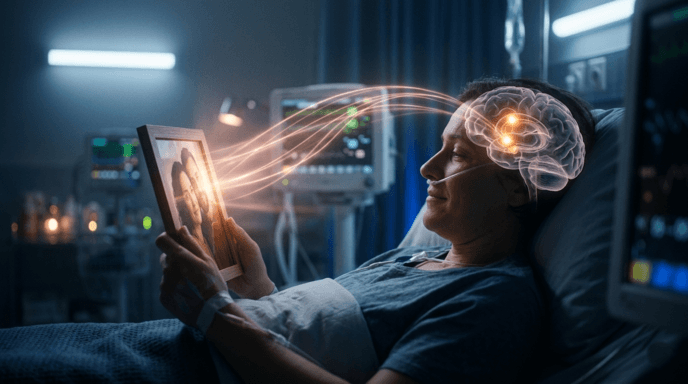
We’ve established that love elicits some of the same brain chemistry as drugs. So, can love reduce pain like drugs do?
In 2010, a team of researchers from Stanford University, including Jarred Younger, Sean Mackey, and Arthur Aron from Stony Brook University, tested this directly.
Using fMRI, the researchers scanned the brains of fifteen people in new relationships while applying mild and severe thermal pain to their forearms. While experiencing the pain, they viewed pictures of either their romantic partner, an equally attractive acquaintance, or completed a word association distraction task.
Published in PLOS ONE, the results indicated that both viewing images of their romantic partner and the distraction task significantly decreased self-reported pain. However, the mechanisms behind these decreases were quite different. The distraction task decreased pain by activating cortical areas associated with cognitive control. The partner photos decreased pain by activating subcortical reward circuitry—specifically, the caudate head, nucleus accumbens, lateral orbitofrontal cortex, amygdala, and dorsolateral prefrontal cortex showed heightened activation corresponding to the amount of pain reduction.
Put more simply, gazing at the person you love activates reward-based analgesic pathways similar to those triggered by opioid pain medications. According to a report in the Stanford Daily, the research suggests “that love may alleviate pain in the same way narcotic painkillers do.”
The Vibe List take: While we don’t recommend replacing your medication with a picture frame, the study shows why the mere presence of a loved one during a health emergency, hospitalization, or acute suffering is not just soothing. It is chemically analgesic. Your reward system is producing its own analgesia—not from a chemical compound, but from a face.
7. Your Heart Rhythms Will Match Those Of Your Romantic Partner {#7-your-heart-rhythms-will-match-those-of-your-romantic-partner}
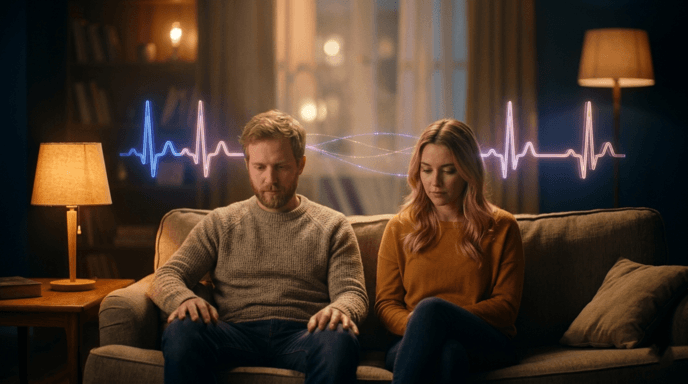
University of California, Davis psychologist Emilio Ferrer studied physiological synchrony in romantic couples and produced a striking finding. He fitted 32 heterosexual couples with devices designed to measure heart rate and breathing rate, then seated them approximately two feet apart in a quiet room. They did not interact verbally. They did not touch.
Their heart rhythms became synchronized. Their breathing rates matched.
Afterwards, Ferrer randomly re-paired participants’ physiological data with non-partners. The synchronization ceased.
Ferrer observed that “women generally adjusted theirs to their partners more,” suggesting a gendered element in physiological attunement. Jonathan Helm, doctoral candidate and lead researcher on the project, interpreted this result: “Her heart rate is linked to her partner’s. I think it means women have a strong link to their partners — perhaps more empathy.”
A 2020 replication published in Frontiers in Psychology used both heart rate and heart rate variability as measures of cardiac synchronization. Consistent with Ferrer’s findings, the researchers demonstrated a large, highly reliable effect of synchronized heart rhythms among romantic partners. A 2026 analysis appearing in Psychology Today further highlighted how stress disrupts this synchronization effect, suggesting the effect reflects relational quality, not just physical proximity.
Vibe List Takeaway: Poets have written about two hearts beating together. This is a measurable physiological event. Two people whose minds are occupied exclusively by each other—not attempting to coordinate their breathing, sitting silently side by side—exhibit identical heart rhythms. Your autonomic nervous system recognizes your partner before you consciously realize it.
8. Romantic Love Causes Hormonal Convergence Between the Sexes {#8-romantic-love-causes-hormonal-convergence-between-the-sexes}
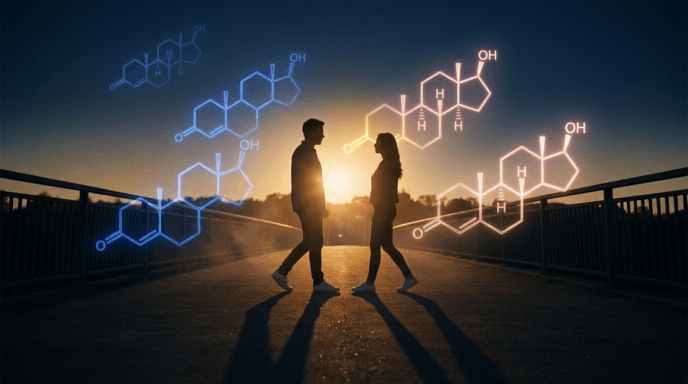
Beyond cortisol, Marazziti measured sex hormones and found that testosterone shifted in opposite directions between men and women. Men who had recently become romantically involved with someone had lower testosterone levels compared to control males. Women who had recently developed romantic feelings toward someone had higher testosterone levels compared to control women.
This observation implies that romantic love causes an initial temporary convergence in sex hormones between the sexes. Men’s testosterone decreases. Women’s testosterone increases. Both sexes converge toward a biochemically neutral zone.
As New Scientist reported, “love is the great gender bender.” This finding does not directly imply behavioral consequences, but it invites speculation. For example, lower testosterone in men has been associated with reduced aggression and increased parental care. Higher testosterone in women has been associated with increased assertiveness and initiative. If these correlations apply to romantic love, lower male testosterone and higher female testosterone could optimize both partners for the cooperative behavior pair-bonding requires.
Similar to cortisol and serotonin shifts, this hormonal convergence is temporary. When Marazziti tested her participants again 12 to 24 months later, all testosterone differences had disappeared.
Vibe List Takeaway: During the first six months of a new relationship, you are literally not the same hormonal person you were before. Your sex hormone profile has actually changed. You may be more patient, more attentive, and more willing to compromise—not because you consciously decided to be, but because your endocrine system is nudging you toward cooperation. This nudge ends. The decisions you make while being nudged determine whether you continue to cooperate after the nudge subsides.
9. Love Elevates a Unique Neurotrophic Growth Factor {#9-love-elevates-a-unique-neurotrophic-growth-factor}
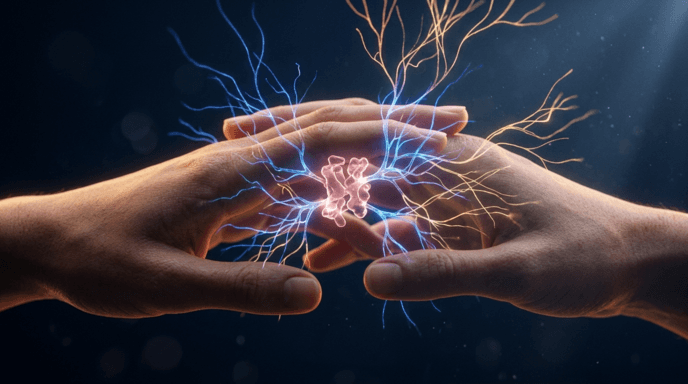
In 2005, a research team at University of Pavia led by Enzo Emanuele published a study in Psychoneuroendocrinology identifying an unprecedented biological indicator of romantic love: elevated levels of Nerve Growth Factor (NGF).
NGF is a protein responsible for promoting neuronal growth and maintaining existing neurons. Critically, NGF is also essential for synaptic plasticity—the brain’s capacity for creating new neural connections. Emanuele’s team observed that people who had recently fallen in love had significantly elevated circulating NGF levels relative to those in long-term relationships and single persons. Furthermore, NGF levels correlated positively with romantic passion intensity as measured by the Passionate Love Scale.
When the same participants were retested one year later (and up to 18 months), their NGF levels had returned to baseline. Thus, NGF elevations appear specific to the early phases of intense romantic love.
This finding opens an exciting possibility: if NGF enhances neuroplasticity, and NGF levels rise when you form new attachments, then the early stages of love provide a unique window for neural remodeling. Your brain may be physically reorganizing itself to incorporate your new partner into its model of reality—encoding your partner’s appearance, voice, daily routines, and emotional responses more rapidly and permanently than usual.
Vibe List Takeaway: This may be the least reported finding in the neuroscience of love. When you fall in love, your brain does not simply feel differently. It produces a protein that enables new neural pathways. You are not hallucinating; your brain is creating real hardware that changes how you perceive the world.
10. Falling In Love Increases Creativity While Lust Increases Analysis {#10-falling-in-love-increases-creativity-while-lust-increases-analysis}

In 2009, Jens Förster, Kai Epstude, and Amina Özelsel published a study in Personality and Social Psychology Bulletin testing whether thoughts of love versus lust trigger different cognitive modes. Across multiple experiments, participants who thought about a long-term loving relationship outperformed others on creative, abstract, and holistic thinking tasks. Conversely, participants who were primed to think about a casual sexual encounter outperformed others on tasks that required detailed, analytical, and concrete thinking.
The authors grounded their hypothesis in construal level theory, which posits that psychological distance influences cognitive processing. Love priming is characterized by far-off time horizons, abstract representations of another person, and forward-thinking. Lust priming is defined by here-and-now immediacy, physical specificity, and present-focused orientation. These different time horizons trigger different thinking styles.
This finding has practical implications for how emotions shape problem-solving. A brain in love may be better suited for big-picture thinking, brainstorming, and connecting seemingly unrelated ideas. A brain experiencing physical attraction may be more adept at close analysis, pattern recognition, and detailed work.
Vibe List Takeaway: This is the rare psychological fact about love that has immediate practical application beyond romantic relationships. Writing creatively? Think about someone you love first. Need to fix bugs in code? Think about someone you find sexually attractive first. Our brains do not compartmentalize emotions and cognition nearly as effectively as we claim they do.
11. The “Love Hormone” Has a Dark Side No One Mentions {#11-the-love-hormone-has-a-dark-side-no-one-mentions}
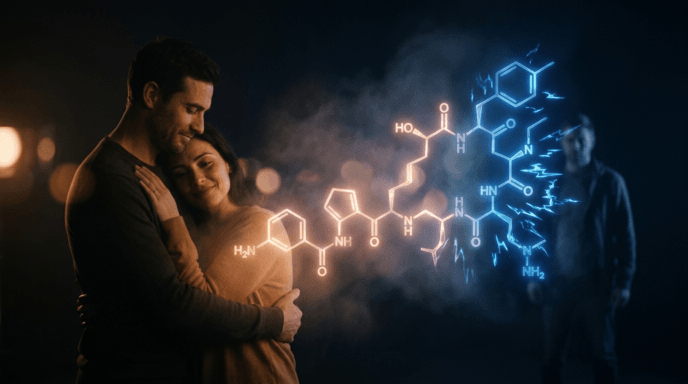
Oxytocin is the most popularized neurochemical in mainstream media. It is commonly called the “hormone of love,” the “cuddle hormone,” and the “trust molecule.” None of these labels are incorrect. They are all, however, deeply misleading.
A study published by the Association for Psychological Science found that administering oxytocin under controlled conditions significantly amplified competitive feelings. After winning these competitions, participants exhibited gloating—a sense of triumph over rivals. According to a 2015 review published in Current Opinion in Behavioral Sciences, oxytocin increased discrimination against out-groups and decreased affiliation among certain individuals. Research highlighted by the British Psychological Society linked oxytocin to increased violent intentions in aggression-prone individuals.
Specificity is at play here, not paradox. Oxytocin will not make you more loving to everyone. Instead, it will amplify your loyalty to your in-group. As such, oxytocin can strengthen your sense of safety within your inner circle. Conversely, it will likely heighten your vigilance toward perceived threats outside it. In romantic love, this may explain why intense jealousy, possessive tendencies, and hostility toward perceived threats can coexist with deep commitment to your partner.
Vibe List Takeaway: Oxytocin is not a love drug. Oxytocin is a loyalty drug. Oxytocin will enhance whatever relational dynamics currently exist in your life. If you have a healthy, trusting relationship, oxytocin will help deepen that connection. If you’re in a relationship plagued by anxiety and threat-sensitivity, oxytocin will simply intensify your scrutiny and surveillance. The neurochemical mechanism is identical regardless of whether it occurs in a positive or negative relationship.
12. Long-Term Love Rewires Your Brain Differently Than New Love {#12-long-term-love-rewires-your-brain-differently-than-new-love}

In 2012, Bianca Acevedo and Arthur Aron at Stony Brook University, along with Helen Fisher and Lucy Brown, conducted the first fMRI study to examine the neural correlates of people in long-term, intense romantic love. The participants averaged 21 years of marriage. While viewing photos of their spouse, the participants’ brains displayed significant activation in the ventral tegmental area (VTA)—the same dopamine-rich reward center activated in new love. However, compared to people in new love, the long-term lovers showed significantly higher activity in additional attachment regions, such as basal ganglia areas tied to pair-bonding and commitment. Additionally, the long-term lovers showed activity in the mirror neuron system—the network that enables anticipation of a partner’s actions and intentions. This accounts for why some couples married for decades complete each other’s sentences or navigate a small kitchen without colliding.
This reframes the conversation about passion. Passion does not slowly erode over time. Instead, it evolves. Obsessive and anxiety-based hyperarousal seen in early love eventually transitions to a quieter but still rewarding arousal built on anticipation, attunement, and deep neural mapping of another person.
The Vibe List take: Couples that remain in love for decades and demonstrate the same level of passion are not defying science. They are demonstrating it. Their brains continue to activate the reward centers. They’ve simply developed a secondary level of intimacy, via their mirror neuron systems, that new couples haven’t yet had time to build. This isn’t less. This is more. And it develops through what relationship psychologists call “showing up”—thousands of uneventful, consistent experiences.
13. Breakups Trigger Actual Neurological Withdrawal {#13-breakups-trigger-actual-neurological-withdrawal}
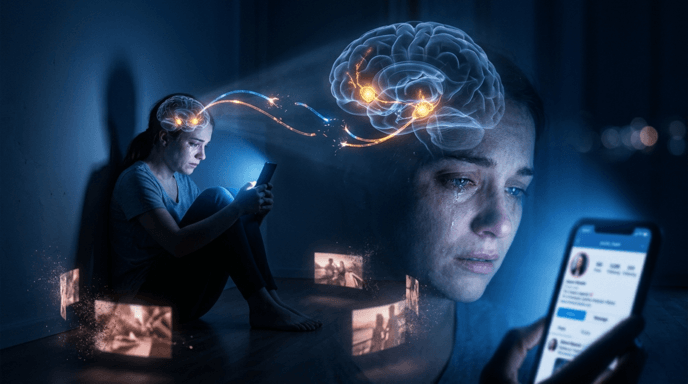
If romantic love activates the same reward circuits as addictive drugs, Fisher reasoned, losing the source of that activation should trigger withdrawal-like responses. She studied this directly.
In 2010, Fisher and her team published a paper in Journal of Neurophysiology examining participants who had been rejected by their romantic partners. Despite still reporting intense love, their fMRI scans indicated continued activation of the ventral tegmental area (VTA) and the nucleus accumbens—the same reward regions active during happy love. But now, they also showed activity in areas related to craving, addiction, and reward-expectation frustration.
Fisher stated that the scan patterns resembled withdrawal from an addictive drug: protesting, crying spells, lethargy, anxiety, sleeplessness, loss of appetite, and obsessive attempts to reconnect with the former partner. The overlap between these behaviors and substance withdrawal is not a coincidence. Both are driven by disruptions in identical dopaminergic pathways.
This has direct implications for how breakups should be understood and handled. Someone going through post-rejection grief is not just sad—they are experiencing a neurochemical withdrawal event. The overwhelming desire to check an ex’s social media, re-read old messages, or pass by their familiar places is not weak willpower—it is a search for dopamine release, like an addict seeking a familiar hit.
The Vibe List take: If you have ever thought your post-breakup suffering seemed disproportionate to the relationship’s length or quality—Fisher’s work provides explanation. Withdrawal intensity is not determined by your logical evaluation of the relationship. Rather, it is a product of how deep a dopaminergic groove the relationship carved. A short, intense relationship can trigger withdrawal as severe as a long, stable one, because the brain doesn’t judge attachment based on weeks or months on a calendar. Rather, it judges attachment based upon dopamine.
14. Four Minutes of Eye Contact Can Create Intimacy Between Strangers {#14-four-minutes-of-eye-contact-can-create-intimacy-between-strangers}
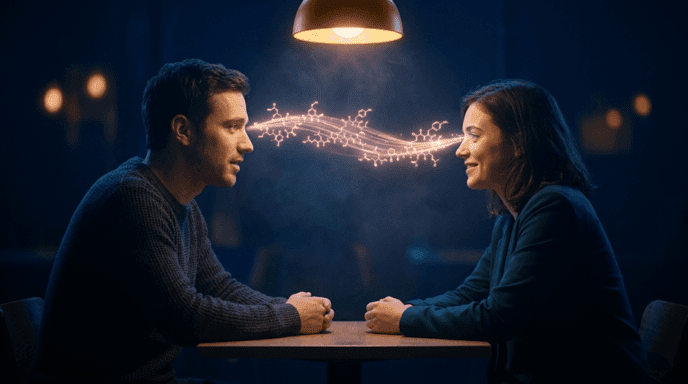
Arthur Aron published a study in Personality and Social Psychology Bulletin in 1997 that would become one of the most influential in relationship psychology. In his study, Aron randomly paired strangers and instructed them to ask each other 36 progressively personal questions. After the questions, the pairs engaged in four minutes of sustained mutual eye contact.
Participants reported feeling remarkably close. In fact, one pair from the experiment married six months later. Aron’s intention was not to “create” love between participants. He intended to determine whether shared vulnerability and escalating self-disclosure, combined with continuous focus, could create conditions where intimacy could emerge.
Aron’s study went mainstream after Mandy Len Catron wrote about it in The New York Times Modern Love column in 2015. Catron’s account generated millions of page views and inspired people worldwide to try Aron’s 36-question process with their partners, friends, and strangers.
Eye contact may be the most powerful aspect of Aron’s procedure. Later studies found that mutual gazing between dogs and their owners increased oxytocin levels by 130% in the dogs and 300% in the owners. Given that gazing can stimulate oxytocin production across species, the effect between two humans who have just spent 45 minutes sharing vulnerabilities would likely be substantial.
The Vibe List take: Aron’s experiment did not establish that love can be manufactured. What he established was more valuable: that intimacy is not random—it emerges from specific, replicable conditions: shared vulnerability, focused attention, and mutual gaze. The 36 questions do not manufacture love. They remove the social barriers that prevent love from emerging when potential exists.
15. Love Recruits the Same Brain System That Tells You to Eat and Drink {#15-love-recruits-the-same-brain-system-that-tells-you-to-eat-and-drink}
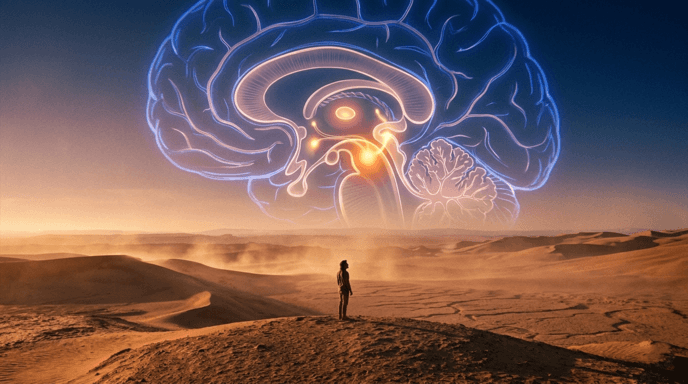
Lucy Brown, a neuroscientist and neurologist at Einstein College of Medicine, reviewed fMRI images from people in early intense romantic love and found something that surprised even the researchers.
The brain region most commonly activated by romantic love—the ventral tegmental area (VTA)—is not a “more advanced” section of the brain associated with complex emotions or social cognition. It is located near sections of the brain controlling swallowing, thirst, and hunger. According to Brown: “While we often think about romantic love as this euphoric, amorphous thing and as a complex emotion, the activation we see in this very basic part of the brain is telling us that romantic love is actually a drive to fulfill a basic need.”
Cacioppo concurred, stating that love represents “a biological necessity—it’s as needed for our well-being as exercise, water, and food.” The imaging evidence supports Cacioppo’s assertion. Love resides not in your cerebral cortex with thoughts and opinions about films and restaurant preferences. Rather, it resides in the midbrain with thirst and hunger drives. It is not an emotion per se. It is a motivation system—a biological drive with the same neural circuitry as fundamental survival needs.
Reframing this concept changes how we understand chronic loneliness, social isolation, and lack of connectedness as sources of disease and early death. Chronic loneliness is not an emotional state. It is a state of deprivation. Research shows that social isolation diminishes life expectancy at rates comparable to smoking.
The Vibe List take: This discovery provides the framework for every other item on this list. Love is not something your brain accomplishes when it has spare time and favorable conditions. Love is something your brain requires with equal desperation as water. All other items on this list—dopamine, serotonin crash, cortisol surge, pain overlap, heart synchronization—are downstream effects of a drive that predates language, culture, and the prefrontal cortex that believes it controls this choice.
15 Things Love Does to Your Brain: Quick Reference Guide
| # | Brain Phenomenon | Key Finding | Primary Researcher(s) | Brain Region / System | Duration / Reversal |
|---|---|---|---|---|---|
| 1 | Love Activates Drug-Use Brain Regions | Romantic attachment activates the same subcortical dopamine regions as cocaine use | Helen Fisher (Rutgers); Stephanie Cacioppo (U of Chicago) | Ventral tegmental area (VTA), caudate nucleus; 12 brain regions total | Persists as long as love is active; shifts with relationship stage |
| 2 | Serotonin Drops Mirror OCD | Newly-in-love individuals show serotonin transporter density equivalent to OCD patients | Donatella Marazziti (University of Pisa) | Platelet serotonin transporter (5-HT) | Normalizes within 12–24 months |
| 3 | Cortisol Stress Surge | Cortisol is significantly elevated in people who have recently fallen in love | Donatella Marazziti (University of Pisa) | Hypothalamic-pituitary-adrenal (HPA) axis | Returns to baseline within 12–24 months |
| 4 | Love Disables Critical Judgment | Viewing a loved one deactivates brain regions used for threat detection and social evaluation | Bartels & Zeki (University College London) | Amygdala (deactivated), prefrontal cortex (deactivated) | Recovers as relationship stabilizes |
| 5 | Rejection Activates Physical Pain Pathways | Social rejection activates the same somatosensory brain regions as a physical burn (PPV up to 88%) | Ethan Kross (University of Michigan) | Dorsal anterior cingulate cortex, anterior insula, secondary somatosensory cortex | Acute; linked to rejection intensity |
| 6 | Love as a Painkiller | Viewing a partner’s photo reduces pain via reward-circuit activation similar to opioid analgesia | Jarred Younger, Sean Mackey (Stanford); Arthur Aron (Stony Brook) | Caudate head, nucleus accumbens, orbitofrontal cortex | Active during early romantic love (first 9 months tested) |
| 7 | Heart Rate Synchronization | Romantic partners’ heart rhythms and breathing rates synchronize without physical contact or speech | Emilio Ferrer (UC Davis) | Autonomic nervous system | Present during active relationship; absent with non-partners |
| 8 | Hormonal Convergence Between Sexes | Men’s testosterone drops and women’s testosterone rises during early love, converging toward a neutral zone | Donatella Marazziti (University of Pisa) | Endocrine system (testosterone, FSH) | Disappears within 12–24 months |
| 9 | Nerve Growth Factor Elevation | NGF levels rise significantly in newly-in-love individuals, correlating with passion intensity | Enzo Emanuele (University of Pavia) | Circulating NGF; synaptic plasticity pathways | Returns to baseline within 12–18 months |
| 10 | Love Boosts Creativity; Lust Boosts Analysis | Thinking about love enhances abstract/creative thinking; thinking about lust enhances analytical thinking | Jens Förster, Kai Epstude, Amina Özelsel | Construal level theory; global vs. local processing | State-dependent; active during priming |
| 11 | Oxytocin’s Dark Side | Oxytocin amplifies in-group loyalty but increases out-group hostility, jealousy, and aggression | Association for Psychological Science; British Psychological Society | Oxytocin receptor system | Persistent; amplifies existing relational dynamics |
| 12 | Long-Term Love Rewires Differently | Couples in love 21+ years show VTA activation like new love plus additional mirror neuron and pair-bonding activity | Bianca Acevedo, Arthur Aron (Stony Brook); Helen Fisher; Lucy Brown | VTA, basal ganglia, mirror neuron system | Sustained; evolves but does not diminish |
| 13 | Breakups Trigger Neurological Withdrawal | Rejected lovers show brain patterns resembling drug withdrawal: craving, reward-expectation frustration | Helen Fisher | VTA, nucleus accumbens; dopaminergic pathways | Acute; intensity tied to dopaminergic groove depth |
| 14 | 4-Minute Eye Contact Creates Intimacy | 36 personal questions + 4 minutes of sustained eye contact generates remarkable closeness between strangers | Arthur Aron (Stony Brook) | Oxytocin system (130% increase in dogs, 300% in owners via mutual gaze) | Immediate effect; one pair married 6 months later |
| 15 | Love Uses the Same System as Hunger & Thirst | The VTA; love’s primary brain region; sits alongside areas controlling swallowing, thirst, and hunger | Lucy Brown (Einstein College of Medicine); Stephanie Cacioppo | Ventral tegmental area (midbrain); near brainstem survival centers | Permanent biological drive; social isolation reduces life expectancy like smoking |
Frequently Asked Questions {#faqs}
Is love truly only based on chemical reactions, or is there more to it?
Both. The neurochemical reactions described above are well-documented: increased dopamine, decreased serotonin, elevated cortisol, and surging oxytocin. These are quantifiable and repeatable. However, the experience of love is influenced by past experiences, culture, attachment style, and the choices we make consciously. Reducing love to chemistry alone would be like reducing music to sound vibrations—technically accurate, but missing everything that matters.
For how long does the “being crazy in love” brain chemistry last?
Multiple studies—including Marazziti’s hormone and serotonin work—show that the dramatic neurochemical changes caused by early love return to normal within 12 to 24 months. This is consistent with what clinicians refer to as the “limerence” phase. However, Acevedo and Aron’s research at Stony Brook University demonstrates that dopaminergic reward activation persists in couples together 20+ years, suggesting passion can endure when partners maintain a supportive relational environment.
Will knowing about the neuroscience behind love enhance your relationships?
In some specific ways. For example, knowing your critical thinking is chemically impaired during early love may encourage you to seek outside input before major decisions. Realizing that physical pain receptors are activated during heartbreak may reduce self-blame as you recover. Recognizing that oxytocin enhances already-established relational dynamics—not necessarily positive ones—can help you distinguish a healthy bond from a merely intense one. Neuroscience does not replace emotional intelligence, but it provides additional clarity.
Are men’s and women’s brains affected differently by love?
Marazziti’s studies showed testosterone shifting in opposite directions for men and women during early love. Ferrer’s work found that women adjusted their physiological rhythms to match their partner’s more than men did. Nevertheless, fMRI studies show that reward activation, serotonin changes, and pain-overlap patterns during rejection are similar across sexes. Therefore, while the neural architecture underlying love is mostly similar for both sexes, the hormonal nuances that influence these responses differ depending upon sex.
Does heartbreak pose a genuine threat to one’s physical health?
Heartbreak can. Harvard Health has reported instances of takotsubo cardiomyopathy (broken heart syndrome)—a cardiac condition triggered by intense emotional distress, including grief and romantic loss, that mimics a heart attack. Broken heart syndrome tends to occur most often in postmenopausal women. In addition to immediate cardiac risks, chronic loneliness and social isolation have been correlated with decreased life expectancy, elevated blood pressure, and increased overall mortality.
Can you “program” your brain to fall in love?
You cannot directly program your brain to fall in love with someone—but you can create conditions that make connection more likely. Aron’s research at Stony Brook showed that sharing vulnerabilities, building mutual trust, and maintaining prolonged eye contact can generate closeness between strangers. Similar to forming connections among friends, repeated exposure can foster liking or familiarity toward someone new. Shared novel experiences elicit dopamine release. You cannot will yourself to love someone, but you can create an environment where connection is more likely to develop.