


Gladiator sweat scraped off with a bronze blade and sold in Roman marketplaces. Crocodile dung spread across the face as an anti-aging treatment. Arsenic paste rubbed into the skin to dissolve body hair for six thousand years. Holes drilled into living teeth and filled with polished jade by artisans whose level of precision modern dentists struggle to explain. None of these people were primitive; they were running the same experiment you run every morning in front of your bathroom mirror, just with fewer warning labels.
Ancient Egyptians, Greeks, Romans, and Mayans did not shy away from chemical substances when modifying their physical appearance the way we do today. They used a wide variety of items that would be considered toxic or unhygienic today; crocodile excrement, human urine, arsenic, and lead were all part of everyday beauty routines.
However, calling these ancient practices weird ignores the reasoning behind them. Many of the ancient practices had an empirical basis in chemistry; others were deeply rooted in spiritual and/or social identity. Additionally, many of these practices continue in refined form in the products sitting on your bathroom shelves today.
This will not be a freak show of bizarre ancient practices. This will be a serious examination of ten of those practices, illustrating how humans throughout history have been willing to apply chemicals to their own bodies in pursuit of transformation, and how for most of human history the distinctions among medicine, rituals, and cosmetics have been non-existent. These practices were adopted by both men and women, transcended social class, and were supported by physicians, priests, and rulers.
The packaging has evolved. The chemistry has improved. The motivation remains the same.
1. Gladiator Body Grime Sold as Skin Treatment in Ancient Rome
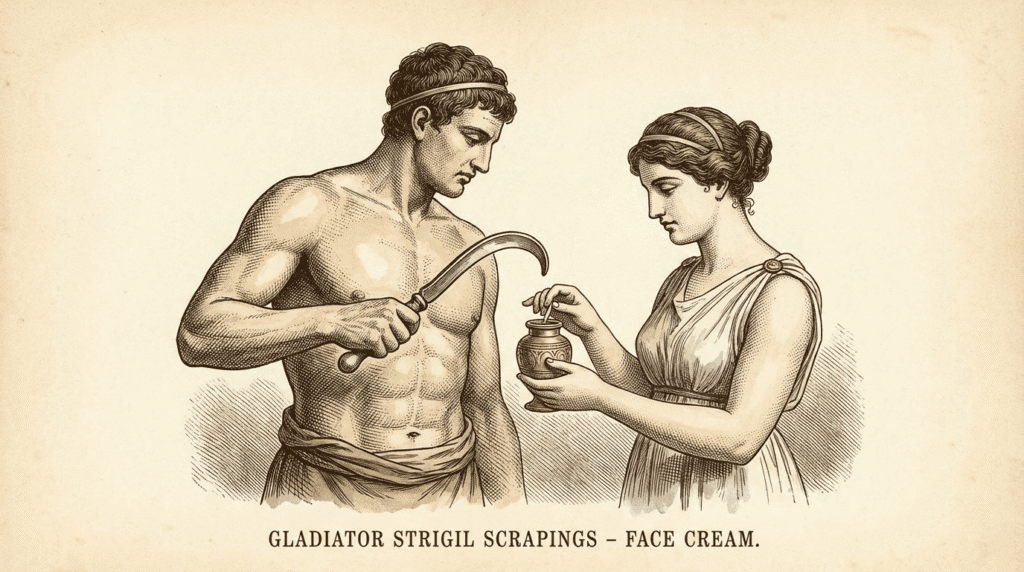
As a gladiator finished his bout at the arena, he likely still had olive oil, sweat, and dirt covering him. An attendant would then scrape away the dead skin, oil, and dirt with a curved bronze instrument called a strigil. The resulting mixture would be collected in a vessel and sold.
The substance had a name: gloios in Greek and strigmentum in Latin. It wasn’t exclusive to gladiators. Athletes in the Greek gymnasia followed the same routine. The residue was a recognized product in the marketplaces of the ancient world. Pliny the Elder wrote about it in his Natural History (Book XXVIII), listing many of its uses: treating swollen joints, healing hemorrhoids, and other ailments.
The Pitt Rivers Museum at the University of Oxford contains ancient strigils, and in November 2024, the museum shared a social media post describing how gladiators collected and bottled the grime scraped from their skin and sold it to fans, comparing the practice to modern athletes throwing jerseys into the crowd.
This has raised a long-standing question: Did gladiators sell their sweat as an aphrodisiac? Maxwell Paule, a classicist at Earlham College, addressed this directly in a 2024 paper, “Blood, Sweat, and Sex: A Note on the Erotic Power of Gladiator Sweat”, published in Preternature (Vol. 13, No. 2). His conclusions were direct and clear: “There is no ancient evidence that corroborates the frustratingly popular claim that Romans collected and sold gladiator sweat as an aphrodisiac.” The medicinal and cosmetic use of athlete gloios, however, is well documented.
There is a kernel of logic to the practice. Modern dermatology understands that the body’s natural oils help protect the skin by maintaining the moisture barrier. The Romans understood this principle but commercialized it at a scale far beyond anything seen before or since.
2. Crocodile Dung Applied to the Face in Ancient Egypt and Rome

Crocodile dung is one of the most commonly referenced ingredients in ancient recipes for facial treatments. Multiple ancient Egyptian texts reference its use as both a cosmetic and medicinal treatment. The practice was adopted in Rome and was used as a skin-bleaching and tightening agent.
Yahoo Lifestyle published a 2023 article on “Ancient Wrinkle Treatments” describing Roman women applying crocodile dung to their faces to “brighten and lighten aging skin”. Variations in the recipes appear across multiple popular histories. Some reports indicate the dung was mixed with mud, while others suggest it was mixed with donkey milk. Donkey milk is more commonly associated with Cleopatra’s fabled baths, as documented by Pliny the Elder.
Was there any rational basis for applying crocodile dung to the skin? The dung has mild acidity, and some historians believe that it could have served as a primitive chemical exfoliant similar to the alpha-hydroxy acids present in modern peels. If donkey milk was added, it would add lactic acid. However, any potential benefits would be far overshadowed by the risk of bacterial infection from applying animal waste to the skin.
The application of crocodile dung to the skin is also an example of how the ancient world did not distinguish between “cosmetics” and “medicine” as we do today. Crocodile dung was referenced in gynecological texts as a possible ingredient in a contraceptive. This demonstrates that the perceived properties of crocodile dung extended far beyond skin care alone.
3. Human Urine Used as Mouthwash in the Roman World

Romans gargled with human urine to whiten their teeth. The chemistry behind this is straightforward: as urine breaks down, it produces ammonia, an effective cleaning agent that can break down organic stains and kill bacteria. The same ammonia-rich urine was used in Roman fulleries (laundry establishments) to clean wool and togas.
The use of urine as a mouthwash was satirized. In Poem 39, the Roman poet Catullus mocks a man named Egnatius, a Celtiberian from the Iberian Peninsula whom Catullus also targets in Poem 37 as a rival for his love interest Lesbia. Catullus describes Egnatius as having a perpetual smile to display his bright white teeth. He then adds: the brighter his teeth, the more urine he must have used to clean them. Importantly, Catullus frames this as a Celtiberian custom and not as something that fashionable Romans borrowed from the Celts. The rumor that rich Romans purchased aged Iberian urine as a luxury item appears to be a modern fabrication not based on any direct evidence from ancient texts.
The urine trade was large enough and profitable enough to be taxed. The vectigal urinae (urine tax) is most commonly associated with Emperor Vespasian (ruled 69 to 79 CE), though it may have been temporarily imposed earlier during the reign of Nero. Vespasian’s son Titus protested the unsavory origin of the tax, leading to Vespasian’s famous response, recorded by Suetonius: Pecunia non olet (“Money does not stink”).
The use of ammonia as a cleaning agent persisted in various forms across Europe for centuries, including into the 18th century before better-tasting chemicals replaced it. Modern whitening strips use hydrogen peroxide and carbamide peroxide to produce comparable effects through entirely different chemical mechanisms.
4. False Unibrows Constructed from Goat Hair in Ancient Greece

In the modern Western world, separate and shaped brows indicate grooming and attention to appearance. In ancient Greece, the reverse was true. A complete eyebrow line (synophrys or unibrow) was considered beautiful, intelligent and authentic. Women who did not naturally have a unibrow chose to create the illusion of one.
One of the earliest methods for creating a unibrow was to dye goat hair with a dark colorant and attach it to the bridge of the nose with tree resin. The resulting false unibrow was a convincing signal that the woman wearing it was not plucking or primping; an indication of unaffected purity.
Greece-is.com published a 2023 feature titled “10 Lesser-Known Facts about Ancient Greece” that confirmed the status of the unibrow as a beauty ideal, stating that “the unibrow, a thick and unbroken line of hair above the nose, was seen as a sign of beauty and intellectual prowess.” Multiple popular histories describe the process of attaching goat hair to the face to create a unibrow.
However, the exact origin of the practice remains unclear due to limited documentation in primary texts.
Beauty standards are not constant across cultures. Beauty standards are culturally constructed, historically conditioned, and sometimes the direct opposite of standards in other cultures. The comparison to Frida Kahlo is often made; in ancient Greek culture, her distinct brow would not have been a symbol of artistic defiance but merely an example of conformity to the prevailing aesthetic standard.
Unibrows were valued in men. Synophrys appears in multiple works of ancient Greek literature and in art depicting both men and women with a unibrow. Therefore, the unibrow was a broadly shared cultural preference, not limited to women.
5. Venetian Ceruse: The Lead-Based Cosmetic That Poisoned People Slowly

For approximately 2,000 years, pale skin was an indicator of wealth, leisure, and social position across much of Europe and the Mediterranean. One of the most effective methods for producing pale skin was Venetian ceruse, a thick white paste made of white lead (lead carbonate) mixed with vinegar.
Ceruse produced an excellent color match and a fine, smooth finish. However, the consequences of prolonged use proved catastrophic: chronic lead poisoning resulting in hair loss, skin lesions, muscular weakness, dementia, and death.
Pliny the Elder described the toxic qualities of white lead in his Natural History (Book XXXIV). Thus, the ancient world was aware of the dangers of lead. Despite this awareness, the product remained in use for centuries. Queen Elizabeth I of England used ceruse for most of her life, especially after smallpox scarred her face in 1562. Historians have suggested that she may have suffered from chronic lead poisoning as a result, although this remains a subject of debate. Other historians caution against making too much of this connection.
Lisa Eldridge, global creative director for Lancôme and a leading expert in the history of makeup (author of the book Face Paint), examined this paradox in a widely watched 2023 video series. Eldridge posed the question: Why did people continue to use ceruse despite knowing that lead was poisonous? Her conclusion was that cultural expectations and vanity have always overridden safety concerns; the same dynamic persists today.
Historical records support Eldridge’s assessment. A 2022 article in The Conversation by Fiona E. McNeill, “Dying for makeup: Lead cosmetics poisoned 18th-century European socialites in search of whiter skin,” demonstrated the tragic consequences of lead-based cosmetics for several aristocratic women. National Geographic’s 2016 feature “Arsenic Pills and Lead Foundation: The History of Toxic Makeup” chronicled the entire timeline of lead-based cosmetics from Rome to the Enlightenment.
6. Ohaguro: Blackening Teeth with Iron and Vinegar in Japan

For more than a millennium in Japan, a bright white smile was not considered aesthetically desirable. Instead, the ideal dental aesthetic was a glossy, jet black. This was achieved by applying a dye to the teeth, and the process of doing so was known as ohaguro. The dye itself was created by mixing dissolved iron filings with vinegar or tea. Powdered vegetable tannins, extracted from gallnuts or tea, were then applied to the teeth over the dye. The resulting color was dramatic but short-lived. The dye faded rapidly and needed to be reapplied frequently; sometimes, daily. Ohaguro was not merely a cosmetic preference; it was a social institution. The black color of the teeth indicated maturity, marital status and social standing. Notably, ohaguro was practiced by both men and women. Male courtiers and samurai of certain periods adopted the practice in addition to noblewomen. To refer to it as a “beauty trend” diminishes its role as a marker of social identity.
Additionally, there may be a link between the ohaguro process and dental health. A 2016 study published in the International Journal of Osteoarchaeology analyzed skeletal remains from the Edo period. The researchers found that “Ohaguro was thought to have enhanced the acid resistance of tooth substance and tightened gingiva and prevented tooth morbidity due to periodontal disease.” Another study, “Teeth blackening as medical practice in Asia, Micronesia and Melanesia,” published by Zumbroich in Ethnobotany Research and Applications in 2011, noted that practitioners of tooth-blackening had observed reduced rates of dental morbidity. However, the authors emphasized that their findings were based solely on observation and not experimentation.
Ohaguro was officially banned by the Meiji government in 1870, two years after the onset of the Meiji Restoration. Japan began to adopt Western cultural norms, and ohaguro fell out of favor. Although officially discouraged, ohaguro persisted in geisha communities throughout much of the 20th century. Today, ohaguro still exists in some ceremonial contexts.
7. Insect-Derived Red Dyes Used for Lip Color from Ancient Egypt to the Present Day

Throughout history, red lips have represented power, vitality, and status. Ancient Egyptian nobility achieved this look using a combination of red ochre (iron oxide) and animal fat or beeswax. Red ochre was a mineral-based lip color, and evidence of its use appears across the vast number of artifacts recovered from ancient Egypt.
However, the story of red lipstick changes dramatically with Cleopatra. An article from National Geographic, written in 2024 and titled “The Surprising Evolution of Red Lipstick and Its Ancient Origins,” states that “Queen Cleopatra preferred carmine, a deep red pigment extracted from cochineal bugs.” While this claim has been widely repeated in popular histories, it has a major flaw. True carmine is obtained from the cochineal insect (Dactylopius coccus) and was first cultivated by the Aztecs and Mixtecs of Mesoamerica. Unfortunately for Cleopatra and her contemporaries, cochineal was not available in the ancient Mediterranean world. Cochineal was brought back to Europe from the New World by Spanish conquistadors in the early 16th century.
What the ancient Egyptians did have access to was a related, yet separate insect: kermes (Kermes vermilio), a scale insect that lived on Mediterranean oak trees and produced a reddish-brown dye. A Getty Museum publication on ancient pigments (Mummy Portraits of Roman Egypt) confirms that “Early Egyptians made this red dye from the dried bodies of a female wingless scale insect; either Kermes ilices or Kermes vermilio.” The oldest confirmed archaeological evidence of kermes dye comes from a textile fragment dated to approximately 1,800 BCE. This textile fragment was uncovered in Israel and reported on by Archaeology Magazine in 2024.
When popular media reports that Cleopatra “used crushed beetles,” the claim likely confuses two separate insect-derived dyes from two different continents and historical eras. The ancient Egyptian use of kermes is documented. The claim that Cleopatra used carmine is anachronistic.
Regardless of the historical confusion, the tradition of producing insect-derived red dye has never truly gone away. True cochineal carmine (labeled as E120, CI 75470, or Natural Red 4) continues to be used as a permissible ingredient in many lipsticks, food coloring, and beverages around the world today. If you have ever eaten red candy or purchased a mainstream red lipstick, you have likely consumed or used crushed insect pigment. The ancient technology has survived; it simply has new names.
8. Pigeon Droppings and Alkaline Pastes Used to Lighten Hair in Ancient Rome

During the late Republic and Imperial periods of ancient Rome, the Romans developed an interest in the blonde and red hair of the Germanic and Gallic peoples whom they encountered through trade and conquest. Since native Roman hair was largely dark, Romans sought to create lighter shades through chemical means. Their recipes were innovative, although unpleasant.
One of the most frequently cited Roman hair-lightening recipes involved a paste made from pigeon droppings, beechwood ashes, and lye. The paste was applied to the hair, and the user would sit in the sun while heat and alkalinity worked together to lighten it. L.J. Trafford, a historian of everyday life in ancient Rome, wrote about the larger Roman context of hair-dyeing in a 2020 article in Historia Magazine. She notes that Roman hair-dyeing recipes varied from henna to “a potion of leeches fermented in vinegar for several months.” The use of pigeon droppings as a hair-lightener falls squarely within this tradition of resourcefulness.
Why do pigeon droppings lighten hair? The reason lies in the presence of ammonia. Bird droppings contain ammonia compounds as they decompose. Ammonia remains a fundamental component of many commercial hair dyes today due to its ability to open the hair cuticle and allow bleaching agents to penetrate the hair shaft. The Roman recipe also contained beechwood ashes and lye, which provided additional alkalinity. Modern hair lighteners use hydrogen peroxide as the primary bleaching agent rather than ammonia alone; the Roman recipe relied on a more rudimentary alkaline mechanism that produced patchy, unpredictable results and a memorable odor.
Wigs made from the hair of captured Germanic women were also commercially available. Ovid, Martial, and other Roman poets referenced hair dye and wigs in their satirical writings, indicating that the desire for blonde hair was a socially recognizable and sometimes ridiculed cultural phenomenon.
The Roman hair-lightening tradition illustrates how premodern civilizations developed functional chemistry through empirical observation rather than theoretical knowledge. Although the Romans did not understand the role of ammonia in opening the cuticle, they observed that the paste worked and developed their recipes accordingly.
9. Jade Dental Inlays in the Ancient Maya World

While modern-day “tooth gems” consist of a small rhinestone bonded to the surface of a tooth using a removable dental adhesive, this has little relation to what ancient Maya artisans accomplished more than 1,000 years prior. Maya artisans carved holes into the living teeth of individuals and then inserted polished stones of jade, obsidian, pyrite, hematite, and turquoise. The stones were held in place using permanent plant-based adhesives.
This was not merely a fad. Maya jade inlays were a cultural practice that was tied to Maya cosmology. A Curationist.org article titled “Maya Deities and Nobles in Living Jade” explains that “Ancient Maya people revered jade as a living stone that embodied sacred water, breath, and regeneration.” Inserting jade into the teeth was a way of spiritually inscribing oneself, linking the individual to the sacred forces of nature.
In 2025, a study published in the Journal of Archaeological Science: Reports, which was covered in detail by Archaeology Magazine (August 2025), revealed a significant discovery. Archaeologists found that jade inlays were present in the teeth of children as young as 7 or 8. The teeth were studied at Francisco Marroquín University’s Popol Vuh Museum. This contradicts previous assumptions that dental modification only occurred among adults, suggesting that the practice may have marked a childhood rite of passage.
The craftsmanship of the Maya artisans was exceptional. First, the artisan drilled a small hole into the tooth enamel. Next, he fit a polished stone into the hole. The stone was secured using a plant-based adhesive. Researchers speculate that the artisans may have used herbal analgesics to minimize the pain experienced by the subject. However, there is no conclusive evidence of anesthesia being used. Many of the existing specimens reveal extremely tight fits with very little evidence of subsequent infection or tooth decay; a reflection of the skill of the artisans and the strength of the adhesive, which in many cases remained intact for decades.
Dental modification in Maya culture was practiced across various social strata, and both men and women received the procedure. The types of stones used and the level of complexity of the work reflected social class. Therefore, Maya dental modification is best understood as a form of embodied identity; one that combined physical alteration, spirituality, and social designation.
10. Arsenic Depilatory Paste in the Ancient Middle East Through Medieval Europe

Body hair removal has been a cosmetic concern for at least 6,000 years. One of the most enduring solutions for removing unwanted hair has also been one of the most harmful. A depilatory paste called Rhusma turcorum originated in the Middle East. The primary components of Rhusma turcorum were arsenic (in the form of orpiment, which is arsenic trisulfide) and quicklime (which is calcium oxide), sometimes mixed with starch or water.
According to a 1989 Washington Post article titled “Hair Removal in History,” the first recorded evidence of body hair removal came from the Mediterranean and Orient, dating from 4000 to 3000 BC. “The earliest records of body hair removal come from the Mediterranean and Orient from 4000 to 3000 B.C., when women mixed arsenic sulphide, quicklime, starch and water into a paste-like depilatory,” the article states. The paste traveled via Ottoman trade routes into medieval Europe. Rhusma turcorum appears in medieval European cookbooks and beauty guides throughout the early modern period.
Application of the paste was simple, but its effects were extreme. The paste would be applied to the skin and left to sit briefly. Then the paste would be scraped off. The arsenic and quicklime in the paste would dissolve keratin, which is the structural protein of hair. The problem was that keratin is also a structural component of living skin. Repeated use led to chemical burns, skin damage, and chronic arsenic absorption through the skin, which could cause long-term organ damage and cancer.
National Geographic’s 2016 article “Arsenic Pills and Lead Foundation: The History of Toxic Makeup” lists arsenic depilatories, lead based foundation, and mercury-based blush among historic examples of cosmetics that were toxic yet still worked. The active ingredients in these cosmetics could remove hair, lighten skin, and kill bacteria, among other effects. However, they also destroyed the biological tissue they were meant to treat.
The use of Rhusma turcorum fell out of favor with the advent of safer chemicals in the nineteenth and twentieth centuries. Today, modern depilatory creams contain calcium thioglycolate instead of arsenic to break down keratin. Calcium thioglycolate is much less damaging to the skin than arsenic, but the fundamental principle of breaking down the protein structure of hair remains the same.
What Do These Practices Say About Humanity?
Each of the ten practices listed above made sense in their respective cultural, chemical, and social contexts. Urine can whiten the surface of the teeth because ammonia is a cleaning agent. Bird droppings can lighten the hair because as the droppings decompose, they release ammonia compounds. The crushed bodies of kermes insects produced a bright, stable red dye; today, the related cochineal insect provides the carmine pigment still widely used in cosmetics and food. And while there is little evidence that crocodile feces served as anything more than a crude exfoliant, the practice persisted for centuries.
The common thread among these practices is not that ancient humans were irrational. Rather, the human desire to alter appearance is so powerful that it routinely overrides the scientific knowledge meant to protect us. Each generation has its blind spots. Ceruse was the lead hazard of Rome. Tanning beds were the uncontrolled hazard of the 1990s. In another hundred years, someone will undoubtedly write a retrospective on Botox, chemical peels, or the unregulated dietary supplement industry, showing how these practices fit into a larger continuum.
These practices also suggest that we need to reassess our definition of “beauty”. For example, Maya jade inlays were a form of spiritual expression. Japanese ohaguro was a social status indicator. Unibrows in ancient Greece indicated intellectual capacity. Calling all of these “beauty trends” limits these practices to a modern-day consumerist paradigm. They represent the intersection of medicine, religion, social identity, and art.
Next time you shop for cosmetics, take a look at the ingredients. Look for carmine (crushed insects, labeled as CI 75470 or Natural Red 4), talc (mineral mined for thousands of years), or lanolin (oil from sheep’s wool). The connection between your bathroom counter and Cleopatra’s court is no metaphor. It is an uninterrupted chemical and cultural continuum spanning thousands of years.
Frequently Asked Questions
Were the ancient beauty treatments effective?
Many were, at least partially. Urine contains ammonia, a true cleaning agent. Kermes insects produce a stable, vibrant red dye still used today in food and cosmetics. The iron acetate solutions used in Japanese ohaguro may have provided antimicrobial protection for tooth enamel. The issue was never solely that these treatments did not work; it was that the same chemical properties that made them effective also caused serious injury after extended use.
What ancient beauty ingredients are now used in modern products?
Carmine (cochineal insect dye, labeled E120, CI 75470, or Natural Red 4) is used in lipstick, food coloring, and beverages. Lanolin, derived from sheep’s wool, is used in moisturizers and lip balm. Talc, a mineral used in cosmetics for thousands of years, continues to be used in powder. Ammonia, previously obtained from urine or bird droppings, is a major component of many commercial hair dyes.
Did men use these beauty treatments too?
Yes. Male athletes and gladiators in Greece and Rome engaged in strigil scraping. Male aristocrats in Japan practiced ohaguro. Both men and women in Maya society received dental modifications using jade and other materials. The widespread notion that cosmetic practices in the ancient world were exclusively used by women misrepresents the historical record.
Were ancient civilizations aware of the potential danger associated with some of the practices mentioned?
In some documented cases, yes. Although Pliny the Elder wrote of the dangers of white lead in his Natural History, Venetian ceruse continued to be used for many generations. The pattern is recognizable: knowledge of risks does not equate to changes in behavior when societal norms and vanity are involved.
How is the history of regulating cosmetics related to the history of these practices?
All of the hazardous ancient cosmetics; lead-based ceruse, arsenic depilatory paste, mercury-based rouge; were used freely for many centuries prior to the development of a regulatory framework that controlled their use. Modern regulations regarding cosmetics; including ingredient labeling and heavy metal testing; are a direct result of the damage caused by unregulated use of these products.


