


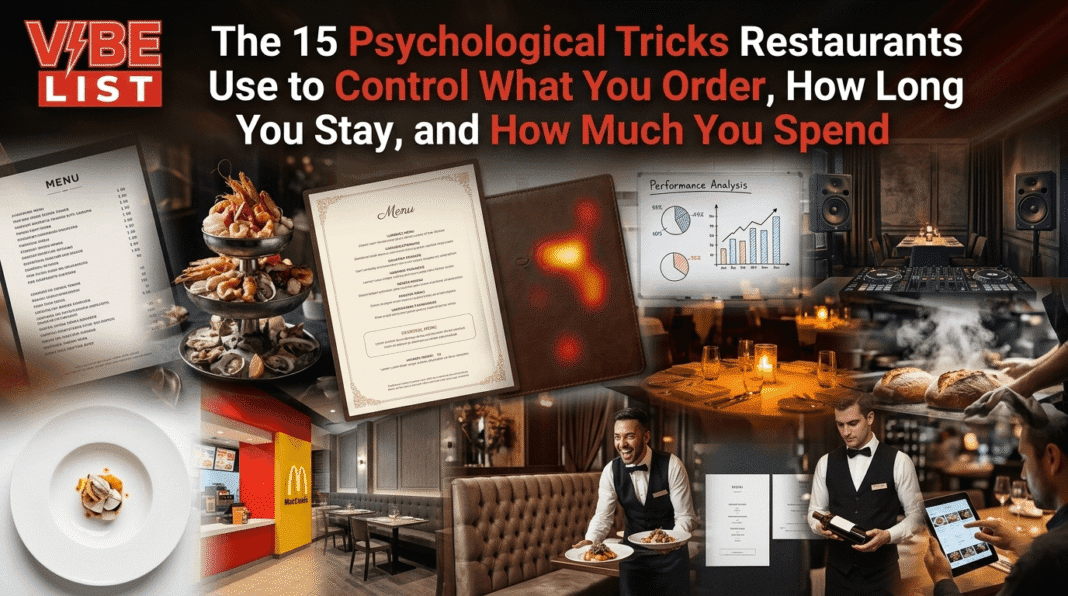
An 8.15% spending increase from deleting a single character on the menu. A 27% sales lift from adding three adjectives to a dish name. Slow jazz extending your dinner by 25% while you order a second bottle you never planned on. A $15 wholesale wine bottle generating $70 in revenue one glass at a time. Dim lighting pushing diners to order 39% more calories without noticing. A $1.55 trillion industry where 42% of operators still lost money last year. The restaurant was never just feeding you; it was reading you.
The $1.55 trillion restaurant industry is about much more than filling bellies. Restaurants exist to influence consumer behavior. Every aspect of the dining experience nudges consumers toward spending more, staying longer, and coming back. Many of these restaurant psychological tricks are rooted in decades of scientific research, while others are trade secrets passed between generations of successful restaurateurs. Next time you dine out, keep in mind that all of these tactics are working on you whether you realize it or not.
This article is your field guide to restaurant psychological architecture; a comprehensive collection of 15 proven methods, each supported by scientific research, expert opinion, and restaurant data, that illustrate how the environments where you dine have been psychologically engineered to shape your decisions before you realize you have made one. Whether your interest is the psychology behind the world’s most popular cuisines or the mechanics behind a single menu page, the principles below apply across every category of dining.
1. The Vanishing Dollar Sign

One of the most powerful and least costly restaurant menu psychology techniques is altering a single character on the menu.
According to a 2009 study conducted at Cornell University’s School of Hotel Administration, co-authored by doctoral candidate Sybil Yang and professor Sheryl E. Kimes, customers who ordered from menus with plain numbers without the “$” paid an average of 8.15% more than customers whose menus listed prices with a dollar sign. The study tested 201 customers at a café located at the Culinary Institute of America in Hyde Park, New York. Each subject received one of three menu formats at random:
Menu Format Type 1 – Prices Listed with a Dollar Sign ($) Example: Steak – $30.00
Menu Format Type 2 – Prices Listed as Plain Numbers Only Example: Steak – 30.00
Menu Format Type 3 – Price Listed as Words (e.g., Thirty Dollars)
Kimes explains the logic: “References to dollars, in words or symbol, reminds people of the ‘pain of paying.'”
That term—”pain of paying”—is not metaphorical. Behavioral economists have documented that the act of spending money triggers the same brain pathways associated with physical pain. The dollar sign functions as a visual cue for that pain response. Removing the dollar sign removes a small but measurable barrier between the customer and a larger order.
Walk into virtually any upscale restaurant today and you will find prices expressed as simple numeric values. Example: Filet Mignon 52. No dollar sign, no decimal point; the number reads more like a catalog entry than a price tag. That is intentional.
2. The Decoy on the Menu
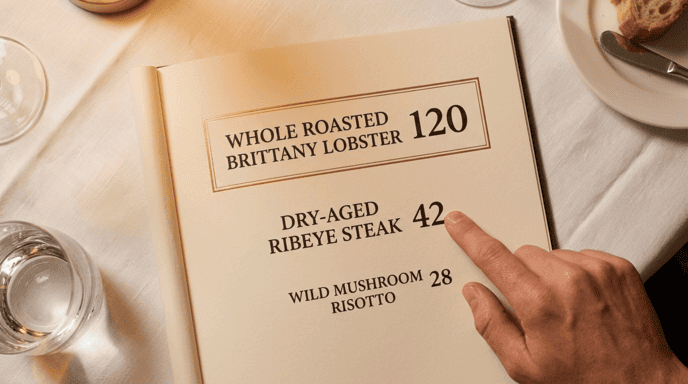
There is often an item on a menu that almost no one orders. A $65 seafood tower, a $400 caviar course, a $120 Wagyu supplement. Its purpose is not to sell it.
This is an example of the anchoring effect, one of the most studied cognitive biases in behavioral economics. First described by psychologists Amos Tversky and Daniel Kahneman in 1974, it demonstrates that people lean heavily on the first number they see when making later judgments. In a restaurant context, the $65 seafood tower resets your internal price calibration. The $32 pasta that follows it suddenly appears affordable. Without the anchor, the same $32 pasta could easily trigger sticker shock.
Aaron Allen, a global restaurant consultant based in Orlando, Florida, confirmed this mechanism in his analysis of restaurant menu psychology: “We can increase the profits of a restaurant by thousands simply by rearranging the items on the menu.” Placing the most expensive item at the top of the menu makes every subsequent item seem more reasonably priced.
The decoy effect operates similarly. When a restaurant offers small, medium, and large portions of the same dish, the medium is typically the intended choice. The large exists to make the medium seem like a reasonable compromise. The small exists to make the medium look like better value. Both other sizes are decoys.
3. Descriptive Language That Rewires Your Appetite
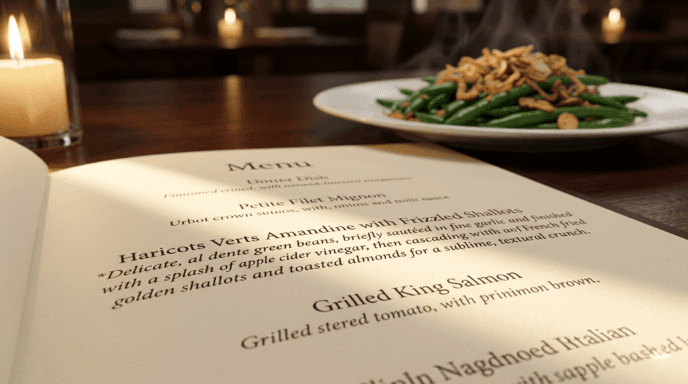
“Green beans” and “sweet sizzlin’ green beans and crispy shallots” are the same vegetable. They are not, however, the same dining decision.
A 2017 study published in JAMA Internal Medicine by researchers at Stanford University found that labeling vegetables with indulgent descriptions led to 25% more diners choosing the vegetable compared to basic labeling, 35% more compared to “healthy positive” labeling, and 41% more compared to “healthy restrictive” labeling. The study, led by graduate psychology student Bradley Turnwald and assistant professor Alia Crum, ran for an entire academic quarter (46 days) at a dining hall on campus. Researchers made no changes to the preparation or presentation of any food items.
These results extend far beyond vegetables. Earlier research by Brian Wansink, James Painter, and Koert Van Ittersum found that giving dishes descriptive names increased sales by 27% and improved how diners rated their meals afterward; diners rated food as tasting better when it carried a more evocative name. “Grandma’s home-baked zucchini cookies” outperformed “zucchini cookies” not because the recipe changed, but because the language triggered nostalgia and emotion.
Dan Jurafsky, professor of computational linguistics at Stanford University, evaluated the language and prices of 650,000 dishes across 6,500 menus and found a direct correlation between word length and price. For each additional letter in the average word used to describe a dish, the price increased by 18 cents. Expensive restaurants use longer words. Cheap restaurants use shorter ones. The language does not merely decorate the dish; it justifies the price.
Charles Spence, professor of experimental psychology at the University of Oxford, told the BBC: “Naming the farmer who grew the vegetables or the breed of a pig can help to add authenticity to a product. Consumers take that as a sign of quality, even it has been made up.”
Next time you notice phrases such as “hand-selected,” “slow-roasted,” “farm-to-table,” or “house-crafted” on a menu, recognize that these are psychological tools designed to make the dish seem worth more.
4. The Menu’s Hidden Map
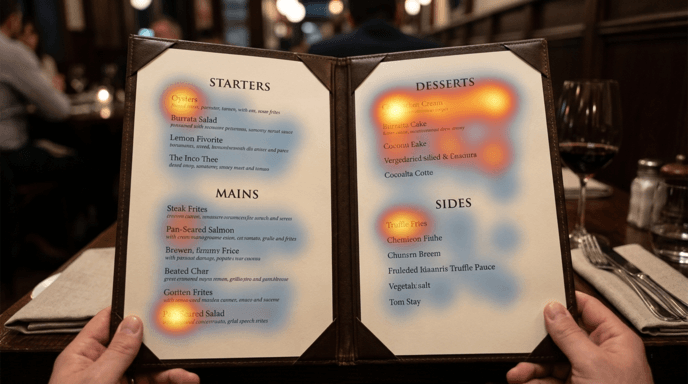
You think you are reading a menu. You are actually navigating a carefully constructed persuasion map.
Gregg Rapp, a menu engineer based in Palm Springs, California, who has spent over three decades designing menus for restaurants ranging from neighborhood cafés to multinational chains, told the BBC: “For a large chain that might have a million people a day coming into their restaurants around the world, it can take up to 18 months to put out a menu as we test everything on it three times.”
The placement of every item on a restaurant menu is a strategic decision. Research using eye-tracking technology shows that diners scan menus in predictable patterns. Rapp described his findings: “When we do eye tracking on a customer with a menu in their hand, we typically see hotspots in the upper right hand side. The first item on the menu is also the best real estate.”
This is why the most profitable dish on the menu rarely appears buried in the middle of the entrée list. It occupies what menu engineers call the “sweet spot”—the upper right corner of a two-panel menu, or the first and last positions in any given category. The first item sets the tone and is the most likely to be read. The last item benefits from the recency effect; it is the most likely to be remembered. Everything in between is comparatively invisible.
Boxes, borders, and shading draw attention to the dishes restaurants most want you to order—typically those with the highest profit margins. These graphical elements are not arbitrary design flourishes. They are attention-engineering tools.
5. The Star, the Plow Horse, the Puzzle, and the Dog

Behind every professionally engineered restaurant menu lies a classification system that most diners have never heard of. It is called the menu engineering matrix, and it classifies every item by two variables: popularity and profitability.
Stars are high-profit, high-popularity items. These are the dishes the restaurant is known for; the ones that sell frequently and generate strong margins. Stars receive the best placement on the menu, the most descriptive language, and often a box or graphical highlight to draw additional attention.
Plow Horses are high-popularity, low-profit items. Customers love them, but they cost more to produce relative to their menu price. The classic example is a burger. Restaurants address Plow Horses by gradually adjusting their preparation; subtly reducing portion sizes, swapping in cheaper ingredients, or pairing them with high-margin add-ons such as premium toppings and specialty sides to boost per-order profit.
Puzzles are high-profit, low-popularity items. They generate excellent margins, but not enough people order them. The restaurant’s response is to reposition them to more prominent locations on the menu, rewrite descriptions with more vivid language, or have servers recommend them at the table.
Dogs are low-profit, low-popularity items. Nobody orders them, and when someone does, the restaurant barely breaks even. Dogs are candidates for removal from the menu entirely, unless they serve a strategic purpose such as diversifying the menu or anchoring prices for other categories.
Chef Sean Huggard, founder and president of Shucking Good Hospitality, explained the system to The Takeout: dishes that are high profit and equally popular are regarded as “stars,” while those with lower demand but still high in profit are labeled as “puzzles.” Popular dishes with a lower profit margin are nicknamed “plow horses.” Even the most beloved desserts on earth are subject to this matrix when they appear on a restaurant menu.
The menu you hold in your hands is not simply a neutral list of options. It is a strategic battlefield where every item has been classified, positioned, and promoted based on its contribution to the bottom line.
6. Music Tempo as an Invisible Speed Dial

The playlist in a restaurant is not chosen because the manager likes jazz. Background music tempo directly determines how long you stay and how much you spend.
A 1986 study by Ronald E. Milliman, published in the Journal of Consumer Research, remains one of the most cited pieces of research in hospitality behavioral science. Milliman placed diners in a real restaurant setting and alternated between slow-tempo and fast-tempo background music during different service periods. The results were striking: slow-tempo music increased dining duration by nearly 25% compared to fast-tempo music. Diners who stayed longer also spent significantly more, particularly on beverages.
Once you understand the mechanism, the logic becomes clear. Slow tempos encourage leisurely eating, extended conversation, and additional rounds of drinks. Fast tempos create a sense of urgency, accelerate the pace of eating, and shorten total dining time. A fine dining restaurant plays slow jazz or classical music because it wants you to linger, order another bottle of wine, and consider dessert. A fast-casual restaurant plays upbeat pop or electronic music because it wants you in, fed, and out to make room for the next customer.
The financial logic is precise. A fine dining restaurant operating at 1 to 2 table turns per dinner service maximizes revenue per seat by extending each stay and lifting each check. A fast-casual restaurant operating at 4 to 6 turns per meal period maximizes revenue through volume. The music is tuned to the business model.
A 2024 study published in PMC confirmed Milliman’s foundational findings and expanded the analysis, noting that the tempo of background music influences not only time spent in a restaurant but also tips and overall bill totals.
Next time you become aware of the music playing in a restaurant, consider whether its purpose is purely to enhance your dining experience or to steer your behavior.
7. Lighting That Loosens Your Wallet
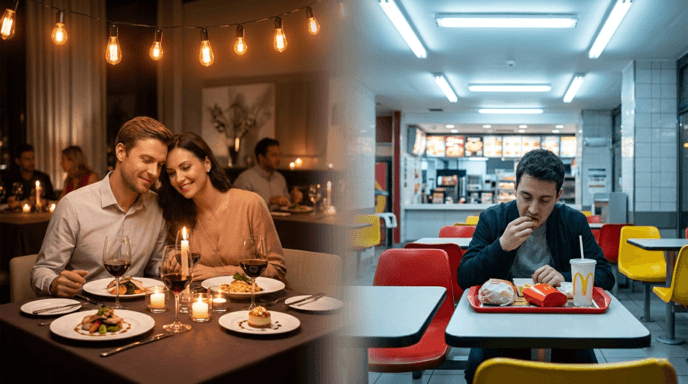
High-end restaurants are dimly lit not merely because the owner wants ambiance. The dim lighting directly impacts your decision-making.
Research published in the Journal of Consumer Psychology found that individuals in dimly lit settings experienced 7% more positive emotions than those in brightly lit environments. A study reported by the Association for Psychological Science found that when a fast food restaurant was remodeled with softer lighting and music, diners ate less food but rated their experience as significantly more enjoyable. Another experiment found that diners in dimly lit rooms ordered 39% more calories than those in brightly lit rooms.
Dim lighting relaxes inhibitions. It reduces self-consciousness about what and how much you are eating. It creates a sense of intimacy that makes you more receptive to spending. Bright lighting, conversely, enhances alertness and makes you more conscious of prices and portions.
This is why fast food restaurants use bright fluorescent lighting; it keeps customers alert, efficient, and cycling through quickly. Fine dining establishments use candles, Edison bulbs, and recessed fixtures that produce soft, warm tones—encouraging you to settle in, relax your price sensitivity, and linger.
The lighting design in a restaurant is not merely decorative. It is a behavioral lever.
8. The Scent You Were Never Supposed to Notice

You walk past a bakery and suddenly desire bread. You enter a café and order a latte you hadn’t planned on. These events are not coincidental. Ambient scent is one of the most powerful sensory tools in the restaurant industry’s arsenal.
A study published in the Journal of Retailing found that introducing a simple ambient scent to a retail environment helped shoppers spend 20% more on average. Research by Nicolas Guéguen and Christine Petr on odors and consumer behavior in restaurants found that pleasant ambient scents extended dining times and increased spending.
Restaurants exploit this in both overt and covert ways. The overt method is the open kitchen; the deliberate architectural decision to let cooking aromas flow into the dining room, stimulating appetite through passive marketing. The covert method involves engineered scent diffusion systems that release specific fragrances—fresh bread, vanilla, coffee, grilled meat—into the dining area at calculated intervals.
The aroma of freshly baked bread, in particular, triggers a cascade of appetite responses that can override the rational part of your brain. The scent activates your limbic system—the oldest part of the brain, responsible for processing emotions and memories—bypassing the frontal cortex where logical decision-making occurs.
9. The Delboeuf Illusion on Your Plate

The plate your food arrives on is not just a vessel. It is a visual trick.
The Delboeuf Illusion, first documented in 1865, demonstrates that the perceived size of a circle changes depending on the size of the circle surrounding it. A small circle inside a slightly larger circle appears bigger than the same small circle inside a much larger circle. Applied to food on a plate: the same portion of pasta looks generous on a small plate but inadequate on a large plate.
A study published in the International Journal of Obesity by researchers at Stanford University tested this illusion with food on plates of varying rim widths and colors. The results confirmed that participants overestimated food portion sizes by approximately 5% in diameter—equivalent to about 10% in visual area—when food was presented on plates with wider rims compared to plates with very thin rims. The researchers also found that colored rims caused participants to overestimate portion sizes by an additional 1.5% in diameter.
Fine dining restaurants exploit this illusion deliberately. A carefully portioned piece of protein placed on a wide-rimmed, elegantly colored plate creates an impression of generosity rather than stinginess. The negative space surrounding the food signals artistic intention.
Research by Koert Van Ittersum and Brian Wansink demonstrated that larger plates lead people to serve themselves more food, while smaller plates lead to smaller servings. The effect is automatic and subconscious; people do not recognize that the plate size is influencing their perception of the portion.
Restaurants invest heavily in custom dishware for this reason. The plate does not merely contain the food; it shapes your perception of how much food you received and whether you feel satisfied.
10. Color Psychology on the Walls and the Menu

The colors inside a restaurant—on the walls, menus, furniture, and lighting—are not chosen arbitrarily. Decades of color psychology research in retail and hospitality now shapes restaurant design.
Research published in Frontiers in Psychology on color and food perception found that warm colors such as red and orange stimulate appetite, while cooler colors such as blue and purple tend to suppress it. A 2025 study published in the Journal of Consumer Psychology examined how red ambient color in restaurants influences food choices, revealing nuanced effects on dining behavior.
Aaron Allen described the practical application to the BBC: green is commonly used to imply food is healthy and fresh, while orange is thought to stimulate the appetite. Red suggests a sense of urgency and draws attention to dishes the chef most wants you to buy; likely because they carry the highest profit margins.
These principles explain why so many fast food logos and interiors feature red and yellow. McDonald’s, Wendy’s, Burger King, KFC, In-N-Out, and Pizza Hut all use red prominently. Red stimulates the heart rate and creates urgency. Yellow evokes happiness and energy. The combination drives hunger, excitement, and quick decision-making.
Fine dining restaurants, by contrast, select deep blues, muted greens, warm golds, and neutral earth tones. These colors slow the diner’s internal pace, promote relaxation, and signal sophistication—enhancing the likelihood that guests will stay longer, spend more, and return.
Charles Spence’s research at Oxford has found that consumers associate rounder typefaces with sweeter tastes and that visual contrast between food and plate affects flavor perception. A white plate with a red rim can make a green salad look fresher. A dark plate can make a pale piece of fish appear more dramatic. The color scheme on a plate contributes directly to the consumer’s culinary experience.
11. The Strategic Seat

Where you sit in a restaurant is not always random, and the design of the seat itself is engineered around the restaurant’s revenue model.
Fast food restaurants use hard plastic seating, bright lighting, and minimal padding for a reason. The discomfort is the mechanism. The restaurant does not want you to linger over a $9 value meal for two hours. It wants you in, fed, and out within 30 to 45 minutes to maximize table turnover rates of 12 to 24 turns per table in a 12-hour operating day. Hard seats and stark lighting accelerate this process without the consumer consciously recognizing the nudge.
Fine dining restaurants invert every element. Plush upholstery, cushioned booths, generous spacing between tables, soft lighting, and ambient sound absorption all keep you comfortable enough to stay for two to three hours—ordering appetizers, main courses, desserts, digestifs, and additional bottles of wine. The revenue model depends on 1 to 2 table turns per dinner service, with each table generating a substantially higher check total.
Hostesses at high-traffic restaurants seat diners strategically. Window seats are filled first because a visibly occupied restaurant attracts foot traffic. Tables near the entrance are sometimes reserved for the most photogenic plates, creating a visual advertisement for passersby. Booths go to parties likely to order more courses because the enclosed, private setting encourages longer stays.
Every surface, texture, and spatial arrangement is calibrated to keep you in the restaurant for exactly as long as the revenue model requires.
12. The Server Script
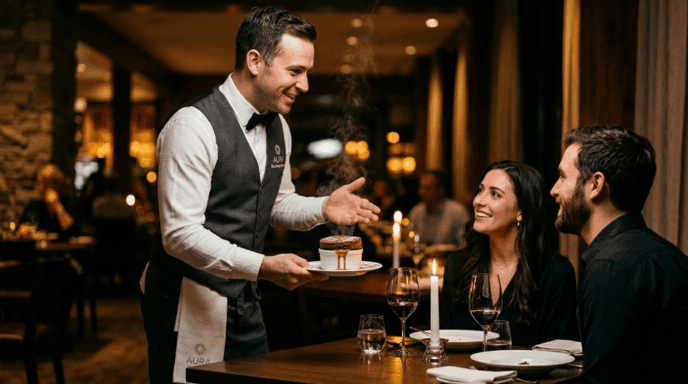
Your server is not casually chatting with you. They are executing a behavioral script designed to increase your order total.
The practice is called suggestive selling, and it is one of the most systematically trained skills in the restaurant industry. A server who asks “Would you like dessert?” is using a weak prompt. A server who tells you about a dark chocolate soufflé with salted caramel that takes twelve minutes to bake—so you can time it perfectly after your entrée—is executing a script that creates urgency, specificity, and sensory anticipation simultaneously.
Many formalized training programs at restaurant chains include specific upselling techniques for every stage of the meal:
At the Drink Order: Recommending a specific cocktail by name rather than asking “Would you like anything to drink?”
At the Appetizer Stage: Suggesting a shareable starter “so you can enjoy it while deciding.”
At the Entrée Stage: Noting premium add-ons such as a $6 truffle supplement or an upgrade to sweet potato fries for an additional $4.
At the Dessert Stage: Describing the most expensive dessert first in vivid sensory detail before presenting a general dessert menu.
The most effective servers do not pressure. They narrate. They share enthusiasm for specific dishes. They describe textures, aromas, and preparation methods. They make ordering an additional item feel like joining a curated experience rather than being upsold.
According to analysis by The Waiter’s Academy, trained staff using suggestive selling techniques can generate significant additional revenue per year for a restaurant; a return that justifies the investment in script development and employee training.
13. The Paradox of Choice on a Page

Giving you more options does not make you happier. It increases your likelihood of selecting something safe, reducing your order size, and feeling dissatisfied regardless of what you chose.
Menu engineers recognize this, which is why the optimal number of items per category on a restaurant menu is tightly controlled. Gregg Rapp stated the formula in his BBC interview: “More than seven is too many, five is optimal and three is magical.”
A study from Bournemouth University found that fast food customers preferred to pick from six items per category, while fine dining customers preferred slightly more—between seven and ten—before experiencing choice overload, a phenomenon documented extensively by Barry Schwartz in his 2004 book The Paradox of Choice.
When choice overload occurs, diners become cognitively fatigued. They default to the familiar—a basic chicken dish—rather than exploring the menu. They may skip courses entirely, declining appetizers or desserts because they are already mentally exhausted from the entrée decision. In extreme cases, excessive menu options decrease overall satisfaction because the diner second-guesses their choice through the entire meal.
Restaurants combat this by limiting visible options through category organization, seasonal rotations, and curated tasting menus that eliminate the burden of choice entirely. The tasting menu is the ultimate revenue optimization tool: the restaurant selects what you eat, in what order, at what pace, and at a predetermined price; and diners often report higher satisfaction precisely because they were relieved of the anxiety of choosing.
14. The Wine List Markup Architecture

The wine list is the single most profitable section of any restaurant menu, and its design is an exercise in restaurant pricing psychology that makes the food menu’s tricks look elementary.
The typical restaurant wine markup ranges from 200% to 400% above wholesale cost. A bottle purchased wholesale for $10 to $15 routinely appears on the list for $40 to $60. Premium bottles carry even steeper markups in absolute dollar terms.
The psychological engineering of the wine list follows a specific pattern. The cheapest bottle on the list is almost never the one the restaurant wants you to order. It establishes a price floor. Most diners, reluctant to appear cheap by ordering the least expensive option but unwilling to splurge on the most expensive, will default to the second or third cheapest bottle. Restaurants know this and place their highest-margin bottles in that sweet spot—the second and third positions from the bottom.
The most expensive bottle on the list, like the most expensive entrée, serves as an anchor. Its presence shifts the entire perceived value range of the list downward. Some restaurants deliberately include a few extravagantly priced bottles—$300, $500, or $1,000—that almost no one orders but that influence the price perception of every other bottle.
Wine by the glass represents even higher margins. A standard 750ml bottle yields approximately five glasses. If the restaurant purchased the bottle for $15 and sells each glass for $14, the gross revenue per bottle is $70; far exceeding the bottle price on the same list. This is why servers are trained to suggest wine by the glass rather than encouraging the table to share a bottle.
15. The Digital Menu Revolution
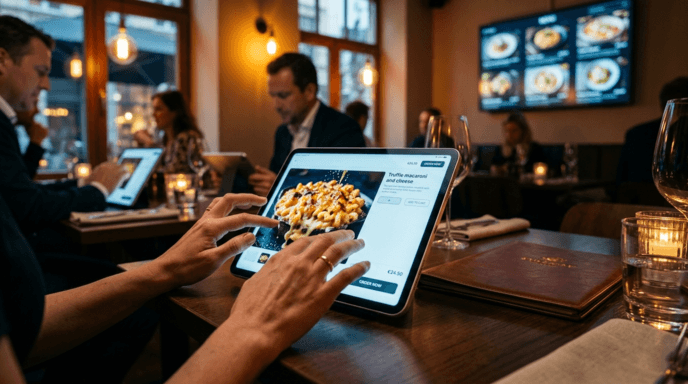
The most sophisticated restaurant psychological tricks of the next decade will not come from leather-bound menus or server scripts. They will come from screens.
As menus migrate to digital platforms—QR codes, tablet ordering, app-based interfaces, and interactive kiosks—the restaurant industry gains access to an entirely new category of behavioral tools. Digital menus can display high-margin items with motion graphics. They can highlight specific dishes based on the time of day, current inventory levels, or the weather outside. They can A/B test different menu layouts across thousands of diners simultaneously and optimize in real time.
Charles Spence told the BBC: “Our minds find protein in motion; oozing cheese and dribbling yolk, very attractive. As menus go digital, there will be more opportunity to show this off with videos and animations.”
Aaron Allen expanded on that prediction: “The restaurant industry has probably spent tens of billions of dollars over the years trying to understand menu design, menu engineering and psychology. But the opportunities presented by the fourth industrial revolution are huge. Imagine being able to order a meal that has been designed to include your favourite foods with a single click.”
Several large chain restaurants have already begun testing artificial intelligence-driven menu personalization. Pizza Hut tested eye-tracking technology to predict which toppings a diner wanted based on their gaze patterns scanning the menu. AI systems can analyze past ordering history, suggest items based on flavor preferences, and arrange options to guide diners toward higher-margin dishes.
Dynamic pricing, already standard in the airline and ride-share industries, is beginning to appear in restaurants. Some digital menus adjust prices based on demand; a burger costs slightly more at 7 PM on Friday than at 2 PM on Tuesday. The price difference is small enough that most diners will not notice, but multiplied across thousands of orders, the revenue impact is substantial.
Leather-bound menus were the first generation of persuasion technology. Digital menus are the second. Unlike leather-bound menus, digital menus learn.
The Vibe List’s Take: What This Means for You
None of these tactics are inherently malicious. Restaurants operate on notoriously thin margins; the National Restaurant Association projected U.S. restaurant industry sales of $1.55 trillion in 2026, yet 42% of operators reported they were not profitable in 2025. Menu engineering, music programming, lighting design, and suggestive selling are survival strategies in an industry where a single percentage point on average check size can determine whether a restaurant stays open or closes.
Chef Sean Huggard of Shucking Good Hospitality told The Takeout: “Due to rising food and labor costs, increasing rent and taxes, and growing legal and insurance expenses. Just because your favorite restaurant looks packed on the weekend does not mean they do not need support during the rest of the week.”
Understanding these restaurant tricks does not make you cynical about dining out. It makes you a more conscious consumer. Once you recognize the anchor, the decoy, the music tempo, and the descriptive language for what they are, you gain the ability to make genuinely autonomous choices. You can still order the $60 bottle of wine. But you will order it because you want it, not because the restaurant’s psychological architecture nudged you there. The same principles apply whether you are navigating a wine list or deciding between fast-food chains on a Tuesday night.
Quick Reference: 15 Restaurant Psychological Tricks at a Glance
| # | Trick | What It Does | Key Research | Key Stat |
|---|---|---|---|---|
| 1 | Vanishing Dollar Sign | Removes the “pain of paying” cue by eliminating the $ symbol from menu prices | Cornell University, 2009 (Yang & Kimes) | Diners spend 8.15% more |
| 2 | The Decoy / Price Anchor | An expensive item resets your internal price calibration, making everything else seem affordable | Tversky & Kahneman, 1974 (anchoring effect) | Profits increase by thousands from reordering alone |
| 3 | Descriptive Language | Evocative dish names trigger nostalgia, emotion, and higher perceived value | Wansink et al., 2001; Turnwald et al. (Stanford), 2017 | Sales boost up to 27%; vegetable selection up 25% |
| 4 | Menu Eye-Tracking Layout | High-profit items are placed in visual hotspots where diners look first | Gregg Rapp, menu engineering (30+ years) | Upper-right corner is the prime “sweet spot” |
| 5 | Star / Plow Horse Matrix | Every item classified by profit and popularity to maximize revenue per dish | Menu engineering matrix (industry standard) | 4 categories: Stars, Plow Horses, Puzzles, Dogs |
| 6 | Music Tempo | Slow music extends dining time and increases spending; fast music accelerates turnover | Milliman, 1986 (Journal of Consumer Research) | Dining time increases ~25% with slow tempo |
| 7 | Dim Lighting | Soft lighting relaxes inhibitions and price sensitivity; bright lighting keeps customers cycling fast | Multiple studies (APS; Biswas et al.) | Diners order 39% more calories in dim rooms |
| 8 | Engineered Scent | Ambient aromas bypass rational thinking and trigger appetite through the limbic system | Journal of Retailing (Spangenberg et al.); Guéguen & Petr | Shoppers spend 20% more with simple scents |
| 9 | Delboeuf Illusion | Plate rim width and color manipulate perceived portion size | Stanford / Int. Journal of Obesity (2014) | Portions appear 5–10% larger on wide-rimmed plates |
| 10 | Color Psychology | Red and orange stimulate appetite and urgency; blue suppresses it | Frontiers in Psychology; J. of Consumer Psychology (2025) | McDonald’s, KFC, Pizza Hut all use red prominently |
| 11 | Strategic Seating | Seat comfort and placement calibrated to control dwell time and table turnover | Hospitality design research | Fast food: 12–24 turns/day; fine dining: 1–2 turns |
| 12 | Server Script | Suggestive selling techniques increase per-table revenue at every stage of the meal | The Waiter’s Academy; industry training standards | 4-stage upselling: drinks, apps, entrées, dessert |
| 13 | Paradox of Choice | Too many menu items cause decision fatigue; diners default to safe, low-spend choices | Bournemouth University; Schwartz (2004) | Optimal: 5–7 items per category; 3 is “magical” |
| 14 | Wine Markup Architecture | Wine lists engineered so the 2nd-cheapest bottle captures the highest margin | Industry data | 200–400% markup; by-the-glass yields $70 per $15 bottle |
| 15 | Digital Menu AI | AI-driven menus personalize, A/B test, and dynamically price in real time | Emerging technology (Pizza Hut eye-tracking; Spence) | Digital menus learn from every order |
Frequently Asked Questions
Why do fine dining restaurants use dim lighting?
Dim lighting in fine dining restaurants is a deliberate behavioral tool, not merely an aesthetic choice. Research from the Association for Psychological Science found that softer lighting environments produce more positive emotions and reduce self-consciousness about spending. Diners in dimly lit settings tend to order more courses and higher-priced items because the relaxed atmosphere diminishes the analytical price awareness that bright lighting promotes.
How do restaurants decide where to place items on the menu?
Restaurants use a discipline called menu engineering, which combines eye-tracking research, sales data analysis, and profit-margin calculations. High-profit items are placed in visual hotspots; typically the upper right corner of a two-panel menu and the first or last position in each category. Menu engineer Gregg Rapp has noted that the first item in any menu section is the most valuable real estate because it is read before customers scan further.
Is it true that restaurants mark up wine by 300%?
Yes; wine markups of 200% to 400% above wholesale cost are standard in the restaurant industry. A bottle purchased for $10 to $15 wholesale typically appears on the wine list for $40 to $60. The highest markups are often found on wines by the glass, where a single bottle yields approximately five pours, each sold at a price that collectively far exceeds the bottle price on the same list.
What is the “pain of paying” in restaurant psychology?
“Pain of paying” is a term from behavioral economics describing the discomfort people experience when spending money. A 2009 Cornell University study found that visual cues of currency—such as dollar signs on menus—activate this pain response and cause diners to spend less. Removing the dollar sign led to an average spending increase of 8.15%.
Do restaurant menu descriptions actually affect how food tastes?
Research suggests they do. A Stanford University study found that vegetables labeled with indulgent descriptions were not only chosen 25% more often but consumed in greater quantities. Separately, research by Brian Wansink found that descriptive menu labels improved diners’ post-consumption ratings of the food itself—the same dish tasted better when it carried a more evocative name.
How does background music affect my dining experience?
Ronald Milliman’s foundational 1986 study in the Journal of Consumer Research found that slow-tempo background music increased dining time by approximately 25% and was associated with greater total spending, especially on beverages. Subsequent research has confirmed that music tempo directly influences pace of eating, length of stay, tip amounts, and bill totals.
This content is for informational and educational purposes only. It describes industry-standard business practices and published behavioral research. The Vibe List encourages readers to dine out, support restaurants, and enjoy the experience—simply with a more informed perspective.


