


A concrete dome standing 1,900 years after the empire that built it collapsed. A 30-gear bronze computer from 150 BCE with no successor for 1,200 years. Carbon nanotubes inside a medieval sword; structures science didn’t name until 1991. A 7-meter iron column that hasn’t rusted in 1,600 years. A clay disc stamped with 45 symbols no one has read in 3,500 years. None of them were supposed to exist. They do; and modern science still can’t fully explain how.
We think of time as moving forward. One century builds on the next; each new innovation is superior to what existed before. And then you pull something from the earth that doesn’t belong there; a gear system that tracks the planets’ orbits from 150 BCE, a concrete recipe from ancient Rome that fixes itself, a medieval sword containing carbon nanostructures that modern science only identified in 1991. None of these items fit our storyline. Instead, they show that ancient civilizations achieved levels of materials science, engineering, and astronomy that we’re still trying to fully comprehend. Many of these lost ancient technologies can now be partially interpreted thanks to recent scientific breakthroughs. Many others remain genuinely unexplained ancient discoveries that provoke active debate among archaeologists, chemists, and engineers.
This is not a collection about aliens or pseudoscience. Every entry here is grounded in peer-reviewed studies, archaeological evidence, and scientific verification. The question is not whether these civilizations developed such ancient engineering mysteries; they did. The question is how civilizations without electron microscopes, computers, or advanced metallurgy created them.
1. Roman Concrete (Opus Caementicium)

It’s 126 CE, and Emperor Hadrian dedicates the Pantheon; the largest unreinforced concrete dome in the world. Nearly 2,000 years later, the Pantheon still stands; meanwhile, many modern concrete structures deteriorate within 50 to 100 years. For decades, this discrepancy puzzled materials scientists.
In January 2023, researchers at MIT, Harvard University, and laboratories in Italy and Switzerland published findings in Science Advances that explained why Roman concrete outlasts its modern counterpart. Researchers found that the Romans employed a technique called “hot mixing,” incorporating quicklime (calcium oxide) directly into their concrete mixture rather than first slaking it with water, as had long been assumed.
This “hot mixing” process creates small, bright white mineral inclusions called “lime clasts” throughout the material; a feature that had been dismissed for years as indicative of poor mixing.
These lime clasts serve as internal repair mechanisms. When cracks develop and water seeps in, it dissolves the calcium-rich lime clasts. The resulting calcium-saturated solution recrystallizes as calcium carbonate, sealing the crack permanently. To test this theory, MIT professor Admir Masic created modern hot-mix concrete samples and deliberately cracked them. Water was run through the cracks, and within two weeks the cracks sealed completely; identical samples without quicklime never healed.
Cement production alone contributes to approximately 8% of global CO2 emissions. If self-healing concrete similar to the Roman formula extended the lifespan of modern infrastructure by even 50 years, it could save millions of tonnes of CO2 emissions annually. The Romans who built aqueducts and harbors two millennia ago inadvertently pioneered principles in materials science that researchers are now racing to commercialize.
2. The Antikythera Mechanism

In 1901, sponge divers recovered dozens of corroded bronze fragments from a Roman-era shipwreck near the Greek island of Antikythera. The following year, archaeologist Valerios Stais noticed that several fragments contained gear wheels. Over more than a century of study, researchers determined that the fragments belonged to the oldest known complex geared device.
The Antikythera Mechanism; built circa 150 BCE and housed in a wooden box roughly the size of a shoebox; consisted of at least 30 interlocking bronze gears. High-resolution X-ray computed tomography of the remaining 82 fragments revealed that the device could track solar and lunar eclipses; calculate the positions of the Sun and Moon across the zodiac; represent the variable rate at which the Moon travels around the Earth; and record the timing of the ancient Olympic Games.
Tony Freeth and his international research team published a landmark study in Nature in 2006 that decoded the function of the mechanism’s back dials. Specifically, they determined how the device predicted solar and lunar eclipses. A subsequent 2021 study, also published in Scientific Reports (Nature), proposed a comprehensive model for the front display; essentially a miniature planetarium representing the motions of Mercury, Venus, Mars, Jupiter, and Saturn via an intricate epicyclic gear system. The researchers described the engineering as so tightly constrained by the physical evidence that the options for a viable model were remarkably few.
What makes the Antikythera Mechanism so extraordinary is its isolation. There are no examples of devices with comparable mechanical sophistication appearing in the archaeological record for another 1,200 years; not until medieval European and Islamic clockwork. It represents a peak of ancient Greek astronomical and engineering knowledge that, for reasons still debated, left no technological successors.
3. Damascus Steel (Wootz Steel)

Warriors in the medieval Middle East wielded swords forged from Damascus steel, named for the Syrian city where the blades were traded. These weapons were renowned for three qualities: extraordinary hardness, sharpness retention, and a distinct watery pattern known as “damask.” Crusader chroniclers began documenting their encounters with these swords as early as the 11th century; Damascus steel blades were manufactured continuously for approximately 1,100 years before the technique was lost sometime in the late 18th century.
Professor Peter Paufler‘s research team at Germany’s Technical University of Dresden published a study in Nature in 2006 that stunned the materials science community. Using high-resolution transmission electron microscopy to examine a 17th-century Damascus sabre, they demonstrated that the steel contained carbon nanotubes and cementite nanowires dispersed within its microstructure. Carbon nanotubes; cylindrical molecules formed from hexagonal arrangements of carbon atoms; were formally identified by modern science only in 1991. Medieval swordsmiths had accidentally produced them as part of their forging processes centuries earlier.
The original blades were forged from wootz steel, a high-carbon crucible steel primarily manufactured in India and Sri Lanka. The trace minerals present in the ore (vanadium, molybdenum, and other impurities), together with the thermal cycling inherent in forging, generated these nanostructures. However, once specific ore sources were depleted or trade routes shifted, the exact combination of raw materials became unavailable. Contemporary metallurgists have attempted to replicate Damascus steel with varying degrees of success; however, none believe their results fully match every property of the original material.
4. Greek Fire

The Byzantine Empire deployed Greek Fire for roughly 700 years; an incendiary weapon so potent and so secretive that, despite numerous attempts since its first use in naval warfare circa 672 CE, historians have never definitively identified its chemical composition. The liquid continued burning on the surface of water and was nearly impossible to extinguish. It was fired from pressurized bronze siphons mounted on warship bows, functioning as ancient flamethrowers.
Multiple sources from both Byzantine and Arabic histories describe Greek Fire’s devastating effects. Historians credit Greek Fire with saving Constantinople during the first Arab siege (674–678 CE); knowledge of its composition was restricted to the imperial family and a select group of engineers. No surviving document records the formula.
Modern historians generally agree that naphtha (petroleum) was likely the primary ingredient, possibly combined with pine resin, sulfur, and quicklime. However, the exact formulation, and more importantly, the pressurization mechanism that allowed it to flow as a continuous stream through a siphon, remain subjects of active debate. Greek Fire gradually disappeared from historical records by the 13th century; historians attribute this largely to the Byzantine Empire’s territorial losses, which cut off access to necessary resources and specialized knowledge. The technology was not superseded; it was lost.
5. The Lycurgus Cup

The Lycurgus Cup, a 4th-century Roman cage cup exhibited at London’s British Museum, is one of the most remarkable glass objects in existence. Uniquely, when lit from one side, it displays a jade green hue; when lit from behind, it glows a deep, translucent red. Known as dichroism, this color-changing phenomenon occurs because of something that should not exist in any Roman artifact: gold and silver nanoparticles embedded in glass at concentrations and scales sufficient to produce what modern physicists call a surface plasmon resonance effect.
Scientific analysis has confirmed that the glass contains particles composed of a gold-silver alloy approximately 50 to 100 nanometers in diameter. At that scale, these metallic particles interact with light differently than bulk metals; absorbing and scattering different wavelengths depending on the direction of illumination. This principle underlies modern nanotechnology applications in biosensing and medical diagnostics. Researchers at institutions including University College London have studied the cup extensively. The consensus is that the dichroic effect was almost certainly produced by accident; the Romans lacked an understanding of nanotechnology but stumbled into it through their glassmaking process.
To date, no Roman workshop has left behind documentation for replicating this effect in glass.
6. The Pyramids of Giza
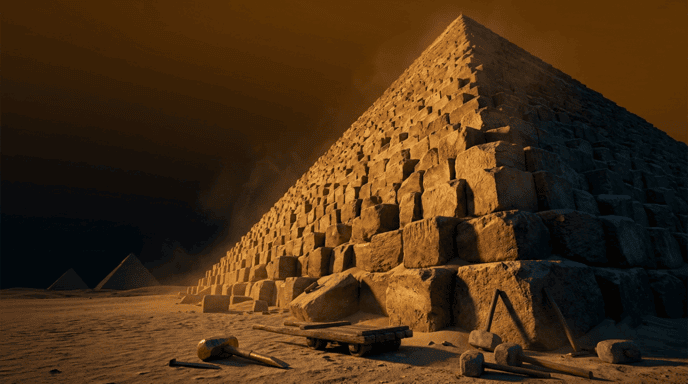
The statistics alone defy easy explanation. The Great Pyramid of Khufu, built around 2560 BCE, was constructed using an estimated 2.3 million stone blocks weighing a total of approximately 6 million tonnes. Most of these blocks weighed approximately 2.5 tonnes; however, the granite blocks in the King’s Chamber weighed up to 80 tonnes and were transported from quarries in Aswan, approximately 800 kilometers to the south.
The base area of the pyramid spans 5.3 hectares and is level to within 2.1 centimeters across the entire footprint. The pyramid’s four sides are aligned with the cardinal directions to better than 1/15th of a degree. Achieving this precision with Bronze Age tools; copper chisels, stone hammers, wooden sledges, and no wheeled vehicles; remains the central engineering mystery. Competing explanations fall broadly into straight ramp, spiral ramp, internal ramp, and water-based transport theories.
No single theory has achieved consensus among Egyptologists and engineers. However, Egyptologists generally agree that the construction required a large, highly organized workforce (recent evidence suggests paid laborers, not slaves), sophisticated project management, and surveying and geometric knowledge remarkable for the era. For nearly 3,800 years, the pyramid was the tallest man-made structure on Earth.
7. Göbekli Tepe

Göbekli Tepe in southeastern Turkey upended one of archaeology’s foundational assumptions: that organized religion followed the development of agriculture. Radiocarbon dating places the site’s earliest monumental structures at approximately 9500 BCE, making them roughly 7,000 years older than Stonehenge and approximately 6,000 years before the earliest known writing.
The site features massive T-shaped limestone pillars, some standing over 5 meters tall and weighing up to 10 tonnes, arranged in circular enclosures. Many of the pillars are carved with elaborate reliefs depicting animals; foxes, lions, scorpions, vultures, and snakes. The construction was accomplished by hunter-gatherer societies that had not yet domesticated crops or animals, challenging the long-held assumption that monumental architecture required settled agricultural communities with surplus food production.
One of the most intriguing aspects of Göbekli Tepe is that the site was deliberately buried around 8000 BCE. The entire complex was filled with soil and debris. It was neither destroyed nor left to deteriorate through abandonment; it was carefully sealed. The reasons for this remain unknown. Some researchers believe it may have been ritually decommissioned; others propose that the builders simply decided to move on and bury what they had created. The site, now a UNESCO World Heritage Site, has only been approximately 5% excavated. Whatever lies beneath the surface may fundamentally alter our understanding of early human societies.
8. The Nazca Lines
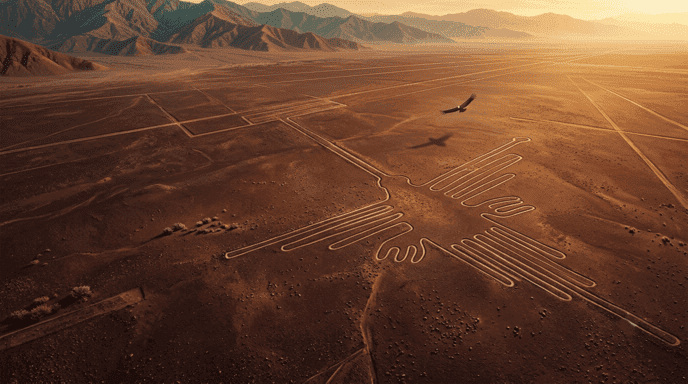
On the arid desert floor of southern Peru lie over 800 straight lines, 300 geometric shapes, and approximately 70 depictions of animals and plants etched into the landscape across nearly 450 square kilometers. The Nazca culture produced these designs between roughly 500 BCE and 500 CE. They were created by removing the reddish surface stones to expose the lighter ground beneath. The region’s dry, windless climate has preserved them for over 1,500 years.
The figures include a hummingbird, a spider, a monkey, a condor, and various geometric shapes, some spanning hundreds of meters. The critical detail that has fueled fascination for decades is that many of the figures are only fully visible from the air; a perspective the Nazca people, as far as we know, could never have accessed.
Theories about their purpose range from astronomical calendars proposed by Maria Reiche, the German mathematician who devoted her life to studying and preserving the lines, to ceremonial walkways connected to water rituals, to religious offerings visible to sky deities. Recent research using AI-assisted image analysis has discovered hundreds of previously unseen smaller figures at the site. The UNESCO World Heritage Site remains one of the most visually striking and functionally debated accomplishments of the ancient world; a remarkable example of ancient inventions ahead of their time in large-scale landscape engineering.
9. The Sacsayhuamán Walls

Approximately 2 kilometers outside Cusco, Peru, stand some of the finest examples of precision stonework on Earth: the Sacsayhuamán walls. Constructed by the Inca in the 15th century, these walls consist of enormous limestone blocks; some exceeding 100 tonnes; that fit together so tightly that not even a sheet of paper can be inserted between adjacent stones. No mortar was used.
Unlike walls built with uniform rectangular blocks, each stone at Sacsayhuamán is an irregular polygon with multiple angles, shaped to fit precisely against its neighbors on every face. This type of construction is far more difficult than stacking uniform bricks and requires each stone to be individually shaped to match the contours of every stone it touches. The Inca accomplished this without iron or steel tools (they worked with bronze and stone), without the wheel, and without draft animals capable of pulling heavy loads.
Proposed methods include complex systems of levers and ramps, stone-pounding techniques using harder diorite or granite hammers, and carefully planned trial-and-error fitting processes. The walls have survived centuries of earthquakes that destroyed later Spanish colonial buildings constructed on top of and around them; proof of the seismic resilience of Inca engineering. For readers interested in how ancient civilizations developed surprising practices, the Inca represent one of the most inventive cultures in the pre-Columbian Americas.
10. The Voynich Manuscript

The Voynich Manuscript, a 240-page illustrated codex housed at Yale University’s Beinecke Rare Book & Manuscript Library, is written in an unknown script that no linguist, cryptographer, or computer scientist has decoded in over a century of attempts. Carbon-14 dating conducted at the University of Arizona determined that the parchment was produced between 1404 and 1438, firmly in the early 15th century.
The manuscript contains illustrations of unidentifiable plants, astronomical diagrams, apparent pharmaceutical recipes, and what appear to be bathing scenes involving groups of women. The script, known as “Voynichese,” follows a consistent system with identifiable patterns of word frequency and character distribution similar to the statistical properties of natural languages. It is not random. Despite extensive efforts applying statistical linguistics, machine learning, and the combined expertise of codebreakers from multiple intelligence agencies, no one has produced a verified translation.
Theories range from an elaborate medieval hoax to an encrypted text in a natural language to a constructed language with no known equivalent. What makes the Voynich Manuscript a technological mystery rather than merely a cryptographic puzzle is its physical production: the parchment is authentic, the inks are period-appropriate, and the binding is consistent with 15th-century bookmaking practices. Someone invested enormous resources into creating it. What they were trying to communicate; or conceal; remains unanswered. Much like the famous legends that sound fake until you examine the evidence, the Voynich Manuscript occupies the unsettling gap between hoax and breakthrough.
11. The Baghdad Battery

In 1936, archaeologists uncovered an unusual artifact near Khujut Rabu, Iraq. The Baghdad Battery consisted of a clay jar, a copper tube, and an iron rod, dating to the Parthian period (roughly 250 BCE to 224 CE). When filled with an acidic solution such as vinegar or grape juice, the assembly produces a small electrical voltage of approximately 1 to 2 volts.
The debate isn’t whether the device generates electricity; experiments have confirmed that it does. The debate is whether it was designed to produce electricity. Supporters of the electrochemical interpretation suggest it may have been used for electroplating; coating objects with thin layers of gold or silver using electrical current. Some ancient Mesopotamian artifacts do show evidence of electroplated coatings. Detractors argue that the devices may have been simple storage vessels for sacred scrolls, and that the galvanic reaction is a coincidence of the materials used.
A study reported in Chemistry World proposed that the artifact functioned as a two-cell battery with an outer air-reacting component, producing higher voltage than earlier reconstructions suggested. The Baghdad Battery remains one of the most contested objects in ancient technology research; not because the science is unclear, but because the intent of its creators is unknowable from the surviving evidence.
12. The Iron Pillar of Delhi

Standing in the Qutb complex in Delhi, India, the Iron Pillar rises over 7.2 meters tall and weighs approximately 6 tonnes. A column of wrought iron, it has resisted corrosion for approximately 1,600 years. Inscriptions on the pillar date its creation to the Gupta period, around the early 5th century CE.
For decades, metallurgists were puzzled by the pillar’s resistance to rust. Modern analysis has revealed that the iron contains an unusually high phosphorus content (approximately 0.25% by weight on average, compared to the negligible phosphorus in most modern iron). This, combined with the unique slag inclusions produced by ancient Indian forge-welding processes, created a thin protective layer of iron hydrogen phosphate on the surface. This passive film, called misawite, effectively shields the iron from oxidation.
Crucially, this was not an intentional application of corrosion science. It was an accidental byproduct of the specific iron ore and the forge-welding techniques practiced by craftsmen of the Gupta era. Nonetheless, the result is a metallurgical achievement that modern engineers study for its insights into passive corrosion protection. In the broader story of decisions and innovations that shaped history, the Iron Pillar stands as a reminder that accidental discoveries can outlast deliberate ones by millennia.
13. Roman Dodecahedra
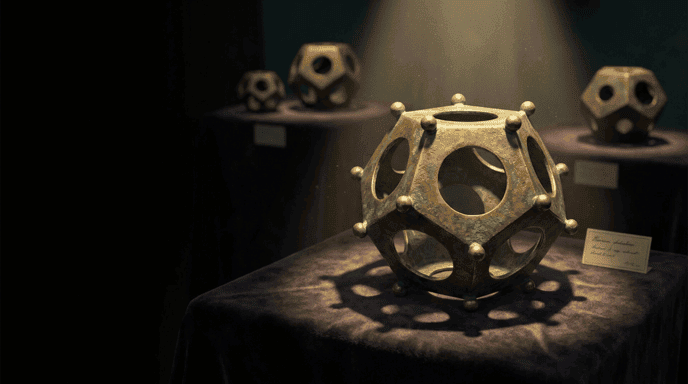
Over 100 hollow bronze objects have been discovered across the former Roman Empire. These objects feature 12 pentagonal faces, each with a circular hole of varying diameter. The majority were found in Gaul and Britain, dating from the 2nd to 4th centuries CE. Despite the vast corpus of surviving Roman texts, images, and inscriptions, none describe these bronze objects.
Roman dodecahedra range in size from 4 to 11 centimeters in diameter. Some feature knobs at each vertex. The holes on each face vary in size. No two dodecahedra are identical. Proposed explanations include candleholders, surveying instruments, religious objects, rangefinders, children’s toys, knitting tools, and flower arrangement devices. None of these hypotheses has achieved scholarly consensus.
What makes the dodecahedra particularly mysterious is the combination of their widespread geographic distribution (found from Wales to Hungary), their complete absence from Roman written records, and the evident skill required to cast them. They were not cheap trinkets; they were carefully crafted objects of considerable value. Their purpose remains entirely unknown.
14. Stradivarius Instruments

Between the late 1600s and 1737, master craftsman Antonio Stradivari and his family produced approximately 1,100 string instruments in Cremona, Italy. Of these, an estimated 650 survive today, including roughly 450 to 500 violins. Individual instruments have sold at auction for tens of millions of dollars, and they are widely regarded as among the finest stringed instruments ever made.
The “secret” of the Stradivarius sound has been the subject of intense scientific investigation for centuries. Studies using X-rays, CT scans, and chemical analysis have identified several unusual properties in the wood: it is denser than wood from comparable modern trees, it shows signs of chemical treatment (possibly with borax or other mineral salts), and growth ring patterns suggest the wood grew during the Maunder Minimum. This period of reduced solar activity, spanning approximately 1645 to 1715, produced colder European winters and potentially denser, slower-growing timber.
Whether these instruments genuinely produce a superior sound or benefit from centuries of psychological expectation remains actively debated. Some double-blind studies have found that professional violinists cannot consistently distinguish a Stradivarius from a high-quality modern instrument; others have detected measurable acoustic differences in resonance and projection. The formula for their wood treatment, varnish composition, and construction techniques has never been fully replicated.
15. The Phaistos Disc
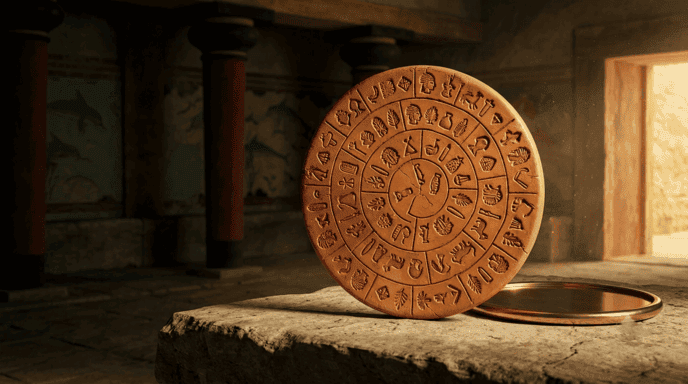
Discovered in 1908 at the Minoan palace complex of Phaistos on the island of Crete, the Phaistos Disc is a fired clay disc approximately 15 centimeters in diameter, covered on both sides with a spiral of stamped symbols. It dates to the middle or late Minoan period, roughly 1700 to 1450 BCE.
The disc contains 241 individual impressions made from 45 distinct symbols, stamped into the wet clay using pre-made punches; making it arguably the oldest known example of movable type printing, approximately 3,000 years before Gutenberg. The symbols depict recognizable objects including heads, animals, plants, tools, and abstract shapes, but the script does not match any known writing system from the ancient Mediterranean.
Despite hundreds of proposed translations since the artifact’s discovery, no decipherment has gained acceptance from the scholarly community. The Phaistos Disc is a singular artifact; no other object bearing the same script has ever been found. Whether it served as a prayer, a legal document, an astronomical text, or something else entirely remains genuinely unknown. Its isolation; one object, one script, no parallels; makes it one of the most compelling unsolved puzzles in ancient history.
Quick Reference Comparison Table
| # | Technology | Origin / Period | Key Mystery | Modern Science Status | Standout Fact |
|---|---|---|---|---|---|
| 1 | Roman Concrete | Roman Empire, c. 300 BCE–476 CE | Self-healing properties via quicklime hot mixing | Partially solved (MIT, 2023) | Cracks seal within two weeks; Pantheon dome still standing after ~1,900 years |
| 2 | Antikythera Mechanism | Ancient Greece, c. 150 BCE | 30+ gear astronomical computer with no known predecessors | Substantially decoded; construction method unknown | No comparable device appears for another 1,200 years |
| 3 | Damascus Steel | Middle East / India, c. 300–1700s CE | Carbon nanotubes in medieval sword steel | Nanostructures identified (Dresden, 2006); reproduction incomplete | Contains carbon nanotubes formally identified by science only in 1991 |
| 4 | Greek Fire | Byzantine Empire, c. 672–1200s CE | Incendiary weapon composition | Unresolved; petroleum base likely | Burned on water; formula restricted to the imperial family for 700 years |
| 5 | Lycurgus Cup | Roman Empire, 4th century CE | Dichroic glass via gold-silver nanoparticles | Explained (accidental nanotechnology); not intentionally reproducible | Gold-silver alloy particles 50–100 nanometers in diameter |
| 6 | Pyramids of Giza | Ancient Egypt, c. 2560 BCE | Construction methodology for 2.3 million blocks | Multiple theories; no consensus | Base level to within 2.1 cm; tallest structure on Earth for 3,800 years |
| 7 | Göbekli Tepe | Southeastern Turkey, c. 9500 BCE | Monumental architecture by pre-agricultural hunter-gatherers | Dating confirmed; purpose and burial motive unknown | 7,000 years older than Stonehenge; only 5% excavated |
| 8 | Nazca Lines | Nazca culture, Peru, c. 500 BCE–500 CE | Giant geoglyphs visible only from the air | Function debated; water ritual theory dominant | Over 800 lines across 450 km²; AI has revealed hundreds more |
| 9 | Sacsayhuamán Walls | Inca Empire, Peru, 15th century CE | 100+ tonne stones fitted without mortar | Construction method debated | Survived centuries of earthquakes that destroyed Spanish colonial buildings |
| 10 | Voynich Manuscript | Central Europe, c. 1404–1438 CE | Undeciphered illustrated codex | Unresolved; no verified translation | 240 pages; unknown script with statistical properties of natural language |
| 11 | Baghdad Battery | Parthian Empire, c. 250 BCE–224 CE | Possible ancient electrochemical cell | Can generate voltage; intent debated | Produces 1–2 volts; purpose remains unknowable from surviving evidence |
| 12 | Iron Pillar of Delhi | Gupta Empire, India, c. 5th century CE | 1,600 years of corrosion resistance | Explained (phosphorus-rich passive film) | 7.2 m tall; accidental misawite coating shields it from rust |
| 13 | Roman Dodecahedra | Roman Empire, 2nd–4th century CE | Function completely unknown | Unresolved; no textual evidence exists | Over 100 found from Wales to Hungary; zero mentioned in Roman texts |
| 14 | Stradivarius Instruments | Cremona, Italy, c. 1680–1737 CE | Superior acoustics from lost construction techniques | Partially explained; full reproduction elusive | ~650 survive; wood density linked to the Maunder Minimum (1645–1715) |
| 15 | Phaistos Disc | Minoan Crete, c. 2nd millennium BCE | Undeciphered script; earliest movable type | Unresolved; no parallel artifacts found | 241 impressions from 45 symbols; 3,000 years before Gutenberg |
Frequently Asked Questions
What is the most technologically advanced ancient technology ever discovered?
The Antikythera Mechanism is widely considered the most sophisticated example of ancient engineering. Constructed around 150 BCE, its system of at least 30 interlocking bronze gears could predict eclipses and model planetary motions. No device of comparable mechanical complexity appears in the archaeological record for another 1,200 years.
Has anyone successfully reproduced Damascus steel?
Modern metallurgists have produced steels exhibiting many properties of historical Damascus blades, but no one has fully reproduced the original material’s complete range of characteristics. A key obstacle is that the specific wootz steel ingots required trace elements from ore sources that are no longer accessible or identifiable.
Why is Roman concrete stronger than modern concrete?
A 2023 MIT study revealed that ancient Roman concrete used a “hot mixing” technique incorporating quicklime, which created calcium-rich inclusions capable of automatically sealing cracks when exposed to water. Modern Portland cement concrete lacks this self-healing mechanism, which is why many Roman structures have outlasted their modern counterparts.
What is the oldest known technology that science cannot fully explain?
Göbekli Tepe, dating to approximately 9500 BCE, is the oldest monumental architectural achievement for which the construction methods, organizational structure, and purpose remain poorly understood. It was built by hunter-gatherer societies thousands of years before the development of agriculture, writing, or metalworking tools.
Are ancient technologies evidence of lost advanced civilizations?
The technologies on this list demonstrate remarkable human ingenuity within their specific cultural and material contexts. They do not require the hypothesis of a lost advanced civilization. What they illustrate is that technological progress is not strictly linear; knowledge and techniques can be developed, refined, and then lost when the specific conditions (materials, trade routes, institutional knowledge) that supported them disappear.
What was Greek Fire made of?
The exact composition of Greek Fire remains unknown, as the formula was a closely guarded Byzantine state secret never recorded in any surviving document. Most modern historians believe the primary ingredient was petroleum-based naphtha, potentially combined with pine resin, sulfur, and quicklime, but the precise formulation and delivery mechanism have not been conclusively determined.


