



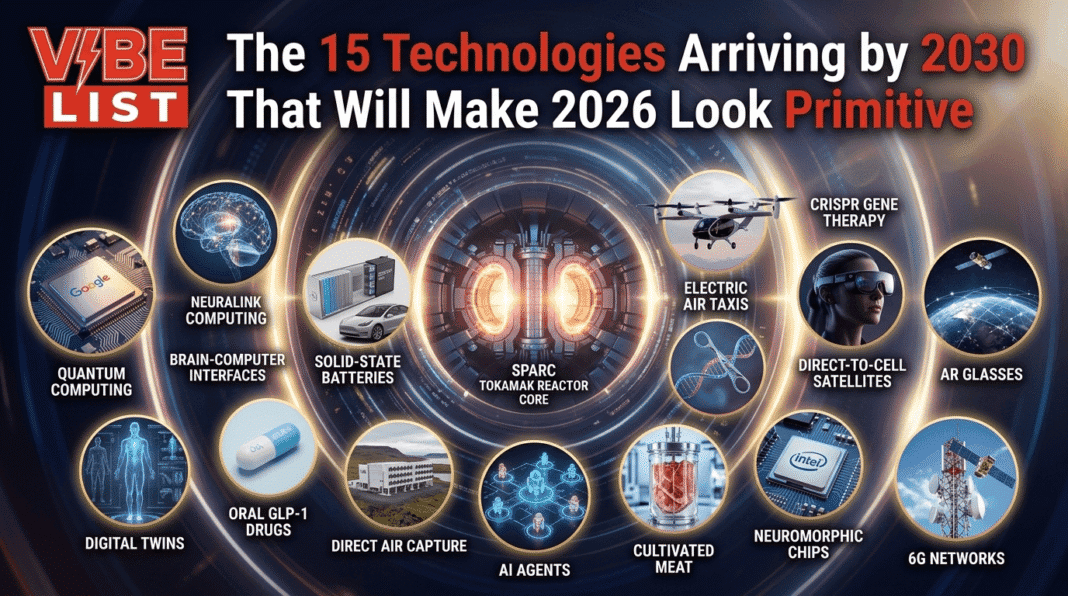
$2.64 billion poured into fusion in twelve months. A quantum chip that finished in five minutes what the fastest supercomputer would need 10 septillion years to complete. A brain implant that restores sight to the blind, cleared for expedited FDA review. A battery that recharges to 80 percent in nine minutes and lasts twenty years. A gene-editing drug that cured sickle cell disease at $2.2 million per patient. None of these are predictions. Every one has a funded timeline, a regulatory filing, and a deadline before 2030; and most people still think the future hasn’t started yet.
Every January, the same pattern emerges across the tech press. Gartner releases its strategic technology trends. MIT Technology Review identifies its breakthrough technologies. Most analysts repeat the refrain: “the future is here.” Then most of these technologies stall between a lab demonstration and a PowerPoint presentation for another decade.
Something, however, is changing. The gap between a proof-of-concept prototype and a mainstream product is narrowing. A fusion reactor that did not exist five years ago is under construction and slated for completion in 2027. Brain implants that were considered science fiction in 2020 are being tested in human clinical trials. A quantum chip that was purely theoretical as recently as 2019 achieved the error-correction threshold in December 2024. An electric aircraft capable of vertical takeoff completed its first FAA-conforming flight test in March 2026.
The 15 technologies that already changed daily life in 2026 arrived quietly, embedded in firmware updates, behind pharmacy counters, and inside ride-hailing app interfaces. These 15 technologies are different. Each represents more disruptive potential. Each has a legitimate, funded, quantifiable path to commercialization before the end of this decade.
This is not speculation. Every technology listed below is backed by peer-reviewed research, confirmed corporate milestones, or a government-sponsored program with publicly disclosed timelines. We acknowledge ambiguity where it exists. Where timelines are aggressive, we articulate the risks. We do not generate hype. We report evidence.
Below are the 15 technologies that will make everything we use in 2026 feel like a beta version.
1. Fusion Energy Reaches Net Power

Fusion energy has been described as “only thirty years away” for seven decades. The punchline is beginning to die.
Commonwealth Fusion Systems (CFS), an MIT spin-off, is constructing SPARC, a compact tokamak fusion reactor at its 47-acre campus in Devens, Massachusetts. CFS intends to achieve first plasma in 2026 and net energy gain (Q > 1) in 2027. If SPARC achieves Q > 1, it will be the first commercially relevant fusion device to produce more energy from the fusion reaction than it consumes — the proof-of-concept moment for commercial fusion, comparable in significance to the Wright brothers’ first powered flight at Kitty Hawk.
SPARC differs from previous approaches through its use of high-temperature superconducting (HTS) magnets. HTS magnets produce much stronger magnetic fields in a smaller machine. Peer-reviewed papers published in the Journal of Plasma Physics predict SPARC will achieve net energy with considerable margin. CFS’s subsequent machine, ARC, is designed to deliver fusion-generated electricity to the commercial grid.
Private investment in fusion is accelerating rapidly. The Fusion Industry Association reports that the private fusion sector raised $2.64 billion during the twelve months ending July 2025, a 178 percent increase over the prior year. Most private fusion companies now expect to reach commercialization by the mid-2030s. The U.S. Department of Energy has outlined a fusion science and technology roadmap to support commercialization.
Vibe List Takeaway: By 2030, there will be sufficient evidence to determine whether fusion can provide commercial base-load electricity. If SPARC achieves net energy gain in 2027 as planned, the scientific question of whether fusion works will be conclusively resolved, and the engineering challenge of scaling it commercially will define the next decade of energy investment.
2. Quantum Computers Solve Real Problems
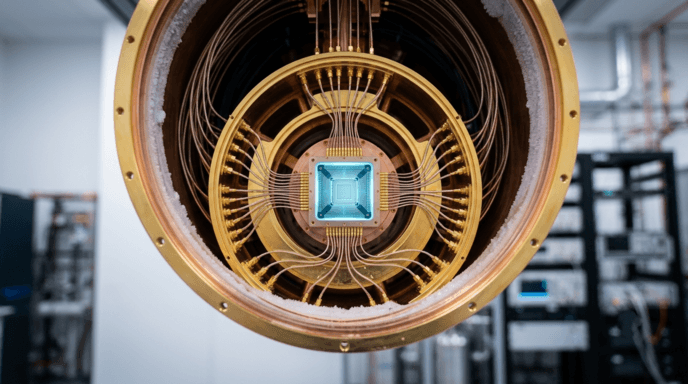
On December 12, 2024, Google Quantum AI revealed Willow, a 105-qubit quantum processor that achieved two milestones simultaneously. First, Willow was the first quantum processor where adding more qubits resulted in exponential improvements in error rates rather than increased noise. This satisfied a condition researchers had pursued for nearly thirty years, since Peter Shor first described quantum error correction in 1995. Second, Willow completed a computation in under five minutes that would require approximately 10 septillion years on today’s fastest supercomputers — longer than the estimated age of the universe.
Google published Willow’s results in Nature. As Quanta Magazine noted, Willow became the first quantum processor to demonstrate that scaling up makes the system more reliable rather than noisier — a fundamental requirement for useful large-scale quantum computing.
IBM released a next-generation quantum chip in 2025 with a novel architecture linking qubits beyond nearest neighbors. IBM’s quantum roadmap for 2026 targets continued scaling toward commercially relevant applications in drug discovery, materials science, and financial optimization.
Hartmut Neven, founder of Google Quantum AI, has argued that quantum computation will be necessary for generating training data for AI models, optimizing AI architectures, and simulating complex quantum systems.
Vibe List Takeaway: Quantum computing will not replace your laptop. It provides the foundation for the next generation of computational tools in drug discovery, battery chemistry, and cryptographic security. The critical breakthrough was not speed; it was proving that quantum error correction works. That changes which problems quantum hardware can solve.
3. Brain-Computer Interfaces Restore Sight and Speech
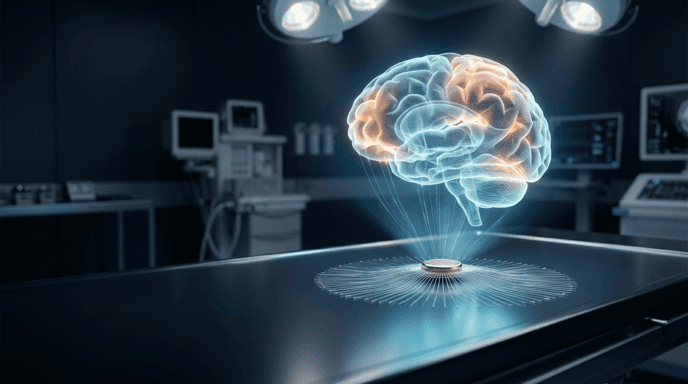
The FDA granted Breakthrough Device Designation to Neuralink’s Blindsight, a brain-computer interface (BCI) implant designed to restore visual perception in people with complete or near-complete vision loss, including those with irreversible damage to the eyes or optic nerve pathways. Blindsight uses a camera to capture the user’s surroundings and transmits the images wirelessly to the brain via the N1 implant, bypassing the normal eye-to-brain pathway.
Neuralink’s ongoing PRIME Study, its initial human clinical trial, is assessing the safety and efficacy of the N1 implant for motor function. Participants use Neuralink devices to control computers and robotic limbs with their thoughts. A new feasibility trial is testing BCI control of an investigational robotic arm.
Neuralink is not alone. Paradromics, a competing neurotechnology company, is conducting human clinical trials with a device designed to restore speech for people with severe motor impairment. The BCI market is projected to grow from $2.62 billion in 2025 to $13.86 billion by 2034, according to Precedence Research.
Regulatory and ethical frameworks are evolving alongside the technology. FDA Breakthrough Device Designation means Blindsight receives expedited review, but it does not mean the device has been approved as safe or effective.
As IEEE Spectrum emphasized, early optimism about Blindsight should be tempered. Any initial visual acuity restored by the device is expected to fall far short of natural human sight.
Vibe List Takeaway: A brain implant that restores vision sounds like science fiction. But FDA Breakthrough Device Designation, active clinical trials with human subjects, and expanding competition in the BCI space suggest that by 2030, BCIs will be clinically available for patients with paralysis, blindness, and speech loss. The open questions are not whether BCIs work, but how well, for whom, and at what cost.
This content is for informational purposes only and does not constitute professional medical advice. Consult a qualified healthcare provider for personalized guidance.
4. Solid-State Batteries Transform Electric Vehicles
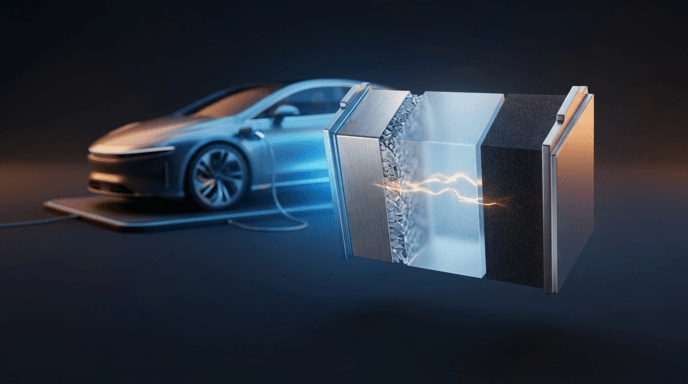
Every battery chemistry powering today’s electric vehicles uses a liquid electrolyte. Solid-state batteries replace the liquid electrolyte with a solid, offering higher energy density, faster charging, longer cycle life, and significantly reduced fire risk.
Samsung SDI has announced plans to begin mass production of all-solid-state batteries in 2027. The planned cells reportedly deliver ranges of 900–1,000 km on a single charge, representing approximately 40 percent higher energy density than current lithium-ion cells. Samsung SDI has also stated that its solid-state cells will last at least twenty years and recharge to 80 percent capacity in approximately nine minutes.
Toyota plans to begin its own solid-state battery vehicle program between 2027 and 2028. CATL, the world’s largest battery manufacturer, is pursuing the same goals.
The competition to develop solid-state batteries is global and extends beyond passenger vehicles to grid-level storage, consumer electronics, and commercial aviation.
Significant technical hurdles remain. Producing solid-state batteries economically at scale requires entirely new manufacturing processes. Dendrite growth, in which lithium forms deposits through the solid electrolyte and causes internal short circuits, remains an engineering barrier. Whether solid-state batteries will achieve cost parity with lithium-ion by 2030 is uncertain.
Vibe List Takeaway: If Samsung SDI and Toyota meet their stated targets, EVs purchased in 2030 will recharge in under ten minutes, travel nearly 600 miles on a single charge, and retain battery capacity for two decades. The caveat is “if” — even companies that have invested billions and possess decades of manufacturing expertise have missed battery timelines before.
5. Electric Air Taxis Enter Commercial Service

Joby Aviation began FAA-conforming flight tests with its first aircraft built for Type Inspection Authorization (TIA) — the final stage before formal certification from the Federal Aviation Administration (FAA). Joby’s pilots will begin performing “for credit” TIA flights with FAA pilots later this year. Joby’s aircraft seats one pilot and four passengers, travels at speeds up to 200 mph, and covers more than 150 miles on a single charge.
The White House-backed eVTOL Integration Pilot Program (eIPP) has authorized preliminary operations for eVTOL designs across ten U.S. states. Joby has constructed an expanded manufacturing facility in Marina, CA, and acquired a 700,000-square-foot facility in Dayton, OH. The company plans to scale production to four aircraft per month by 2027, with capacity for up to 500 aircraft per year thereafter.
Not all competitors have survived. On February 22, 2025, Lilium, a European eVTOL competitor, ceased operations after failing to secure financing. The first FAA type certification for an eVTOL aircraft is anticipated later this year or early 2027.
Vibe List Takeaway: You will not commute by air taxi in 2027. But you may hail one for airport-to-city transfers in major metropolitan areas by 2028 or 2029. Joby’s progress is tangible: FAA-conforming flight tests, ten-state operational authorization, and a scalable manufacturing pipeline producing hundreds of units annually. The question is not whether the technology works — it is whether the business model sustains itself before widespread adoption.
6. CRISPR Therapies Cure Genetic Diseases

In late 2023, Casgevy became the first CRISPR-based medicine approved by the FDA — a functional cure for sickle cell disease and transfusion-dependent beta-thalassemia. As of spring 2026, Casgevy has been approved in the United States, Canada, the United Kingdom, the EU, Switzerland, Bahrain, Kuwait, Saudi Arabia, and the United Arab Emirates, according to the Innovative Genomics Institute.
The results are dramatic. Of 17 patients with sickle cell disease, 16 were free of the vaso-occlusive crises that define the illness. Of 27 patients with beta-thalassemia, 25 were no longer transfusion-dependent, some for longer than three years.
The pipeline is expanding rapidly. A peer-reviewed study documents 69 active CRISPR clinical trials and six completed as of 2025. Diseases under investigation include cardiovascular disease, multiple cancers, lupus, muscular dystrophy, hereditary blindness, type 1 diabetes, and HIV. In May 2025, a team including researchers from the Innovative Genomics Institute achieved a historic milestone: the team developed a personalized CRISPR therapy for an infant with an ultra-rare genetic disease, secured FDA approval, and delivered it to the patient in just six months.
In February 2026, the FDA released draft guidance for a “plausible mechanism framework” for platform therapies. This framework could allow a single clinical trial to test a customizable CRISPR platform across multiple rare diseases, dramatically accelerating approval timelines.
Vibe List Takeaway: CRISPR is not a theoretical tool anymore. It is an approved medicine with patients living free of genetic diseases. With the pipeline now encompassing cardiovascular disease, cancer, and autoimmune disorders, the evidence suggests that by 2030, genome editing will be a standard treatment category in major hospitals. The challenges are access and cost — Casgevy is priced at $2.2 million per patient — but the FDA’s platform therapy framework could accelerate the path to broader and more affordable treatments.
This content is for informational purposes only and does not constitute professional medical advice. Consult a qualified healthcare provider for personalized guidance.
7. Augmented Reality Glasses Replace Your Phone Screen
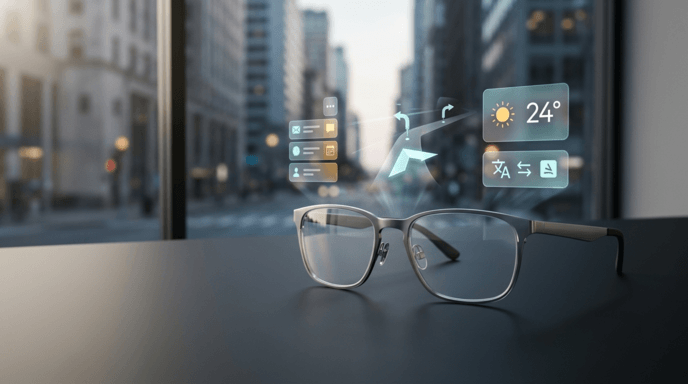
Meta launched the Ray-Ban Display glasses in early 2026, starting at $799, delivering a small heads-up display in the familiar Ray-Ban form factor. Meanwhile, Meta’s true AR prototype, Orion, demonstrated holographic display technology in 2024 and is expected to reach consumers by 2027.
Apple is developing smart glasses internally codenamed N50. According to MacRumors, Apple is testing four frame designs and could debut the glasses in late 2027. Apple has reportedly assigned the design team behind iPhone to ensure the glasses are consumer-ready, not developer-kit prototypes.
Meta’s Ray-Ban smart glasses have sold over seven million units as of 2026. The category is growing rapidly; Treeview Studio’s 2026 roundup identified fifteen commercially available models across AI-only, AR display, and extended-reality segments.
The strategic competition between Meta and Apple echoes the smartphone wars of the late 2000s. Meta pursues an open ecosystem with affordable hardware and AI integration. Apple pursues premium hardware with tight vertical integration. OpenAI has recruited Jony Ive, the designer behind the iPhone, to explore what a post-smartphone personal device could look like. As ESADE professor Esteve Almirall noted, the search for the smartphone’s successor continues.
Vibe List Takeaway: AR glasses will not replace the smartphone by 2030. But they will establish a second screen that lives on your face rather than in your pocket. The transition from “phone in hand” to “display on glasses” will begin with navigation, notifications, and translation, and expand into productivity, commerce, and entertainment. The same AI tools reshaping productivity in 2026 will be the first applications built for wearable displays.
8. Direct-to-Cell Satellites Eliminate Dead Zones
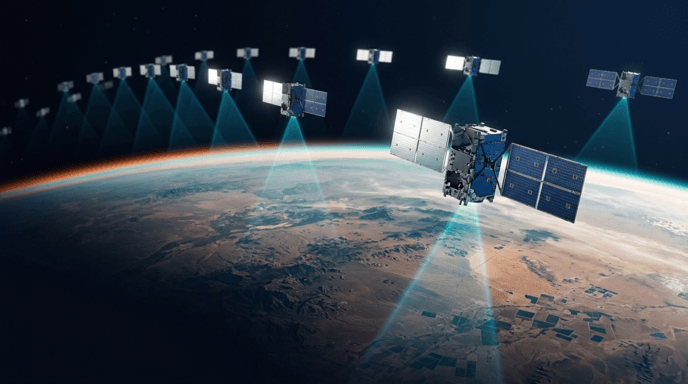
SpaceX’s StarlinkDirect-to-Cell service reached twelve million connections at the end of 2025. The technology uses Starlink satellites as cell towers in space, connecting standard smartphones directly to orbiting satellites.
T-Mobile commercially launched its satellite messaging service in July 2025, using approximately 650 Starlink satellites. Coverage spans most of the continental United States, including rural regions, agricultural areas, and desert expanses that traditional cell towers never reached. As of June 2026, 10,413 Starlink satellites are in orbit, with 10,397 operational.
Next-generation Starlink V2 mobile satellites will deliver full cellular coverage, including voice calls and data — not just text messaging. The commercial rollout of full voice and data direct-to-cell service is expected between 2027 and 2028.
Vibe List Takeaway: By 2030, the concept of “no signal” may be functionally obsolete. When your unmodified smartphone connects directly to orbiting satellites, dead zones, dropped calls in rural areas, and emergency communication failures in remote locations — all become engineering problems with orbital solutions. The infrastructure already exists in space; coverage expands every month.
9. Digital Twins Simulate Your Body Before Surgery
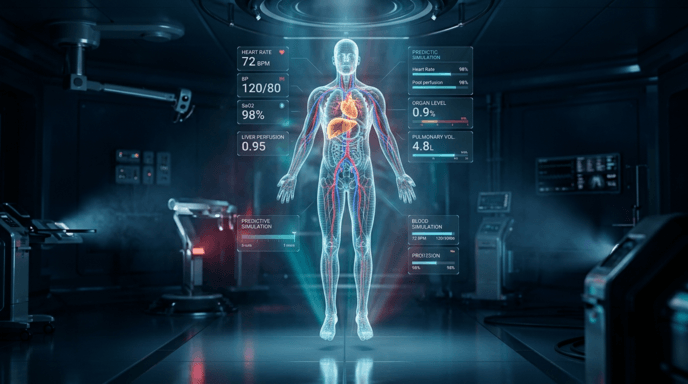
A digital twin is a virtual replica of a physical object, system, or person, updated in real time with sensor data. In healthcare, researchers are building digital twins to simulate individual patient physiology before surgery, during drug trials, and for chronic disease management.
McKinsey projects global digital-twin market growth of approximately 60 percent annually over the next five years. Total market value is projected to reach $73.5 billion by 2027. The healthcare segment is projected to grow from $7.47 billion in 2026 to $101.19 billion by 2031 at a compound annual growth rate of 68.4 percent, according to MarketsandMarkets. Beyond healthcare, digital twins are transforming urban planning, manufacturing, and supply-chain management. Companies build digital replicas of entire cities to simulate traffic patterns, energy consumption, and stress on infrastructure systems before making physical changes. Fortune Business Insights projects the total digital-twin market will reach $384.79 billion by 2034.
Vibe List Takeaway: Before your surgeon operates in 2030, they may rehearse the procedure on a digital replica of your body, accounting for your specific anatomy, blood-flow patterns, and tissue characteristics. The technology is already deployed in manufacturing and urban planning and is entering healthcare, where the stakes are highest and the impact most personal.
This content is for informational purposes only and does not constitute professional medical advice. Consult a qualified healthcare provider for personalized guidance.
10. Next-Generation Weight-Loss Drugs Go Oral
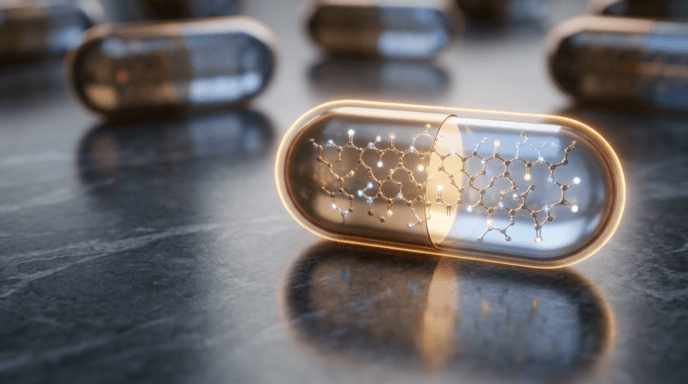
The GLP-1 medications revolutionizing healthcare in 2026 are primarily injectable. By 2030, the next generation will be pills.
CNBC reported that 2026 is “the year of obesity pills,” as both Novo Nordisk and Eli Lilly compete to release oral formulations. Novo Nordisk is advancing amycretin, a dual GLP-1/amylin receptor agonist, into Phase III trials in both subcutaneous and oral forms. Eli Lilly’s pipeline includes orforglipron, an oral GLP-1 agonist in advanced development.
The implications extend far beyond convenience. As we documented in the technologies already shaping life in 2026, approximately one in eight Americans already use GLP-1 medications. Oral formulations would remove the injection barrier that still prevents millions of eligible patients from starting treatment. The commercial implications are significant: GLP-1 medications are already influencing the food service industry, snack manufacturers, and the fitness economy.
Vibe List Takeaway: Semaglutide changed the pharmaceutical landscape with its injectable formulation. Oral versions of next-generation compounds such as amycretin could reshape treatment adoption at population scale — if pricing becomes competitive with generic medications rather than remaining priced like branded biologics.
This content is for informational purposes only and does not constitute professional medical advice. Consult a qualified healthcare provider for personalized guidance.
11. Direct Air Capture Scales to Megaton Capacity

In 2024, Climeworks began operating Mammoth, currently the world’s largest direct air capture (DAC) facility, in Iceland. The plant can remove up to 36,000 tonnes of CO₂ annually. In January 2026, Climeworks unveiled its Generation 3DAC technology, designed to scale to megaton capacity. Climeworks aims to reach megaton-level CO₂ removal by 2030 and gigaton-level by 2050. The technology removes CO₂ directly from the air using only renewable energy and stores it permanently underground through mineralization.
The cost of DAC currently remains high, estimated at $200 to $400 per tonne of CO₂ removed, based on research from Harvard University’s Belfer Center. For DAC to become a practical climate solution at scale, costs must fall below $100 per tonne. Climeworks’ Gen 3 technology outlines a path toward that target.
Direct air capture is one piece of a larger puzzle. DAC alone cannot solve climate change, but a technology that removes CO₂ from the atmosphere and stores it indefinitely underground is a critical tool. It complements broader efforts to reduce emissions, expand renewable energy, and improve efficiency.
Vibe List Takeaway: DAC will not reverse climate change on its own. But a technology that removes carbon dioxide from the air and locks it underground permanently is the kind of insurance policy the planet needs — if costs drop fast enough and deployment scales beyond a single facility in Iceland.
12. Autonomous AI Agents Run Your Workflows

If 2025 was the year of asking AI questions, 2026–2030 is the era of AI taking action.
By 2026, Gartner projects that up to 40 percent of enterprise applications will contain embedded task-specific AI agents — nearly double from five percent in 2025. Multi-agent systems (MAS) are included in Gartner’s Top Strategic Technology Trends for 2026. MAS represent modular AI agents that collaborate on complex tasks to scale automated workflows.
Despite the momentum, Gartner also predicts that by 2027, roughly 40 percent of organizations will decommission autonomous AI agents due to insufficient governance frameworks. The AI controversies documented during 2025 and 2026 — from Replit’s AI agent deleting a live database to Instacart’s AI pricing experiments charging customers different prices for the same item without disclosure — illustrate the governance vacuum organizations must fill.
The technology exists. OpenAI, Google, Anthropic, and Microsoft are all developing agent frameworks. The question is governance: who is accountable when an autonomous agent makes a consequential decision that no human reviewed?
Vibe List Takeaway: AI agents will manage at least half of routine enterprise workflows by 2030. The technology is advancing rapidly. Governance structures to monitor and control autonomous AI agents are lagging far behind. Organizations that deploy autonomous agents without adequate oversight will learn the same lessons documented across the AI failures that proved the hype was lying.
13. Cultivated Meat Reaches Supermarket Shelves

Cultivated meat — real meat grown from animal cells in bioreactors rather than raised on farms — has been approved for sale in Singapore, the United States, and Australia, according to the Good Food Institute. At least seven companies have received regulatory approval globally, including UPSIDE Foods, GOOD Meat, Vow, and Wildtype.
According to FoodNavigator’s2026 regulatory overview, Singapore and the United States are the most mature markets. The regulatory pathway in Europe remains uncertain, as the EU has not approved cultivated meat for sale. Several U.S. states have also banned the sale of cultivated meat, adding further uncertainty.
Production costs currently remain significantly higher than conventional meat. The trajectory parallels early solar panel development: each generation of bioreactor technology reduces per-kilogram costs. Multiple companies plan to achieve price parity with premium conventional meat products by 2030.
Vibe List Takeaway: You will not find cultivated meat replacing conventional chicken at your grocery store in 2027. But cultivated products may enter specialty markets and high-end restaurants in approved countries by 2030, in the same way that plant-based alternatives entered restaurant menus over the past decade. The technology is proven. The regulatory, cultural, and economic barriers are the remaining unknowns.
14. Neuromorphic Chips Power Edge AI Without the Cloud
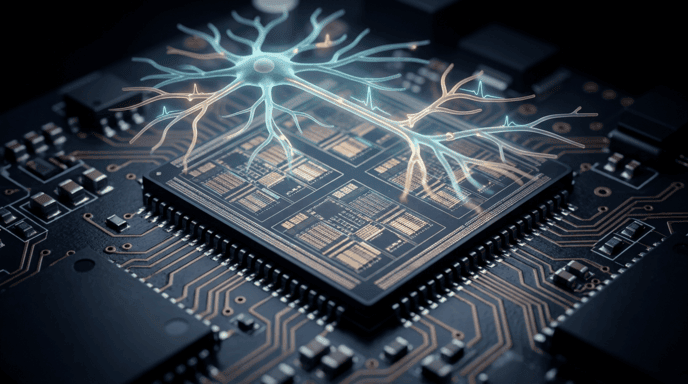
Traditional AI chips process information by shuttling data between memory and processors — a limitation known as the von Neumann bottleneck. Neuromorphic chips emulate the structure of the human brain, processing and storing information at the same location, which substantially reduces energy consumption.
Intel’s second-generation neuromorphic processor, Loihi 2, delivers up to ten times faster processing than its predecessor. Intel has also constructed the world’s largest neuromorphic system, Hala Point, supporting 1.15 billion neurons and 128 billion synapses across 140,544 cores.
Neuromorphic chips are designed for edge computing: processing AI locally on devices rather than sending data to the cloud. These capabilities are critical for autonomous vehicles, medical devices, industrial robots, and smart homes — all systems that must process data locally and in real time. Neuromorphic systems consume a fraction of the energy traditional architectures require for certain AI tasks.
Vibe List Takeaway: Brain-inspired chips will not replace GPUs for training massive LLMs. But for the trillions of edge devices that need local AI processing — cars, watches, home security systems, medical wearables — neuromorphic computing enables intelligence that does not depend on a datacenter.
15. 6G Networks Begin Testing
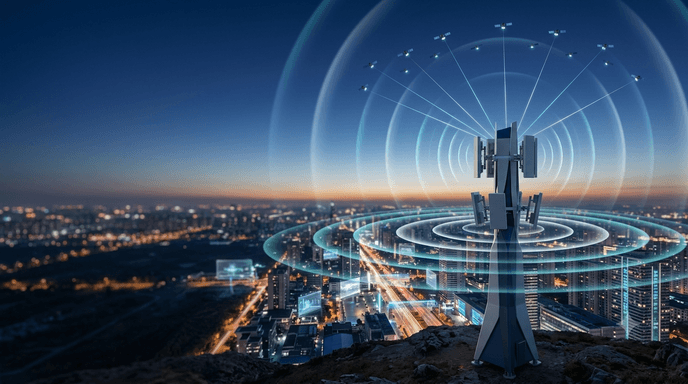
Commercial deployment of 6G networks is anticipated around 2030. Core standards are expected between 2028 and 2029. The ITU-R organizes development under its IMT-2030 program framework.
6G networks are designed to deliver data rates 50 to 100 times faster than 5G, with sub-millisecond latency, and to natively integrate AI with satellite and terrestrial networks. Light Reading reports that major industry participation is expected to accelerate from March 2027. Major players in 6G research include China, which is already testing “10G” networks, alongside South Korea, Japan, the EU, and the United States.
6G is not simply a faster version of 5G. The architecture defines a unified communication fabric encompassing satellites, ground stations, drones, and underwater sensors — a single network layer connecting all devices. That fabric would enable applications from real-time holographic communication to synchronized digital twins to city-scale coordination of autonomous vehicles.
Vibe List Takeaway: You will not have a 6G phone in 2028. But the standards defining 6G architecture are being written now, and the research underway in 2026 and 2027 will determine the wireless infrastructure connecting every device for at least the next decade.
15 Technologies Arriving by 2030: The Complete At-a-Glance Reference
| # | Technology | Key Milestone | Timeline | Market / Investment | Biggest Risk |
|---|---|---|---|---|---|
| 1 | Fusion Energy | SPARC net energy gain (Q > 1) | First plasma 2026; net energy 2027 | $2.64B private investment (12 mo. ending Jul 2025) | Engineering scale-up to commercial grid delivery |
| 2 | Quantum Computing | Below-threshold error correction (Willow) | Achieved Dec 2024 | IBM, Google scaling toward commercial apps | Practical applications still years away for most industries |
| 3 | Brain-Computer Interfaces | FDA Breakthrough Device Designation (Blindsight) | Active clinical trials 2026 | $2.62B (2025) → $13.86B (2034) | Visual acuity far below natural human sight |
| 4 | Solid-State Batteries | Samsung SDI mass production announced | 2027 (Samsung SDI); 2027–28 (Toyota) | 900–1,000 km range; 9-min 80% charge | Dendrite growth; missed battery timelines historically |
| 5 | Electric Air Taxis | FAA-conforming flight test (Joby) | TIA testing Mar 2026; certification 2026–27 | 4 units/month by 2027; 500/year capacity | Business model viability before widespread adoption |
| 6 | CRISPR Therapies | Casgevy FDA approval; 69 active trials | Approved 2023; platform framework 2026 | $2.2M per patient | Access and cost at population scale |
| 7 | AR Glasses | Meta Ray-Ban Display launch; Apple N50 in development | Meta 2026 ($799); Apple late 2027 | 7M+ units sold (Meta, 2026) | Will not replace smartphones by 2030 |
| 8 | Direct-to-Cell Satellites | Starlink 12M connections | Full voice/data 2027–28 | 10,413 satellites in orbit (Jun 2026) | Regulatory and spectrum allocation challenges |
| 9 | Digital Twins | Healthcare segment rapid growth | $73.5B market by 2027 | $7.47B (2026) → $101.19B (2031) in healthcare | Data privacy and patient consent frameworks |
| 10 | Oral GLP-1 Drugs | Amycretin Phase III; orforglipron in development | Oral launch expected 2027–28 | 1 in 8 Americans on GLP-1 (2026) | Pricing at population scale vs. generic competition |
| 11 | Direct Air Capture | Climeworks Mammoth operational; Gen 3 unveiled | Megaton capacity target 2030 | Cost: $200–$400/tonne (target: <$100) | Cost must fall 75%+ for practical climate impact |
| 12 | AI Agents | 40% enterprise app integration (Gartner) | Scaling 2026; governance lag through 2027 | 40% may be decommissioned by 2027 | Governance vacuum; accountability when agents fail |
| 13 | Cultivated Meat | Approved in 3 countries; 7 companies | Price parity targeted by 2030 | 7 companies with regulatory approval | EU regulatory uncertainty; U.S. state bans |
| 14 | Neuromorphic Chips | Intel Loihi 2; Hala Point system | Available now; edge deployment scaling | 1.15B neurons; 128B synapses | Will not replace GPUs for large model training |
| 15 | 6G Networks | Core standards development underway | Standards 2028–29; commercial ~2030 | China, South Korea, Japan, EU, U.S. active | No commercial deployment before 2030 |
Frequently Asked Questions
Will there be commercially available fusion energy by 2030?
Consumer-accessible fusion electricity is not expected before the mid-2030s at the earliest. The first critical indicator is achieving net energy gain. Commonwealth Fusion Systems plans to accomplish this with SPARC in 2027. A successful demonstration would lead to operation of the ARC reactor, designed to deliver fusion electricity to the grid. According to the Fusion Industry Association, most private fusion companies expect commercial fusion electricity by the mid-2030s.
Will quantum computers replace regular computers?
No. Quantum computers are designed to solve specific classes of problems, such as molecular simulations, optimization, and cryptanalysis, that classical computers handle poorly. Classical computers will continue to handle everyday tasks. The significance of Google’s Willow chip is that it proved quantum error correction works — a fundamental requirement for commercially useful quantum computing. Researchers expect practical applications in drug discovery and materials science by the end of the decade.
How much do brain-computer interfaces cost?
Neuralink has not released public pricing for its N1 implant. Current clinical trials are research programs, not commercial products. Precedence Research forecasts the BCI market will grow from $2.62 billion in 2025 to $13.86 billion by 2034. Initial commercial BCI products will likely be expensive medical devices prescribed for specific conditions — paralysis, blindness, speech loss — and funded through healthcare systems or insurance.
Can solid-state batteries actually arrive in 2027?
Samsung SDI has formally stated its intention to begin mass production of all-solid-state batteries in 2027, targeting EV ranges of 900–1,000 km. Toyota and CATL are targeting the same 2027–2028 window. History, however, is filled with missed battery timelines. Mass production of solid-state batteries will face significant engineering hurdles, and initial deployments will likely serve premium automotive segments before costs drop enough for mass-market adoption.
Is cultivated meat safe to eat?
Regulatory agencies have approved cultivated meat for sale in Singapore, the United States (jointly overseen by the FDAandUSDA), and Australia. The Good Food Institute lists seven companies with regulatory approvals globally. The FDA and USDA treat cultivated meat identically to conventional meat for food-safety purposes.
What is 6G and when can I get it?
6G is the next generation of cellular network technology, targeting data speeds 50 to 100 times faster than 5G, sub-millisecond latency, and native integration of AI with satellite and terrestrial networks. Core standards are expected between 2028 and 2029, with first commercial deployments anticipated around 2030. Governments in China, South Korea, Japan, the EU, and the United States are conducting active R&D, though none have announced official commercial launch dates.