


A count who asked for gin where soda should have been. A Havana bar with Ernest Hemingway’s handwriting still on the wall. A young model who walked up to a London bartender and asked for a drink that would “wake me up and then mess me up.” A single Peruvian bar that turned a local grape spirit into a binational obsession. The world’s bestselling cocktails were never designed in boardrooms. They were invented by bartenders who broke the rules, and the broken rules became the recipe.
Disclaimer: This article features cocktails containing alcohol. This content is intended strictly for readers of legal drinking age in their respective jurisdictions. The Vibe List does not promote underage drinking or the misuse of alcohol. Please enjoy responsibly and drink in moderation.
WHY THESE 20 COCKTAILS {#why-these-20-cocktails}
The global alcoholic beverages market was valued at $2,564.92 billion in 2025, according to Fortune Business Insights. One of the fastest-growing segments within that figure is cocktails. The RTD (Ready-to-Drink) cocktails market alone was worth $3.69 billion in 2025 and is projected to grow to $10.72 billion by 2033. Over the past two decades, the cocktail evolved from a niche bar offering into a global commodity. Multiple global awards now honor the best bars, distilleries, and brands annually. Celebrity-backed spirit brands have reshaped the industry. Cocktail bars and craft distilleries worldwide now compete directly with fine wine establishments for consumer spending.
Drinks International publishes an annual report polling 100 of the world’s award-nominated and award-winning bars. That poll identifies the bestselling classic cocktails across those venues. Difford’s Guide tracks the popularity of individual cocktails by page views across its database of thousands of recipes. The World’s 50 Best Bars Awards, which named Bar Leone in Hong Kong the world’s number one bar in 2025, round out the industry’s most authoritative benchmarks.
We drew on each of these sources alongside deep research into the cultural histories and verified origin accounts behind each cocktail. From that research, we identified and ranked the 20 greatest cocktails ever made. In our previous article covering the 18 most iconic drinks on Earth, we explored beverages ranging from tea to tequila and from coffee to champagne. This time, we focused exclusively on mixed cocktails and ranked them.
HOW WE RANKED THIS {#how-we-ranked-this}
We evaluated each cocktail across five categories. Those categories were: commercial dominance at the world’s best bars (using data from the Drinks International 2026 Cocktail Report), historical and cultural significance, innovative technique or ingredients, ongoing international relevance, and editorial conviction. We weighted those categories to reflect what matters most when answering one question: which cocktails are the greatest? The result is a ranking that respects the data but is shaped by the Vibe List’s editorial judgment.
20. The Jungle Bird {#20-the-jungle-bird}

In 1978, a bartender at the Aviary Bar inside the Kuala Lumpur Hilton created a welcome drink for hotel guests. What made it unusual was the inclusion of Campari alongside rum. The Jungle Bird includes dark rum, Campari, pineapple juice, lime juice, and simple syrup. Technically, the combination is unusual; Campari is not a standard tiki ingredient. Rum, pineapple juice, and lime juice are tiki staples, but Campari’s bitterness has no precedent in the genre. Yet Campari’s bitterness against pineapple’s sweetness produces something both familiar and disorienting. It is a tiki drink for people who find tiki drinks too sweet, and a bitter cocktail for people who find bitter cocktails too harsh.
The Jungle Bird was nearly forgotten until bartender Giuseppe González revived it in the early 2010s at Painkiller bar in New York. After González’s revival, the global bartending community took notice. By 2025, the Jungle Bird had climbed to 13th on Difford’s Guide’s most-viewed cocktails list, up from 32nd in 2021. The Drinks International 2026 Cocktail Report confirmed it among the bestselling classics.
The Vibe List’s Take: The Jungle Bird earns its spot at number 20 because it proved that geographic cocktail traditions are suggestions, not boundaries. A Malaysian hotel bar drink that uses Italian bitter liqueur and Caribbean rum works brilliantly.
19. The Boulevardier {#19-the-boulevardier}

Before the Negroni claimed the world’s number one spot, the Boulevardier came first. In 1927, American expatriate Erskine Gwynne (nephew of railroad tycoon Alfred Vanderbilt, socialite and editor of a Paris magazine called The Boulevardier) requested that Harry McElhone create a drink using whiskey. McElhone created a cocktail using bourbon, sweet vermouth, and Campari. The recipe was published in McElhone’s 1927 book Barflies and Cocktails.
Where the Negroni is bright, herbal, and Mediterranean, the Boulevardier is warm, round, and autumnal; bourbon’s caramel and vanilla replace gin’s botanicals. Bourbon’s caramel and vanilla temper Campari’s bitterness in a way gin’s botanicals never could.
For decades, the Boulevardier lived in the shadow of its younger cousin, the Negroni. The craft cocktail revival of the 2010s changed that. Today the Boulevardier appears on virtually every serious “best cocktails” list and holds a permanent place at whiskey bars worldwide. Cocktail historian David Wondrich has documented how the Boulevardier’s Prohibition-era creation, when American bartenders and drinkers decamped to Paris, places it squarely in one of cocktail history’s most inventive periods.
The Vibe List’s Take: The Boulevardier is the quiet older sibling of the Negroni; it arrived first but gained recognition later. It delivers complexity without heaviness, and its Prohibition-era Parisian origins add an undeniable allure.
18. The Caipirinha {#18-the-caipirinha}

Brazil’s national cocktail likely originated from a folk remedy during the 1918 Spanish flu pandemic. A mixture of lime juice, garlic, honey, and cachaça (a spirit distilled from fermented sugarcane juice) was used as a flu remedy in rural communities near São Paulo. Over time, garlic and honey dropped out of the recipe. What remained; cachaça, fresh lime juice, and sugar; became the Caipirinha.
Cachaça production in Brazil started in the 1500s, making it one of the oldest distilled spirits in the Americas. Brazil produces over one billion liters of cachaça annually, and nearly all of it is consumed domestically. The Brazilian government designated the Caipirinha as Cultural Heritage in 2003. Rio de Janeiro followed in 2019, designating it as Intangible Heritage, as we covered in our previous article about the world’s most iconic drinks.
Technique matters: lime wedges are muddled with sugar directly in the glass, ice is added, and cachaça is poured over the top. No shaker, no strainer, no garnish required.
The Vibe List’s Take: The Caipirinha earns its spot because it serves as proof that cocktails don’t require layers of complexity to achieve greatness. Three ingredients and one specific technique built around cachaça made it a symbol of national pride.
17. The Paper Plane {#17-the-paper-plane}

Sam Ross created the Paper Plane in 2008 as a gift for his friend Toby Maloney at The Violet Hour in Chicago. Maloney was a fellow bartender who had previously worked with Ross at Milk & Honey in New York City. Ross named it after M.I.A.’shit song “Paper Planes.” The Paper Plane utilizes an equal-parts ratio consisting of bourbon, Aperol, Amaro Nonino, and fresh lemon juice.
The balance comes from each ingredient doing a distinct job. Bourbon provides the structure. Aperol brings bittersweetness and citrus. Amaro Nonino layers in herbal complexity. Lemon juice pulls everything together with acidity.
The equal-parts formula has existed for centuries, but finding four ingredients that balance perfectly in that ratio is far harder than it sounds. Its position at 15th on Difford’s Guide’s 2025 most-viewed list confirms its stature.
The Paper Plane proved that modern bartending could produce instant classics. Ross invented the Paper Plane just three years after the Penicillin.
The Vibe List’s Take: Sam Ross created two modern classics within three years (the Penicillin and the Paper Plane). Arguably that makes Ross the most consequential cocktail inventor of the 21st century. The Paper Plane shows that even though bartenders have been experimenting with equal-parts ratios for centuries, there remain untapped territories.
16. The Cosmopolitan {#16-the-cosmopolitan}

Multiple bartenders claim credit for early versions of the Cosmopolitan, but Toby Cecchini is generally credited with creating the modern recipe at The Odeon in Manhattan in 1988. Cecchini built his version around Absolut Citron (then a newly available flavored vodka), Cointreau, fresh lime juice, and cranberry juice.
South Beach bartender Cheryl Cook claims she created a predecessor with different ingredients in the mid-1980s. Cecchini’s version gained traction and spread across the United States.
Sex and the City played a significant role in popularizing the Cosmopolitan. Starting in 1998, Carrie Bradshaw (played by Sarah Jessica Parker) made the Cosmopolitan her signature order on the show, shaping late-1990s and early-2000s nightlife culture. While bartenders grew tired of making them, drinkers never stopped ordering.
On Difford’s Guide’s 2025 rankings, the Cosmopolitan returned to 20th after dropping to 53rd in 2022. Its resurgence coincides with the broader nostalgia trend for early-2000s pop culture.
The Vibe List’s Take: Whatever you think of its flavor profile, the Cosmopolitan holds enormous cultural value: it showed a generation of women that ordering a cocktail could be a statement, not just a request.
15. The Penicillin {#15-the-penicillin}

Bartender Sam Ross created the Penicillin at Milk & Honey in New York City in 2005. The base combines blended scotch, lemon juice, and honey-ginger syrup. Smoky Islay scotch floats on top. The name plays on its supposed healing properties; a nod to folk remedies like hot toddies and lemon-honey elixirs.
The Penicillin accomplished something rare: it made scotch accessible to drinkers who believed they did not enjoy scotch. Honey-ginger syrup tempers the intensity of the spirit, while the smoky float contributes aromatic depth without overpowering the palate. The Penicillin became the default recommendation for anyone curious about whisky-based cocktails.
Ross built on the Gold Rush (a bourbon, lemon, and honey syrup cocktail), swapping in scotch and adding ginger. That iterative approach; taking an existing classic and twisting one or two elements; is how most great cocktails are born. In less than two decades, the Penicillin has earned recognition as a modern classic among bartenders worldwide.
The Vibe List’s Take: The Penicillin is one of the few 21st-century cocktails that genuinely stands alongside the great 19th-century classics. It also introduced thousands of drinkers to Islay scotch, one gentle, smoky sip at a time.
14. The Pisco Sour {#14-the-pisco-sour}

The Pisco Sour was born in Lima, Peru. American bartender Victor Vaughen Morris moved to Peru to work in the mines and opened Morris’ Bar in Lima in 1916. There, he began serving a pisco-based cocktail. The modern recipe; pisco, lime juice, simple syrup, egg white, and Angostura bitters; was formulated in the 1920s. Peruvian bartender Mario Bruiget is credited with adding the egg whites that give the drink its frothy crown.
The Pisco Sour has sparked one of the world’s most heated arguments over national spirits. Both Peru and Chile claim ownership of pisco and have a dispute over the Pisco Sour. Peru escalated the stakes by officially designating the Pisco Sour as Cultural Heritage of the Nation in 2007 and celebrating National Pisco Sour Day every first Saturday in February. Chile produces its own version of pisco and offers its own variation of a sour, resulting in a culinary cold war with no end in sight.
What both sides agree on is that the drink itself is exceptional. The egg whites provide a silky texture and almost meringue-like head that carries the aromatic flavor of Angostura bitters to the top. Below lies a clean, grape-forward pisco base; lighter than most spirits but full of complexity.
The Vibe List’s Take: The Pisco Sour earns its spot because it functions simultaneously as a drink, a national symbol, and an international incident. Any drink two nations have fought over for decades has earned its place.
13. The French 75 {#13-the-french-75}

The French 75 gets its name from the Canon de 75 modèle 1897, the French 75-millimeter artillery piece used in World War I; an armament famous for its accuracy and destructive power. According to legend, British troops created the cocktail on the Western Front, combining gin with lemon juice and sugar, and topping it with champagne. The resulting kick, legend held, was like being bombarded by the 75mm gun.
The earliest printed recipe resembling today’s French 75 appears in The Savoy Cocktail Book, written by Harry Craddock and published in 1930. Craddock was a legendary bartender at London’s Savoy Hotel. The recipe has barely changed since: gin, champagne, lemon juice, and simple syrup. Some versions substitute cognac for gin; this argument has gone on for well over a century.
The French 75 occupies a unique position on this list: it is both a cocktail and a champagne drink. That duality makes it extraordinarily versatile. It can be served anywhere from formal black-tie New Year’s Eve galas to casual Sunday morning brunch. The champagne’s carbonation lifts the gin botanicals and brightens the lemon’s acidity.
The Vibe List’s Take: A cocktail named after a World War I cannon, now a worldwide symbol of celebration. Such a journey; from battlefield to ballroom; is one of the great storytelling arcs in cocktail history. The French 75 ranks at number 13 because it can turn an ordinary Tuesday night into an event.
12. The Paloma {#12-the-paloma}

Ask Americans to name their favorite tequila cocktail and most will say the Margarita. Most Mexicans, however, will tell you the Paloma. “Paloma” translates to “dove” in Spanish, and the drink is widely regarded as Mexico’s national cocktail, surpassing sales of Margaritas inside Mexico by a wide margin.
The Paloma’s origins are uncertain. Don Javier Delgado Corona, owner of La Capilla; the oldest bar in Tequila, Jalisco; was long credited as its inventor, although some question whether he truly created it. What is certain is that the Paloma evolved from Mexican bar culture in the mid-20th century and became Mexico’s default way of drinking tequila outside of shooting it straight with sangrita.
Difford’s Guide ranked the Paloma 14th in 2025. Since 2018, when it was ranked 27th, the Paloma has risen steadily. Internationally, the Paloma’s rise has tracked alongside the premiumization of tequila. As drinkers shift from mixto tequilas to sipping-quality blancos and reposados, they gravitate toward cocktails that let the agave speak; and no cocktail does that more cleanly than the Paloma.
The Vibe List’s Take: The Paloma is simply the drink that Mexico actually consumes. That alone carries more cultural weight than hundreds of cocktails with better-documented origin stories. At number 12, we hold that a cocktail’s bond with its native culture matters almost as much as its global reach.
11. The Sazerac {#11-the-sazerac}

Many cocktail historians regard the Sazerac as one of America’s oldest cocktails. In 1838, Antoine Amédée Peychaud began making his own secret bitters formula which he would combine with cognac at his pharmacy located at 437 Royal Street in New Orleans. Eventually, the Sazerac traveled to the Sazerac Coffee House (named after the Sazerac de Forge et Fils brand of cognac). There, bartenders would serve it as a house pour. When phylloxera destroyed vineyards across France, limiting cognac supply, American rye whiskey took its place as the base spirit. Absinthe would arrive later, giving the drink its distinctive anise aroma; swirled around the walls of a chilled glass, then discarded.
The Louisiana State Legislature designated the Sazerac as the official cocktail of New Orleans in 2008, making it the first legislatively recognized official cocktail of any American city; a sign of how deeply this drink is woven into the city’s identity.
Precision is key when preparing a Sazerac. The absinthe should coat the walls of a chilled glass without dripping. Sugar should fully dissolve into Peychaud’s Bitters before rye whiskey is poured. Lemon peel should be expressed over the surface but never dropped into the drink. Every step has a purpose. Deviate, and you will taste the difference.
The Vibe List’s Take: The Sazerac is America’s cocktail; an unbroken line from a Creole pharmacist’s counter in 1838 to present-day craft bars everywhere. Its specificity; one city, one set of bitters, one precise ritual; defines why it stands apart.
10. The Aperol Spritz {#10-the-aperol-spritz}

Spritz-style cocktails have roots going back to 19th-century Austria, when Austrian soldiers occupying northern Italy found local wines too potent and added a splash (spritzen) of water to dilute them. The modern Aperol Spritz includes Aperol (produced in 1919 by brothers Luigi and Silvio Barbieri in Padua, Italy), prosecco, and soda water.
Aperol had been a regional favorite across Italy for decades before Campari Group, which acquired the brand in 2003, repositioned the Aperol Spritz through a major marketing campaign. The campaign cast the Aperol Spritz as the quintessential Italian summer drink; low ABV, bright orange color, served in oversized glasses, meant to be savored slowly in the golden hour preceding dinner. Social media completed the rest. The Aperol Spritz is arguably the most Instagrammable cocktail of the past decade, thanks to its vivid orange hue and its associations with Italian la dolce vita.
The Aperol Spritz has divided the cocktail community. In 2019, a New York Timesarticle called it “not a good drink,” sparking intense backlash from Aperol Spritz enthusiasts. This debate highlighted a real philosophical divide: does a cocktail’s duty lie in delivering complexity or providing enjoyment within a particular context? The Aperol Spritz does not try to be the Sazerac. It tries to be the drink you reach for while sitting outside at 6 PM on a June afternoon, and at that, nothing else comes close.
The Vibe List’s Take: The Aperol Spritz proved to a generation of drinkers that a low-ABV cocktail can carry just as much cultural weight as any spirit-forward classic. Its number 10 ranking reflects enormous commercial success and cultural reach; more people are drinking Aperol Spritzes right now than several cocktails ranked above it.
9. The Mai Tai {#9-the-mai-tai}

Victor “Trader Vic” Bergeron created the Mai Tai by combining 17-year-old J. Wray & Nephew Jamaican rum, fresh lime juice, Orange Curaçao, French orgeat (almond syrup), and a touch of rock candy syrup. He served it to friends from Tahiti who were visiting him in the summer of 1944. One of his friends tasted it and exclaimed “Maita’i roa ae!”; Tahitian for “Out of this world! The best!” The Mai Tai was born.
Years later, Donn Beach (the founder of the rival tiki bar Don the Beachcomber) began claiming he had created the Mai Tai first. Trader Vic filed suit against Donn Beach. Neither party could definitively prove their claim, although most cocktail historians agree that Bergeron’s version is the global standard.
Like many of the greatest cocktails on this list, the Mai Tai has been ravaged by commercialism. Bars across the globe serve terrible, over-sweetened, and fruity versions that don’t resemble Bergeron’s original. A properly made Mai Tai should be spirit-forward, dry, nutty and restrained; similar to an Old Fashioned rather than the sweet fruity punch that many tourists associate with the name.
By 2025, the Mai Tai had climbed to 5th on Difford’s Guide’s rankings. The broader tiki revival has driven renewed interest in making the Mai Tai properly.
The Vibe List’s Take: The Mai Tai is the most misinterpreted great cocktail. The gap between how people imagine the Mai Tai (a sweet, fruity punch) and what it actually is (elegant, balanced, and spirit-driven) is wider than for any other cocktail on this list. The first time someone tastes a well-made Mai Tai is usually a revelation.
8. The Whiskey Sour {#8-the-whiskey-sour}

The sour is one of the oldest cocktail templates. In 1862, Jerry Thomas published The Bartender’s Guide; the first true cocktail manual issued in the United States, containing more than 500 recipes. It included recipes for a Brandy Sour and a Gin Sour. Although the exact date the Whiskey Sour first appeared in print is debated, by 1870 it was documented. Historian David Wondrich has documented how the sour, and particularly its whiskey incarnation, was one of the cardinal American cocktail forms from the 1860s onward.
The basic components are whiskey, lemon juice, and sugar. Egg whites add a creamy frothiness that transforms a basic sour into something almost dessert-like. Adding a splash of red wine turns it into a New York Sour; adding wine and egg white turns it into a Boston Sour.
On Difford’s Guide’s 2025 list, the Whiskey Sour jumped from 43rd in 2020 to 12th. The Drinks International 2026 Cocktail Report placed it among the top 10 bestselling classics at the world’s best bars. Over the last five years, the Whiskey Sour has become one of the biggest comeback stories in cocktails.
The Vibe List’s Take: The Whiskey Sour proves that simple does not mean unrefined. After more than 150 years and decades of abuse by cheap pre-mixed sour mixes, it has earned its spot at #8.
7. The Mojito {#7-the-mojito}

The Mojito traces its roots to Cuba, with precursors dating back to the 1500s. A 16th-century concoction called “El Draque” may have been the earliest precursor. El Draque reportedly combined aguardiente (raw sugarcane liquor), lime juice, sugarcane, and mint, and was used as medicine for Sir Francis Drake’s sailors.
The modern Mojito combines white rum, lime juice, sugar, mint leaves, and soda water. It gained widespread popularity in Havana in the early 20th century.
La Bodeguita del Medio in Havana is widely cited as one of the Mojito’s birthplaces, though the claim is disputed. Regardless, La Bodeguita del Medio is associated with Ernest Hemingway, who allegedly wrote on the wall: “My mojito in La Bodeguita, my daiquiri in El Floridita.” Scholars have questioned whether Hemingway actually penned those words, but the inscription remains, drawing visitors from across the globe.
The Mojito is one of the world’s most ordered cocktails by volume, particularly at beach and resort bars. However, making Mojitos is extremely labor-intensive. Muddling fresh mint leaves per drink takes considerably longer than stirring or shaking a three-ingredient cocktail. Building a proper Mojito demands more time behind the bar than most classics.
The Vibe List’s Take: The Mojito is perhaps the only cocktail that smells like summer. With its unique combination of fresh mint leaves, lime juice, and rum, it produces an aroma unlike any other cocktail on this list. Its global popularity, deep roots in Cuban bar culture, and unmatched ability to conjure a warm evening with a single sip earn it the #7 spot.
6. The Daiquiri {#6-the-daiquiri}

Around 1896, American mining engineer Jennings Cox was working in Cuba’s Sierra Maestra Mountains close to the small town of Daiquirí. Cox reportedly created the Daiquiri as a substitute when he ran out of gin while entertaining guests, using locally sourced rum instead, along with lime juice and sugar. He named the drink after the nearby town.
The basic recipe consists of white rum, fresh lime juice and simple syrup. The Daiquiri achieves its perfect balance through ratios so precise that shifting any component by half an ounce changes the drink entirely. As Difford’s Guide states: “Made well, this is a brilliantly refreshing cocktail. Sadly, all too few do it well!”
Ernest Hemingway drank countless Daiquiris at El Floridita in Havana and inspired the now-famous Hemingway Daiquiri (Papa Doble). It contains maraschino liqueur, grapefruit juice and no sugar.
Mass-produced frozen versions loaded with artificial flavoring and sold at resorts worldwide have battered the Daiquiri’s reputation.
The Vibe List’s Take: The Daiquiri belongs in the top 10 of every serious cocktail ranking as the prototype for the entire sour family. Three ingredients combined in perfect harmony, shaken and strained. If you cannot make an excellent Daiquiri, you probably should not be making cocktails.
5. The Manhattan {#5-the-manhattan}
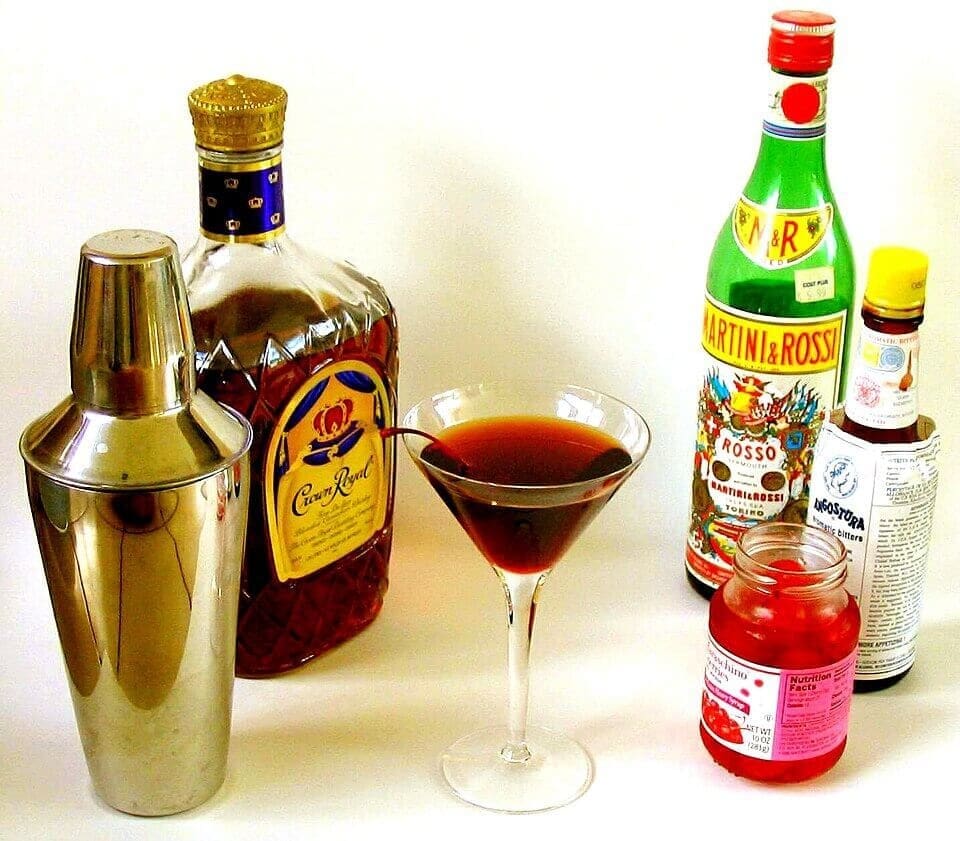
Its use of aromatized fortified wine (sweet vermouth) earns the Manhattan the distinction of being widely regarded as the first “modern cocktail.” It emerged in the 1860s–1870s in New York City.
One common origin myth says that a bartender at the Manhattan Club created the drink as part of a banquet hosted by Lady Randolph Churchill (Winston Churchill’s mother). Most historians, however, doubt the story’s accuracy.
Regardless of origin, the Manhattan reshaped cocktail history. Its template; spirit, vermouth, and bitters; became the blueprint for countless classics, from the Martini to the Negroni to the Rob Roy.
The recipe includes rye whiskey (or bourbon), sweet vermouth, Angostura bitters, garnished with a brandied cherry. The quality of the vermouth matters as much as the quality of the whiskey; a Manhattan made with oxidized, months-old vermouth is a completely different drink from one made with freshly opened, properly refrigerated vermouth.
On Difford’s Guide’s 2025 list, the Manhattan climbed to 10th from 41st in 2022. The Drinks International 2026 Cocktail Report ranked it at number 10 on its bestselling classics list.
The Vibe List’s Take: The Manhattan is America’s first modern cocktail and the foundation for virtually every spirit-vermouth-bitters classic that followed. Its template is essentially how most cocktails work. It earns #5 on historic importance alone, plus the reality that a perfectly made Manhattan is one of the finest things you can drink.
4. The Espresso Martini {#4-the-espresso-martini}

Dick Bradsell created the Espresso Martini (originally called the “Vodka Espresso”) at London’s Soho Brasserie circa 1983; a young model approached the bar and requested a drink that would “wake me up and then mess me up.” He created a mixture of vodka, espresso, coffee liqueur, and sugar syrup. Initially called the “Vodka Espresso,” he later renamed it the “Pharmaceutical Stimulant” at Damien Hirst’s Pharmacy bar in Notting Hill before it finally settled into the name we know today.
For roughly two decades, the Espresso Martini remained a London bartender’s secret. Its global explosion came in the early 2020s, driven by social media, post-pandemic nightlife culture, and a younger generation seeking caffeinated cocktails.
By 2022, according to Forbes, the Espresso Martini was among the top-selling cocktails in the United States.
The Drinks International 2026 Cocktail Report placed the Espresso Martini at number 5 on their bestselling classics list at the world’s best bars; an impressive feat considering it was created less than 40 years ago.
Bradsell passed away in 2016 before seeing his creation explode into global success. Today his daughter, Bea Bradsell, carries her father’s legacy forward; sharing his true creative vision and educating bartenders around the world about its authentic beginnings.
The Vibe List’s Take: The Espresso Martini is one of the fastest-rising stars in cocktail history; from near-obscurity to the global top five in under a decade. Born from a simple request for caffeine and alcohol at the same time, it might be the most emotionally honest cocktail ever made. It earns its spot at #4.
3. The Dry Martini {#3-the-dry-martini}

The Martini is the most debated, mythologized, and personally customized cocktail in history. There is no known exact origin. The most likely ancestor is the Martinez; a sweet cocktail popular in San Francisco in the mid-to-late 19th century. The progression to dry came as people started preferring dry vermouth to sweet vermouth and as gin producers shifted their style from heavy, malty Old Tom gins to crisp London Dry gins. Harry Johnson’sBartender’s Manual, first published in 1882 and updated through 1900, contained evolving Martini recipes that traced the drink’s gradual shift from sweet to dry; Johnson’s later editions reflected the transition toward dry vermouth that would define the modern Dry Martini.
The 20th century turned the Martini into a cultural icon. James Bond’s “shaken, not stirred” (which purists consider heresy; stirring a Martini chills it without the dilution and aeration that shaking causes) is one of the most quoted lines in cinema history. Dorothy Parker, Frank Sinatra, and Winston Churchill were all famously devoted Martini drinkers.
Unlike any other cocktail, the Martini has an entire culture built around customization. Bone dry, wet, dirty, filthy, with a twist, with an olive, with a cocktail onion (making it a Gibson), gin or vodka, stirred or shaken. How you want your Martini reveals as much about who you are as what is in the glass.
The Drinks International 2026 Cocktail Report placed the Dry Martini at number 4 among the world’s best bars.
The Vibe List’s Take: The Martini is the cocktail against which all others are measured. It put the cocktail glass on the map, turned bartending into performance art, and gave ordering a Martini more cultural weight than almost any other beverage order in history. It ranks at #3 because the only things that outrank pure elegance are cultural movement and reinvention.
2. The Margarita {#2-the-margarita}

The origin of the Margarita is as debatable as it is interesting. Difford’s Guide catalogs numerous competing claims: Danny Negrete allegedly created it in 1936 at Hotel Garci Crespo in Tehuacán, Mexico, for his girlfriend Margarita. Socialite Margaret Sames claims she created it in 1948 at her family vacation home in Acapulco. Carlos “Danny” Herrera may have created it in the late 1930s or early 1940s for actress Marjorie King at his Tijuana restaurant; King was allegedly allergic to all spirits except tequila. According to the Diageo Bar Academy: “Its provenance can never be truly verified.”
What no one disputes is its commercial dominance. It is consistently one of the most purchased cocktails in the United States and one of the bestselling classics at the world’s top bars. The Drinks International 2026 Cocktail Report ranked it number 2. The most significant variation is Tommy’s Margarita, created by Julio Bermejo at Tommy’s Mexican Restaurant in San Francisco in 1989. Bermejo swapped triple sec for agave nectar, and the result has become nearly as iconic as the original.
Beyond the glass, the Margarita helped build the premium tequila industry. Celebrity-backed tequila brands owe their existence to that demand. Casamigos, founded by George Clooney, sold to Diageo for up to $1 billion; a transaction that would have been unthinkable without the Margarita’s mass-market pull.
The Vibe List’s Take: The Margarita is the most commercially successful cocktail in the Western Hemisphere. It has single-handedly created an entire market for quality tequila. We rank it #2 because it achieved something no other cocktail on this list has: it changed the way money flows through an entire spirit category.
1. The Negroni {#1-the-negroni}

At Caffè Casoni (later Caffè Giacosa) on Via de’ Tornabuoni in Florence, Italy, in 1919, Count Camillo Negroni (1868–1933) requested that bartender Fosco Scarselli take his usual Americano and replace the soda water with gin. The resulting combination of gin, Campari, and sweet vermouth became the Count’s regular order. Other customers at Caffè Casoni began requesting “one of Count Negroni’s drinks,” and before long, it was simply called “a Negroni.”
The origin story is disputed. Cocktail historian Colonel Hector Andres Negroni has argued that the actual creator was a French general, not an Italian count. Recipes for structurally similar cocktails (the Camparinete and Campari Mixte) appear in cocktail literature from 1929 or earlier. But in cocktails, as in most things, history belongs to whichever name sticks. And “Negroni” did.
Orson Welles reportedly told the Coshocton Tribune during his stay in Rome while filming Black Magic in 1947: “The bitters are excellent for your liver, the gin is bad for you. They balance each other.” The quote encapsulates the Negroni’s appeal: it is a drink built on tension. Bitter Campari pulls against sweet vermouth. Herbal gin mediates between them. Logically, this should not work. It works perfectly.
This cocktail has generated an entire industry. Negroni Week; founded by Imbibe Magazine and sponsored by Campari in 2013; has grown from 120 participating venues to thousands of bars worldwide, raising over $5 million for charitable causes. The Negroni Sbagliato; an “accidental” variation born when bartender Mirko Stocchetto at Bar Basso in Milan grabbed prosecco instead of gin; went viral in 2022 after a meme featuring House of the DragonstarEmma D’Arcy turned it into the most searched cocktail on the internet.
The Drinks International 2026 Cocktail Report crowned the Negroni as the number one bestselling classic cocktail at the world’s best bars for 2026. Difford’s Guide data confirms it remains one of the most popular cocktails online by search volume and page views.
Three ingredients. Equal parts. No embellishment required.
The Vibe List’s Take: The Negroni is currently the #1 cocktail in the world; and the Vibe List agrees. It is three ingredients perfectly balanced. It is unrelenting; there is no softening of any ingredient, no amplification of any flavor, no hiding of any element. You are forced to meet it on its own terms. Every great cocktail on this list shares a common trait: conviction. Of all of them, the Negroni has more conviction than any other.
Quick Reference: The 20 Greatest Cocktails at a Glance {#quick-reference}
| Rank | Cocktail | Base Spirit | Origin | Key Data Point | Vibe List Verdict |
|---|---|---|---|---|---|
| 1 | Negroni | Gin | Florence, Italy (1919) | #1 bestselling classic, Drinks International 2026 | Three ingredients, equal parts, more conviction than any other cocktail on Earth |
| 2 | Margarita | Tequila | Mexico (1930s–1940s) | #2 bestselling classic; drove tequila’s billion-dollar premiumization | Changed the way money flows through an entire spirit category |
| 3 | Dry Martini | Gin / Vodka | USA (1860s–1900s) | #4 bestselling classic; the most customized cocktail in history | The cocktail against which all others are measured |
| 4 | Espresso Martini | Vodka | London, UK (1983) | #5 bestselling classic; youngest cocktail in the global top 5 | The most emotionally honest cocktail ever made |
| 5 | Manhattan | Rye Whiskey | New York, USA (1860s–1870s) | Template for all spirit-vermouth-bitters cocktails | America’s first modern cocktail; the blueprint for everything that followed |
| 6 | Daiquiri | White Rum | Cuba (c. 1896) | Benchmark for the entire sour cocktail family | If you can’t make an excellent Daiquiri, you shouldn’t be making cocktails |
| 7 | Mojito | White Rum | Cuba (16th–20th c.) | One of the world’s most ordered cocktails by volume | Perhaps the only cocktail that smells like summer |
| 8 | Whiskey Sour | Whiskey | USA (1860s) | Climbed from 43rd to 12th on Difford’s Guide in five years | Simple does not mean unrefined; 150+ years of proof |
| 9 | Mai Tai | Rum | Oakland, USA (1944) | Rose to 5th on Difford’s Guide; the most misunderstood great cocktail | The first properly made Mai Tai is usually a revelation |
| 10 | Aperol Spritz | Aperol / Prosecco | Italy (19th c. / 1990s) | Defined the low-ABV cocktail movement of the 2010s | Proved low-ABV can carry as much cultural weight as any classic |
| 11 | Sazerac | Rye Whiskey | New Orleans, USA (1838) | Possibly the oldest American cocktail; official cocktail of New Orleans | An unbroken line from a Creole pharmacist’s counter to craft bars everywhere |
| 12 | Paloma | Tequila | Mexico (mid-20th c.) | Mexico’s actual national cocktail; outsells the Margarita domestically | The drink Mexico actually consumes speaks louder than any origin story |
| 13 | French 75 | Gin / Champagne | France / UK (WWI era) | Named after a WWI field gun; straddles cocktail and champagne worlds | From battlefield to ballroom; one of cocktail history’s greatest arcs |
| 14 | Pisco Sour | Pisco | Lima, Peru (1920s) | Subject of an ongoing diplomatic dispute between Peru and Chile | Simultaneously a drink, a national symbol, and an international incident |
| 15 | Penicillin | Scotch | New York, USA (2005) | Made scotch approachable for a generation of whisky-curious drinkers | One of the few 21st-century cocktails that stands alongside the 19th-century greats |
| 16 | Cosmopolitan | Vodka | New York, USA (1988) | Defined late-1990s cocktail culture through Sex and the City | Showed a generation that ordering a cocktail could be a statement |
| 17 | Paper Plane | Bourbon | New York / Chicago (2008) | The equal-parts modern classic; proof the formula still had frontiers | Sam Ross may be the most consequential cocktail inventor of the 21st century |
| 18 | Caipirinha | Cachaça | São Paulo, Brazil (c. 1918) | Brazil’s national cocktail and Cultural Heritage since 2003 | Three ingredients and one technique built a symbol of national pride |
| 19 | Boulevardier | Bourbon | Paris, France (1927) | The Negroni’s whiskey sibling; born from Prohibition-era exile | The quiet older sibling that arrived first but gained recognition later |
| 20 | Jungle Bird | Dark Rum | Kuala Lumpur, Malaysia (1978) | Broke tiki’s unwritten rules by pairing Campari with tropical flavors | Proved geographic cocktail traditions are suggestions, not boundaries |
Frequently Asked Questions {#faq}
What is currently the #1 cocktail in the world according to Drinks International’s 2026 Cocktail Report?
According to the Drinks International 2026 Cocktail Report, which polled 100 of the world’s top bars, the Negroni is the number one bestselling classic cocktail. The Margarita ranks second, followed closely by the Old Fashioned, the Dry Martini, and the Espresso Martini. Our ranking agrees with the Negroni’s top placement based on its cultural, historical, and commercial influence.
Which cocktail is the oldest in existence?
Many historians agree that the Sazerac (created circa 1838 in New Orleans), the Manhattan (circa 1860s–1870s), and the Whiskey Sour (first documented in the 1860s) are among the oldest cocktails still enjoyed today. The original definition of a “cocktail”; spirits, sugar, water, and bitters; dates to at least 1806.
Which cocktail is most often ordered at bars?
Based on global sales data from Drinks International (2026), both the Negroni and the Margarita lead as the most commonly ordered cocktails at the world’s best bars. Within the United States, the Old Fashioned and the Margarita frequently swap the top spot depending on the data source, while the Espresso Martini has risen rapidly to join their ranks since 2022.
What are the primary differences between the Negroni and the Boulevardier?
Both follow the same template; base spirit, Campari, and sweet vermouth in equal parts; but diverge at the base spirit. Gin gives the Negroni its herbaceous, citrus character. Bourbon or rye whiskey adds warmth, spice, and vanilla flavors to the Boulevardier. The Negroni has a bright, Mediterranean personality, while the Boulevardier is warmer and more autumnal.
What is fueling the popularity of the Espresso Martini since 2020?
Several factors drove the post-2020 Espresso Martini explosion: the rise of specialty coffee culture making espresso more accessible, social media’s appetite for the drink’s photogenic crema, the post-pandemic return to nightlife, and the universal appeal of wanting to feel awake and relaxed at the same time.
What defines a “classic” cocktail?
No organization formally establishes what constitutes a “classic” cocktail; however, the general consensus among industry professionals is that a classic cocktail must meet several criteria: it must have been adopted worldwide across multiple countries and continents; it must contain a consistent, broadly agreed-upon recipe; it must have endured at least one full generation of bartenders; and it must consistently appear on bar menus without needing explanation to the average patron. The International Bartenders Association (IBA) officially maintains a registry of recognized cocktails, but the ultimate defining characteristic of a classic cocktail is its enduring presence in popular culture.


