


38% of web pages from 2013; gone. A $3.57 billion acquisition demolished in a decade. 215 million users streaming through the only player that existed. An 18-year-old’s dorm room project that forced a $30.6 billion industry to reinvent itself. A search engine that asked questions in plain English; 25 years before ChatGPT made it a billion-dollar idea. The internet doesn’t honor its ancestors. It strips them for parts and buries the originals.
The internet has a demolition problem.
According to a landmark study published by the Pew Research Center in May 2024, 38% of web pages that existed in 2013 are no longer accessible a decade later. Not archived. Not redirected. Gone. A full quarter of all web pages that existed between 2013 and 2023 have vanished entirely, taking with them the links, content, and cultural artifacts they once held. The study also found that 54% of Wikipedia pages contain at least one broken reference link pointing to a page that no longer exists.
The internet does not preserve itself. It deteriorates.
And somewhere inside that deterioration are the foundations of every app on your phone. The platforms that invented personal web publishing, peer-to-peer file sharing, algorithmic content discovery, social bookmarking, RSS aggregation, and natural language search are either dead or so diminished that most people under 30 have never heard of them. Their innovations were absorbed, sometimes quietly and sometimes through outright acquisition, by the companies that now dominate the web. Spotify inherited what Napster proved. Google inherited what AltaVista pioneered. TikTok‘s recommendation engine perfected the discovery model that StumbleUpon prototyped a decade earlier.
The dead social media apps that once ruled the internet have their own autopsy. This is the story of the websites and web platforms; the infrastructure beneath the social layer; that built the internet you use today and then disappeared from it.
Every entry below traces the same three-part arc: what the dead site invented, which living platform inherited it, and the specific corporate decision, lawsuit, or market failure that killed the original. This is internet archaeology with a thesis.
1. GeoCities; The Web’s First Neighborhood

Born: 1994 | Killed: October 26, 2009 | What it pioneered: Personal web publishing for non-technical users | Who inherited it: WordPress, Squarespace, Wix, Tumblr
In 1999, GeoCities was the third most-visited website on the entire World Wide Web. It hosted at least 38 million user-created pages organized into themed virtual “neighborhoods”; Hollywood for entertainment, SiliconValley for technology, Nashville for country music. The concept sounds quaint now, but what GeoCities offered in 1994 was revolutionary: anyone, regardless of technical skill, could publish a personal web page for free. Before GeoCities, creating a website required knowledge of HTML, access to a web server, and either money or institutional affiliation. GeoCities removed every one of those barriers.
Yahoo purchased GeoCities in January 1999 for approximately $3.57 billion in stock, making it one of the largest acquisitions of the dot-com era. What happened next became a textbook case of corporate mismanagement. Yahoo folded GeoCities into its broader platform, imposed new terms of service that claimed broad rights over users’ content, and failed to modernize the product as the web evolved. By 2009, Yahoo decided to shut GeoCities down entirely.
The shutdown, announced in April 2009 and executed on October 26, 2009, triggered a frantic volunteer rescue operation. The Archive Team, a loose collective of digital preservationists, launched a coordinated effort to download as much of GeoCities as possible before Yahoo pulled the plug. They managed to save approximately one terabyte of data; a fraction of what existed. But millions of personal web pages; amateur fiction, family photo galleries, fan tributes, hobbyist databases; disappeared forever.
GeoCities proved the market for personal website publishing that now generates billions of dollars in annual revenue. WordPress powers roughly 43% of all websites on the internet. Squarespace, Wix, and Weebly generate billions in combined revenue. The concept of a “website builder” exists because GeoCities proved the demand in 1994. Yahoo paid $3.57 billion for that proof of concept and then demolished it.
2. Napster; The Lawsuit That Built Spotify

Born: June 1, 1999 | Killed: September 2001 (forced shutdown); June 2002 (bankruptcy) | What it pioneered: Peer-to-peer music distribution at scale | Who inherited it: iTunes, Spotify, Apple Music, Tidal, Amazon Music
Shawn Fanning was 18 years old when he launched Napster from his dorm room at Northeastern University in Boston. Four months later, 150,000 people had signed up. By February 2001, Napster had peaked at a verified 26.4 million users, with some estimates topping 80 million, according to The Guardian‘s retrospective. At its peak, the platform facilitated nearly two billion file transfers per month.
Napster did not invent file sharing. But it made file sharing effortless enough to reach a mainstream audience, and in doing so, it proved a consumer demand that the music industry had refused to acknowledge: people wanted to access individual songs digitally, on demand, without buying an entire $17 CD for two tracks they actually liked.
The Recording Industry Association of America (RIAA) filed suit against Napster in December 1999. Metallica‘s drummer Lars Ulrich delivered 13 boxes of documents to Napster’s offices in May 2000, listing hundreds of thousands of users suspected of sharing the band’s music. A federal judge issued a preliminary injunction ordering Napster to shut down in July 2000. Usage spiked 71% the next day as users scrambled to download everything they could before the gates closed.
Napster filed for bankruptcy in June 2002. The global recorded music industry, which had peaked at $30.6 billion in revenue in 1999, began a decline that would not reverse until 2015, according to data tracked by the International Federation of the Phonographic Industry (IFPI).
Napster’s real legacy is what it forced into existence. Steve Jobs saw the demand Napster revealed and launched the iTunes Store in 2003, offering individual songs at $0.99 each. Spotify‘s founder Daniel Ek was inspired by Napster and brought Sean Parker, Napster’s co-founder, onto his team. Today, Spotify has surpassed 250 million paying subscribers worldwide. The entire streaming music industry is built on the consumer behavior pattern that Napster proved in a college dorm in 1999.
3. AltaVista; The Search Engine That Taught Google How to Crawl

Born: December 15, 1995 | Killed: July 8, 2013 | What it pioneered: Full-text web indexing at scale | Who inherited it: Google
Before Google existed, there was AltaVista. Launched on December 15, 1995, by researchers at Digital Equipment Corporation (DEC), AltaVista was the first search engine to index a significant portion of the web’s full text rather than just page titles and metadata. By 1997, AltaVista was receiving more than 80 million hits per day, making it the dominant search engine on the planet.
AltaVista introduced features that users now take for granted: Boolean search operators, natural language queries, and the ability to search billions of words across millions of web pages in fractions of a second. Its indexing technology, built on DEC’s powerful Alpha servers, demonstrated that the entire World Wide Web could be searchable; a concept that was not obvious in 1995.
AltaVista’s decline began when its parent company decided the search engine should become a web portal. Rather than doubling down on search quality, DEC (later acquired by Compaq, then Hewlett-Packard) expanded AltaVista into a Yahoo-style portal offering email, shopping, news, and entertainment. The search engine that had made AltaVista dominant got buried inside a cluttered portal that users did not want. Meanwhile, Larry Page and Sergey Brin launched Google in 1998 with a singular obsession: make search better.
Yahoo acquired AltaVista in 2003 and officially shut it down on July 8, 2013. AltaVista proved that full-text search at web scale was possible. Google proved that if you do only that, and do it better than anyone else, you can build one of the most valuable companies in human history. Google’s current market capitalization exceeds $2 trillion.
4. Netscape Navigator; The Browser That Started a War
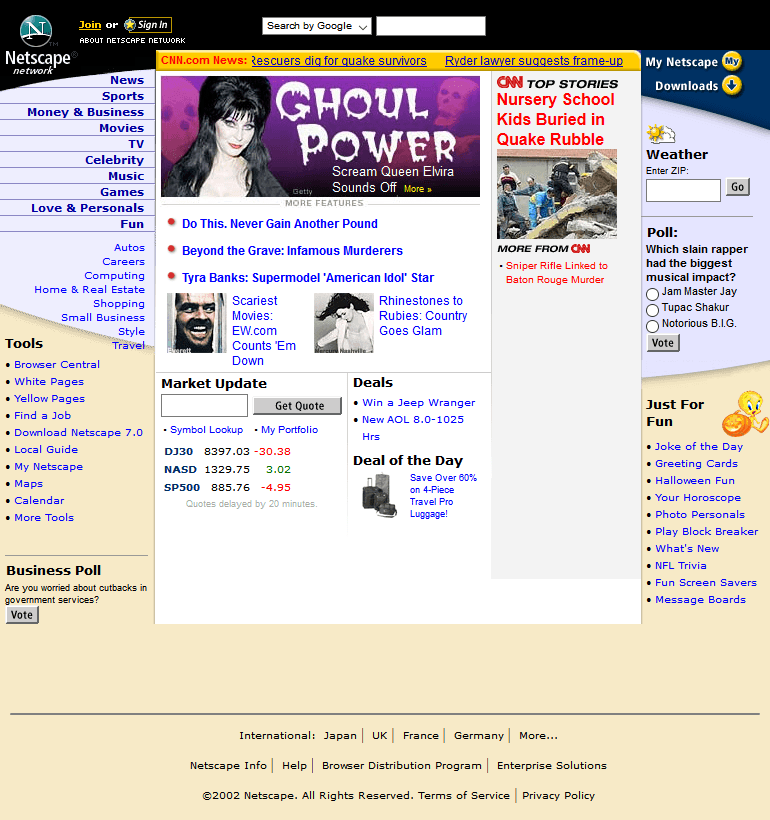
Born: December 15, 1994 | Killed: February 1, 2008 (support officially ended) | What it pioneered: Commercial web browsing for the masses | Who inherited it: Firefox (directly), Chrome, Safari, Edge
Netscape Navigator did not invent the web browser. But it commercialized it. When Netscape Communications launched Navigator in December 1994, it made the World Wide Web accessible to millions of people who had never seen a web page. By mid-1995, Netscape held roughly 86% of the browser market.
The company’s IPO on August 9, 1995, became a defining moment of the dot-com era. Shares were originally priced at $28 but opened trading at $71, soaring as high as $74.75 before closing at $58.25. The closing price valued the 16-month-old company at roughly $2.9 billion. Netscape’s IPO is widely credited with igniting the dot-com investment boom.
What killed Netscape was Microsoft. In what became known as the “Browser Wars,” Microsoft bundled its own Internet Explorer directly into the Windows operating system, giving it to hundreds of millions of users for free. The U.S. Department of Justice filed an antitrust lawsuit against Microsoft in 1998, arguing that bundling IE with Windows constituted an illegal monopoly.
Netscape was acquired by AOL in 1999. Support for the Netscape browser officially ended on February 1, 2008. But before it died, Netscape made one final contribution that still shapes the web today: in 1998, the company released its browser’s source code as open source, creating the Mozilla project, which evolved into Firefox. The open-source browser movement that Netscape initiated remains the philosophical foundation of projects like Chromium (which powers Google Chrome, Microsoft Edge, Brave, and Opera). Every modern browser descends, philosophically or architecturally, from the open web principles Netscape fought for; and died for.
5. Digg; The Front Page of the Internet Before Reddit Took the Title

Born: December 2004 | Killed: July 12, 2012 (sold for $500,000) | What it pioneered: Democratic, user-voted news aggregation | Who inherited it: Reddit
In August 2006, Kevin Rose; Digg’s founder; appeared on the cover of BusinessWeek. The site was described as the 24th most popular website in the United States, ahead of Fox News. At its peak in early 2010, Digg attracted between 29 and 44 million monthly unique visitors, according to data from comScore and Compete.com. A 2008 investment round valued the company at $164 million.
Digg’s innovation was straightforward yet powerful: users submitted links, and the community voted them up or down. The stories with the most “diggs” rose to the front page. This democratic, crowd-sourced news curation model became the prototype for how content now rises on Reddit, Hacker News, and Product Hunt.
The killing blow came in August 2010 when Digg launched v4, a catastrophic redesign that removed core community features and replaced the democratic voting system with a publisher-driven model. Users revolted immediately. In one of the most famous protest actions in internet history, Digg’s own front page was flooded with links to Reddit as users symbolically migrated to the competitor. The exodus was not temporary. Reddit’s traffic surged and Digg’s cratered.
On July 12, 2012, Digg was sold to New York tech incubator Betaworks for $500,000 in cash plus equity. That represents a loss of more than 99% of its value in four years. The Washington Post Company separately purchased Digg’s engineering team for $12 million, and LinkedIn acquired its patents for $4 million. Digg’s story is an example of how a single bad product decision can destroy a platform that once defined an entire category.
6. Google Reader; The RSS Tool That Predicted the Newsletter Boom
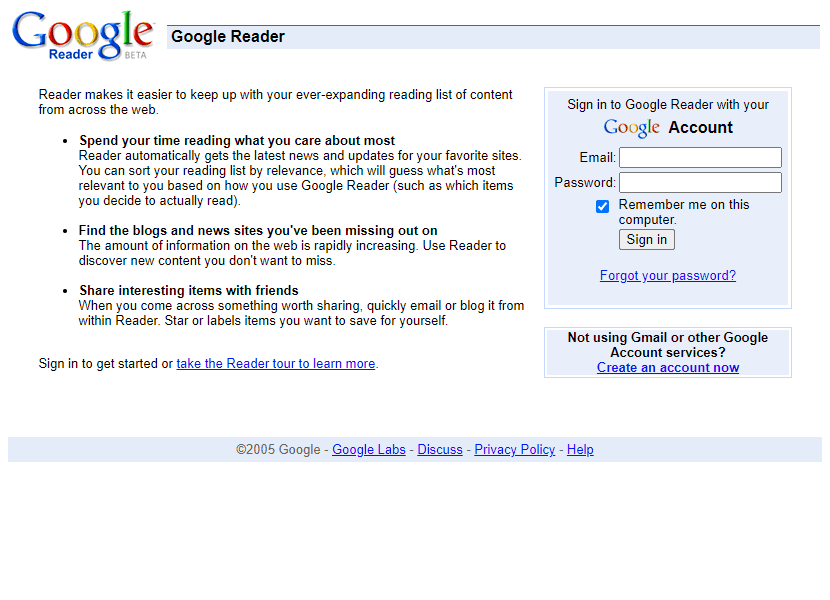
Born: October 7, 2005 | Killed: July 1, 2013 | What it pioneered: Centralized web content aggregation via RSS | Who inherited it: Feedly, Substack, newsletters, podcast apps
The sign in the Google Reader team’s workspace read: “Days Since Cancellation.” The number below it was always zero. The Verge‘s definitive 2023 oral history revealed that from the earliest days, the Reader team felt the product was perpetually on the chopping block.
At its peak, Google Reader had approximately 30 million users, many of them logging in daily. Engineer Mihai Parparita recalled that while users spent approximately five minutes a day on iGoogle, they spent an hour a day reading feeds in Google Reader. The developers never viewed Reader solely as a feed reader; they envisioned it as a polymorphic content aggregation platform that could pull in blogs, photos from Flickr, videos from YouTube, and podcasts; essentially the “everything feed” that no single product has fully achieved since.
Google shut down Reader on July 1, 2013, as part of a broader restructuring driven by Google’s obsessive; and ultimately failed; attempt to compete with Facebook through Google+. The Reader team’s engineers were reassigned to Google+. Designer Jenna Bilotta told The Verge: “If they had taken all those millions of dollars they used to build Google Plus and threw them into Reader, I think things would be quite different right now.”
When Google announced the shutdown, over 30,000 people signed a petition demanding the company reverse its decision. TechCrunchreported extensively on the backlash. Google did not relent. Google+ itself was shut down in 2019 after a data breach exposed personal information for 52 million users.
The vacuum Google Reader left behind spawned an entire ecosystem. Feedly launched a month after Google’s shutdown announcement and now serves millions of users. The collapse of RSS as a mainstream distribution channel is widely credited with creating the conditions for the newsletter boom that platforms like Substack later capitalized on. Google killed the tool; the need it served never went away.
7. LiveJournal; The Platform That Invented Fandom as We Know It
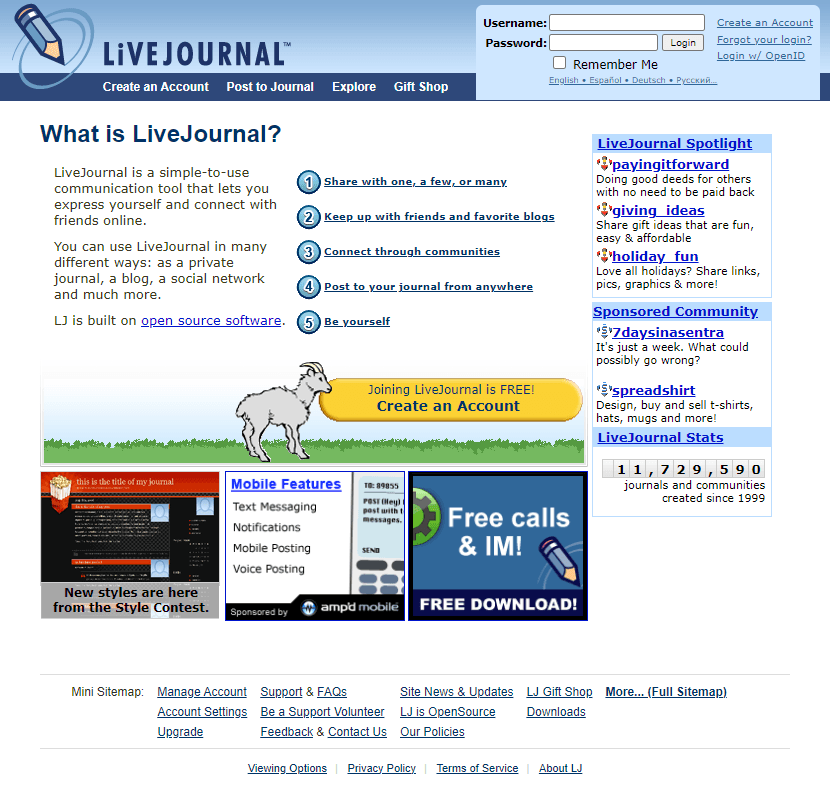
Born: April 15, 1999 | Effectively dead (for English-language users): 2009–2012 | What it pioneered: Blogging communities, internet fandom infrastructure, friends-locked content | Who inherited it: Tumblr, Archive of Our Own (AO3), Discord fan communities
Brad Fitzpatrick created LiveJournal in 1999 after being banned from AOL for tampering with servers. What started as a personal project eventually became the backbone of internet fandom for nearly a decade. LiveJournal pioneered several concepts including “friends lists” as content feeds, friends-locked posts (content visible only to approved connections), and community-based group blogging.
Most critically, LiveJournal established itself as the primary infrastructure for organized internet fandom. Fan fiction writers, fan artists, and media analysis communities built elaborate ecosystems on the platform. The site’s community features allowed fans to create dedicated spaces for specific fandoms, run collaborative writing challenges, and build the transformative works culture that eventually migrated to Tumblr and Archive of Our Own.
LiveJournal’s decline came in stages. Fitzpatrick sold the platform to Six Apart in 2005, which then sold it to Russian media company SUP Media in 2007. The 2007 events known as Strikethrough and Boldthrough; in which Six Apart mass-deleted hundreds of accounts and communities based on content flagging without adequate review; triggered a mass exodus of fandom communities. The subsequent Russian ownership raised additional concerns among English-language users about terms of service changes, privacy, and Russian content laws. By 2012, the majority of English-language fandom communities that had defined LiveJournal’s cultural significance had migrated elsewhere.
Although LiveJournal technically still exists, primarily as a Russian-language blogging platform, its legacy lives in the fandom infrastructure it pioneered: fan fiction communities, friends-locked personal blogging, and community-moderated discussion spaces now found on platforms like Discord, Tumblr, and AO3.
8. Delicious; The Bookmarking Site That Invented the Hashtag’s Ancestor

Born: 2003 | Killed: June 2017 (acquired and shut down by Pinboard) | What it pioneered: Social bookmarking and user-generated tagging (folksonomy) | Who inherited it: Pinterest, Pocket, Twitter (hashtag lineage), every platform with a save/bookmark function
Delicious (originally styled as “del.icio.us”) was founded by Joshua Schachter and Peter Gadjokov in 2003. Its concept was deceptively simple: save your bookmarks online instead of in your browser, and tag them with descriptive labels so you and other users could find them later. The innovation was the tagging system; a user-generated classification method that information scientists later termed “folksonomy.” Instead of relying on pre-built categories, users created their own labels, and the most popular labels rose to the surface through collective use.
This user-generated tagging model is the direct conceptual ancestor of the hashtag. While Chris Messina proposed the “#” symbol for grouping content on Twitter in 2007, the underlying concept; users applying free-form labels to content for collective discovery; was already a functioning reality on Delicious years earlier.
Yahoo acquired Delicious in December 2005. As with GeoCities, Yahoo’s stewardship proved catastrophic. An internal Yahoo document leaked in 2010 listed Delicious among products to be “sunsetted,” triggering a user panic. The site passed through multiple owners; YouTube co-founders Chad Hurley and Steve Chen in 2011, then Science Inc. in 2014; before being acquired by Pinboard in June 2017, which promptly shut it down.
Every “save” button on every social platform today, every bookmarking feature in every browser, and every Pinterest board owes a conceptual debt to Delicious. The site proved that users would voluntarily organize information for each other if given simple, intuitive tools to do so.
9. StumbleUpon; The Discovery Engine That TikTok’s Algorithm Perfected

Born: November 2001 | Killed: June 30, 2018 | What it pioneered: Algorithmic content discovery based on user preferences | Who inherited it: TikTok’s For You Page, Spotify Discover Weekly, YouTube Recommendations
Here is how StumbleUpon worked: you pushed a button, and the internet showed you something you did not know you wanted to see. The platform learned your preferences from your thumbs-up and thumbs-down reactions and served increasingly personalized content with each click.
At its peak, StumbleUpon was the largest source of social referral traffic on the web, surpassing Facebook for sending users to external websites. The site sent publishers roughly one billion stumbles per month.
The innovation StumbleUpon pioneered; using a feedback loop of user reactions to algorithmically surface content the user did not explicitly search for; is the foundational mechanic of the modern internet. TikTok‘s “For You” page, Spotify‘s “Discover Weekly” playlist, YouTube‘s recommendation sidebar, and Instagram‘s Explore tab all operate on the same principle: show users content they never asked for but are statistically likely to engage with, and refine the model with every interaction.
StumbleUpon shut down on June 30, 2018, and its remaining users were migrated to a replacement product called Mix.com, which failed to gain traction. The discovery engine model StumbleUpon created did not die with it; it matured into the algorithmic recommendation systems that now govern how billions of people consume content daily. StumbleUpon demonstrated what was technologically possible. TikTok demonstrated what happens when that technology is executed flawlessly.
10. Ask Jeeves; The Natural Language Search Engine 25 Years Ahead of ChatGPT
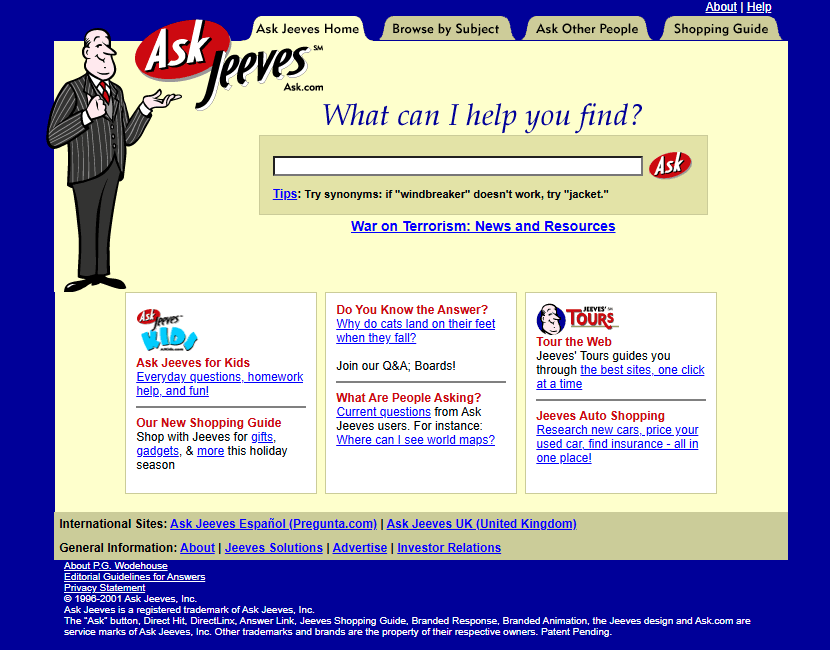
Born: 1996 | Killed: May 1, 2026 | What it pioneered: Natural language question-and-answer search | Who inherited it: ChatGPT, Google Gemini, Perplexity, every AI chatbot
Ask Jeeves launched in 1996 with a concept that seemed almost naively ambitious: instead of typing keywords into a search box, you could ask a question in plain English; “What is the tallest building in the world?”; and a search engine with a butler mascot would attempt to provide a direct answer.
The idea was arguably a precursor to today’s AI-powered chatbots, as TechCrunchnoted in its obituary. The problem was that Ask Jeeves arrived two decades before the underlying technology could deliver on the promise. In 1996, natural language processing was still relatively basic. Ask Jeeves relied heavily on human editors to match questions to pre-written answers, supplemented by keyword-based search. The results were inconsistent, and when Google arrived with demonstrably superior keyword search in 1998, Ask Jeeves could not compete on accuracy or speed.
IAC acquired Ask Jeeves in 2005, dropped the “Jeeves” branding in 2006, and rebranded as Ask.com. By 2010, IAC had scaled back its search product to focus on Q&A. IAC Chairman Barry Diller, speaking at TechCrunch Disrupt in 2010, stated: “Ask.com is not competitive with Google… [and] has no value inside of IAC.”
Ask.com officially closed on May 1, 2026, ending a 30-year run. A farewell message on the site read: “After 25 years of answering the world’s questions, Ask.com officially closed on May 1, 2026.”
The timing is bitterly ironic. In 2026, natural language question-answering is the hottest sector in technology. ChatGPThas 900 million weekly users. Google Gemini, Perplexity, and Claude all operate on the exact principle Ask Jeeves articulated in 1996: ask a question in natural language, get a direct answer. Ask Jeeves had the right idea. It was born 25 years too early.
11. Winamp; The MP3 Player That Taught a Generation to Customize Everything

Born: April 21, 1997 | Effectively killed: December 20, 2013 (original shutdown by AOL; later revived in diminished form) | What it pioneered: Customizable media playback and the skin/plugin ecosystem | Who inherited it: Spotify (playlist culture), iTunes (library management), Discord (customizable interface culture)
“Winamp. It really whips the llama’s ass.”
That audio clip; sampled from a Wesley Willis song; greeted every user upon opening the most iconic MP3 player of the late 1990s and early 2000s. By 2001, Winamp had 60 million users. By 2002, some estimates placed the figure at 90 million.
Beyond its playback functionality, Winamp reshaped internet culture. The platform popularized “skins”; downloadable visual themes that completely altered the software’s appearance. Thousands of user-created skins turned Winamp into one of the first platforms where personal customization was a core part of the user experience. The plugin architecture let third-party developers extend Winamp’s capabilities far beyond music playback. This skin-and-plugin model directly influenced the customization cultures that later flourished on platforms from WordPress themes to Discord server customization.
AOL acquired Winamp’s parent company, Nullsoft, in 1999 for approximately $80 million. As with nearly every acquisition on this list, the buyer failed to invest in the product. Winamp stagnated while Apple‘s iTunes and, later, streaming services captured the market. AOL shut down Winamp on December 20, 2013. A Belgian company called Radionomy acquired the brand and released updated versions, but none ever approached the level of success Winamp experienced during its peak.
12. RealPlayer; The Buffering Icon That Invented Streaming Media
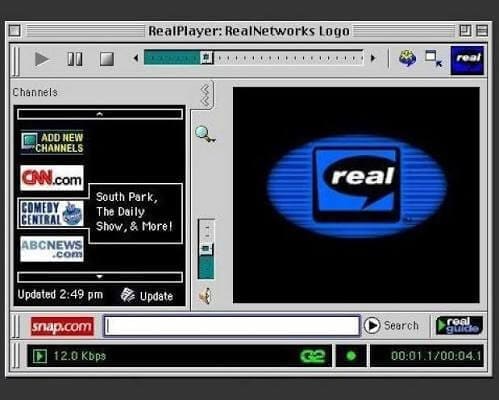
Born: April 1995 (as RealAudio Player) | Effectively dead: mid-2000s (company pivoted; original product abandoned) | What it pioneered: Streaming audio and video over the internet | Who inherited it: YouTube, Netflix, Spotify, Twitch, every streaming platform
Before YouTube existed, before Netflix streamed a single frame, before the word “buffering” entered the global vocabulary, there was RealPlayer.
In April 1995, Rob Glaser; a former Microsoft executive; launched RealAudio Player through his company Progressive Networks (later renamed RealNetworks). It was the first software that enabled audio streaming over the internet, letting users listen in real time rather than waiting for an entire file to download. In 1997, Glaser introduced RealVideo, extending the same principle to video. For the first time, a mainstream consumer could watch a video clip in a web browser without downloading the file first.
By mid-2000, RealNetworks’ software had reached 215 million registered users; roughly 85% of the streaming media market, according to Britannica. RealPlayer was not merely popular; it was the only viable option. If a website offered streaming audio or video in the late 1990s, it almost certainly required RealPlayer to play it. News websites, sports broadcasters, music labels, and early internet radio stations all relied on RealPlayer’s proprietary .rm and .ram file formats.
What killed RealPlayer was a combination of aggressive monetization and superior competitors. RealNetworks began bundling the free RealPlayer with intrusive toolbars, pop-up advertisements, and unwanted software installations, earning it a reputation as borderline adware. When Windows Media Player came preinstalled on every Windows PC and Apple‘s QuickTime offered a cleaner alternative on Macs, users abandoned RealPlayer rapidly. The arrival of Adobe Flash video in the mid-2000s; and later YouTube in 2005, which used Flash for browser-based playback; rendered RealPlayer’s proprietary format obsolete.
RealPlayer’s fundamental innovation; the concept that media content could be consumed as a continuous stream rather than as a downloaded file; is the architectural foundation of the entire modern streaming economy. Netflix binge sessions, Spotify playlists, Twitch livestreams, and YouTube videos all operate on the principle RealPlayer introduced to mainstream consumers in 1995. The platform that invented streaming is now a footnote in the history of the industry it created.
13. LimeWire; The Chaos Engine That Accidentally Stress-Tested the Entire Internet

Born: May 2000 | Killed: October 26, 2010 (court-ordered shutdown) | What it pioneered: Decentralized peer-to-peer file sharing without a central server | Who inherited it: BitTorrent protocol, decentralized file-sharing networks, blockchain-based distribution models
If Napster proved that people wanted digital music, LimeWire proved that shutting down one platform would not stop them. Built on the open-source Gnutellanetwork, LimeWire did not rely on a central server, which meant there was no single entity to sue into oblivion; or so its developers believed.
LimeWire became the de facto replacement for Napster in the early 2000s, and for millions of users, it was simultaneously the most exciting and most dangerous piece of software on their computer. The platform’s decentralized architecture meant that search results were unpredictable: a file labeled “Britney_Spears_Hit_Me_Baby.mp3” might be the actual song, might be a completely different track, or might be a virus. LimeWire unintentionally became one of the largest vectors for malware distribution on the consumer internet.
A federal judge ordered LimeWire to shut down on October 26, 2010, after the RIAA won a copyright infringement lawsuit. The RIAA initially sought damages of $75 trillion; a figure the judge described as “absurd.” LimeWire ultimately settled for $105 million.
LimeWire’s architectural legacy; the concept of decentralized peer-to-peer distribution without a central server; lives on in the BitTorrentprotocol and in the broader realization that centralized platforms can be sued to death while decentralized protocols cannot.
14. Bloglines; The Feed Reader That Proved the Market Before Google Dominated It

Born: 2003 | Killed: November 1, 2010 | What it pioneered: Web-based RSS reading | Who inherited it: Google Reader (directly), Feedly, NewsBlur
Before Google Reader existed, Bloglines was the dominant web-based RSS reader. Founded by Mark Fletcher in 2003, Bloglines proved that millions of users wanted a browser-based tool for subscribing to and reading web feeds. Ask Jeeves acquired Bloglines in February 2005, and IAC eventually absorbed it.
Bloglines mattered because it was the proof of concept that convinced Google to build Reader. Google Reader launched in October 2005, just months after Bloglines had demonstrated the market. Google’s massive infrastructure advantages; its web crawlers, its data centers, its engineering talent; allowed Reader to rapidly outpace Bloglines in speed, reliability, and feature development. By the time Bloglines shut down on November 1, 2010, virtually all of its users had migrated to Google Reader years earlier.
Bloglines represents another instance of a pattern that recurs throughout internet history: a smaller company proves the concept, a larger company builds a superior version, and the pioneer disappears. The irony is that Google then killed the very product that had absorbed Bloglines’ users.
15. Homestar Runner; The Flash Empire That Proved Web-Native Entertainment Could Work

Born: 2000 | Effectively inactive: 2009–2014 (sporadic updates since) | What it pioneered: Original serialized entertainment created exclusively for the web | Who inherited it: YouTube creators, web series, Netflix original content pipeline
Homestar Runner was not a website that hosted content. It was the content. Created by brothers Mike and Matt Chapman (the “Brothers Chaps“), the site featured original animated comedy series; most notably Strong Bad Email; produced entirely in Adobe Flash and distributed exclusively through homestarrunner.com. No television deal. No studio backing. No distribution through traditional media channels.
The site grew into an internet phenomenon through pure word of mouth, predating YouTube by five years and proving that audiences would seek out serialized web-native entertainment on their own. At its peak, the site attracted millions of visitors per week and inspired a devoted fan community that dissected every episode.
Homestar Runner’s decline coincided with the rise of YouTube, which gave creators a centralized distribution platform with built-in discovery and monetization tools. The Brothers Chaps shifted to a YouTube channel after Flash’s obsolescence made the original site increasingly inaccessible. The death of Adobe Flash in December 2020 further complicated access to the site’s vast archive of original content.
Homestar Runner proved that web-native entertainment could build a massive, engaged audience without any involvement from traditional media gatekeepers. YouTube creators, web series producers, and streaming platforms commissioning original digital content are all operating in the space Homestar Runner carved out two decades earlier.
The Pattern: How the Internet Eats Its Own Foundations
A consistent cycle emerges from these 15 stories.
Phase one: A small team builds something genuinely new. GeoCities proves anyone can publish. Napster proves everyone wants digital music. StumbleUpon shows algorithmic discovery works. Ask Jeeves shows people want to ask questions in natural language.
Phase two: A larger company acquires the pioneer or copies its core innovation. Yahoo buys GeoCities and AltaVista. AOL buys Winamp and Nullsoft. Google builds Reader on Bloglines’ model. Microsoft bundles IE and destroys Netscape. TikTok perfects StumbleUpon’s recommendation engine.
Phase three: The pioneer dies. The innovation survives inside the acquirer or imitator; until the acquirer kills that too, or a new entrant inherits the concept.
The Pew Research Center’s finding that a quarter of all web pages from 2013 to 2023 have disappeared is not just a data point about link rot. It is a structural description of how the internet operates. The web does not honor its ancestors. It absorbs them, strips their innovations for parts, and discards the original containers.
The Internet Archive‘s Wayback Machine has archived more than one trillion web pages as of October 2025, capturing roughly 500 million pages per day. It is the closest thing the internet has to a collective memory. But even one trillion archived pages represent only a fraction of what has been published and deleted since the web began. The internet’s unsolved mysteries include not just cryptographic puzzles and anonymous identities, but a deeper structural question: how do you preserve the cultural history of a medium designed to overwrite itself?
Every platform on this list answered that question the same way: you don’t. You build, you innovate, you grow, and then you disappear; leaving behind nothing but the ghost of your ideas inside the products that replaced you.
15 Dead Websites at a Glance
| # | Website | Years Active | Peak Users / Traffic | What It Pioneered | What Killed It | Modern Inheritor |
|---|---|---|---|---|---|---|
| 1 | GeoCities | 1994–2009 | 3rd most-visited site (1999); 38M+ pages | Personal web publishing for non-coders | Yahoo acquisition; neglect; shutdown | WordPress, Squarespace, Wix |
| 2 | Napster | 1999–2002 | 26.4M verified users; est. 80M | Peer-to-peer music sharing at scale | RIAA lawsuit; court injunction; bankruptcy | Spotify, Apple Music, iTunes |
| 3 | AltaVista | 1995–2013 | 80M+ hits/day (1997) | Full-text web indexing at scale | Portal bloat; Yahoo neglect; Google | Google Search |
| 4 | Netscape Navigator | 1994–2008 | 86% browser market share (1995) | Commercial web browsing | Microsoft’s IE bundling (Browser Wars) | Firefox, Chrome, all modern browsers |
| 5 | Digg | 2004–2012 | 29–44M monthly uniques (peak 2010) | User-voted news aggregation | v4 redesign catastrophe; user revolt | |
| 6 | Google Reader | 2005–2013 | 30M+ daily users | Centralized RSS/feed aggregation | Google’s Google+ obsession; internal neglect | Feedly, Substack, newsletters |
| 7 | LiveJournal | 1999–present (diminished) | Millions of English-language users (mid-2000s) | Blogging communities; fandom infrastructure | Strikethrough scandal; Russian ownership | Tumblr, AO3, Discord |
| 8 | Delicious | 2003–2017 | Millions of bookmarks; pioneered folksonomy | Social bookmarking; user-generated tagging | Yahoo acquisition; serial ownership failures | Pinterest, Pocket, hashtags |
| 9 | StumbleUpon | 2001–2018 | Largest social referral traffic source (2011–2012) | Algorithmic content discovery | Revenue model failure; declining engagement | TikTok, Spotify Discover, YouTube Recs |
| 10 | Ask Jeeves | 1996–2026 | Mainstream search engine (late 1990s) | Natural language question-answering | Google’s keyword dominance; too early for NLP | ChatGPT, Gemini, Perplexity |
| 11 | Winamp | 1997–2013 (original) | 60–90M users (2001–2002) | Customizable media players; skins/plugins | AOL neglect; iTunes and streaming dominance | Spotify, Discord customization |
| 12 | RealPlayer | 1995–mid-2000s (mainstream) | 215M registered users; 85% market share (2000) | Streaming audio/video over the internet | Adware reputation; Windows Media Player/Flash/YouTube | YouTube, Netflix, Spotify, Twitch |
| 13 | LimeWire | 2000–2010 | Tens of millions of downloads | Decentralized P2P file sharing | RIAA lawsuit; court-ordered shutdown | BitTorrent, decentralized networks |
| 14 | Bloglines | 2003–2010 | Leading web-based RSS reader (2003–2005) | Web-based feed reading | Google Reader outcompeted it | Feedly, NewsBlur |
| 15 | Homestar Runner | 2000–2009 (peak) | Millions of weekly visitors (mid-2000s) | Web-native serialized entertainment | YouTube centralization; Flash death | YouTube creators, web series |
Frequently Asked Questions
What percentage of old web pages have disappeared from the internet?
According to a Pew Research Center study published in May 2024, 38% of web pages that existed in 2013 are no longer accessible a decade later. A quarter of all web pages that existed between 2013 and 2023 have vanished entirely, a phenomenon researchers call “digital decay.”
Which dead website had the biggest impact on the modern internet?
Napster is arguably the most transformative. By proving mass consumer demand for on-demand digital music, Napster forced the creation of the legal digital music industry; from iTunes in 2003 to Spotify, which now has over 250 million paying subscribers. The entire streaming economy traces back to a dorm room project in 1999.
Why did Yahoo destroy so many pioneering websites?
Yahoo acquired GeoCities for $3.57 billion (1999), AltaVista (2003), and Delicious (2005), and mismanaged all three into irrelevance or shutdown. The pattern was consistent: Yahoo treated acquisitions as assets to be folded into its portal strategy rather than products to be invested in on their own terms.
What happened to Google Reader and why do people still miss it?
Google shut down Reader on July 1, 2013, despite having over 30 million loyal users. Google wanted to redirect resources toward Google+, its failed social network. Over 30,000 people signed a petition protesting the shutdown. Google+ was itself shut down in 2019, making Reader’s death a casualty of a project that ultimately failed.
Is there a way to see what old, deleted websites looked like?
The Internet Archive’s Wayback Machine has archived over one trillion web pages as of October 2025. Users can visit web.archive.org, enter any URL, and browse historical snapshots of how that website appeared at different points in time.
When did Ask.com shut down?
Ask.com officially closed on May 1, 2026, after nearly 30 years of operation. Its natural language search concept is now the dominant paradigm in AI-powered search tools like ChatGPT and Google Gemini.
What was RealPlayer and why was it important?
RealPlayer, launched in 1995 by RealNetworks, was the first mainstream software to enable audio and video streaming over the internet. At its peak in 2000, it had 215 million registered users and controlled roughly 85% of the streaming media market. Its core innovation; consuming media as a continuous stream rather than a downloaded file; is the foundation of every modern streaming service from Netflix to Spotify.
This content is for informational and entertainment purposes only. All data, statistics, and claims cited in this article are sourced from the publications linked within the text. Historical usage figures and valuations reflect the best available public data and may include estimates where noted.


