


Thirty phone numbers stored in your brain. A stack of printed paper on the passenger seat doubling as your GPS. Eight hundred million dollars collected in late fees from people who forgot to return a VHS tape. Sixty-one million teenagers crafting Away Messages like they were writing poetry for an audience of forty. A three-megabyte song that took twenty minutes to download and had a fifty-fifty chance of being a virus. None of it was considered unusual. All of it would get you committed today.
Early 2000s; A Time of Technological Liminality
The early 2000s occupy one of the strangest technological liminal spaces in modern history. By 2004, approximately 63 percent of American adults accessed the internet, as reported by the Pew Research Center. However, smartphones did not yet exist, and while Apple’s first iPhone arrived in June 2007, widespread smartphone adoption took years beyond that. You lived in a world where information was theoretically accessible but physically inconvenient to reach. You could send files via email, but exchanging contact information still required handing a stranger a folded piece of paper with your phone number scribbled on it.
This is not an article about the products of the early 2000s. It is about the behaviors; the daily rituals, unspoken social contracts, and completely normalized habits that every single person performed between roughly 2000 and 2007 without once questioning whether any of it was strange. Spoiler alert: all of it was strange. We just didn’t know yet.
1. Printing MapQuest Directions and Trusting Them With Your Life {#1}

MapQuest dominated online directions between 1996 and 2006. You typed in your starting address and destination, clicked “Get Directions,” and received a numbered list of turn-by-turn instructions. You printed these instructions; sometimes three, four, five pages depending on the distance; and placed them on the passenger seat. If you missed a turn, you were navigating by instinct, sun position, and the vague hope that the next gas station attendant knew where Pine Street was. The concept of “recalculating” did not exist. MapQuest launched its TripQuest route-finding feature in 1996 and by the early 2000s it was among the most popular websites in the United States. Many times the routes provided by MapQuest were incorrect or incomplete. MapQuest was notorious for routing drivers into dead ends, one-way streets going the wrong direction, and roads that had been closed for construction since the Clinton administration.
The truly unsettling aspect was that no one questioned this method of getting around. You printed directions to a wedding. You printed directions to a job interview. You printed directions to a hospital. And if your directions got wet, flew out of the window, or your handwriting was illegible in low light conditions, you were literally lost.
What killed it: Google Maps launched in February 2005 and introduced real-time, interactive mapping that didn’t require a printer. Additionally, GPS capabilities were integrated into iPhones in 2007, allowing users to locate themselves at any given time. Although MapQuest still exists today, its user demographics skew significantly older (approximately 55–64); those who remember the ritual of printing directions.
2. Memorizing Every Phone Number You’d Ever Need {#2}
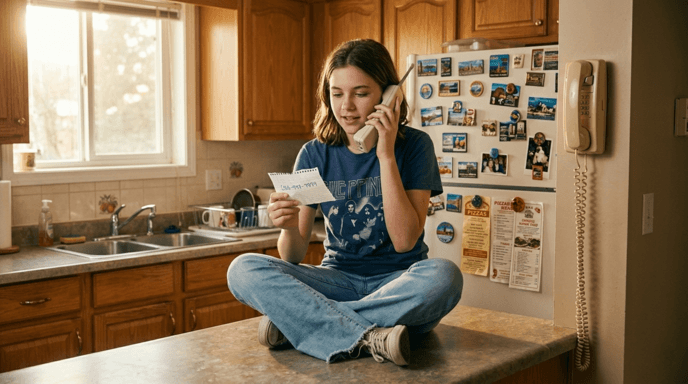
You knew your home phone number. You knew your best friend’s phone number. You knew your parents’ work phone numbers. You knew your father’s cell phone number (if he had one). You knew your grandmother’s phone number. You knew the local pizza delivery restaurant’s phone number. You knew the local movie theater’s showtimes hotline number. According to conservative estimates, most early-2000s teenagers had between 15–30 phone numbers memorized because you either handed someone a slip of paper with your phone number on it or you called directory assistance.
No one thought anything of this. This was normal.
Researchers at Penn State have documented what they call “digital amnesia”; the experience of forgetting information you trust a digital device to store and remember for you. A study conducted by WhistleOut surveyed nearly 1,500 people and discovered that roughly 80 percent of those polled remembered fewer than five phone numbers. In 2003, the average teenager could recite twelve phone numbers without stopping.
It changed almost overnight. Once mobile phones stored contacts digitally, the skill became unnecessary. And once it became unnecessary, the neural pathways eroded with startling speed. Research published inComputers in Human Behavior found that people who rely more heavily on smartphones for information retrieval tend to engage in less analytical thinking; essentially, outsourcing memory to a device changes how your brain allocates effort.
What killed it: Contact lists on mobile phones. The moment you could select “call” versus “dial,” phone numbers disappeared from your brain and never returned.
3. The Friday Night Blockbuster Pilgrimage {#3}

Every Friday evening, families would pile into the car and drive to Blockbuster. At its peak, Blockbuster operated over nine thousand stores worldwide and maintained approximately sixty-five million registered customers. You walked through the door and into that unmistakable smell; a mixture of plastic DVD cases, industrial carpet, and the faint desperation of hoping the one movie you came for wasn’t already rented.
The key issue was supply and demand. There were a finite number of physical copies. If you wanted to watch The Matrix Reloaded on a Friday in 2003, and all seven copies of the film were unavailable for rent, your choices were: choose another movie title, drive to a different Blockbuster store, or leave empty-handed. The idea that “it’s always available” was not applicable to renting movies.
Additionally, Blockbuster charged late fees. In 2000, Blockbuster earned approximately $800 million from late fees alone, accounting for 16 percent of the company’s overall income. You returned a movie one day late and you owed money. Two days late and you owed more money. Should you lose the actual movie altogether, you would be functionally in debt to a video rental store.
Late fees were an acceptable aspect of renting movies at home.
What killed it: Netflix’s DVD-by-mail service eliminated late fees. Then streaming eliminated the need for physical media entirely. Blockbuster famously turned down the chance to buy Netflix for $50 million in 2000; today there remains only one remaining Blockbuster store; located in Bend, Oregon; existing primarily as a tourist attraction.
4. Crafting the Perfect AIM Away Message Like It Was Literature {#4}
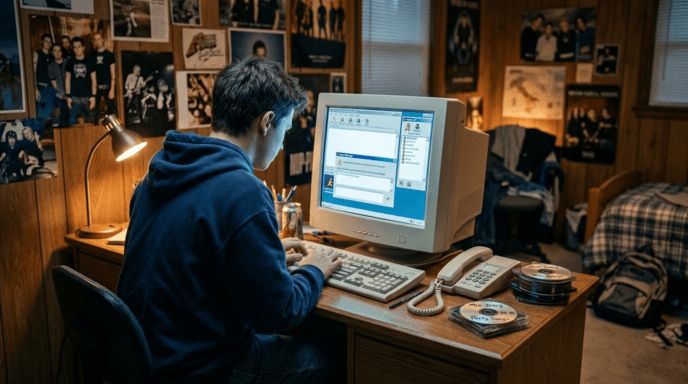
By 2000, AOL Instant Messenger (AIM) attracted 61 million members and accounted for 52 percent of North America’s instant messenger market share by mid-decade. For an entire generation of teenagers, the AIM Away Message was the first public status update; a tiny text box that broadcast your mood, your personality, and your social allegiances to everyone on your Buddy List.
The stakes were absurdly high. You could not merely write “Away.” You needed to compose something. Lyrics from Dashboard Confessional. Inside jokes that referenced only one person. Passive-aggressive subtweets directed at your best friend who sat with someone else at lunch yesterday afternoon. Custom fonts. Custom colors. An author writing for The New Yorker later described AIM as “the cafeteria and the clubhouse, the place where everyone I knew went to meet up and joke around and gossip and fight and flirt.”
Your Away Message represented where you performed your identity before your identity performance had an official name. What makes it especially bizarre compared to today is the effort-to-audience ratio. You spent 15 minutes perfecting a status that maybe 40 people would see, most of whom already knew exactly what you were talking about.
AIM shut down permanently on December 15, 2017. The DNA of an Away Message lives within every Instagram bio, Twitter status update, and Slack status update that you have ever created.
What killed it: Social media platforms offered permanent profiles visible at all times. AIM’s binary online/offline model couldn’t compete with a world where you were never truly away.
5. Burning a Mix CD as the Ultimate Act of Devotion {#5}
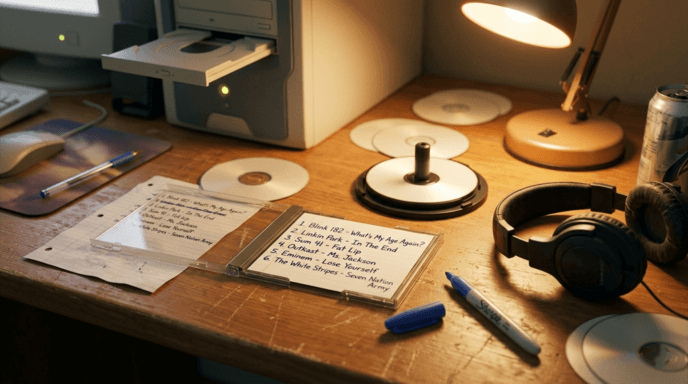
Mix CDs were the ultimate expression of devotion in the early 2000s. You opened your CD burning software; Nero, Roxio, or Windows Media Player; selected precisely the right songs in precisely the right order, and ensured that the total run time was under eighty minutes since most CD-Rs contained 700 megabytes of storage space. Then you burned the CD; a process taking anywhere from ten minutes to thirty minutes; rendering your computer completely useless during that timeframe. Should you fail to successfully complete a burn cycle, you would waste an entire disc and begin again.
Once completed, you would take an extra few minutes to handwrite the track listing directly onto the CD using a Sharpie, or print a custom insert with lyrics, song titles, dedications, and possibly some clip art retrieved from Ask Jeeves.
This was not casual. This was an investment of 45 minutes to two hours of focused creative labor, and the result was a physical artifact that said “I thought about you for this long and curated these songs specifically for your ears.” While the music industry experienced declining sales from $14.6 billion in 1999 to $9 billion in 2008, blank CD-Rs were gradually becoming their own form of currency representing expressions of devotion.
What killed it: Spotify playlists allow users to curate collections of songs and easily share those playlists; typically in under four seconds. While the gesture is identical, the effort required is incomparably smaller.
6. Waiting for Dial-Up Internet to Connect While Everyone Screamed at You {#6}
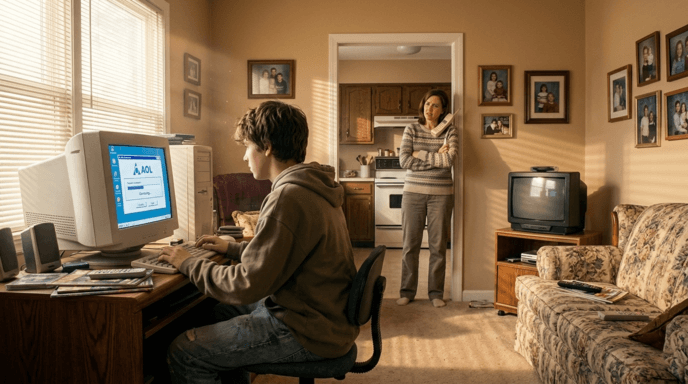
If you lived online during the years 1996 through roughly 2004, you remember the sound. Shrieks. Beeps. Static bursts. Tonal handshakes between the modem and the server. The process took 20 to 45 seconds. During those moments, your phone line was occupied. Meaning if anyone in the house picked up the phone, your connection would die. If someone needed to make a call, you had to disconnect. If your mother was expecting a call from your aunt, you were not going online.
In 2000; AOL’s peak year; 25 million subscribers used AOL dial-up service. According to Pew Research Center data, as late as March 2003, 37 percent of American internet users still connected via dial-up, compared to only 16 percent on broadband. However, by the end of March 2006, broadband use reached 42 percent of all adult Americans, but dial-up did not vanish overnight. In fact, as recently as 2015, 2.1 million Americans still used AOL dial-up.
Dial-up speeds were staggering by today’s standards, with a good day yielding 56 kilobits per second. An image-heavy webpage could take over a minute to load. A three-megabyte MP3 file could take anywhere between ten to fifteen minutes to download. And throughout the entire process, both the telephone and the internet were locked in a zero-sum competition for the same copper wire.
What killed it: Broadband cable and DSL connections, which were always on, didn’t tie up the phone line, and were orders of magnitude faster than dial-up. Although the transition was slow and uneven, by the end of the 2000s, dial-up became a relic.
7. Downloading a Single Song on LimeWire and Hoping It Wasn’t a Virus {#7}

You wanted one song. You opened LimeWire or Kazaa or BearShare, typed in the title of the song you desired, and a list of files appeared. Some files were three megabytes in size. Others were seven megabytes in size. Other files had very suspicious filenames. You clicked “download,” and twenty minutes later you had either the song you wanted, a completely different song mislabeled with the correct title, a corrupted file, or a virus that required your father to spend the next weekend reformatting the family computer.
The Recording Industry Association of America took this personally. By the mid-2000s, the RIAA filed more than 30,000 lawsuits against individual file sharers. A mother in Minnesota was initially ordered to pay $1.9 million for sharing 24 songs, a figure which was eventually reduced upon appeal. LimeWire also agreed to pay $105 million to settle with major record labels after a court found that 98.8 percent of all traffic on LimeWire involved unauthorized copyrighted material.
What makes this behavior especially unhinged looking back is the risk-reward calculation you made before engaging in it. You were willing to expose your family computer to malware, potentially face federal charges, and spend half an hour downloading a single song; all to avoid spending $0.99 on a song purchase from Apple’s iTunes Store, which launched in April 2003.
What killed it: The moment legal music became cheaper, faster, and safer than illegal music, piracy stopped being a lifestyle and became a hassle.
8. Ranking Your Friends Publicly on Your MySpace Top 8 {#8}

MySpace peaked approximately 2007–2008 with an estimated monthly active user base of over 100 million visitors. The signature feature of MySpace; the “Top 8”; was a section on each user’s profile where they publicly displayed their eight closest friends ranked in order of importance. Everyone who was listed as a friend could see who made the cut and who didn’t. Your best friend could see whether they were ranked number one or four. Your ex could see whether they’d been removed. The social hierarchy of your peer group was literally visible online for anyone with access to the internet to judge.
This was considered a perfectly normal feature of a social network.
Real consequences for real people followed quickly. Moving down from being ranked #2 to #5 was a demotion visible to everyone. Being removed from the Top 8 altogether was the equivalent of being blocked, unfollowed, and subtweeted all simultaneously. Friendships ended over Top 8 positioning. Significant romantic relationships were declared by placing a significant other in the number one slot.
No social media platform since has replicated this level of forced, public relationship ranking. Instagram doesn’t require you to create a list of your eight favorite people. Facebook doesn’t rank friends. The concept of public ranking was something that nobody admitted was actually an experiment at the time, and the results consisted primarily of anxiety, conflict, and an entire generation of people who learned how fragile online social capital really is.
What killed it: Facebook. When Facebook overtook MySpace, it quietly dropped the public ranking concept. Your friend list just became a list without any sort of hierarchy or drama; at least none specifically caused by this feature.
9. Calling a Landline and Asking a Parent for Permission to Speak to Their Child {#9}

You wanted to talk to your friend. So you picked up the landline, called them, waited until someone answered (most likely their parent). Once someone answered, you had to identify yourself, state why you called, and politely request to be transferred to whomever you were trying to reach. Maybe they said yes, maybe they said “they’re eating dinner, try again in an hour,” maybe they said “who is this?” in a tone that caused you to question whether talking to them right now was such a great idea after all.
In 2001, landline penetration reached 97 percent of U.S. households, according to Pew Research Center analysis of government data. By the early 1990s, nearly three-quarters of U.S. households had answering machines, meaning that even if nobody picked up, a caller would leave a message saying “hi, it’s [your name]; is [friend’s name] home?” that would be heard by every member of the household.
There was no texting. There was no direct messaging. There was no way to contact another person without first going through the gatekeeper device located in their kitchen.
Every conversation was, by design, a semi-public negotiation.
What killed it: Private cell phones provided every person their own unique number, ending forever the era of calling a household.
10. Using a Disposable Camera and Waiting a Week to See Your Own Photos {#10}

You spent $8–$12 at a drugstore buying a Fujifilm or Kodak disposable camera containing either 24 or 27 frames. Each photo cost roughly $0.40–$0.50 once processing fees were included; because there was no preview screen, no delete button, you aimed, fired, heard a click, and had absolutely no idea what type of moment you may have captured until you physically walked to the local CVS, Walgreens, or Walmart photo counter, dropped off the film, and waited anywhere between three to seven days for the prints to come back.
Thus, every photo shot was a gamble.
You couldn’t review or retake shots. You couldn’t apply filters. You couldn’t crop. You composed each frame in your head, fired away, and waited a week to find out if your composition was properly executed, if everyone in the picture had their eyes open, and if the flash fired properly.
The concept of taking forty-seven photos of the same plate of food to find the perfect angle for Instagram was technologically impossible and would have been considered utterly bizarre behavior.
The transition from film to digital accelerated rapidly through the early 2000s as consumer digital cameras became affordable, and the smartphone camera eventually eliminated the dedicated camera for most casual users entirely.
What killed it: Digital cameras, and later smartphone cameras; instant review, unlimited storage, and zero processing time made disposable cameras’ value proposition obsolete.
11. Watching Whatever Was on TV Because That’s All There Was {#11}

There were no queues. There were no algorithms. There was no “Continue Watching.” You flipped on the TV and whatever channel you landed on because of how many channels (50 to 200) your cable service had available to watch at that moment was what you would be watching. If nothing good was on, you watched something mediocre. And if that didn’t pan out either, you would have been stuck watching infomercials. The concept of selecting specific content on demand simply did not exist for most households until the late 2000s.
TV Guide magazine was once essential infrastructure for this system. At one point, TV Guide magazine reached a peak audience of about 20 million readers. By 2010, circulation dropped dramatically from 9.1 million down to just over 2 million, and continued to drop as more viewers started using free online programming listings along with on-screen TV listings, eliminating the need for a weekly printed magazine.
The behavioral result of this model of viewing television was that television viewing became a shared, synchronized experience. On Thursday nights during the original run of Friends, tens of millions of people viewed it at the same time. In the days after the airing, you could discuss it with others who attended school or worked with you, assuming they all saw it at the same time. Since the rise of binge-watching culture today, the possibility exists that two people are currently viewing the exact same series but are both on different episodes for several weeks. The synchronized communal nature of television viewing in the early 2000s is dead and gone.
What killed it: DVRs, on-demand cable services, and ultimately streaming platforms. The ability to watch what you want when you want it turned live broadcast from the default into a choice.
12. Sitting Through Every Single Commercial During a Commercial Break Without Checking Your Phone {#12}

You stayed. You watched it. You watched everything. You watched the car commercial, the pharmaceutical advertisement listing side effects for 30 seconds, the local furniture store advertisement featuring the owner yelling about weekend-only prices, and the Coca-Cola advertisement that was objectively very well made. You watched four to six minutes of advertising without using your phone, checking an application, or scrolling through anything because you couldn’t use a phone, check an application, or scroll through anything.
Second screens did not exist. Your phone was in the kitchen on a wall. Your computer was in the den, turned off. The remote control was the only technology within reach, and channel surfing during a break was the sole available escape.
Currently, during a commercial break, 41 percent of American adults who are “almost constantly” online will grab their phone. Back in the early 2000s, you simply waited. You either looked at the screen or looked at the wall, and either choice was perfectly acceptable.
What killed it: Smartphones and DVRs. The ability to skip advertisements (DVRs) or fill the dead airtime with a phone (smartphones) meant that sitting through a full commercial break became something that only happened if every device in your home was dead.
13. Looking Something Up in a Physical Encyclopedia for a School Report {#13}

Your teacher gave you an assignment on the Nile River. You walked to the bookshelf, pulled down the “N” volume of your family’s encyclopedia set, and flipped to the entry. You copied important information in your notebook. If your family did not own an encyclopedia, you visited your local library and browsed through the reference section for the same resource. Encyclopædia Britannica’s book sales peaked in 1990 and then declined by 60 percent in just six years as CD-ROM references such as Microsoft Encarta and eventually the internet replaced print references. Eventually, Encyclopædia Britannica stopped producing print editions in 2012 after publishing continuously for 244 years. Prior to Encarta and the internet, buying an encyclopedia was seen as a point of domestic pride; comparable to having fine china; and cost roughly $1,400 for a complete 32-volume set.
The research process is significantly different today. You could not search for phrases such as “Nile River length controversy” or “was the Nile River longer than the Amazon.” You opened to the article and received what the authors wrote. Cross-referencing required looking up another volume. Getting deeper into research involved visiting the library. The idea that every fact in human history would be searchable from your pocket in real time was science fiction.
What killed it: Wikipedia (launched January 2001), Google, and the transition to searching for references online.
14. Buying a Whole Album for One Song {#14}

You heard a song on the radio. You loved it. You drove to Tower Records, Sam Goody, or Best Buy. You spent $13–$18 for an entire album. You took it home, removed the plastic wrapping, opened the jewel case, and discovered that the one song you wanted was Track 7 on the album and the remaining eleven songs were somewhere between mediocre and bad.
For nearly forty years, this was how the recorded music industry operated, and it worked spectacularly well; U.S. CD sales reached $14.6 billion in 1999. You paid for an entire package while you only wanted a single product. Industry professionals knew this was a forced bundling issue and were quite comfortable with it.
When Apple released the iTunes Store in April 2003 allowing users to purchase individual songs at $0.99 per song, it did not simply provide a new price model. It exposed how the old model had been a forced bundle all along. As soon as consumers were able to unbundle albums, overall recorded music sales in the United States began to drop from their previous high in 1999.
What killed it: Digital singles and streaming services. Unbundling the album was one of the most significant changes in entertainment economics of the twenty-first century.
15. Leaving the House With No Way to Be Contacted {#15}

You left. Your parents said “be back by dinner.” You walked out the door, and from that moment until you returned, you were unreachable. No one could text you. No one could call you. No one could track your location. If plans changed, if someone was running late, if there was an emergency, the only option was to physically go to where you were expected to be and hope you were there.
This wasn’t reckless. This was Tuesday.
Today, leaving the house without a phone triggers genuine anxiety; not just in parents, but in the person leaving. Pew Research Center has documented the steady rise of constant connectivity, and research on phantom vibration syndrome confirms that nearly 90 percent of people have felt their phone vibrate when it hadn’t; evidence that our nervous systems have adapted to expect perpetual contact. In the early 2000s, being unreachable was the default state of being outside your home.
What killed it: The personal cell phone and then the smartphone. Once you could be reached anywhere, the expectation became that you would be reached anywhere, and the window for unsupervised, untracked, uncontactable existence closed permanently.
16. Printing an Entire Essay at a Friend’s House Because Your Printer Was Out of Ink {#16}

Your paper was due tomorrow and your printer ran out of cyan ink, preventing it from printing simple black text documents. Your options were: (a) drive to Staples and buy a $35 cyan ink cartridge, (b) call a friend, explain the situation, save your document to a floppy disk or later via USB stick, and make copies of your essay at their place, or (c) arrive at school tomorrow before classes start and plead with your school librarian to allow you to use their school printer before class starts.
Option B was usually chosen by most students. The floppy disk (1.44 MB capacity) had space for approximately 500 pages of plain text, which was plenty enough for a standard five-page English paper.
You traveled to your friend’s house, placed the floppy disk in their PC (hopefully their version of Microsoft Word would load your file correctly), prayed that their software loaded your file properly, and printed your copy. Occasionally formatting would change; occasionally fonts would change; sometimes page breaks would move; you took whatever came out of the printer and stapled it together.
The entire scenario; the ink crisis, the drive, the compatibility prayer, the reformatting; would be completely alien to a student in 2026 who can submit a Google Doc from their phone.
What killed it: Email attachments, cloud storage, and digital submission processes. The physical printer went from essential to optional to irrelevant for most student work.
17. Waking Up at 7 AM on Saturday for Cartoons Because You Had No Other Option {#17}

Saturday morning cartoons were a staple of American childhood for nearly four decades. The routine was non-negotiable: wake up before your parents, pour cereal, sit on the floor in front of the television, and watch three to four hours of animated programming that aired only during this specific window. If you overslept, you missed it. There was no DVR, no on-demand service, no YouTube. The last Saturday morning cartoon block on a major broadcast network aired on September 27, 2014.
Several factors led to the demise of Saturday morning cartoons, including the Children’s Television Act of 1990, which mandated educational programming requirements that reduced the profitability of broadcasting cartoons; 24-hour-a-day cable networks such as Cartoon Network and Nickelodeon, which carried cartoons at various times throughout each day; and ultimately, streaming platforms that rendered scheduling obsolete.
During this time, waking up early enough on Saturday mornings was a ritualistic event for kids in America. They organized their lives around watching Saturday morning cartoons. They set internal alarms so they would not sleep past their favorite show’s time slot. Siblings would fight over which channel they should watch cartoons on.
Watching cartoons together was a communal experience, limited by timing and scarcity in a way that on-demand content can never replicate.
What killed it: Cable channels carrying cartoons (Cartoon Network and Nickelodeon), DVRs, and streaming services. Once viewers can watch cartoons at any time anywhere, Saturday morning cartoon blocks become structurally obsolete.
18. Screening Calls by Listening to the Answering Machine in Real Time {#18}

Phone rings. No one moves. Phone answers; outgoing greeting plays. Caller begins speaking, and the voice is heard through the speaker of the answering machine in the same instant. Entire household listens. If the caller is a person you want to speak to, you rush to pick up the phone during the message. If the caller is a telemarketer, you allow them to complete the message and then the machine swallows it. If the caller is your aunt calling about some subject you don’t feel like discussing today, you exchange glances with your family and collectively agree, through silent eye contact, to let it go to the machine.
Call screening was never done better than this. Nearly 75 percent of U.S. households were using answering machines by the mid-1990s, and the Library of Congress has described the answering machine as a key contributor to “our anxiety-ridden culture of continuous communication.” The speaker portion of the answering machine made every incoming call into a live audition. The household would judge the audition prior to determining whether they would participate.
What killed it: Caller ID, voicemail, and cell phones killed it. When you can view who is calling prior to answering, and when voicemail captures messages silently without broadcasting them to the room, there was no longer any need to screen calls in real time.
What These 18 Behaviors Have in Common
Each one of these behaviors made perfect sense at the time based on technological limitations. In those days, you memorized your friends’ phone numbers because contact lists didn’t exist. You printed out directions using MapQuest because there wasn’t GPS. You burned mix CDs because there weren’t playlist apps. You screened incoming calls via an answering machine because there wasn’t caller ID.
These things that were normal in the early 2000s weren’t stupid; they were the most efficient solutions available within the technological boundaries of the time. The reason they seem unhinged now is not that we became smarter; it’s that the constraints disappeared. The smartphone removed so many friction points from daily life so quickly that the pre-smartphone world now feels like a different civilization rather than a different decade.
The early 2000s were the final era in which it was considered normal to be unable to reach someone, boredom was unavoidable without deliberate effort to escape it, and it was normal to go somewhere to enjoy some form of entertainment. Everything on this list was standard operating procedure for a species that had not yet learned to carry the entire internet in its pocket. This species very quickly learned that lesson, and once it did, it couldn’t unlearn it.
You either lived it yourself, or you know someone who remembers having to dial a phone number over and over until they finally get through, hang up, and try again in five minutes.
They will both agree: it all really happened.
Early 2000s Behaviors vs. 2026: A Quick Comparison
| # | Early 2000s Behavior | 2026 Equivalent | What Changed | Key Fact |
|---|---|---|---|---|
| 1 | Printing MapQuest Directions | Google Maps / Apple Maps GPS | Real-time navigation on smartphones replaced paper printouts | MapQuest dominated online directions 1996–2006 |
| 2 | Memorizing 15–30 Phone Numbers | Contacts app stores thousands | Digital memory replaced biological memory | 80% of people now recall fewer than 5 numbers |
| 3 | Friday Night Blockbuster Trip | Netflix / streaming queue | Unlimited on-demand content from home | Blockbuster earned $800M in late fees in 2000 |
| 4 | AIM Away Messages | Instagram bio / Slack status | Always-visible persistent profiles replaced binary online/offline | AIM had 61 million users by 2000 |
| 5 | Burning a Mix CD (45+ min) | Sharing a Spotify playlist (4 sec) | Digital distribution eliminated physical media effort | CD-Rs held 700MB / ~80 minutes of audio |
| 6 | Dial-Up Internet (56 kbps) | 5G / fiber broadband (1+ Gbps) | Speed increased ~20,000x; always-on connection | 25 million AOL dial-up subscribers in 2000 |
| 7 | Downloading Songs on LimeWire | Spotify / Apple Music streaming | Legal access became cheaper and safer than piracy | RIAA filed 30,000+ lawsuits against file sharers |
| 8 | MySpace Top 8 Ranking | No modern equivalent | Public friend-ranking was too socially destructive to survive | MySpace peaked at 100M+ monthly visitors |
| 9 | Calling a Landline / Parent Gatekeeping | Texting / DM directly | Personal devices bypassed household gatekeepers | 97% of U.S. households had landlines in 2001 |
| 10 | Disposable Camera (24 shots, week wait) | Smartphone camera (unlimited, instant) | Zero cost per shot, instant review | Each photo cost ~$0.40–$0.50 with processing |
| 11 | Watching Whatever Was on TV | Streaming on demand | Content scarcity replaced by infinite choice | TV Guide circulation fell from 9.1M to 2M by 2010 |
| 12 | Sitting Through Full Commercial Breaks | Skipping ads / second-screen scrolling | DVRs and smartphones filled dead time | 41% of adults are “almost constantly” online |
| 13 | Encyclopedia Research (Physical Books) | Google / Wikipedia search (seconds) | Instant access to all human knowledge | Britannica stopped print after 244 years in 2012 |
| 14 | Buying a Full Album for One Song ($16) | Streaming any song ($0 with ads) | Unbundling of the album format | U.S. CD sales peaked at $14.6 billion in 1999 |
| 15 | Leaving the House Unreachable | GPS-tracked, always connected | Perpetual connectivity became the default expectation | ~90% of people experience phantom vibration syndrome |
| 16 | Printing Essay at Friend’s House (Floppy Disk) | Google Docs / cloud submission | Cloud eliminated physical file transfer | Floppy disk capacity: 1.44 MB |
| 17 | Saturday Morning Cartoons (Scheduled) | On-demand streaming (anytime) | 24/7 access eliminated scheduled scarcity | Last broadcast block aired Sept. 27, 2014 |
| 18 | Answering Machine Call Screening | Caller ID / voicemail | Silent identification replaced live broadcast screening | ~75% of U.S. households had answering machines by mid-1990s |
Frequently Asked Questions {#faqs}
Why do early 2000s nostalgia lists emphasize products over behaviors?
Products are visually recognizable and instantly photographable, making them ideal for image-heavy listicles. A Tamagotchi looks like a Tamagotchi in a thumbnail. But “calling a landline and asking a parent for permission to speak” is harder to visualize, even though it reveals far more about how people actually lived. Products show us what people used while they were living. Behavior tells us how people lived.
When did the early 2000s technological limbo finally come to an end?
There is one single date where this transition became most evident; June 29, 2007, when Apple launched the first iPhone. However, it wasn’t until later that widespread use of smartphones became prevalent. A more accurate answer is that the liminal period ran from roughly 2000 to 2010, with the sharpest transition occurring between 2007 and 2012, when smartphones, social media, and streaming services all reached critical mass at the same time.
Were early 2000s behaviors less efficient, or just different in terms of efficiency?
Both. Memorizing phone numbers was cognitively demanding but eliminated device dependency. Printing MapQuest directions took longer than using GPS navigation but allowed users to navigate regardless of whether their device was charged or had cell service. Each early 2000s behavior presented a trade-off; either in terms of mental effort or lack of reliance upon devices. Smartphones essentially flipped this equation and moved the burden from users to device capabilities. Whether this shift was entirely positive depends on what one values; the early 2000s required more effort from users but created more resilient habits.
Why is early 2000s nostalgia viewed as distinct from 1980s or 1990s nostalgia?
Because the early 2000s were the last pre-smartphone era, and the smartphone changed daily life more fundamentally than any single technology since electricity. Early 2000s nostalgia is therefore seen as structural rather than merely aesthetic; the world represented by early 2000s nostalgia is not just dated but functionally impossible to recreate. It is possible to purchase cassette tapes in 2026. There is no possibility of forgetting that Google Maps exists.
Which early 2000s behavior do people miss most?
Based on the volume and emotional intensity of online discussions (from Reddit’s r/nostalgia community to BuzzFeed comment sections), the behaviors that appear to be missed the most include: leaving the house with no way to be contacted (freedom), Friday night Blockbuster trips (ritual), and creating mix CDs (personal effort). All three share a similar theme: they involved intentional effort and physical presence in a way that their digital replacements do not.


