




A 70-meter pit of fire burning continuously in a desert since 1971. 10,582 square kilometers of salt reflecting the sky perfectly in just 1.8 centimeters of water. Electric blue flames combusting at 600 degrees while miners carry 80-kilogram loads of sulfur through toxic fumes in the dark. 600-year-old dead trees standing perfectly preserved against 300-meter-high dunes of crimson sand. We spend billions launching deep-space probes to search the distant cosmos for strange, alien worlds. We should probably realize that we are already standing on one.
There are places on this Earth that should not exist.
Not metaphorically. Literally. Salt flats that reflect the light so perfectly that the ground seems to disappear from under your feet and you’re walking through the sky. Volcanoes that burn blue in the darkness. Forests composed solely of stone. Nine-hundred-year-old trees that won’t decompose and a crater that has burned continuously since 1971. Soviet engineers thought it would burn for just a couple of weeks. It didn’t.
The majority of travel content simply regurgitates the same eight or nine “otherworldly” locations — Iceland, Cappadocia, Antelope Canyon — and cycling them through list articles with two-sentence blurbs and a stock photograph. The 2026 travel discussion has shifted toward what Vogue referred to as the “Mystic Outlands” trend — a growing desire for surreal, escapist hidden gem travel destinations where the landscape is the main draw.
Each of the surreal places on Earth listed below is unique in the way its geological, ecological, or atmospheric conditions create a visual experience that does not exist anywhere else on our home planet. We confirmed the scientific basis for the oddities of each location, examined the feasibility of reaching it, and used the Vibe List’s editorial criteria to assess whether the destinations deliver on their promises. Some are accessible weekend excursions. Others demand expedition-level logistics and the ability to tolerate conditions that most travelers will never encounter. If you have been searching for unusual places to visit that go beyond the typical travel list, this is where to start.
Every one of these destinations will change how you think about the surface of this planet.
1. Socotra Island, Yemen {#socotra}
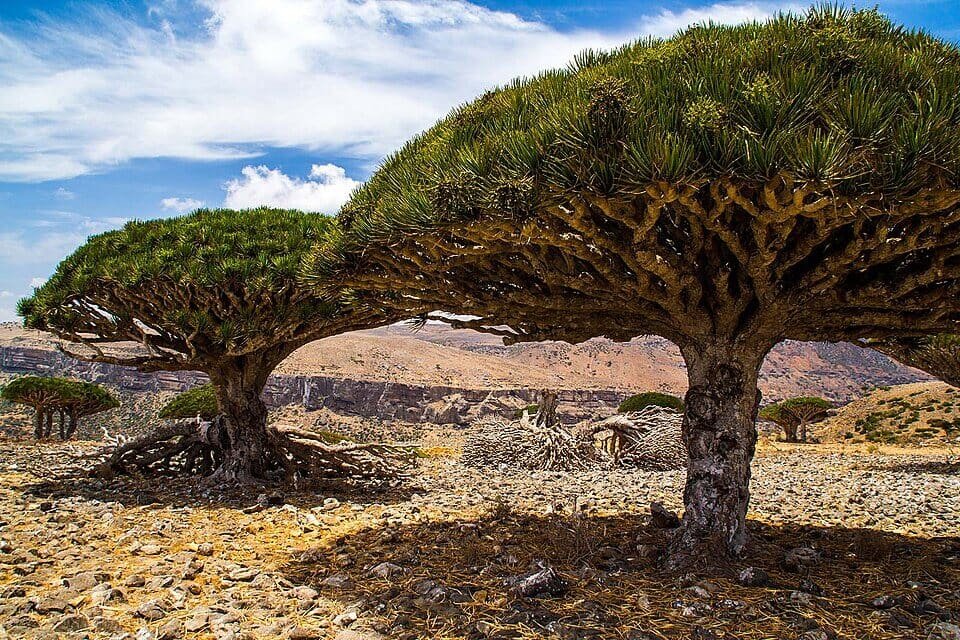
Why it feels alien: The flora. Nothing on Earth looks like anything on Socotra.
Socotra Archipelago is located 250 kilometers off the Horn of Africa in the northwest Indian Ocean. Because of its prolonged geological isolation, Socotra has developed an ecosystem that could be classified as biological science fiction. According to UNESCO’s World Heritage designation, 37 percent of Socotra’s 825 plant species are found nowhere else on Earth. Ninety percent of its reptile species and 95 percent of its land snail species are found nowhere else. UNESCO describes Socotra as a site of “universal importance” for biodiversity, a comparison otherwise reserved for the Galápagos.
The signature species is the dragon blood tree (Dracaena cinnabari), which appears so unlikely in form that it looks more like concept art than something evolved in nature. Dragon blood trees spread their domed canopies like giant mushrooms, producing a bright red sap that has been harvested for medicinal and ceremonial purposes for over a thousand years. Desert roses (Adenium obesum socotranum) emerge as bulbous formations on flat limestone, resembling both bonsai and molten candles. The cucumber tree (Dendrosicyos socotranus) — the only member of the cucumber family that forms a tree — develops a grotesquely swollen trunk, storing water through Socotra’s dry periods.
The landscape these species inhabit is equally bizarre. Limestone plateaus cut by massive canyons. White sand beaches surrounded by turquoise waters that may remind you of the Maldives. Cave systems carved into the rocky core. Socotra feels like four separate planets compressed into 3,625 square kilometers.
The Vibe List’s take: Socotra is the single most alien-looking place on Earth. And it isn’t remotely close. The problem is getting there. The U.S. State Department maintains a Level 4: Do Not Travel advisory for all of Yemen, including Socotra. In early January 2026, the U.S. Embassy noted a limited resumption of commercial flights to the island. While tour operators specializing in Socotra describe the island itself as safe and physically separate from the mainland conflict, getting there is logistically and geopolitically complicated. This is not a casual weekend trip. However, if you can make it work, you will witness things that exist nowhere else on our planet.
Best time to visit: October through April, during the dry season.
2. Danakil Depression, Ethiopia {#danakil}
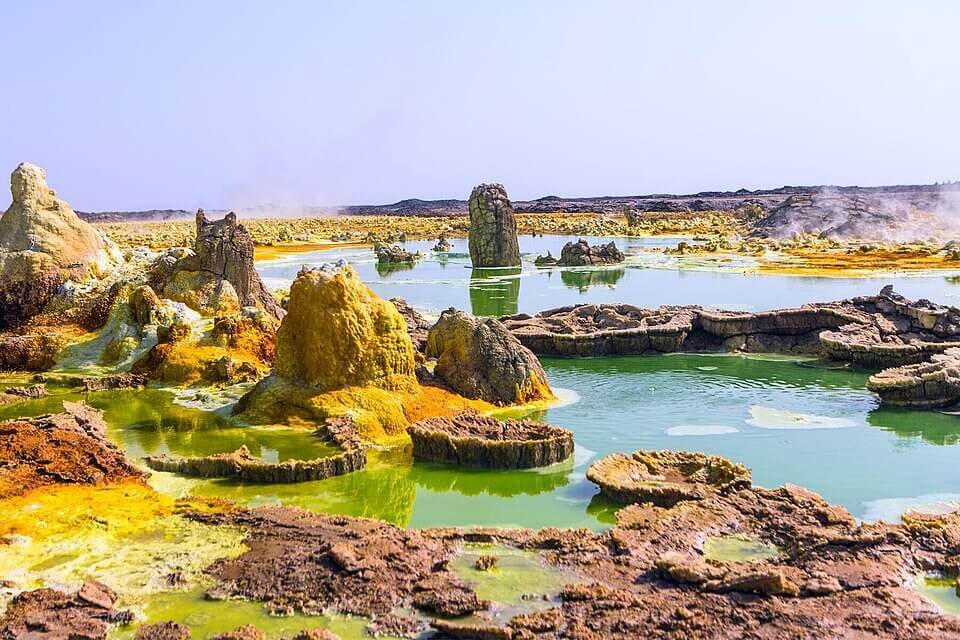
Why it feels alien: The temperatures, the chemistry, and the colors have no business coexisting on the same planet as a temperate forest.
The Danakil Depression in northeastern Ethiopia is the hottest place on Earth measured by year-round average temperatures. Daily high temperatures commonly reach 50°C (122°F). The depression rests approximately 100 meters below sea level, ranking among Earth’s lowest points. The geological driver behind this extreme heat is the divergence of three tectonic plates — the African, Somali, and Arabian — which are slowly separating the Horn of Africa and will ultimately flood this area with seawater, creating a new ocean.
In the meantime, the depression produces a variety of visually stunning features. At Dallol, a volcanic crater within the depression, hydrothermal minerals produce vibrant hues of neon yellow, toxic green, and deep orange caused by interactions between superheated brine and minerals including sulfur and potassium. Acid pools with pH values lower than 1 bubble adjacent to crystallized salt formations. The smell of sulfur permeates the air. One of Earth’s only persistent lava lakes burns inside the shield volcano Erta Ale, providing a radiant orange glow visible from the crater rim at night.
Between the volcanic craters and acid pools, the Afar people have extracted salt from the depression’s floor for generations, manually cutting blocks and loading them onto camel caravans. This is not a museum exhibit; it is a working environment where human endurance meets extreme geology in ways that challenge comprehension.
The Vibe List’s take: Danakil represents the closest you can get to standing on another world without leaving Earth, but doing so comes with a physical cost. Extreme temperatures, sulfur gas, and treacherous terrain render this an expedition — not a vacation. Only guided expeditions departing from Mekelle provide realistic access, usually lasting three to five days with armed escorts due to the proximity of a remote international border. This destination is for travelers who define “rewarding” by the intensity of the experience rather than its comfort.
Best time to visit: November through March, when temperatures are marginally less severe.
3. Tsingy de Bemaraha, Madagascar {#tsingy}
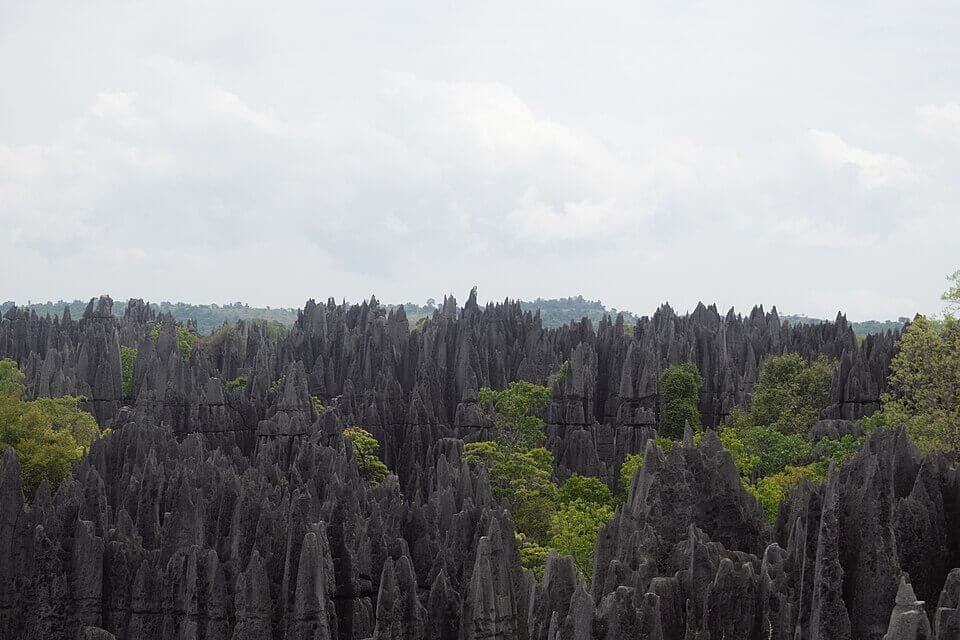
Why it feels alien: The ground itself has become a forest of stone needles — and nothing in your past experiences has prepared you for it.
On the western coast of Madagascar, Tsingy de Bemaraha contains the largest formation of tsingy; a Malagasy word meaning “where one cannot walk barefoot.” These razor-sharp limestone pinnacles stretch vertically as high as 90 meters and were carved over millions of years by tropical rainfall dissolving soluble limestone from above while groundwater eroded it from beneath. The resulting landscape of vertical spikes, narrow chasms, and suspended stone walkways looks like what you would get if Gothic cathedrals and coral reefs collided.
The formation was inscribed as a UNESCO World Heritage Site in 1990 for both its geological uniqueness and its function as habitat for endemic species, including lemurs capable of navigating the jagged stone terrain with acrobatic agility that borders on parody.
Exploring the Grand Tsingy demands climbing metal ladders fastened into rock walls, wearing safety harnesses, and traversing via ferrata-style cable lines. The Strict Nature Reserve section remains largely off-limits to visitors, meaning only a fraction of this vast formation is currently accessible. The sheer impracticality of the terrain — impossible to walk through, drive across, or build upon — has effectively preserved this environment for centuries.
The Vibe List’s take: Tsingy is one of the rare destinations where the word “otherworldly” is a factual description, not marketing language. Photographs of Tsingy depict landscapes so unlike anything else on Earth that they appear digitally manipulated even though they’re real. The major obstacle is infrastructure: reaching Tsingy requires driving 8-10 hours in a 4×4 from Morondava on roads that push the limits of the term. Nonetheless, this is among the strangest places on Earth, and the payoff is a geological landscape unlike any other.
Best time to visit: May through November; the park is inaccessible during the wet season.
4. Zhangye Danxia National Geopark, China {#zhangye}
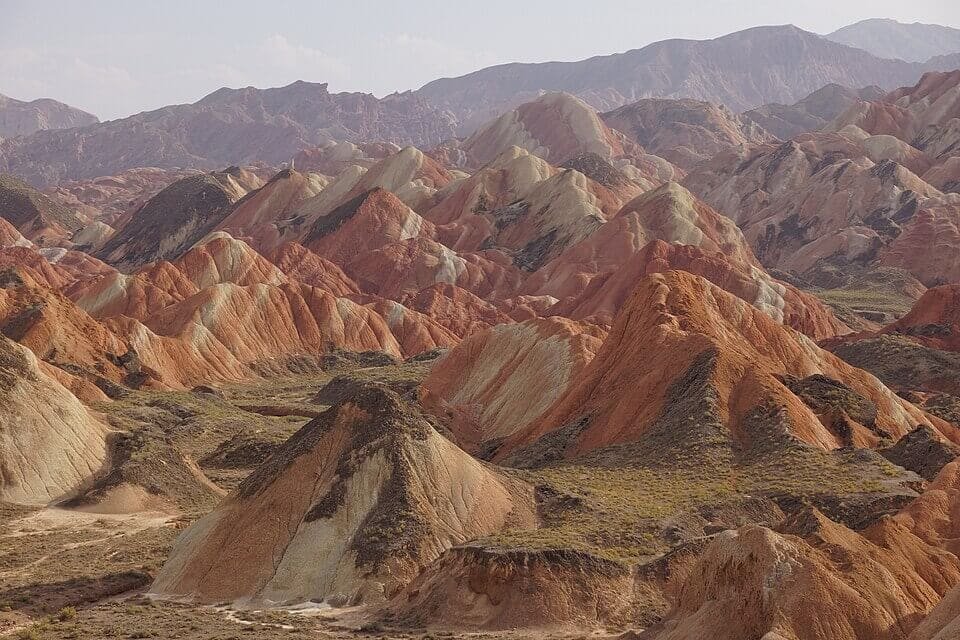
Why it feels alien: The mountains are painted with colors that don’t belong in nature — yet they do.
The Zhangye Danxia National Geopark in Gansu Province covers sandstone formations striped with parallel bands of red, orange, yellow, teal, and lavender. The colors are the result of sandstone and trace mineral deposits laid down over approximately 24 million years and subsequently compressed and uplifted by the collision between the Indian and Eurasian tectonic plates. NASA’s Earth Observatory has documented Zhangye Danxia’s geological history spanning tens of millions of years.
Iron oxide (hematite) in each sedimentary layer produces the red hues. Chlorite-altered sandstone creates the green and teal bands. The result is a landscape that looks like Earth’s crust was sliced open to reveal a painter’s palette beneath.
Viewing areas and boardwalks have been installed throughout the geopark to manage visitor flow while protecting the fragile formations. Four viewing areas capture different angles and color variations; the most dramatic visual effect occurs near sunset when low-angle sunlight intensifies the contrasts between layers.
The Vibe List’s take: The coloration at Zhangye Danxia is so vivid that many viewers assume photographs have been color-enhanced. They have not. The formations genuinely display those colors, and seeing them in person surpasses any photograph. The geopark is well-managed and accessible by road from Zhangye City, making it one of the most approachable destinations on this list. The trade-off is that boardwalks and fixed viewing platforms reduce the sense of discovery, though the experience works for visitors at every fitness level.
Best time to visit: June through September for the clearest skies and best light conditions.
5. Salar de Uyuni, Bolivia {#salar}
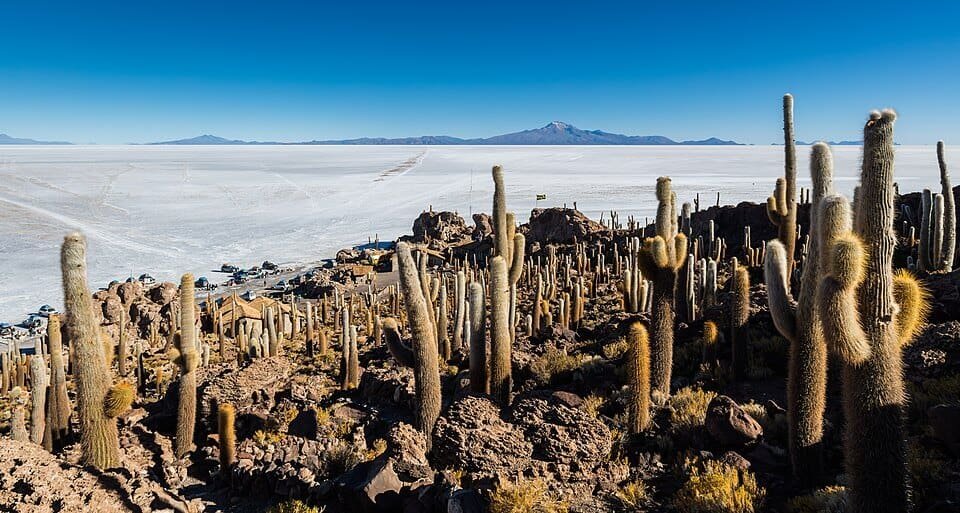
Why it feels alien: The ground vanishes. You are standing in the sky.
The Salar de Uyuni in southwestern Bolivia is the largest salt flat on Earth; approximately 10,582 square kilometers of crystallized salt that exhibits less than one meter of vertical relief across its entire surface. That flatness is the key. During the wet season (December through April), a thin layer of rainwater floods the salt flat and transforms it into the world’s largest natural mirror. The European Space Agency’s Copernicus Sentinel-3 satellite measured the water layer at just 1.8 centimeters deep during peak mirror conditions; thin enough to create a specular reflection so precise that the horizon disappears and the sky extends in every direction, including beneath your feet.
The salt crust is up to eight meters thick in places and sits atop a brine rich in lithium; the United States Geological Survey considers Uyuni one of the largest lithium deposits in the world. The flat formed roughly 30,000-40,000 years ago from the evaporation of prehistoric lakes, and its hexagonal salt tile patterns during the dry season are visually striking on their own.
The Vibe List’s take: Uyuni appears on many “otherworldly” lists, and for once the consensus is deserved. The mirror effect during the wet season is one of the most photographically surreal experiences on the planet; the vanishing horizon genuinely disorients your spatial awareness in a way that no photograph fully conveys. Tours depart from the town of Uyuni, conditions vary significantly by season, and the best mirror conditions require rainfall followed by calm winds. Dry season visits (May through November) offer a different but equally striking experience: hexagonal salt patterns stretching to the horizon under crystalline Andean skies.
Best time to visit: February through April for the mirror effect; June through October for dry salt patterns and stargazing.
6. Lençóis Maranhenses, Brazil {#lencois}
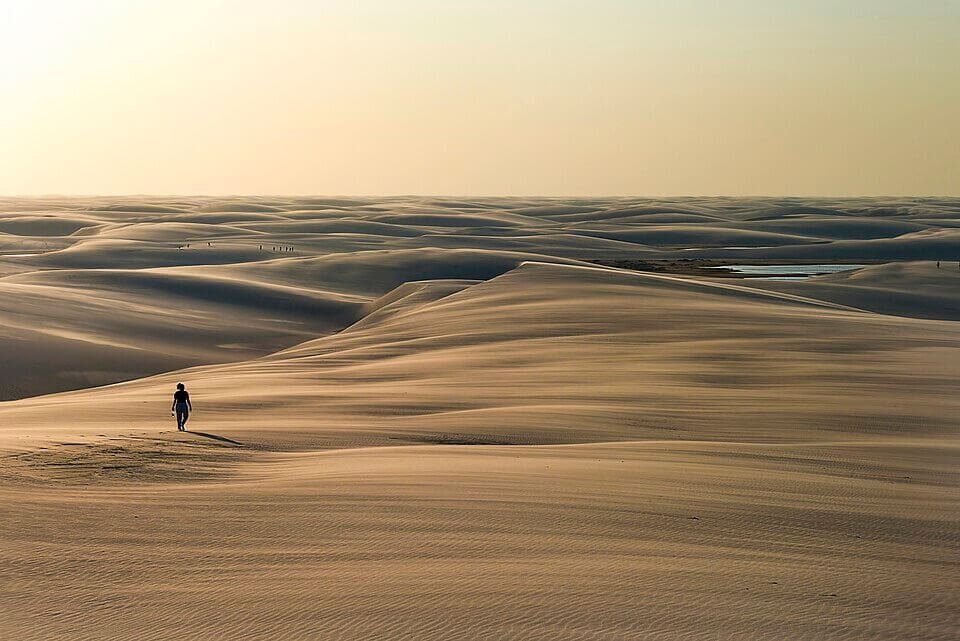
Why it feels alien: A desert that fills with thousands of freshwater lagoons every year should not work. It does.
The Lençóis Maranhenses National Park in northeastern Brazil covers 155,000 hectares (approximately 1,550 square kilometers) of rolling white sand dunes that, during the rainy season, fill with thousands of crystal-clear freshwater lagoons. The BBC described the landscape as a “lagoon-filled desert you can hike barefoot”; dunes rising up to 30 meters, with lagoons large enough to swim in, pooling in the valleys between dunes.
The geological explanation is counterintuitive. Despite looking like a desert, the park receives approximately 1,600 millimeters of rainfall per year — far more than a true desert. The sand sits atop an impermeable layer of clay or peat that prevents rainwater from draining, forcing it to pool between the dunes. The lagoons appear between January and June, peak around May, and begin evaporating by September. Some lagoons develop fish populations despite being temporary — a phenomenon that has puzzled researchers.
The Vibe List’s take: Lençóis Maranhenses is the most visually disorienting entry on this list that is also genuinely comfortable to visit. The sand is soft and cool enough to walk barefoot, the lagoons are clean enough to swim in, and the nearest town of Barreirinhas has the tourism basics covered. It is the rare surreal landscape that does not punish you for wanting to experience it. The catch is timing; arrive outside the lagoon season and you see only sand. Arrive during peak lagoon conditions and the landscape looks like a rendering error in a simulation.
Best time to visit: May through September; the lagoons are fullest in June and July.
7. Wadi Rum, Jordan {#wadi-rum}
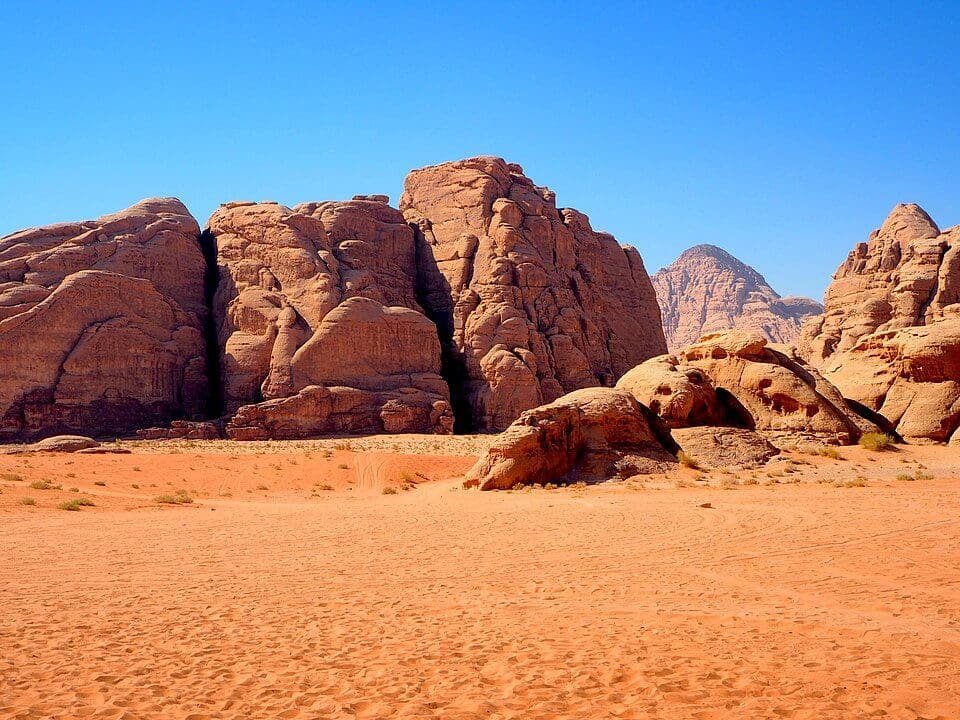
Why it feels alien: Hollywood agrees. This is Mars.
Wadi Rum in southern Jordan is a UNESCO World Heritage Site whose red sandstone and granite landscape has doubled as Mars in virtually every major film that needed a Red Planet stand-in. NASA’s Earth Observatory has noted Wadi Rum’s role as cinema’s default Mars, and the films shot here include The Martian, Dune, Rogue One: A Star Wars Story, and Lawrence of Arabia.
The geological reality justifies the comparison. Sandstone monoliths rise hundreds of meters from the desert floor, their surfaces carved by wind erosion into arches, bridges, and narrow canyons. The iron-rich sand produces a color palette of deep reds, burnt oranges, and dusty pinks that shifts dramatically with the position of the sun. At midday, the desert is harshly bright. At sunset, it glows. At night, the absence of light pollution produces what many visitors describe as the clearest sky they have ever seen.
Jordan’s broader appeal is explored in our feature on criminally overlooked countries, which details the country’s tourism recovery. For travelers drawn to European beauty instead, our list of the most beautiful cities in Europe offers a different kind of visual spectacle.
The Vibe List’s take: Wadi Rum is one of the few places on this list where the extraterrestrial comparison is not hyperbole; it is literally why filmmakers shoot there. The overnight Bedouin camp experience — sleeping in the open desert with the Milky Way visible in its entirety above you — is the kind of experience that justifies an entire trip to Jordan. The site is also remarkably accessible: established tourist routes originate from Wadi Rum Village.
Best time to visit: March through May or September through November for moderate desert temperatures.
8. Pamukkale, Turkey {#pamukkale}
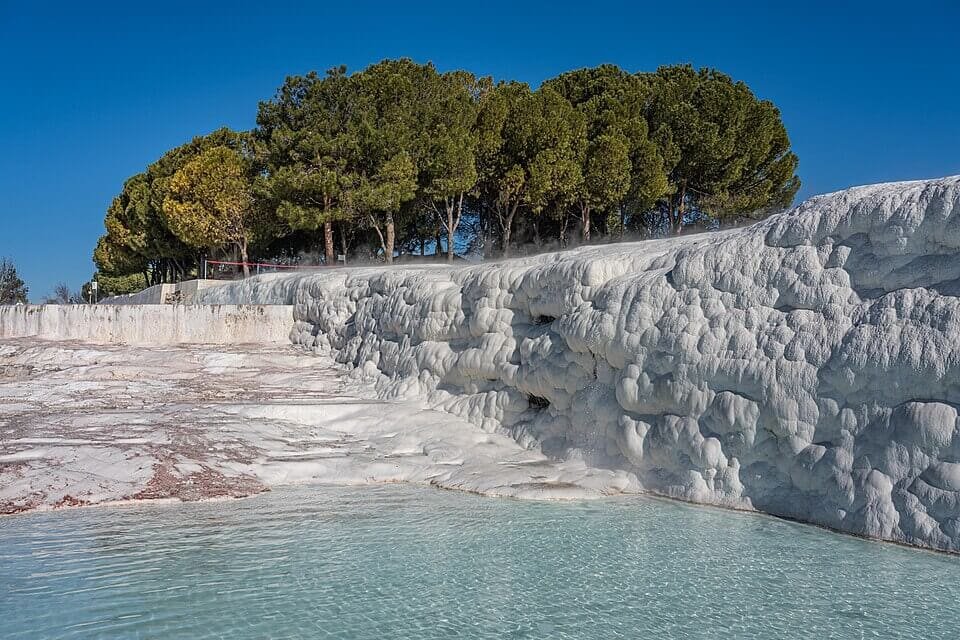
Why it feels alien: A calcified waterfall of white mineral terraces cascading down a cliffside, steaming with geothermal water, should not exist outside a science fiction film set.
UNESCO’s World Heritage listing for Hierapolis-Pamukkale describes the site as a place where “calcite-laden waters from hot springs, emerging from a cliff almost 200 metres high overlooking the plain, have created a visually stunning landscape.” The Turkish name Pamukkale means “Cotton Castle,” and that description is both literal and remarkably accurate. Over millennia, calcium carbonate deposited by thermal springs has built terraces of brilliant white travertine that extend down the hillside in stepped formations, each basin holding pools of warm, mineralized water.
NASA’s Earth Observatory notes that Pamukkale’s hot springs have produced “the world’s largest deposit of travertine.” Visitors have come to Hierapolis since ancient times; the spa city was founded in the 2nd century B.C. While excavations continue today, much of the Roman necropolis and theater remain intact above these natural formations, giving visitors the rare chance to walk through Roman ruins and geological wonder in the same afternoon.
The Vibe List’s take: Pamukkale delivers a visual experience unlike anywhere else on Earth. The white terraces against blue sky create an almost blinding brightness that photographs struggle to capture. Visitor access to the travertine terraces is now restricted to protect the formations, though designated bathing areas allow some thermal water experience. Combining the Hierapolis Roman ruins — which include a remarkably well-preserved theater and extensive necropolis — with the natural terraces makes this a rare two-for-one destination. Easily accessible by car from Denizli or from larger Turkish airports.
Best time to visit: April through June or September through November, when valley temperatures are tolerable.
9. Waitomo Glowworm Caves, New Zealand {#waitomo}
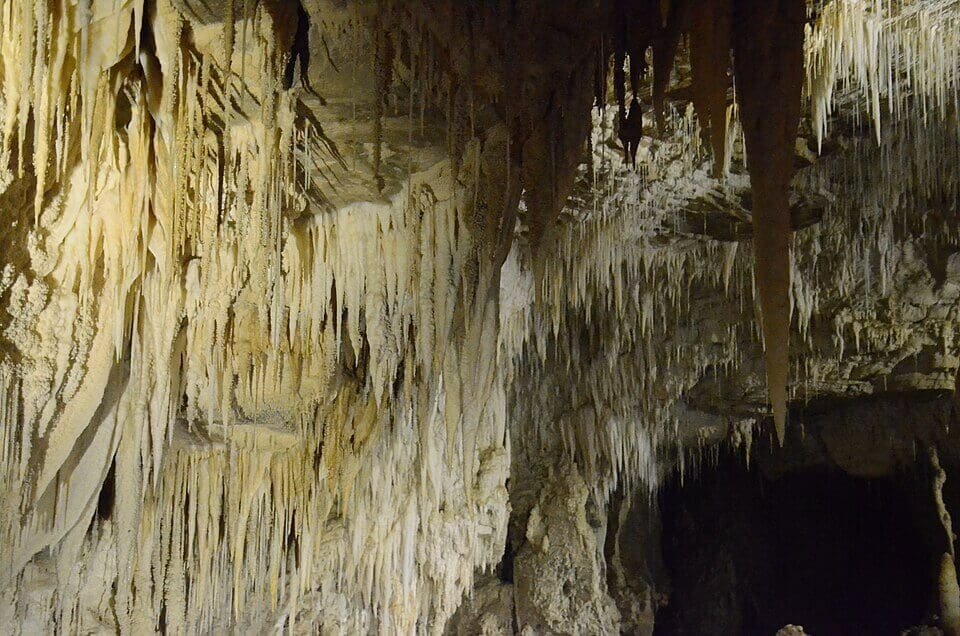
Why it feels alien: The ceiling of the cave resembles a bioluminescent night sky — except the stars are alive.
Beneath the farmland of New Zealand’s North Island, the Waitomo Glowworm Caves contain a population of Arachnocampa luminosa — a glowworm species found exclusively in New Zealand. Thousands of these larvae suspend silk threads from cave ceilings and emit blue-green bioluminescence to attract prey. The cumulative effect — thousands of tiny lights massing above dark water — creates a living planetarium as you float gently downstream in silent boats through underground caverns.
The cave system formed approximately 30 million years ago as limestone dissolved under the action of underground rivers. Guided boat tours have operated here since 1889, making Waitomo one of the oldest natural tourist attractions in the Southern Hemisphere.
The Vibe List’s take: Waitomo is easily reachable from Auckland via highway (approximately three hours), with well-managed visitor infrastructure that operates year-round. What makes it truly special is the silence; boat rides through the glowworm grotto are conducted entirely without motors, in near-total darkness except for the bioluminescent ceiling above. For those seeking a deeper experience, black water rafting — tubing through underground river systems in the dark — takes the experience further through nearby cave networks.
Best time to visit: Year-round; the glowworms are not seasonal.
10. Deadvlei, Namibia {#deadvlei}
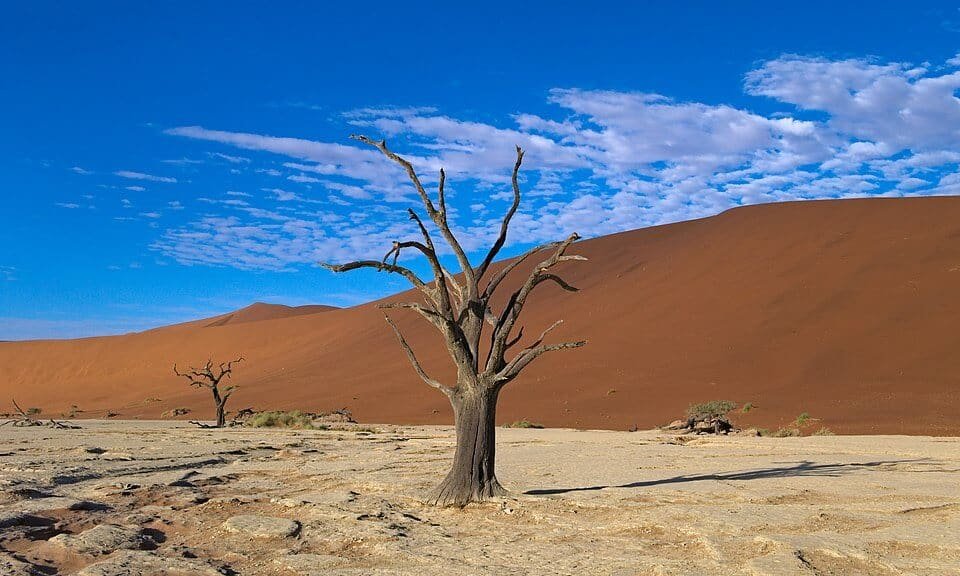
Why it feels alien: Dead trees standing for centuries on a white clay pan next to the tallest sand dunes on Earth. Not one element in this scene resembles your home planet.
Deadvlei is a white clay pan in the Namib-Naukluft Park containing the skeletal remains of camel thorn trees (Vachellia erioloba) that died approximately 600-700 years ago when the Tsauchab River diverted, eliminating the water source. These dead trees are not petrified; they dried out due to the extreme aridity of the Namib Desert. The wood simply did not decompose. The red-orange dunes surrounding the pan reach heights exceeding 300 meters — among the tallest on Earth.
The extreme contrast between white clay, black tree trunks, red dunes, and deep blue sky has made Deadvlei one of the most photographed landscapes on the African continent.
The Vibe List’s take: Deadvlei has made experienced photographers question their camera settings. The visual contrasts are so extreme that your mind insists something must be wrong with the image, but there isn’t. Travelers need a 4×4 to cross the sandy terrain and should be prepared to hike across the dune field to reach the vlei. Arrive at sunrise for optimal conditions; the dunes shift from black silhouette to vibrant crimson within minutes.
Best time to visit: May through October for cooler temperatures and clearer skies.
11. Kawah Ijen, Indonesia {#kawah-ijen}
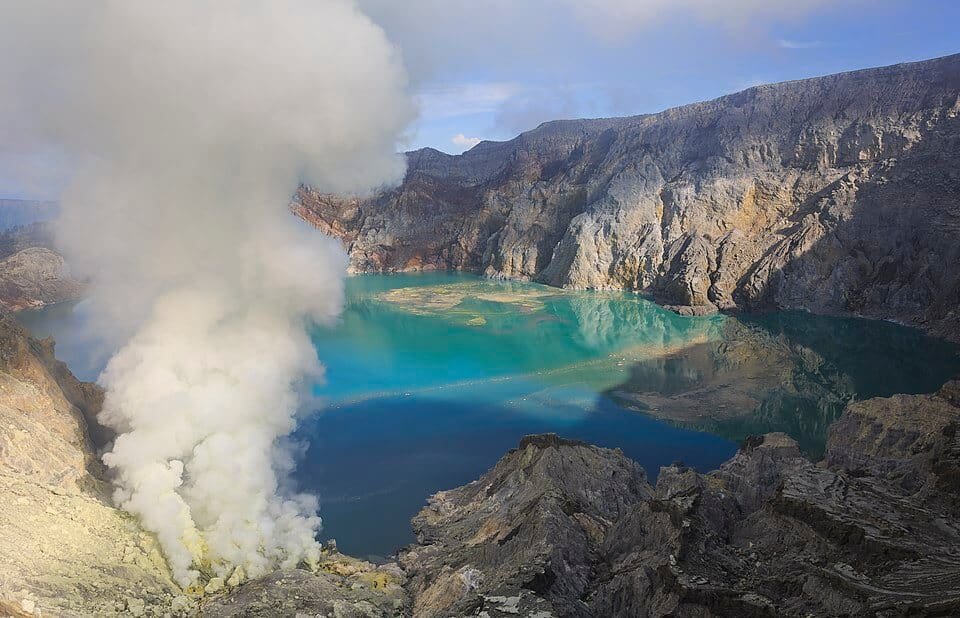
Why it feels alien: The volcano burns blue. Streams of electric blue fire flow down the crater walls at night like lava from a planet with different atmospheric chemistry.
Kawah Ijen is a volcanic crater in eastern Java, Indonesia. What makes it otherworldly is a phenomenon that National Geographic documented in 2014: sulfurous gases emerging from vents inside the crater combust on contact with air at temperatures exceeding 600°C, producing electric blue flames that can reach up to five meters. These flames are visible only at night. By daytime, another spectacle takes over; the crater lake is the largest highly acidic lake in the world, with a pH below 0.5 and a bright, milky turquoise color produced by dissolved metals and sulfur.
The human dimension deepens the surrealism: sulfur miners descend into the crater nightly, carrying loads of solid sulfur weighing approximately 80 kilograms on their backs. The BBC documented these miners in a piece titled “The men who mine the ‘Devil’s gold'”; workers laboring in toxic fumes with minimal protective gear for daily wages of a few dollars.
The Vibe List’s take: Kawah Ijen is one of the most viscerally intense destinations on this list. The blue flames are mesmerizing, and the acid lake at dawn is a color that does not exist in any other body of water we have ever seen. There is an ethical weight here — this is not a sanitized tourist attraction but a working industrial site where beauty and human cost coexist in the same frame. The hike begins at approximately 1:00 AM to reach the crater before the blue flames fade at sunrise. Bring a gas mask; the sulfur fumes are no joke.
Best time to visit: April through October; the dry season provides clearer conditions for the night hike.
12. Marble Caves, Chile {#marble-caves}
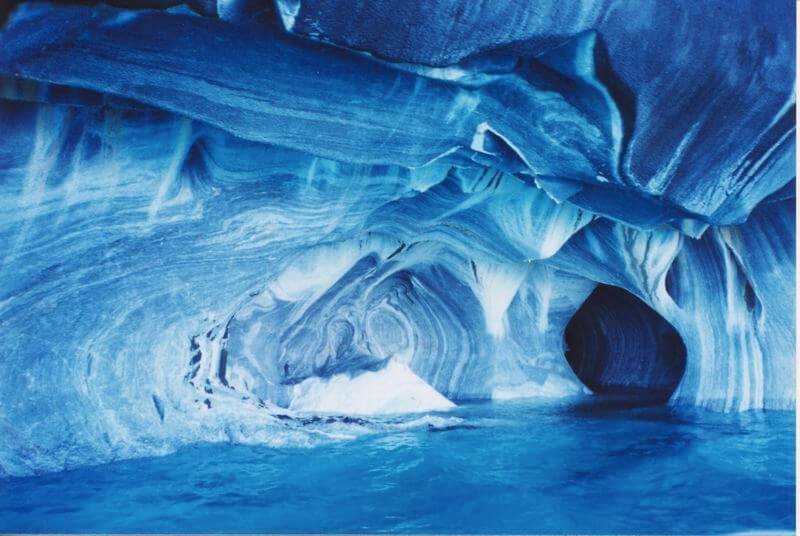
Why it feels alien: The interior of a solid marble peninsula, dissolved into caverns by glacial water over 6,000 years, looks more like the inside of a gemstone than a geological formation.
The Marble Caves (Cuevas de Mármol) are located on the shores of Lake General Carrera in Chilean Patagonia; one of the deepest lakes in South America. The caves were formed over approximately 6,200 years by wave action eroding a peninsula of solid marble into a network of caverns, columns, and tunnels. The calcium carbonate composition of the marble walls creates swirling patterns of blue, grey, and white that shift with water levels and the angle of sunlight entering the cave openings.
The glacial water of the lake itself creates an otherworldly turquoise hue caused by glacial silt, and the reflection of this water on the marble ceiling produces a rippling light show inside the caves that changes continuously throughout the day.
The Vibe List’s take: The Marble Caves show what patient erosion and the right light can do to a single geological material. Accessible exclusively by boat or kayak from the village of Puerto Río Tranquilo, the best conditions occur in the morning when sunlight enters at low angles and the water is calmest. The remoteness of Patagonian Chile means getting here requires commitment — approximately four hours’ drive from Coyhaique along the Carretera Austral. But the isolation is part of the point. You will not be fighting crowds.
Best time to visit: September through February; the Southern Hemisphere spring and summer provide optimal lighting and the calmest water.
13. Spotted Lake (Kliluk), Canada {#spotted-lake}
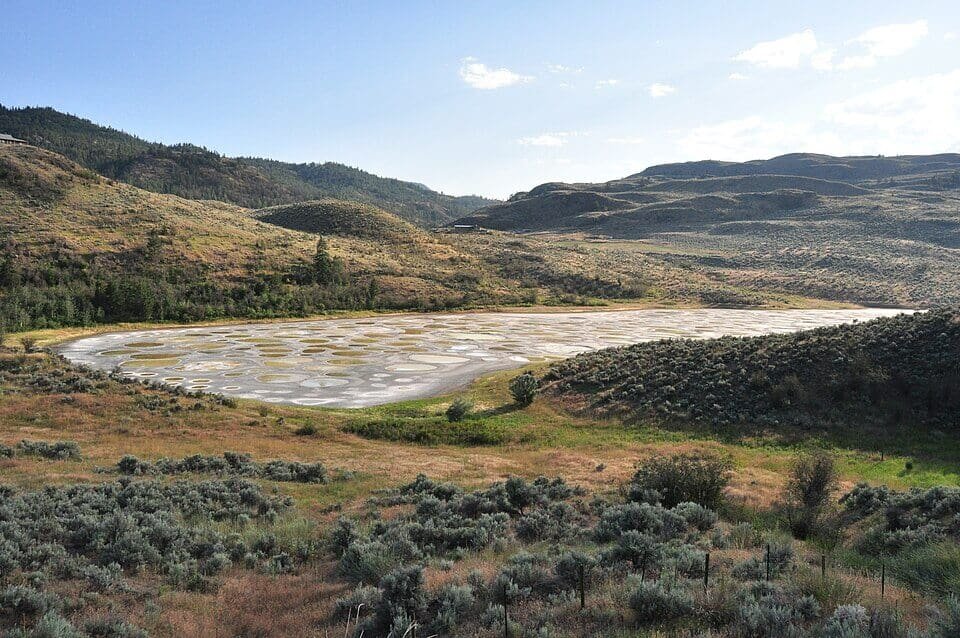
Why it feels alien: A lake that fractures into hundreds of colored polka dots during summer, each circle a concentrated mineral pool with a different hue.
Spotted Lake is a saline endorheic alkali lake near Osoyoos in British Columbia’s Okanagan Valley. During summer, evaporation reveals concentrated mineral deposits that form dozens of large, distinct circles across the lakebed. Each spot has a different concentration of magnesium sulfate, calcium, and sodium sulfates, producing circles ranging from pale green to vivid yellow to deep blue.
The lake is named Kliluk in the language of the Syilx Okanagan Nation, and it has been held sacred for its healing properties for centuries. During World War I, the minerals were extracted for ammunition manufacturing. Today, the lake resides on unceded Syilx Nation territory maintained by the Osoyoos Indian Band.
The Vibe List’s take: Spotted Lake is a genuinely strange visual experience — a polka-dotted landscape that looks like something designed by a pop artist rather than by geology. The lake is visible from a designated roadside viewpoint along Highway 3, and visitors are asked to respect the sacred significance of the site by observing from the designated area rather than approaching the lakebed directly. This is not a hiking destination; it is a place to observe, understand, and respect. The visual effect is strongest during peak summer heat when evaporation peaks.
Best time to visit: Late June through September, when evaporation reveals the mineral spots.
14. Chocolate Hills, Philippines {#chocolate-hills}
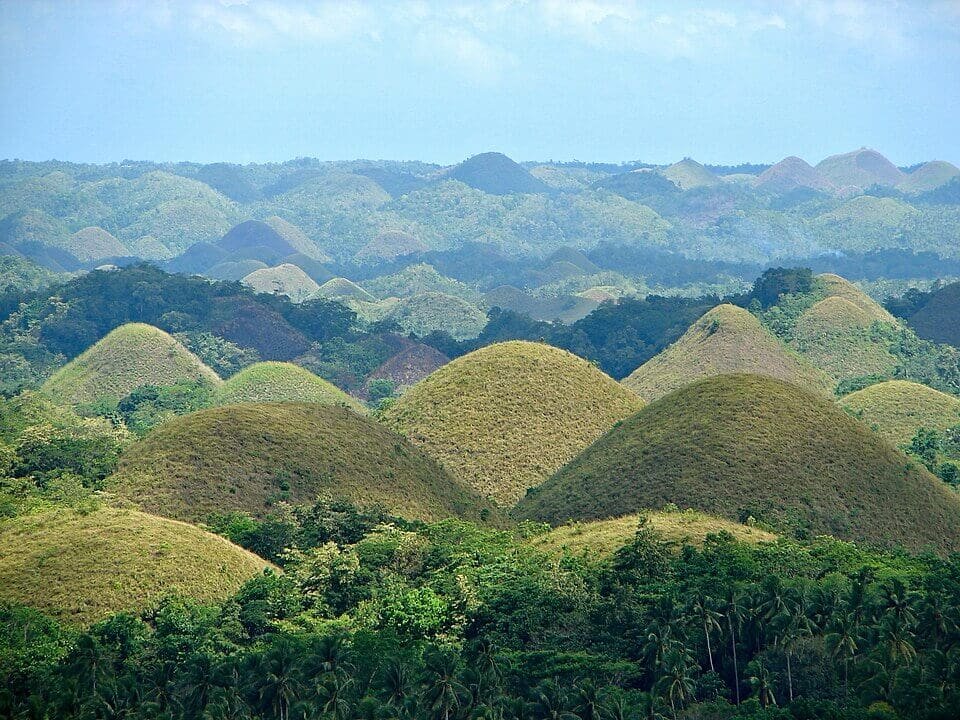
Why it feels alien: More than 1,200 nearly identical mounds rise from flat terrain as though algorithmically generated.
In the Bohol province of the Philippines, the Chocolate Hills are a geological formation consisting of at least 1,260 and possibly up to 1,776 symmetrical limestone mounds spread across more than 50 square kilometers. The hills are on UNESCO’s Tentative List for World Heritage status. The hills range from 30 to 120 meters in height, covered in grass that turns vivid green during the wet season and chocolate brown during the dry season — the color that gives them their name.
The exact geological origin is not fully settled. The dominant theory attributes the formations to the uplift and weathering of marine limestone from the seabed, with subsequent dissolution by rainfall creating the characteristic conical shapes. Local legend offers a more entertaining explanation involving a giant who wept enormous tears after heartbreak.
The Vibe List’s take: The Chocolate Hills produce an uncanny valley effect: too regular, too uniform, and too numerous to feel natural. Standing at the viewing platform in the town of Carmen and looking out across hundreds of identical brown mounds extending to the horizon triggers the same visual disorientation as staring at a fractal pattern. The dry season (February through June) produces the chocolate-brown coloring that gives the formation its name and its most alien appearance. Bohol has solid tourist infrastructure, and the hills combine easily with other attractions such as the Philippine tarsier sanctuary.
Best time to visit: February through June for the brown “chocolate” appearance; July through December for vivid green.
15. Darvaza Gas Crater, Turkmenistan {#darvaza}
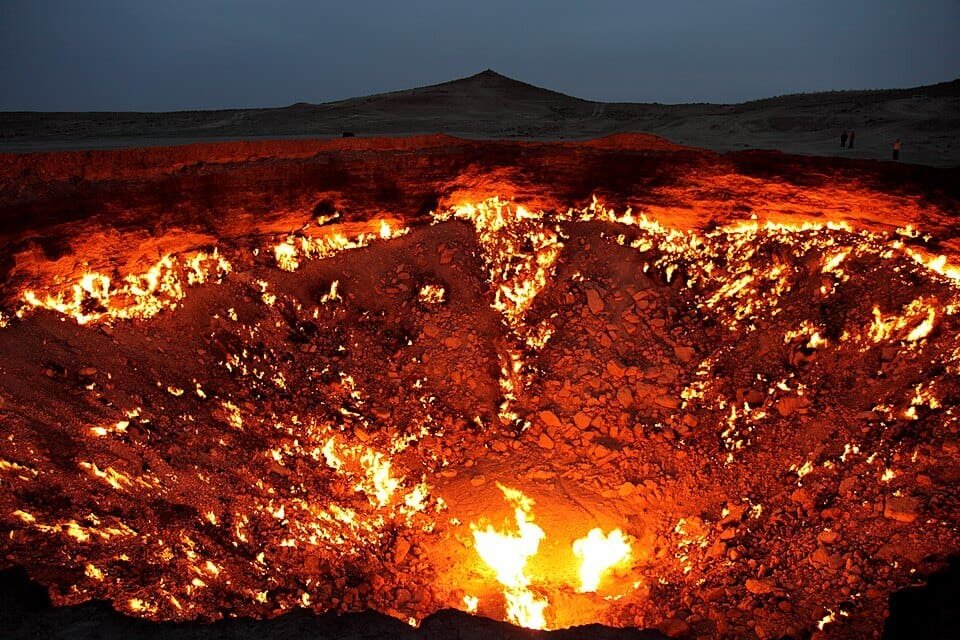
Why it feels alien: A 70-meter-wide pit of fire has been burning continuously in the middle of a desert for over 50 years because the people who created it thought the flames would die down in a few weeks.
The Darvaza Gas Crater — colloquially known as the “Door to Hell” — is a collapsed natural gas cavern in Turkmenistan’s Karakum Desert that has been burning since 1971. The prevailing account holds that Soviet geologists drilled into a gas pocket, the ground collapsed, and engineers ignited the escaping methane to prevent it from spreading, expecting it to burn out within weeks. Over five decades later, the crater remains on fire.
The Smithsonian has called Darvaza one of the most surreal accidental attractions on Earth. At night, the 70-meter-wide, 30-meter-deep pit glows orange against the black desert, visible from a considerable distance. The heat radiating from the rim is intense enough to keep visitors from getting too close.
Recent research suggests the fire may finally be fading. Scientists reported in 2025 that after 54 years, the inferno is showing signs of diminishing, meaning 2026 may represent one of the final opportunities to witness the full spectacle.
The Vibe List’s take: Darvaza is the only entry on this list created entirely by accident, and the absurdity of its origin story is inseparable from its appeal. A 50-year fire that was supposed to last two weeks, burning in the middle of a desert in one of the world’s most closed countries. Turkmenistan requires a visa and significant advance planning; most visitors arrive via organized tours from Ashgabat. The overnight camping experience — pitching a tent within sight of the burning crater under a desert sky — is one of the most cinematic things you can do as a traveler. If the fire is indeed fading, the window to see it is narrowing.
Best time to visit: April through May or September through November for manageable desert temperatures; the fire burns year-round.
15 Alien-Like Destinations: Quick Reference Guide
| # | Destination | Country | Why It Feels Alien | Accessibility | Best Season |
|---|---|---|---|---|---|
| 1 | Socotra Island | Yemen | Endemic alien flora; 37% of plants found nowhere else | Difficult; active travel advisory | Oct – Apr |
| 2 | Danakil Depression | Ethiopia | Hottest place on Earth; neon acid pools; lava lake | Expedition-level; guided only | Nov – Mar |
| 3 | Tsingy de Bemaraha | Madagascar | Stone needle forest; razor-sharp limestone pinnacles | Moderate; 4×4 required | May – Nov |
| 4 | Zhangye Danxia | China | Rainbow-striped mountains; 24-million-year mineral layers | Easy; boardwalks and platforms | Jun – Sep |
| 5 | Salar de Uyuni | Bolivia | World’s largest salt flat; sky-mirror effect | Moderate; tour from Uyuni town | Feb – Apr (mirror) |
| 6 | Lençóis Maranhenses | Brazil | Desert that fills with thousands of freshwater lagoons | Easy to moderate | May – Sep |
| 7 | Wadi Rum | Jordan | Mars-red desert; Hollywood’s stand-in for the Red Planet | Easy; established infrastructure | Mar – May, Sep – Nov |
| 8 | Pamukkale | Turkey | White travertine thermal terraces cascading down a cliff | Easy; accessible from Denizli | Apr – Jun, Sep – Nov |
| 9 | Waitomo Caves | New Zealand | Bioluminescent glowworm ceiling; living underground sky | Very easy; 3 hrs from Auckland | Year-round |
| 10 | Deadvlei | Namibia | Centuries-old dead trees on white clay; tallest dunes | Moderate; 4×4 essential | May – Oct |
| 11 | Kawah Ijen | Indonesia | Blue-fire volcano; world’s largest acid lake | Moderate; night hike required | Apr – Oct |
| 12 | Marble Caves | Chile | Glacial water that eroded solid marble into blue caverns | Moderate; remote Patagonia | Sep – Feb |
| 13 | Spotted Lake | Canada | Polka-dot mineral lake; sacred Indigenous site | Very easy; roadside viewpoint | Jun – Sep |
| 14 | Chocolate Hills | Philippines | 1,200+ identical limestone mounds; seasonal color change | Easy; well-developed tourism | Feb – Jun (brown) |
| 15 | Darvaza Crater | Turkmenistan | 70-meter pit of fire burning since 1971 | Difficult; visa required | Apr – May, Sep – Nov |
Frequently Asked Questions {#faq}
What is the most surreal place on Earth to visit?
That depends on your tolerance for logistical difficulty. For sheer visual alienness, Socotra Island in Yemen has the strongest claim; its endemic flora creates a landscape that exists nowhere else on the planet. For accessible surrealism, Salar de Uyuni in Bolivia during the wet season produces a mirror effect that eliminates the horizon and makes you feel like you are standing in the sky.
Are these otherworldly destinations safe to visit?
Most destinations on this list are safe and well-toured. Notable exceptions include Socotra Island (Yemen; active Level 4 travel advisory from the U.S. State Department) and the Danakil Depression (Ethiopia; expedition-level terrain requiring armed guides). Darvaza Crater in Turkmenistan is safe but requires a visa and organized tour access. Always check your government’s travel advisories before planning.
What causes the blue fire at Kawah Ijen in Indonesia?
The blue flames result from the combustion of sulfurous gases released from volcanic vents at temperatures exceeding 600°C. When these gases contact atmospheric oxygen, they ignite, producing electric blue flames visible only at night. The phenomenon is not blue lava; it is burning sulfur gas.
Why is the Danakil Depression the hottest place on Earth?
The Danakil Depression holds the record for the highest average annual temperature of any place on Earth. Situated approximately 100 meters below sea level in northeastern Ethiopia, it lies at the junction of three diverging tectonic plates. Geothermal activity combined with extreme low elevation and minimal cloud cover produces year-round temperatures that regularly exceed 50°C.
Can you swim in the lagoons at Lençóis Maranhenses in Brazil?
Yes. The lagoons that form between the sand dunes during the rainy season are freshwater, clean, and safe for swimming. The largest lagoons can reach depths of several meters. The best swimming conditions occur between May and September when the lagoons are at their fullest.
Is Salar de Uyuni always a mirror?
No. The mirror effect occurs only during the wet season, typically December through April, when a thin layer of rainwater covers the salt flat. The reflection requires calm conditions; wind disturbs the water surface and breaks the mirror effect. During the dry season, the salt flat displays hexagonal tile patterns and is completely dry, offering a different but equally striking visual experience.
This content is for informational purposes only and does not constitute professional travel advice. Always consult your government’s travel advisories and a qualified travel professional before visiting destinations with active safety concerns.