
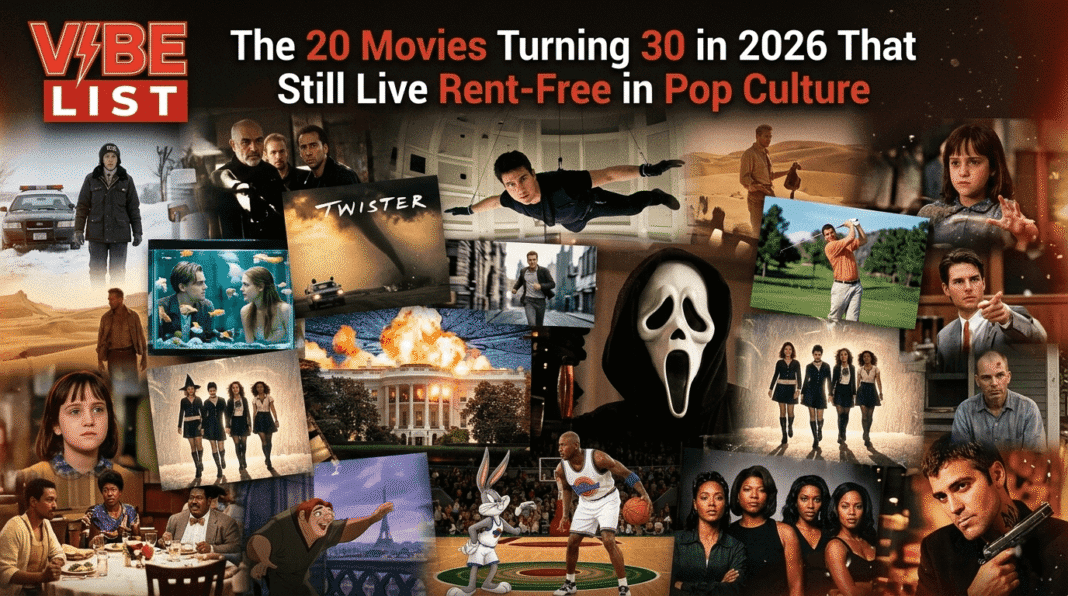
$817 million for an alien invasion filmed with miniature models. $4.35 billion from a franchise that started with one man dangling from a wire. A $1.5 million Scottish drug film ranked among the greatest British movies ever made. A slasher that revived an entire genre and just crossed $1 billion three decades later. A basketball game between Michael Jordan and Bugs Bunny that generated $6 billion in total economic value. Nine Oscars for a love story most people argued about more than they watched. 1996 didn’t just produce movies; it built the templates Hollywood is still copying and the franchises it still can’t kill.
Cinema Has Never Recovered From What Happened in 1996
30 years ago may seem like a weird milestone. Enough time for a film to disappear forever or harden into something indelible — a reference point, a visual style template, a catchphrase that gets tossed around in group chats without anyone saying “Hey, I saw this film.”
That’s what happened with 1996. This was the year the U.S. box office passed nearly $5.8 billion thanks to a perfect storm of blockbuster action films, independent art-house films, and genres getting remade in new ways we hadn’t seen in the mainstream since the early ’80s. It was the year that audiences showed up by the tens of millions to see the White House blow up thanks to the vision of Roland Emmerich; a Coen Brothers masterpieces low-budget Scottish film about heroin-addicted junkies became one of the best-selling foreign-made British films of all time; and a masked killer in a suburban garage got horror fans excited about the genre again. We got alien invasions, tornadoes the size of small towns, and a one-liner delivery system named Will Smith. We got a basketball game between Michael Jordan and Bugs Bunny — and it worked.
It’s the aftermath of these films that separates 1996 from simply another profitable year. These weren’t just movies that performed well at the box office and then disappeared. Their success helped launch massive franchises that today are worth billions of dollars. They established talent whose careers are still among the biggest in the business today. And they embedded themselves within our pop-culture lexicon in such a way that even non-filmgoers can quote lines, wear jerseys, and instantly recognize symbols.
So as these films celebrate their 30th anniversaries in 2026, we are doing what any self-respecting pop-culture publication should do: we are going through all 20 of them, entry by entry, with the full breakdown — box-office numbers, cultural legacy, franchise updates, and a Vibe List verdict on why each one still matters. No filler. No fluff. Just the movies that shaped a generation and the receipts to prove it.
These are the Class of 1996. And while it’s been 30 years since they hit theaters, they’re still very much here.
For more deep dives into entertainment history, see our breakdown of The Most Satisfying Oscar Upsets in Academy Awards History.
1. Independence Day
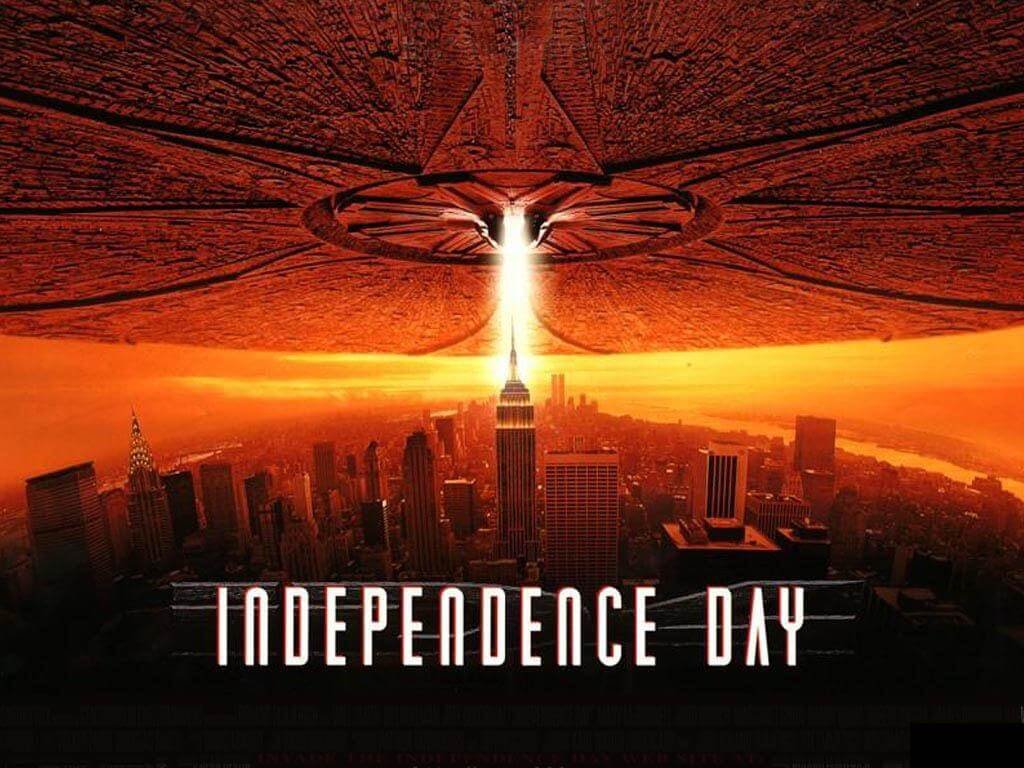
Release Date: July 3, 1996 Director: Roland Emmerich Worldwide Box Office: $817.4 million Budget: $75 million Rotten Tomatoes: 67%
Before Marvel pioneered the ensemble spectacle as a franchise model, Roland Emmerich found a simple yet powerful concept: show audiences something they’ve never seen before, and they’ll wait in line to see it. For Emmerich, that image was of a mile-wide spaceship destroying Washington, D.C., with a laser beam. That image became the most viewed movie clip of 1996 and one of the iconic images of the decade.
With a budget of $75 million, Independence Day earned $817.4 million worldwide and became the number-one film of 1996. At the time, it was also the second-highest-grossing film at the box office, trailing only Jurassic Park. While those numbers tell us how big the film was financially, they do not convey how large an impact it had on Hollywood’s perception of scale. Prior to Independence Day, disaster movies had peaked in the 1970s with The Poseidon Adventure and The Towering Inferno. Following Independence Day, every major studio wanted its own disaster film, and destroyed cities were now the staple of summer blockbusters using CGI for destruction.
Will Smith punching an alien in the face and delivering the line “Welcome to Earth” became the defining image of ’90s action cinema. Jeff Goldblum hacked an alien mothership with a laptop — a plot point that makes less sense with every passing year and somehow becomes more beloved because of it. Bill Pullman’s presidential speech before the final battle is still quoted at Fourth of July barbecues, and it has shown up in political campaign edits more times than anyone can count.
The film solidified Will Smith as a lead actor who could carry a production valued at $75 million. He delivered a physically active, charming, and infinitely quotable performance as Captain Steve Hiller. Studios have spent billions attempting to recreate Bill Pullman’s presidential address during the film, which is likely one of the most parodied monologues in film history. Jeff Goldblum demonstrated once again why he is one of the best actors at delivering exposition like it’s jazz.
Independence Day won the Academy Award for Best Visual Effects at the 69th Academy Awards and also received a nomination for Best Sound.
Vibe List Take: Independence Day is not a subtle film. It does not require subtlety. Its legacy is structural, not thematic. It is the film that taught Hollywood how to market global destruction as a Fourth of July party, and the cinematic blockbuster landscape is still influenced by this film.
2. Twister
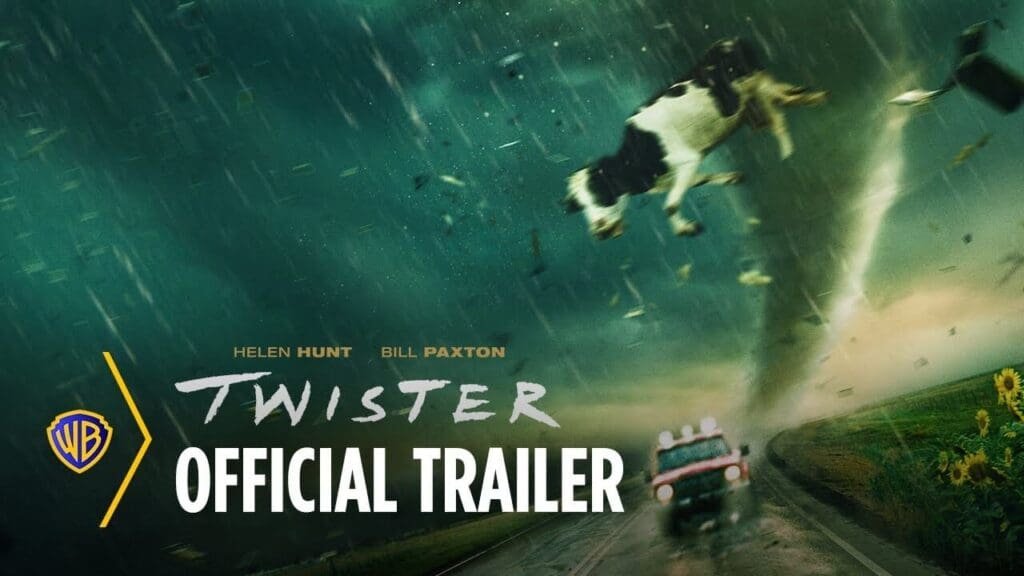
Release Date: May 10, 1996 Director: Jan de Bont Worldwide Box Office: $494.5 million Domestic Box Office: $241.8 million Budget: $92 million Rotten Tomatoes: 57%
Before the term “extreme weather” became a permanent fixture in the daily news cycle, Twister turned tornado chasing into a blockbuster spectacle.Twister was one of the most efficient spectacles of the decade. On paper, Twister had a straightforward premise: storm chasers drove into tornadoes, and tornadoes fought back. However, there is nothing straightforward about executing this premise with an endless amount of energy to keep an audience glued to their seat.
Helen Hunt and Bill Paxton provided undeniable chemistry playing roles co-written by Michael Crichton and Anne-Marie Martin. The visual effects used in Twister earned two Academy Award nominations for Best Visual Effects and Best Sound. Twister grossed $241.8 million in domestic box office sales selling an estimated 54.7 million tickets in America alone and approximately $494.5 million worldwide, making it the second-highest-grossing film of 1996.
The plot is thin — estranged storm chasers reunite, chase tornadoes, reconcile — but the execution is massive. Helen Hunt and Bill Paxton brought genuine chemistry to roles that were essentially delivery mechanisms for set pieces, and those set pieces delivered. The drive-in theater sequence, the flying cow, and the final F5 tornado are seared into the memory of anyone who saw this film in a theater. Twister earned two Academy Award nominations: Best Visual Effects and Best Sound.
The film’s cultural impact extends well beyond its runtime. It made storm chasing cool, drove enrollment in meteorology programs across the country, and cemented the disaster film as a reliable Hollywood formula for the rest of the decade. The Van Halen needle drop during the opening credits remains one of the most effective soundtrack choices of the era.
The enduring legacy of Twister lies in its 2024 sequel. Twisters generated more than $372 million in worldwide box office sales, demonstrating that Twister‘s original DNA was still commercially viable. The original did not just succeed — it defined a genre template.
Vibe List Take: Twister does not apologize for what it is. It understands that the audience came to see a spectacle and provides that spectacle with an ease and skillfulness that few modern blockbusters can claim. There is occasionally beauty in simplicity.
3. Mission: Impossible
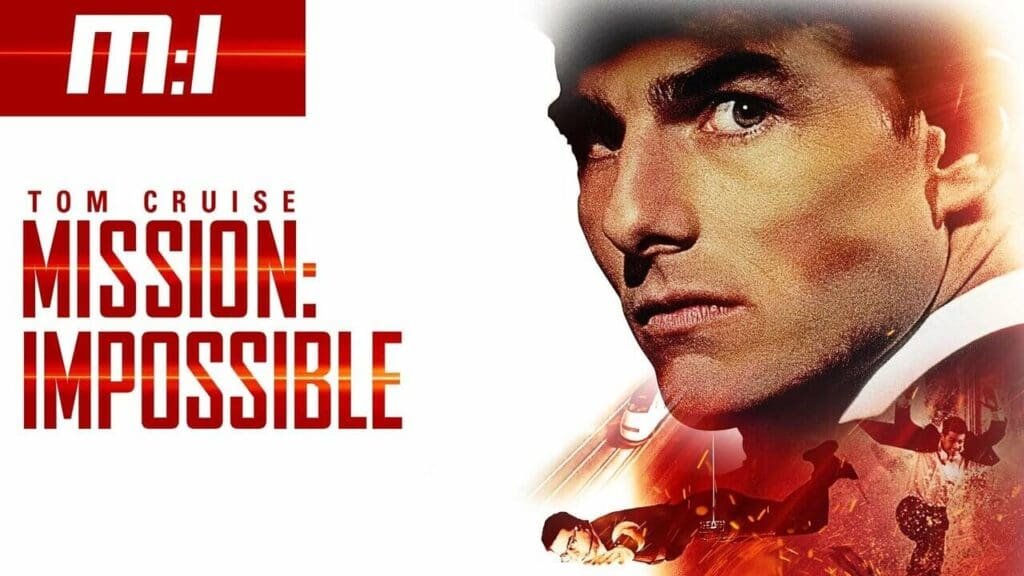
Release Date: May 22, 1996 Director: Brian De Palma Worldwide Box Office: $457 million Budget: $80 million Rotten Tomatoes: 66%
Mission: Impossible marks the beginning of one of the longest-running celebrity-driven franchise templates in modern cinema. The Mission: Impossible franchise has grossed over $4.35 billion across eight films over three decades. Brian De Palma directed the 1996 version as a paranoid Cold War-style espionage thriller. The film features elements reminiscent of The Untouchables rather than the aerial stunts present in subsequent installments.
The original Mission: Impossible did something that almost never works: it took a beloved 1960s television series and turned it into a legitimate blockbuster franchise that is still running 30 years later. Directed by Brian De Palma, the 1996 film introduced Tom Cruise as Ethan Hunt, an operative for the Impossible Missions Force (IMF), and delivered one of the most iconic heist sequences ever filmed — the near-silent CIA vault break-in, where Cruise dangled from a wire inches above a pressure-sensitive floor.
The film earned $457 million worldwide on an $80 million budget and immediately established itself as a franchise engine. The plot — Hunt framed for the murder of his team, forced to go rogue to prove his innocence — borrowed from espionage thrillers but executed with a level of visual style and tension that De Palma’s background in suspense made possible.
Tom Cruise starred in Mission: Impossible as Ethan Hunt, an operative working for the Impossible Missions Force (IMF). What makes Mission: Impossible remarkable in retrospect is how much better the franchise got over time. The series now spans eight films over 30 years, with the most recent installment — Mission: Impossible – The Final Reckoning — released in May 2025. The franchise has earned over $4.35 billion worldwide, making it one of the most commercially successful film series in history. And at the center of all of it is Tom Cruise, who still does his own stunts at 63, including hanging off the side of actual planes and jumping off actual motorcycles off actual cliffs.
De Palma directed one of the most intricately choreographed suspense scenes in modern cinema — the Langley CIA vault heist scene. In this scene, Tom Cruise hangs off the edge of a pressure plate that will detonate if he steps on it.
Thirty years later, De Palma’s Mission: Impossible still stands as the most restrained entry in the franchise.
Vibe List Take: The 1996 original Mission: Impossible is less elaborate than any other entry in the franchise. De Palma realized something some of the later entries seemed to forget — silence builds more tension than any mid-air helicopter stunt.
For more on entertainment’s biggest earners, see Celebrity Billionaires Who Built Empires Beyond Their Fame.
4. Scream
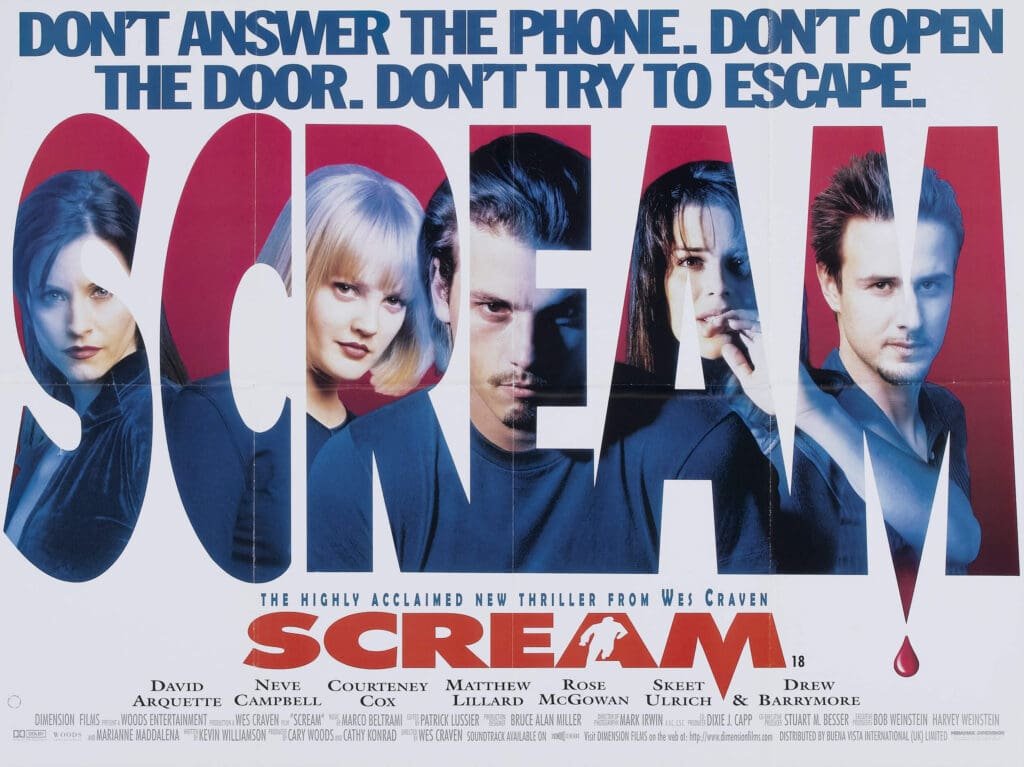
Release Date: December 20, 1996 Director: Wes Craven Budget: $15 million Worldwide Box Office: $173 million Domestic Box Office: $103 million Rotten Tomatoes: 79%
In 1996, slasher films were functionally dead. The golden age of horror films — Halloween, Friday the 13th, and A Nightmare on Elm Street — had come to a close. Most slasher films released from this period were straight-to-video ripoffs with little attention paid to quality. Then Wes Craven and writer Kevin Williamson did something no one predicted: they wrote a slasher film that referenced slasher films while also critiquing slasher films, and audiences loved it.
The opening sequence — Drew Barrymore as Casey Becker, answering a phone call that turns lethal within minutes — is one of the greatest cold opens in film history. Barrymore was the biggest name in the cast, and killing her off in the first 12 minutes was a statement: nobody is safe, and the rules you think you know do not apply. Drew Barrymore’s character Casey Becker‘s phone call is still studied in film schools as an example of creating dread.
The Ghostface mask, inspired by Edvard Munch’s The Scream, became an instant cultural icon. It has appeared on Halloween costumes, in memes, in parodies, and in the marketing for every subsequent Scream sequel — of which there are now six. The Ghostface mask has become one of the most recognizable icons in horror.
Scream debuted with an opening weekend gross of $6.3 million — small compared to other blockbuster openings, but impressive considering how well Scream stayed in theaters for nine consecutive weeks, earning an eventual domestic gross of $103 million.
No other slasher film had achieved such longevity prior to Scream. More importantly, Scream changed how horror films interact with their audiences through meta-textual approaches: characters that have seen the same horror films they are currently living through.
The Scream franchise has grossed over $1 billion worldwide since its inception, including Scream 7, released on February 27, 2026, with an opening weekend gross of approximately $64 million, setting a new franchise high mark for openings. As of early April 2026, Scream 7 has surpassed $200 million globally.
Vibe List Take: Scream was not just self-aware; it was self-aware and frightening. Many films have attempted to follow Scream‘s lead and use meta-horror approaches, but almost none have been able to achieve Scream‘s balance of humor and fear.
5. Fargo
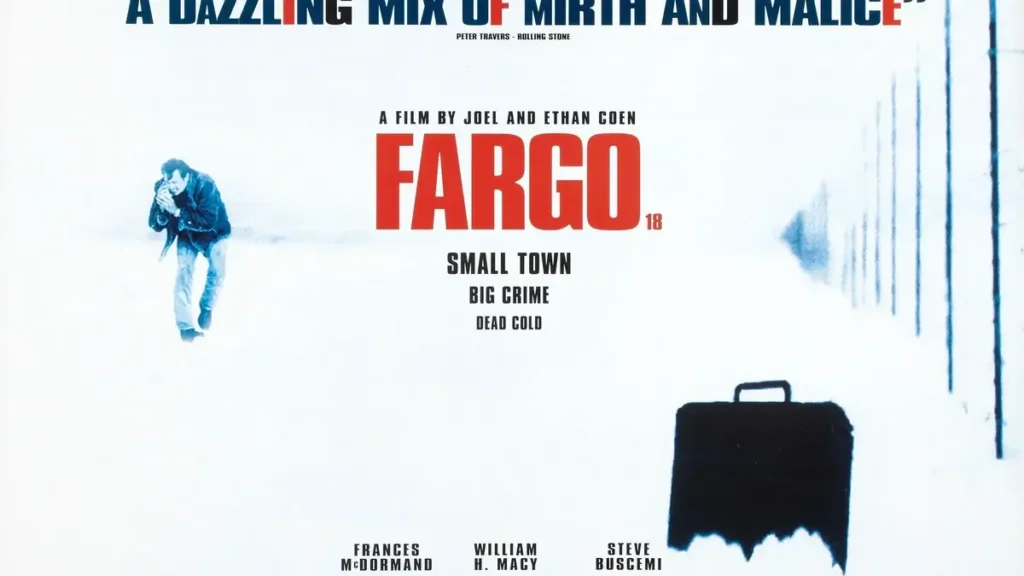
Release Date: March 8, 1996 Directors: Joel Coen and Ethan Coen Worldwide Box Office: $60.6 million Budget: $7 million Rotten Tomatoes: 94%
Joel and Ethan Coen created what many film critics believe is the finest American crime film of the 1990s for under $7 million with Fargo. The opening title card states that Fargo is based upon actual events — a bold lie that ultimately contributed significantly to the Coen Brothers’ brand identity.
Fargo earned Frances McDormand an Academy Award for Best Actress in addition to Joel and Ethan Coen receiving an award for Best Original Screenplay. The film earned seven total nominations, including Best Picture and Best Director.
The film earned $60.6 million worldwide on a $7 million budget — an extraordinary return — and won two Oscars: Best Actress for McDormand and Best Original Screenplay for the Coen Brothers. It was nominated for five additional categories, including Best Picture and Best Director.
However, Fargo‘s greatest achievement lies in its tone — it successfully combined comedy, violence, and humanity all together without any of those tones overshadowing each other.
FX developed a television series called Fargo in 2014 using much of the Coen Brothers’ original material. The TV series ran for five seasons and 51 episodes, solidifying that the Coen Brothers’ unique voice — rhythmically, morally, and darkly comedic — was strong enough to endure over multiple seasons across different times and characters.
The film’s influence on independent cinema is difficult to overstate. It demonstrated that a modestly budgeted, dialogue-driven crime film set in the middle of nowhere could compete with — and outperform — studio blockbusters on pure quality. Thirty years later, “You’re darn tootin'” remains a more memorable line than anything in most $200 million franchise entries.
Vibe List Take: Fargo is a rare film where every aspect — writing, acting performance, cinematography, and score — reached their respective peaks all at once. Thirty years later, it has not lost one frame of precision.
6. Trainspotting
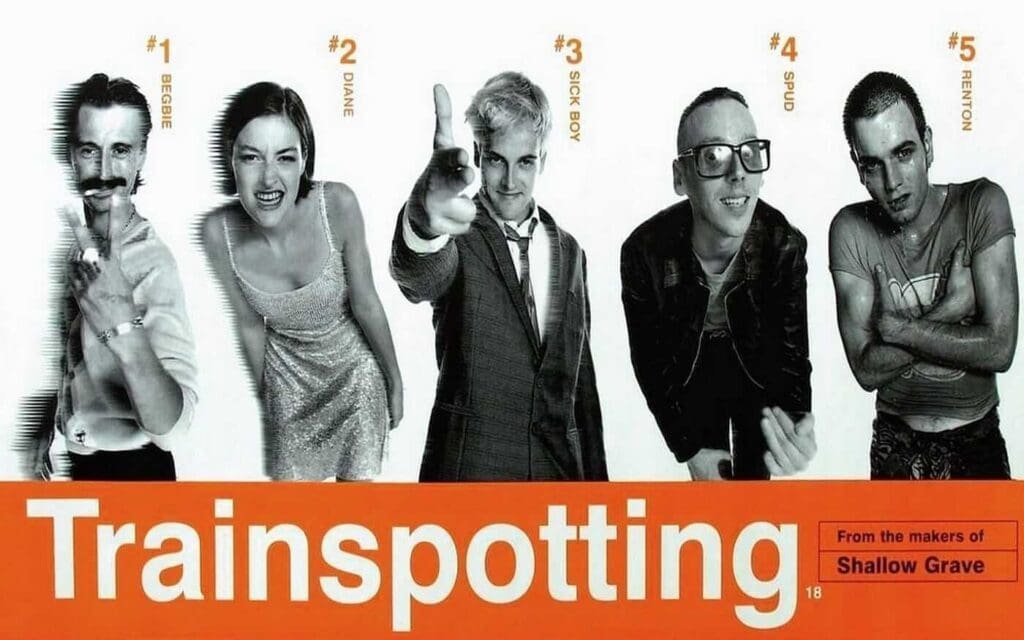
Release Date: February 23, 1996 (UK); July 19, 1996 (US) Director: Danny Boyle Budget: £1.5 million (approximately $2.3 million) Worldwide Box Office: $72 million Rotten Tomatoes: 89%
Danny Boyle created Trainspotting using £1.5 million in outright bravado, and it generated $72 million at the global box office, making it one of the top-grossing British films ever. Trainspotting was ranked No. 10 on the BFI’s list of the 100 greatest British films, and it won the British Council’s “90 Years of Culture” survey with a vote as the best-ever British film.
Trainspotting wasn’t unique because it depicted addiction as a miserable experience; many movies had shown that. What made Trainspotting so innovative was how it showed how much fun you can have while addicted to drugs, and then showed what that fun will cost. Ewan McGregor’s Mark Renton has charisma, articulation, and complete awareness of himself and his addiction; he knows what heroin does to him and continues to go back anyway. This level of truthfulness was something the studios wouldn’t allow in America. Because of this truthfulness, Trainspotting brought an authenticity that no audience had experienced previously.
The visuals used in Trainspotting — handheld camera work, bold color palette, surreal fantasies, and a soundtrack featuring Iggy Pop, Blur, and Underworld — became an artistic template for generations of British filmmakers. The impact doesn’t end there: Trainspotting‘s marketing strategy utilizing black-and-white images of their actors as part of an overall aesthetic plan remains one of the most effective film marketing plans in Britain.
The soundtrack — featuring Iggy Pop’s “Lust for Life,” Underworld’s “Born Slippy .NUXX,” and New Order’s “Temptation” — became a cultural artifact in its own right, one of the best-selling soundtracks of the 1990s and a gateway album for an entire generation discovering electronic music and Britpop.
A sequel, T2 Trainspotting, arrived in 2017, reuniting the original cast for a meditation on aging, regret, and the impossibility of recapturing youth. It was well received, though it lacked the raw, anarchic energy of the original — which, to be fair, is an impossible standard to match.
Vibe List Take: Trainspotting is more than a great drug movie. It is more accurately described as a great film about the particular lie that youth perpetuates: that consequences happen to others. Thirty years later, that lie remains unchanged.
7. Romeo + Juliet
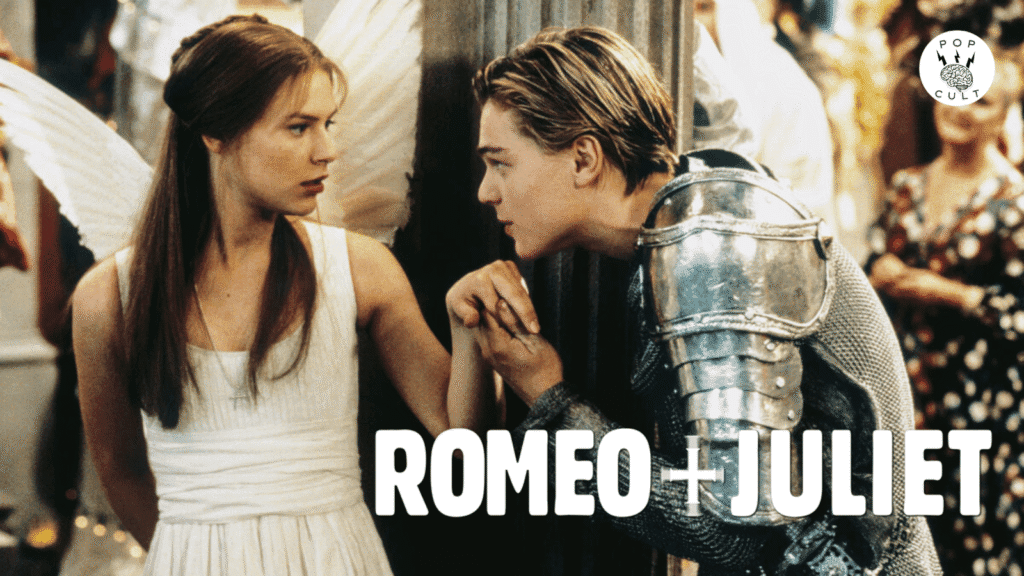
Release Date: November 1, 1996 Director: Baz Luhrmann Worldwide Box Office: $147.5 million Budget: $14.5 million Rotten Tomatoes: 73%
Baz Luhrmann took a $14.5 million budget and the most-performed play in the English language — Romeo and Juliet — and turned it into the highest-grossing Shakespeare film of all time (a Guinness World Record that remains unbroken). Romeo + Juliet raked in $147.5 million at the global box office, earning Leonardo DiCaprio the Silver Bear for Best Actor at the Berlin International Film Festival.
Luhrmann’s Romeo + Juliet was an act of aesthetic violence against traditional Shakespeare adaptations. Luhrmann transplanted the tragic love affair to a fictional coastal town called Verona Beach, swapped swords with guns labeled “Sword” and “Dagger,” flooded the film with bright colors and religious imagery, and scored the film to a soundtrack featuring Radiohead, Garbage, and Des’ree. It should’ve been a catastrophe. Instead, it introduced an entire new generation of teens to Shakespeare through sheer sensory overload.
The film made Leonardo DiCaprio a global heartthrob — his performance as Romeo, all feverish intensity and doomed romanticism, turned him into the biggest young star on the planet a full year before Titanic cemented his legend. Claire Danes matched him scene for scene as Juliet, grounding Luhrmann’s visual excess with genuine emotional vulnerability.
Three decades on, Romeo + Juliet‘s visual style continues to spread across social media. Costume design from the film, altar scenes, and first meetings lit by aquarium lights continue to appear frequently in TikTok aesthetics, fan art, and fashion editorial pages.
The soundtrack became a best-seller in its own right, and “Kissing You” by Des’ree remains synonymous with cinematic romance. The film also kicked off a brief wave of modernized literary adaptations that dominated the late ’90s, though none matched Luhrmann’s audacity.
Vibe List Take: Luhrmann knew that the language of Shakespeare didn’t require a museum environment to endure. What it required was pace, volume, and someone prepared to blow up the entire thing. Romeo + Juliet is the greatest evidence that classic text and spectacle are not rivals, but accelerators.
8. Jerry Maguire
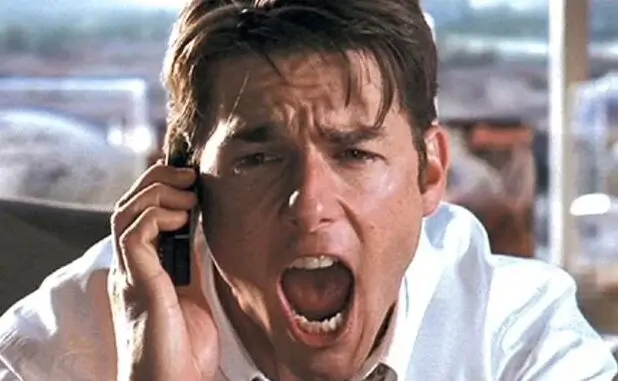
Release Date: December 13, 1996 Director: Cameron Crowe Worldwide Box Office: $273.6 million Budget: $50 million Rotten Tomatoes: 84%
Jerry Maguire is one of the most memorable films of the decade, and its three catchphrases (“Show me the money!”, “You complete me,” “You had me at hello”) became so ingrained within popular culture that many people using these phrases today have never actually seen the film. Jerry Maguire grossed $273.6 million at the global box office, provided Tom Cruise with a Best Actor Oscar nomination, and awarded Cuba Gooding Jr. the Academy Award for Best Supporting Actor.
Cameron Crowe’s Jerry Maguire accomplished something rare: it became one of the most quotable films of the decade while also being a genuinely well-crafted character study. Tom Cruise plays the titular sports agent who has a crisis of conscience, writes a mission statement about integrity in the sports industry, and is promptly fired. What follows is a story about rebuilding a career, a relationship, and a sense of self — wrapped in enough charm and humor to gross $273.6 million worldwide on a $50 million budget.
While most remember Jerry Maguire for its catchphrases, few recall just how sophisticated the film’s argument actually is. Jerry Maguire is a film about a man who finds that his business operates based upon cynicism and chooses to operate with sincerity; however, he finds that operating with sincerity within a system designed to reward cynicism comes with an enormous cost. As such, Jerry Maguire is both a sports film that is fundamentally about labor relations and a romantic film that is ultimately about professional ethics, as well as a comedy that is fundamentally about the possibility that one person’s moral awakening can withstand contact with an economy that does not care.
Jerry Maguire received five Academy Award nominations, including Best Picture and Best Actor for Cruise. It launched Zellweger into leading-lady status and solidified Crowe’s reputation as a writer-director who could balance heart with commercial appeal.
In a timely footnote, TriStar Pictures is re-releasing Jerry Maguire in theaters for its 30th anniversary on April 12, 14, and 15, 2026 — proving the film’s appeal has not faded.
Vibe List Take: Jerry Maguire is one of those films whose relevance has increased as society has grown increasingly cynical. With the rise of personal branding and influencer capitalism, Jerry’s question — can you succeed without selling out? — now appears less like a movie idea than like a daily choice.
For more on the business of sports and celebrity, see NBA’s Greatest Players of All Time — The Definitive Ranking.
9. The Rock
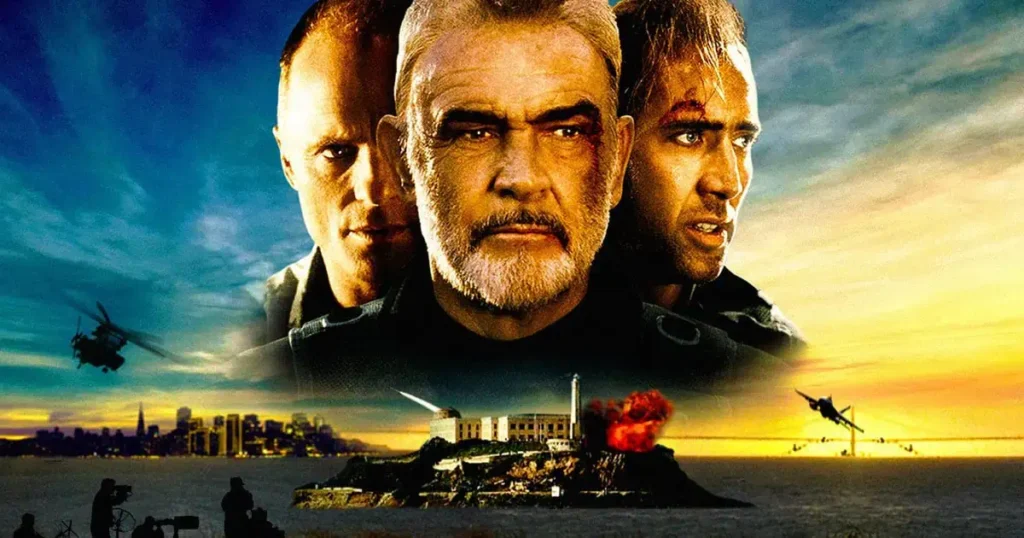
Release Date: June 7, 1996 Director: Michael Bay Worldwide Box Office: $335 million Budget: $75 million Rotten Tomatoes: 66%
Michael Bay’s second feature film paired Sean Connery with Nicolas Cage on Alcatraz Island and generated $335 million in box office revenue on a $75 million budget. The Rock is generally regarded as the best film that Bay has ever directed — the film in which Bay’s maximalism was tempered by an extremely effective script and two leads capable of providing some substance to the pyrotechnics.
Connery’s John Mason is essentially an unofficial James Bond sequel performance — a British intelligence operative who has spent 30 years in American black sites. Cage, portraying an FBI chemical warfare expert who has never experienced battle, provided the film’s frenetic, erratic energy. Ed Harris, who portrayed the rogue general who seized Alcatraz Island and threatened San Francisco with chemical warfare, provided the film with something that most Bay movies do not possess: a rational and somewhat sympathetic reason for why he behaves the way he does.
The car chase through San Francisco is one of the best of the ’90s. Hans Zimmer’s score, featuring the now-iconic “Rock Anthem,” became a staple of movie trailers for years afterward. And the film’s tonal balance — serious enough to have stakes, self-aware enough to have fun — is a formula Bay has never quite recaptured since.
Vibe List Take: The Rock demonstrates that Michael Bay is able to restrain himself when presented with good material. Additionally, it illustrates what his career may have looked like had he accepted more scripts as good as this.
10. The English Patient
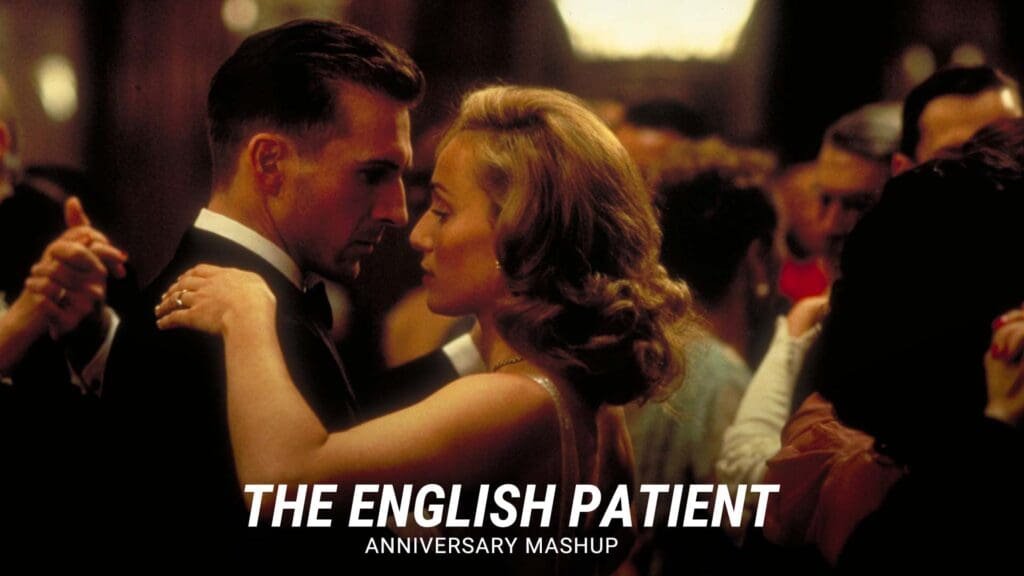
Release Date: November 15, 1996 Director: Anthony Minghella Worldwide Box Office: $232 million Academy Awards: 9 wins from 12 nominations Rotten Tomatoes: 83%
Anthony Minghella’s adaptation of Michael Ondaatje’s Booker Prize-winning novel The English Patient swept the 69th Academy Awards, garnering nine Oscars from twelve nominations, including Best Picture, Best Director, and Best Supporting Actress for Juliette Binoche. This tied the record for the most awards bestowed upon one film at a single ceremony, matching The Last Emperor (1987) and Gigi (1958). Ralph Fiennes and Kristin Scott Thomas both received nominations in the lead acting categories but did not win.
The film earned $232 million worldwide on a $27 million budget — remarkable numbers for a nearly three-hour wartime romance adapted from Michael Ondaatje’s Booker Prize-winning novel. Fiennes plays a mysterious, severely burned man in a World War II-era Italian monastery; the film unravels his identity through a series of lush, intricately structured flashbacks that reveal a doomed love affair in the North African desert.
The English Patient is a wartime romance presented in non-linear sequence; therefore, it demands that the audience reconstruct the events of the film from fragments of memory, similar to how a nurse attempts to determine the identity of a severely injured patient she cares for in an Italian monastery. Ralph Fiennes’ and Kristin Scott Thomas’ performances exhibited such restraint that their love scenes seemed to carry perilous undertones — not due to the nature of their subject matter, but rather due to everything they chose not to say.
It is sweeping, operatic, and unapologetically romantic — the kind of prestige filmmaking that Hollywood rarely attempts anymore and almost never pulls off at this scale. The cinematography by John Seale transforms the Sahara into a character of its own, and Gabriel Yared’s score remains one of the most hauntingly beautiful in modern cinema.
The film became a cultural flashpoint in 1997, most memorably when an episode of Seinfeld centered on Elaine’s hatred of the movie — a reaction that resonated with audiences who found the film either transcendently beautiful or excruciatingly slow, with very little middle ground.
Vibe List Take: The English Patient is one of those types of films that Hollywood no longer produces — a mid-budget, adult-targeted, emotionally rich drama that earned nine Oscars yet retreated silently from public consciousness shortly thereafter. Its absence from contemporary filmmaking serves as a commentary regarding what the film industry sacrificed when it ceased producing films targeted toward mature audiences.
11. The Craft
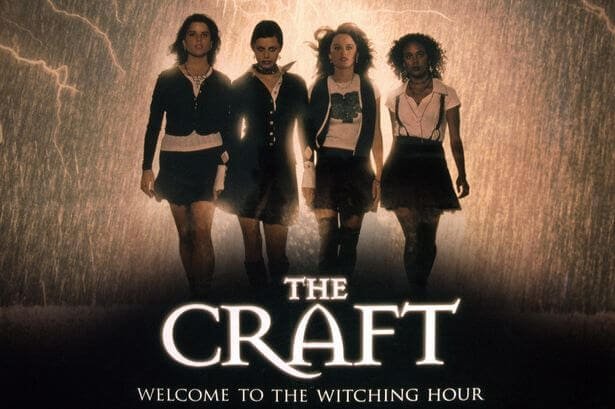
Release Date: May 3, 1996 Director: Andrew Fleming Domestic Box Office: $24.8 million Budget: $15 million Rotten Tomatoes: 55%
Although The Craft only generated $24.8 million at the domestic box office and grossed $55.6 million worldwide against a budget of $15 million, The Craft went on to establish itself as one of the definitive cult classics of the 1990s among young women, as well as established an aesthetic (Catholic school uniform, dark lipstick, silver jewelry, candlelit rituals) that would prefigure “dark femininity” and “witchcore” aesthetics found on TikTok years later.
Fairuza Balk’s performance as Nancy Downs remains one of the most unhinged and dedicated villain performances in teen horror. The themes behind The Craft — adolescent isolation, the intoxication of power, corrupting influence, and weakness in female alliances under duress — added a degree of psychological complexity missing from other teen horror films during the same time frame.
The success of The Craft‘s afterlife was further validated when the 2020 sequel, The Craft: Legacy, demonstrated The Craft‘s continued relevancy while simultaneously highlighting just how challenging it is to recreate the anarchic energy present in The Craft nearly three decades earlier. The Craft: Legacy received poor critical and commercial reception, which solidified The Craft‘s position as one of those instances of “lightning in a bottle.”
The film’s themes — teenage alienation, the desire for power and control, the cost of unchecked ambition — remain universally resonant. For a generation of young women who felt like outsiders, The Craft was not just a movie; it was a manifesto.
Vibe List Take: The Craft succeeds because it treats its teenage protagonists with respect. Rather than patronizing them or reducing their anger to a fleeting phase, The Craft establishes trust with its audience, which allowed it to endure long enough for younger generations who were not alive when it was initially released to reclaim it for themselves.
12. Space Jam
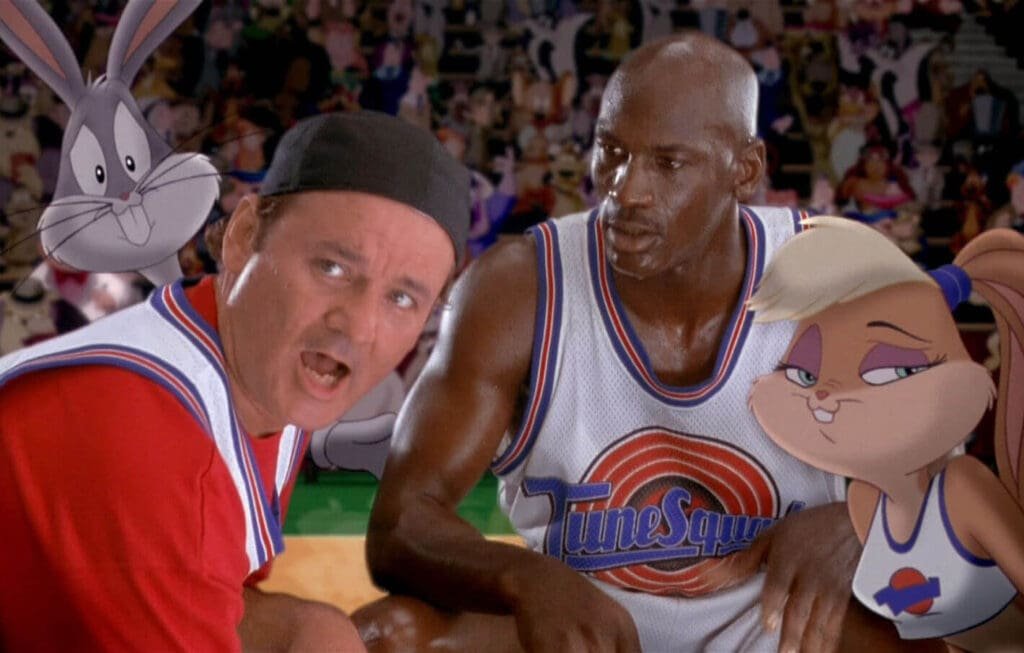
Release Date: November 15, 1996 Director: Joe Pytka Worldwide Box Office: $250 million Budget: $80 million Rotten Tomatoes: 44%
Space Jam is not an excellent motion picture. However, Space Jam does serve as an outstanding cultural artifact. When Michael Jordan reached the pinnacle of his marketability, combined with Warner Bros.‘ Looney Tunes franchise reaching its height of merchandising popularity in 1996, they created a film which generated over $250 million globally and spawned $1.2 billion in merchandise related to Space Jam alone. Therefore, by 2009, the total economic value of Space Jam was conservatively estimated between $4 billion and $6 billion around the globe.
The Tune Squad jerseys created by Nike became one of the best-selling items of sports-related merchandise during the 1990s. The soundtrack for Space Jam (anchored by R. Kelly’s “I Believe I Can Fly” and Seal’s “Fly Like an Eagle”) was another multi-million-dollar commercial success. Furthermore, the Space Jamwebsite (spacejam.com) remained online and unchanged for over 25 years, making it possibly one of the most recognizable examples of preservation for early web design.
The film’s original website, became an internet legend in its own right — a relic of 1996 web design that remained unchanged for approximately 2.5 decades until it was finally archived in 2021 ahead of the sequel, Space Jam: A New Legacy, starring LeBron James. That sequel grossed $163 million worldwide and received significantly worse reviews, reinforcing the original’s status as the definitive article.
The soundtrack, featuring Seal’s “Fly Like an Eagle,” R. Kelly’s “I Believe I Can Fly,” and Coolio’s “The Winner,” was a multiplatinum juggernaut. “I Believe I Can Fly” transcended the film entirely, becoming one of the most played songs of the late ’90s and a staple of graduation ceremonies for the next two decades.
The Warner Bros. film also cemented Jordan’s status as a cultural figure who transcended athletics — a brand unto himself whose appeal extended far beyond the basketball court and into every corner of entertainment.
Vibe List Take: Space Jam is possibly the ultimate manifestation of cross-platform marketing synergies available to brands during late 20th-century America. Although it cannot be said that Space Jam functions as a cinematic experience, Space Jam is a flawless embodiment of Michael Jordan’s ability to sell anything, anywhere, anytime.
13. Happy Gilmore
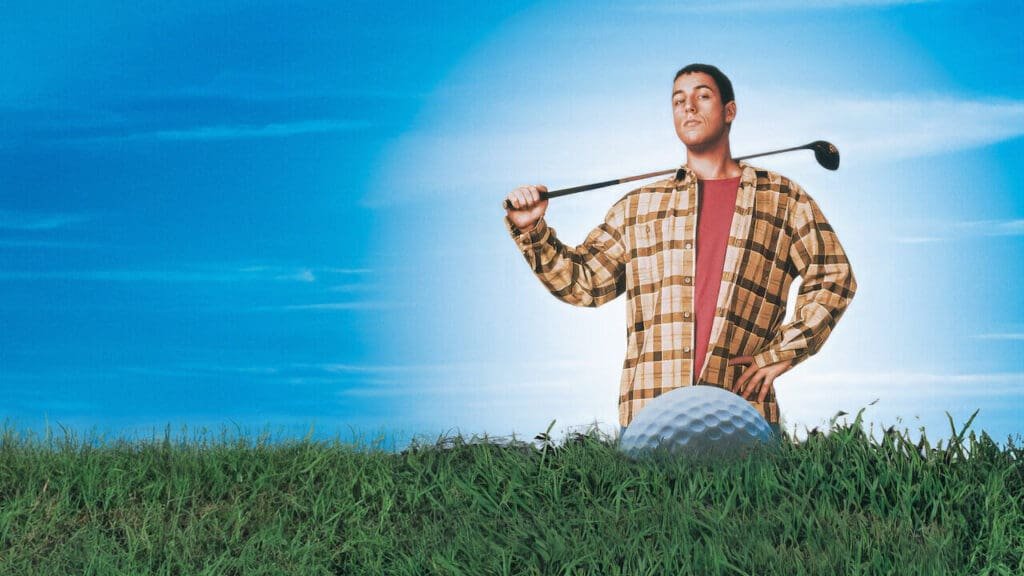
Release Date: February 16, 1996 Director: Dennis Dugan Worldwide Box Office: $41.4 million Budget: $12 million Rotten Tomatoes: 61%
On a budget of $12 million, Adam Sandler’s second major comedic success brought in $41.4 million globally. Happy Gilmore cemented Sandler’s comedic persona (brash, physically violent, curiously charming) that would eventually bring him hundreds of millions of dollars over the next three decades. While Happy Gilmore generated multiple quotable lines (“The price is wrong”), none would generate more attention than Sandler’s fight scene with Bob Barker on a golf course, winning the MTV Movie Award for Best Fight Scene. Lines such as “The price is wrong” would forever be embedded in comedy lore.
Adam Sandler’s Happy Gilmore was not the first sports comedy, but it might be the most influential one of the last 30 years. The premise — a failed hockey player discovers he can drive a golf ball 400 yards and enters the PGA Tour to save his grandmother’s house — is pure Sandler absurdism, and it works because Sandler commits to it with the intensity of someone who genuinely believes this is a plausible career path.
Happy Gilmore‘s continuing relevance saw an astonishing rebirth in 2025 with Netflix releasing Happy Gilmore 2, which achieved an incredible 46.7 million viewers in its initial three-day window, marking the largest U.S. opening weekend in Netflix history at that point. While Happy Gilmore 2 clearly indicated Happy Gilmore still resonates with millennials and Gen Xers, there is nothing suggesting Happy Gilmore 2 captured anywhere near the raw energy that defined Happy Gilmore.
Vibe List Take: Happy Gilmore illustrated that Adam Sandler’s brand was economically unbreakable — regardless of whether you view this as uplifting or disturbing, Happy Gilmore provided ample data indicating so.
Speaking of streaming giants, see our list of The Best Netflix Binge-Worthy Series You Probably Haven’t Watched Yet
14. Set It Off
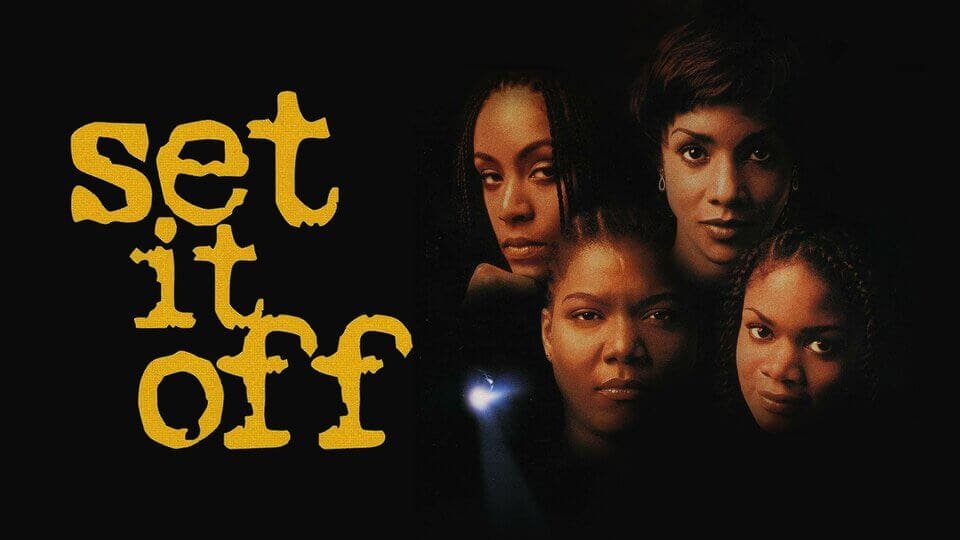
Release Date: November 6, 1996 Director: F. Gary Gray Worldwide Box Office: $41 million Budget: $9 million Rotten Tomatoes: 63%
F. Gary Gray’s Set It Off is one of the most powerful and underappreciated crime dramas of the 1990s. The film follows four Black women in Los Angeles — played by Jada Pinkett, Queen Latifah, Vivica A. Fox, and Kimberly Elise — who turn to bank robbery after systemic failures, economic desperation, and personal tragedies leave them with no other options. It is a heist film, but it is also a searing commentary on race, class, gender, and the American economic system’s capacity to crush the people it claims to serve.
F. Gary Gray directed Jada Pinkett, Queen Latifah, Vivica A. Fox, and Kimberly Elise in a heist film generating approximately $41 million internationally against a budget of $9 million, establishing it as one of the most influential Black ensemble films of the 1990s. Set It Off tells the story of four low-income, working-class women living in Los Angeles who turn to bank robbery as they face extreme financial hardship, doing so with greater detail and emotional resonance than expected for a heist film.
Queen Latifah’s portrayal of Cleo — an openly queer and assertively masculine character in a mainstream Hollywood production — served as groundbreaking for its time, and continues to be referenced in conversations surrounding LGBTQ+ representation in 1990s cinema. The soundtrack for Set It Off (featuring En Vogue, Organized Noize, and Brandy) exists as a time-capsule recording for mid-’90s R&B.
Set It Off has experienced a significant cultural reassessment in recent years. Film scholars and critics have increasingly recognized it as a precursor to modern conversations about systemic inequality, intersectionality, and the socioeconomic conditions that drive people to desperate acts. The film does not romanticize crime — the consequences are devastating and final — but it refuses to moralize about characters whose circumstances are depicted with unflinching honesty.
The soundtrack, featuring En Vogue, Organized Noize, and Queen Latifah herself, is a time capsule of mid-’90s R&B and hip-hop. And the film’s final act, a brutal and emotionally gutting sequence of consequences, remains one of the most effective third-act turns in ’90s cinema.
Vibe List Take: Set It Off represents perhaps one of the first instances where Black women were used to anchor an action/heist thriller generating comparable box-office revenues compared to films possessing three times its budget. How necessary it was for Black women to demonstrate this fact is reflective of how little faith existed in their abilities prior to Set It Off demonstrating otherwise.
15. Matilda
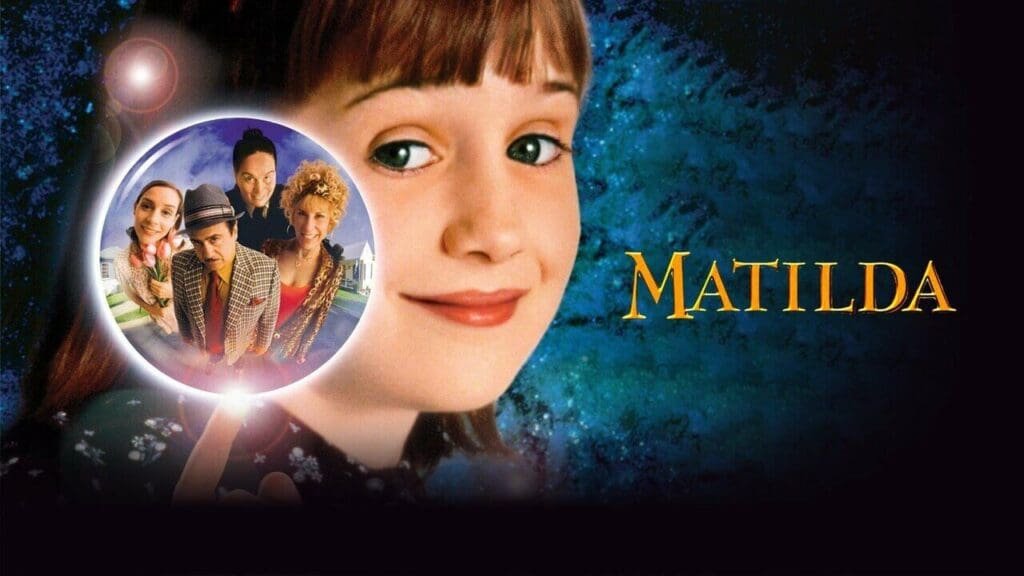
Release Date: August 2, 1996 Director: Danny DeVito Worldwide Box Office: $33.5 million Budget: $36 million Rotten Tomatoes: 90%
On a budget of $36 million, director, producer, narrator, and star Danny DeVito adapted Roald Dahl’s book Matilda into a film achieving global box office totals of $33.5 million. Although its theatrical run was modest, it established itself as one of the most financially successful home video releases for an entire generation of millennials.
Mara Wilson’s portrayal of Matilda contained an appropriate level of heartiness while avoiding saccharine sentimentality — DeVito effectively struck a balance between Dahl’s inherent darkness and genuine affection throughout the film. The relationship between Matilda (played by Mara Wilson) and her teacher Miss Honey (played by Embeth Davidtz) remains one of the most genuinely authentic mentor-student relationships depicted in family-oriented cinema.
The film’s themes — the power of reading, the importance of kind mentors, and the quiet resilience of children in hostile environments — have resonated with every generation that has discovered it since. Embeth Davidtz’s portrayal of Miss Honey, the gentle teacher who becomes Matilda’s surrogate family, provides the emotional anchor for a film that alternates between anarchic comedy and genuine tenderness.
A new adaptation of Matilda premiered on Netflix in 2022 as Roald Dahl’s Matilda the Musical, confirming Matilda‘s lasting appeal. However, it also underscored how difficult it will be for future productions attempting to recreate that exact same anarchic energy present in DeVito’s Matilda nearly three decades ago.
Vibe List Take: Matilda is certainly one of those very rare children’s films that recognizes the intelligence of its intended audience sufficient enough to inform them of reality: sometimes adults will fail you — but ultimately it is solely you who can rescue yourself.
16. The Hunchback of Notre Dame
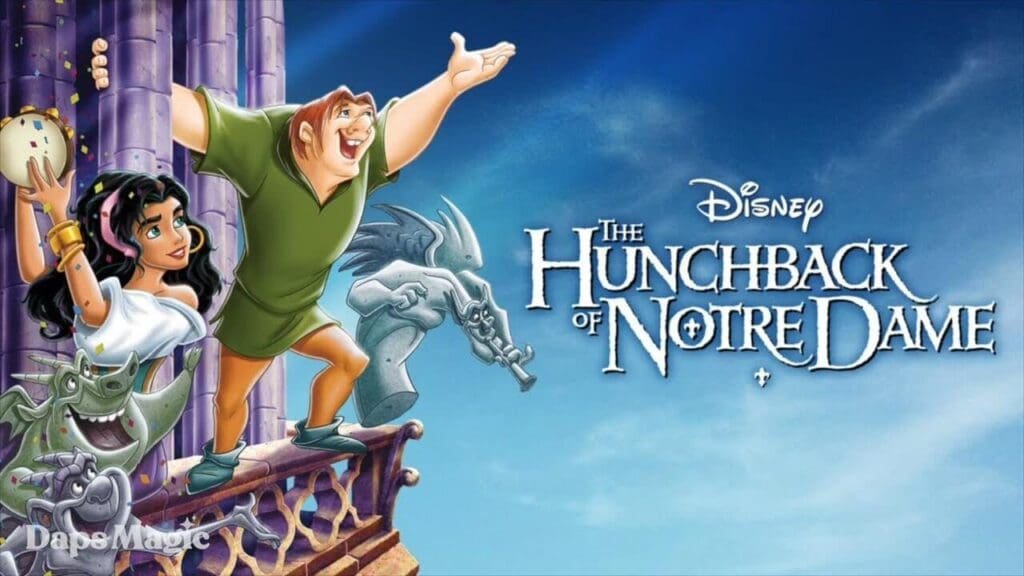
Release Date: June 21, 1996 Directors: Gary Trousdale and Kirk Wise Worldwide Box Office: $325 million Budget: $100 million Rotten Tomatoes: 73%
In 1996, Disney made what can only be described as its darkest animated film to date. Based on Victor Hugo’s famous 1831 novel, The Hunchback of Notre Dame would eventually gross a total of $325 million.
However, this figure doesn’t come close to measuring the significance of The Hunchback of Notre Dame. This film was the darkest that Disney had ever made — a tale that explores fanatical religion, lust, genocide, and the marginalizing of groups of people through music written by Alan Menken and Stephen Schwartz. One example is “Hellfire,” the most thematically complex musical number that Disney has ever produced.
The film suffered from a split personality due to its origin as a very dark piece of literature versus Disney’s goal of selling products such as toys. As a result, there were constant tone shifts throughout the film. For example, Frollo’s campaign of genocide against Romani people during medieval France was juxtaposed with three wisecracking gargoyles, Quasimodo’s friends. The contrast is exactly what makes The Hunchback of Notre Dame the subject of debate today. On one hand, the film is much too dark for young children; on the other hand, it is much too light for the original book.
Three decades later, the critical reassessment has been overwhelmingly positive. “Hellfire” is now widely regarded as one of the greatest villain songs in Disney history — a masterclass in animation, vocal performance, and thematic darkness that makes most modern Disney antagonists look like they are reading from a corporate sensitivity handbook. The film’s depiction of religious hypocrisy, systemic persecution, and the dehumanization of marginalized communities resonates more powerfully now than it did in 1996.
The film’s score earned an Academy Award nomination for Best Original Score, and the song “Someday” was nominated for a Golden Globe. A stage musical adaptation has been developed and performed in various productions, including a well-received run in Germany and regional U.S. theaters.
Vibe List Take: The Hunchback of Notre Dame demonstrated that Disney could produce something much darker than everyone had anticipated — but just as quickly showed that Disney was unwilling to risk going further. Therein lies the internal struggle within the film. It is a true masterwork trapped within a series of compromises. This struggle is exactly why we continue to argue about the film.
17. A Time to Kill
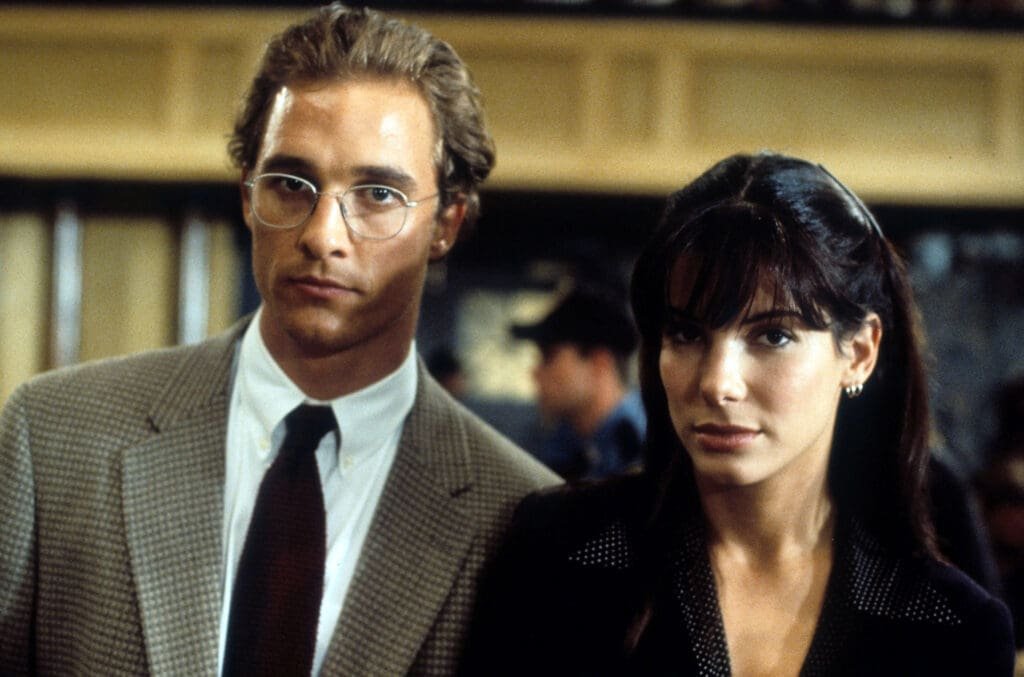
Release Date: July 24, 1996 Director: Joel Schumacher Worldwide Box Office: $152 million Budget: $40 million Rotten Tomatoes: 67%
Joel Schumacher’s adaptation of John Grisham’s A Time to Kill arrived during the peak of the ’90s legal-thriller wave and became one of the most commercially successful entries in the genre. The film stars Samuel L. Jackson as Carl Lee Hailey, a Black father in Mississippi who kills the two white men who brutally assaulted his young daughter, and Matthew McConaughey as Jake Brigance, the young attorney tasked with defending him.
Based upon John Grisham’s novel of the same name, Joel Schumacher’s version of A Time to Kill generated $152 million in worldwide box office sales and helped establish Matthew McConaughey as a major motion picture star. In addition to launching McConaughey as a leading man, the film featured an emotionally charged performance by Samuel L. Jackson as Carl Lee Hailey — a father who murdered the two men who raped his daughter and is now standing trial in front of a Mississippi jury.
The large group of talented actors appearing in the film includes Sandra Bullock, Kevin Spacey, Ashley Judd, Oliver Platt, and Donald and Kiefer Sutherland. Additionally, McConaughey’s closing argument to the jury in court will forever be remembered as one of the most memorable monologues in courtroom drama history.
That closing argument is the film’s defining moment and one of the most effective courtroom scenes in modern cinema. It strips away every layer of legal procedure and forces both the fictional jury and the real audience to confront the racial double standard at the heart of American justice. The line “Now imagine she’s white” entered the cultural lexicon immediately and has been referenced in legal scholarship, journalism, and social commentary ever since.
The film also solidified McConaughey’s transition from supporting player to leading man — a trajectory that would eventually, after years of romantic-comedy detours, lead to the “McConaissance” of the 2010s with performances in Dallas Buyers Club, True Detective, and Interstellar.
Vibe List Take: A Time to Kill presented its audience with a difficult question that no audience member had the luxury of comfortably answering — and left them sitting with those uncomfortable feelings for two hours. It is a morally ambiguous film that refuses to neatly conclude its moral ambiguity.
18. Sling Blade
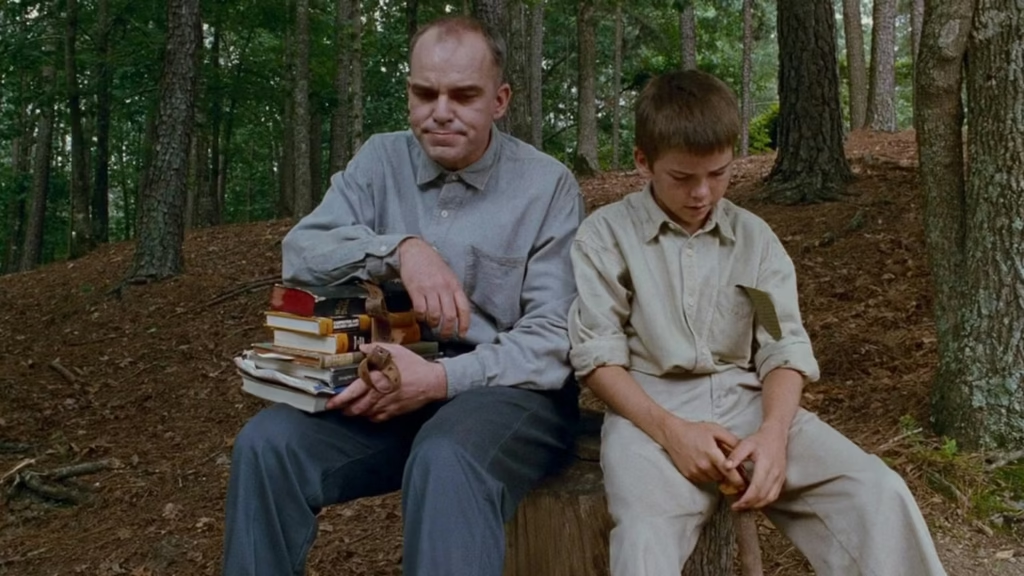
Release Date: November 22, 1996 Director: Billy Bob Thornton Budget: $1 million Worldwide Box Office: $24.5 million Rotten Tomatoes: 95%
On a budget of approximately $1 million, Billy Bob Thornton wrote, directed, and starred in Sling Blade. He went on to win the Academy Award for Best Adapted Screenplay for his efforts and received an Oscar nomination for Best Actor for his portrayal of Karl Childers — a developmentally disabled man who spent most of his life confined in a psychiatric institution after being convicted as a boy of murdering his mother and her lover with a sling blade. Released from a psychiatric institution after 25 years, Karl forms a bond with a young boy named Frank (Lucas Black) and his mother Linda (Natalie Canerday), whose abusive boyfriend Doyle (Dwight Yoakam) represents an escalating threat to the fragile family unit.
Thornton’s commitment to this role resulted in one of the most intense physical acting performances in cinematic history. Thornton developed Karl’s physical appearance, voice, and emotional expression in such detail that audiences found themselves unable to reconcile the person on screen with the man receiving the Oscar.
The film is quiet, deliberate, and deeply compassionate. Thornton’s performance — Karl’s slow, gravelly voice, his careful way of moving through the world, his childlike decency coexisting with the capacity for violence — is one of the most fully realized character portrayals in modern American cinema. Yoakam’s Doyle is a genuinely menacing presence, all coiled hostility and casual cruelty, and the tension between him and Karl drives the film toward an inevitable, devastating conclusion.
The film also explored complex moral questions — specifically whether Karl needs to kill again to protect someone he cares for. Ultimately, it failed to provide clear-cut solutions for either side of the debate.
Sling Blade is one of those films that proves budget has almost nothing to do with quality. Everything works: the writing, the performances, the pacing, and the emotional payoff. Thirty years later, Karl’s catchphrase — “I like them French-fried potaters, mmm-hmm” — has become an affectionate cultural reference, though the film itself is far more complex and emotionally devastating than that single line suggests.
Vibe List Take: Sling Blade catapulted Billy Bob Thornton from being a talented character actor into becoming a feature film star. And he accomplished it all thanks to one truly spectacular physical transformation of an acting performance. Audiences actually couldn’t separate the person playing Karl Childers from the man who was actually accepting the Oscar.
19. The Nutty Professor
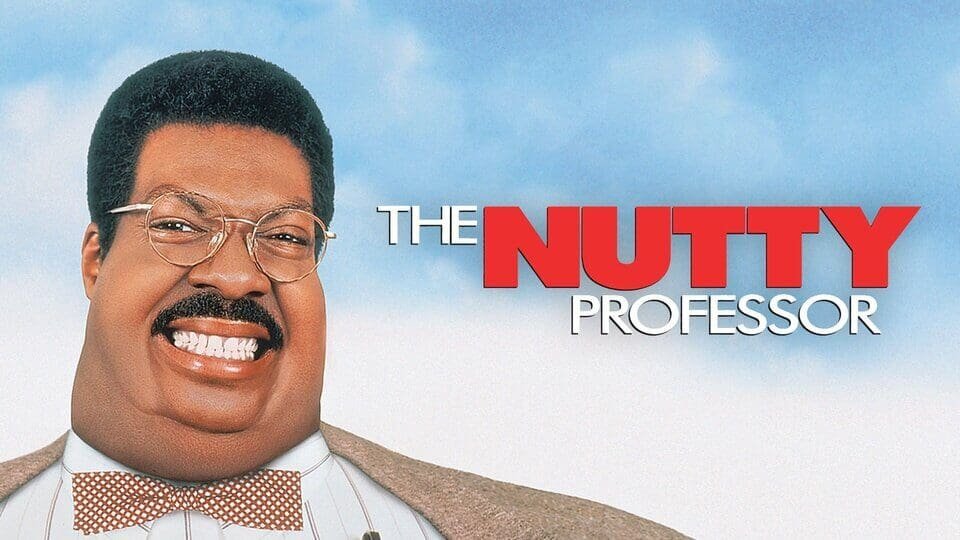
Release Date: June 28, 1996 Director: Tom Shadyac Worldwide Box Office: $274 million Budget: $54 million Rotten Tomatoes: 64%
Eddie Murphy’s career was in a rough patch by the mid-1990s. A string of commercial and critical disappointments had dimmed the star power that had defined the previous decade. Then The Nutty Professor arrived and reminded everyone exactly what Murphy could do when given the right material and the freedom to perform.
Tom Shadyac’s return-of-the-formula vehicle for Eddie Murphy produced a worldwide box office gross of $274 million. More importantly, the film served as a reminder to the world that Eddie Murphy is still one of the greatest comedic performers on earth. As seven different characters — each with completely unique characteristics and abilities — Eddie Murphy delivered perhaps his finest hour as a comedic actor since Coming to America.
Murphy played each of these characters and also portrayed two of them simultaneously. His performances as both Professor Sherman Klump — a college professor who invented an obesity-reducing serum — and Buddy Love — an arrogant, womanizing alter ego — provided the film with a level of depth that many thought it wouldn’t be able to achieve given its status as a traditional comedy. The Nutty Professor dealt with issues related to body image, self-esteem, and how cruel society can be toward overweight individuals. Rick Baker won the Academy Award for Best Makeup for his work on the film.
Vibe List Take: The Nutty Professor demonstrated to us all that Eddie Murphy is capable of carrying a huge blockbuster based solely on talent alone. No guns-blazing action sequences existed in The Nutty Professor; no classic buddy-cop formula existed here; no large-scale concert-type footage was present — simply one single talented performer playing seven different characters and earning $274 million.
20. From Dusk Till Dawn
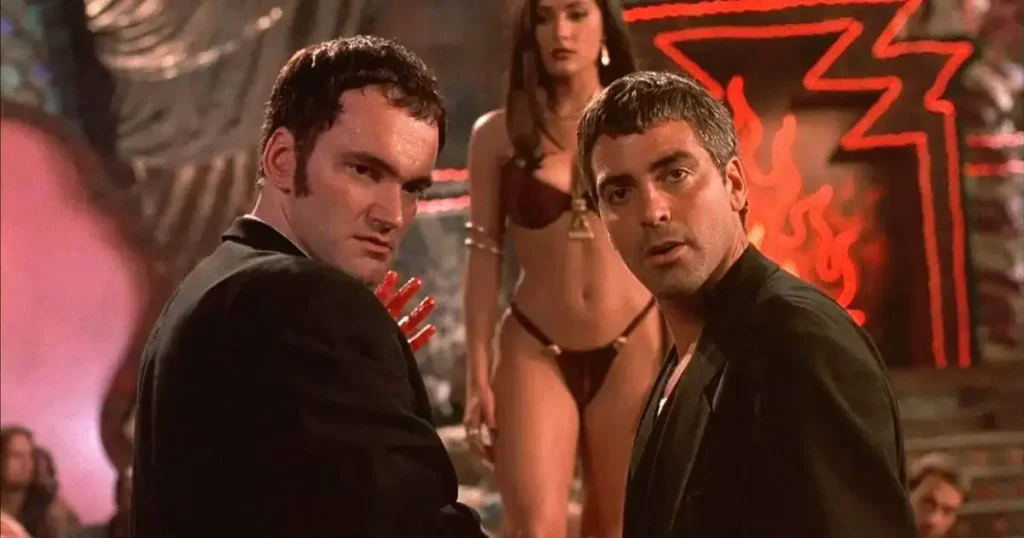
Release Date: January 19, 1996 Director: Robert Rodriguez Domestic Box Office: $25.8 million Budget: $19 million Rotten Tomatoes: 63%
Robert Rodriguez collaborated with Quentin Tarantino on their wild mashup hybrid film (part crime drama, part vampire horror) From Dusk Till Dawn, which netted $25.8 million domestically against a $19 million budget.
Rodriguez’s clever use of structure in From Dusk Till Dawn provided viewers with a thrilling experience. Initially beginning as a tight crime drama in Tarantino’s signature thriller style, the movie suddenly shifts into full-fledged vampire horror right at its midway point.
Robert Rodriguez’s From Dusk Till Dawn is a film of two halves, and the seam between them is one of the most audacious tonal shifts in modern cinema. The first half is a taut, Tarantino-scripted crime thriller about two fugitive brothers — Seth Gecko (George Clooney) and Richie Gecko (Quentin Tarantino) — kidnapping a family and fleeing to Mexico. The second half, triggered when they arrive at a roadside strip club called the Titty Twister, is a full-blown vampire action-horror film with gallons of blood, practical effects, and Salma Hayek dancing with a snake.
Although this plot twist came out of nowhere and wasn’t telegraphed anywhere prior, it worked perfectly for this particular film. George Clooney appeared in this film while already starring in his role on the NBC television series ER, which had premiered in September 1994. From Dusk Till Dawn served as Clooney’s breakout film role, providing him with big-screen action credentials that complemented his television stardom. Tarantino’s appearance as Clooney’s disturbed brother added real menace to this film while leaving viewers questioning until the end whether anything supernatural had really occurred.
Tarantino’s screenplay — and his performance as the deeply unsettling Richie — divides audiences to this day, but there is no denying the film’s energy and inventiveness. Rodriguez and Tarantino’s collaboration produced a film that refuses to be categorized, and that refusal is precisely what makes it endure. The Titty Twister sequence alone — with its abrupt descent into supernatural chaos — is one of the most memorable genre pivots in ’90s cinema.
The film spawned two direct-to-video sequels and a three-season television adaptation on the El Rey Network (2014–2016), none of which captured the anarchic energy of the original. From Dusk Till Dawn remains a singular artifact: half crime film, half horror film, and entirely its own thing.
Vibe List Take: The only thing wilder than the premise of From Dusk Till Dawn is its genre-shifting nature. The only reason it works so well is that Rodriguez and Tarantino deliberately avoided signaling what kind of story they were telling until halfway through — which is exactly what they wanted to do.
The Class of 1996 at a Glance: 20 Films Turning 30 and Their Lasting Legacy
| # | Film | Director | Release Date | Worldwide Box Office | Budget | Key Legacy | Notable 2025–2026 Update |
|---|---|---|---|---|---|---|---|
| 1 | Independence Day | Roland Emmerich | July 3, 1996 | $817.4M | $75M | Oscar for Best Visual Effects; redefined disaster blockbusters | — |
| 2 | Twister | Jan de Bont | May 10, 1996 | $494.5M | $92M | 2 Oscar noms; 54.7M tickets sold domestically | Sequel Twisters (2024) grossed $372M worldwide |
| 3 | Mission: Impossible | Brian De Palma | May 22, 1996 | $457M | $80M | Launched 8-film, $4.35B franchise | The Final Reckoning (8th film) released May 2025 |
| 4 | Scream | Wes Craven | Dec 20, 1996 | $173M | $15M | Revived the slasher genre; Ghostface became a cultural icon | Scream 7 (Feb 2026) passed $200M; franchise crossed $1B |
| 5 | Fargo | Joel & Ethan Coen | Mar 8, 1996 | $60.6M | $7M | 2 Oscars (Best Actress, Best Original Screenplay) | FX TV series ran 5 seasons, 51 episodes |
| 6 | Trainspotting | Danny Boyle | Feb 23, 1996 (UK) | $72M | £1.5M (~$2.3M) | BFI Top 100 British Films (#10); Oscar nom for Best Adapted Screenplay | T2 Trainspotting sequel released 2017 |
| 7 | Romeo + Juliet | Baz Luhrmann | Nov 1, 1996 | $147.5M | $14.5M | Guinness Record: highest-grossing Shakespeare adaptation | — |
| 8 | Jerry Maguire | Cameron Crowe | Dec 13, 1996 | $273.6M | $50M | 5 Oscar noms; 3 iconic catchphrases entered the lexicon | 30th anniversary theatrical re-release Apr 12, 14 & 15, 2026 |
| 9 | The Rock | Michael Bay | Jun 7, 1996 | $335M | $75M | Widely considered Michael Bay’s best film | — |
| 10 | The English Patient | Anthony Minghella | Nov 15, 1996 | $232M | $27M | 9 Oscars from 12 noms; tied all-time record | — |
| 11 | The Craft | Andrew Fleming | May 3, 1996 | $55.6M | $15M | Definitive ’90s cult classic; prefigured “witchcore” aesthetic | Sequel The Craft: Legacy released 2020 (VOD) |
| 12 | Space Jam | Joe Pytka | Nov 15, 1996 | $250M | $80M | $1.2B in merchandise; website unchanged for 25 years | Space Jam: A New Legacy sequel released 2021 |
| 13 | Happy Gilmore | Dennis Dugan | Feb 16, 1996 | $41.4M | $12M | Cemented Adam Sandler’s comedic persona | Happy Gilmore 2 (Netflix, Jul 2025): 46.7M views opening weekend |
| 14 | Set It Off | F. Gary Gray | Nov 6, 1996 | $41M | $9M | Landmark LGBTQ+ representation; influential Black ensemble cast | — |
| 15 | Matilda | Danny DeVito | Aug 2, 1996 | $33.5M | $36M | Box-office flop turned generational home-video classic | Roald Dahl’s Matilda the Musical on Netflix (2022) |
| 16 | The Hunchback of Notre Dame | Gary Trousdale & Kirk Wise | Jun 21, 1996 | $325M | $100M | Disney’s darkest animated film; “Hellfire” is iconic | — |
| 17 | A Time to Kill | Joel Schumacher | Jul 24, 1996 | $152M | $40M | Launched Matthew McConaughey; iconic closing argument | — |
| 18 | Sling Blade | Billy Bob Thornton | Nov 22, 1996 | $24.5M | ~$1M | Oscar for Best Adapted Screenplay; Best Actor nom | — |
| 19 | The Nutty Professor | Tom Shadyac | Jun 28, 1996 | $274M | $54M | Eddie Murphy plays 7 characters; Oscar for Best Makeup | — |
| 20 | From Dusk Till Dawn | Robert Rodriguez | Jan 19, 1996 | $25.8M | $19M | Genre-shifting cult classic; Clooney’s breakout film role | 3-season TV adaptation on El Rey Network (2014–2016) |
Frequently Asked Questions
What was the highest-grossing film of 1996?
Independence Day was the highest-grossing film of 1996, earning approximately $817.4 million worldwide on a $75 million budget. Domestically, it grossed over $306 million, making it the top-performing film at the U.S. box office that year and, at the time of its release, the second-highest-grossing film in history behind Jurassic Park (1993).
Which 1996 films won Academy Awards?
Several 1996 films earned significant recognition at the 69th Academy Awards, held on March 24, 1997. The English Patient dominated the ceremony with nine wins, including Best Picture, Best Director (Anthony Minghella), and Best Supporting Actress (Juliette Binoche). Fargo won Best Actress (Frances McDormand) and Best Original Screenplay (Joel and Ethan Coen). Jerry Maguire earned Best Supporting Actor (Cuba Gooding Jr.). Independence Day won Best Visual Effects. The Nutty Professor won Best Makeup. Sling Blade won Best Adapted Screenplay (Billy Bob Thornton).
Are any of these films getting sequels, reboots, or re-releases in 2026?
Yes. Scream 7 was released on February 27, 2026, and has grossed over $200 million worldwide, pushing the franchise past the $1 billion global milestone. Jerry Maguire is returning to theaters for a 30th anniversary limited engagement on April 12, 14, and 15, 2026, distributed by TriStar Pictures. Happy Gilmore 2 debuted on Netflix in July 2025 and became the platform’s biggest U.S. opening-weekend film ever with 46.7 million views. The Mission: Impossible franchise released its eighth installment, The Final Reckoning, in May 2025.
What made 1996 such a significant year for movies?
The domestic box office totaled nearly $5.8 billion in 1996, driven by a historically diverse and commercially successful lineup. The year produced blockbusters (Independence Day, Twister, Mission: Impossible), award-winning dramas (The English Patient, Fargo, Sling Blade), genre-redefining horror (Scream), cult classics (The Craft, Trainspotting, From Dusk Till Dawn), and family films (Space Jam, Matilda, The Hunchback of Notre Dame) that collectively reshaped Hollywood’s understanding of what audiences wanted. Many of these films launched franchises that continue to generate billions in revenue three decades later.
Which 1996 film has the most successful franchise?
The Mission: Impossible franchise is the most commercially successful, with eight films spanning 30 years (1996–2025) and a combined worldwide gross of over $4.35 billion. The Scream franchise, with seven films, recently crossed the $1 billion worldwide mark in March 2026.
Is the original Space Jam website still online?
The original 1996 Space Jam website remained essentially unchanged for approximately 25 years, becoming one of the most famous relics of early internet design. It was archived in 2021 when the domain was updated ahead of the sequel, Space Jam: A New Legacy. The original site remains accessible at its archived URL and continues to be cited as a landmark of 1990s web culture.
Which 1996 film had the smallest budget but biggest cultural impact?
Sling Blade, made for approximately $1 million, earned $24.5 million worldwide and won the Academy Award for Best Adapted Screenplay. However, Trainspotting, made for approximately £1.5 million (around $2.3 million), grossed over $72 million worldwide and is widely considered one of the most culturally influential British films ever made, ranked No. 10 on the BFI’s list of the 100 greatest British films.
Have any movies from 1996 had sequels or reboots?
There are many films from 1996 that have either been followed up by sequels or rebooted. Some examples include: Mission: Impossible (eight films); Scream (seven films); Space Jam (a sequel was released in 2021); Twister (the original film received a sequel called Twisters in 2024); Happy Gilmore (Netflix released a sequel, Happy Gilmore 2, in July 2025); The Nutty Professor (a sequel titled The Nutty Professor II: The Klumps was released in 2000); The Craft (a sequel, The Craft: Legacy, was released in 2020); and Matilda (in 2022, a musical adaptation titled Roald Dahl’s Matilda the Musical was released on Netflix).
For more on pop-culture business empires, see The Biggest Corporate Fails in Business History.
Disclaimer: Box-office figures are sourced from Box Office Mojo, The Numbers, and IMDb. Award information is sourced from the Academy of Motion Picture Arts and Sciences and IMDb. All figures are in U.S. dollars unless otherwise noted. Rotten Tomatoes scores reflect the Tomatometer as of the date of publication where included. Cultural assessments and editorial verdicts reflect the opinion of The Vibe List editorial team.
This content is intended for informational and entertainment purposes only.