



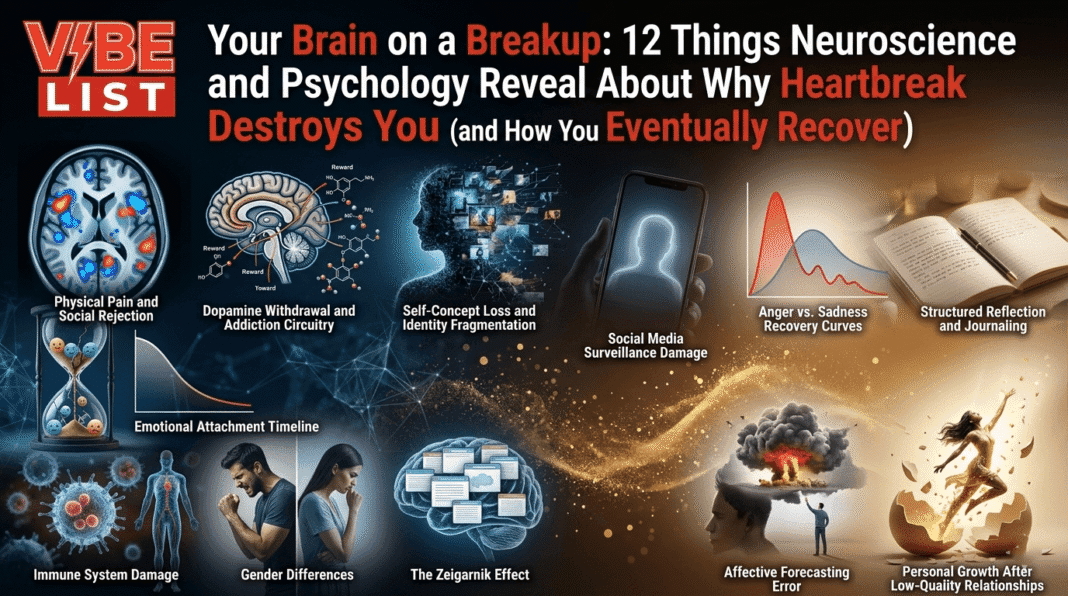
Forty fMRI scans showing rejection lighting up the same brain regions as a physical burn. Fifteen heartbroken subjects with reward circuits indistinguishable from cocaine withdrawal. 4.18 years to dissolve half an emotional bond; eight to finish the job. An inflammatory marker spiking 113% from a single hostile conversation. 5,705 people across 96 countries proving that men who suppress grief the fastest heal the slowest. A 71% growth rate among those who walked away from the wrong relationship. None of them got over it by stopping thinking about it; they got over it by finally understanding what their brain was doing and why.
This content is for informational purposes only and does not constitute professional medical, psychological, or financial advice. Consult a qualified professional for personalized guidance.
According to Psychology Today, over 80% of people will go through a breakup at some point in their lives. While that statistic is striking on its own, it’s the underlying biological changes that occur in the brain that make a breakup unique. Over the last twenty years, scientists studying the biology of heartbreak have identified several ways in which a breakup reshapes our brains. Unlike sadness alone, heartbreaks affect our entire bodies, our nervous systems, and even our ability to connect emotionally with others. Like burns to the arm, we can expect heartbreak to hurt for a very long time. This article is not a self-help listicle written in a lab coat. Each listed fact is supported by scientific research and is fully referenced so you can look up the research itself.
If you understand why heartbreak occurs, then you will likely have a greater chance of surviving it; and recovering from it. Here are twelve insights from science into what heartbreak does to us, how long the damage lasts, and what the research indicates about heartbreak recovery.
1. Your Brain Treats Rejection as Painfully as It Does Burns

Ethan Kross and his team at the University of Michigan performed an fMRI scan on forty newly heartbroken individuals in 2011. When participants looked at pictures of the person who had rejected them, the researchers saw the secondary somatosensory cortex, dorsal posterior insula, and thalamus; regions responsible for processing physical pain; activate just as they would when you burned your hand or received a punch to the stomach. According to a meta-analysis of 524 neuroimaging studies that found social rejection activates brain regions involved in processing physical pain with high predictive accuracy (as much as 0.88), when people tell you a breakup “hurts,” they are telling you the truth. The brain does not seem to differentiate between a pulled muscle and a lost relationship; both activate the same pain circuitry, which is why people experiencing a breakup report feeling nauseous, having their chest tighten, and feeling a visceral pain that is not alleviated by rational thinking. The study appeared in PNAS (Kross et al., 2011).
In practical terms, this is an unusual but vital point: since heartbreak can feel similar to a physical injury, it should be treated with similar seriousness. Give yourself permission to rest, seek support, and allow yourself time to heal; these are not indulgences; they are scientifically supported responses to a neurologically based event.
2. Heartbreak Activates Similar Brain Regions as Cocaine Withdrawal

In 2010, Dr. Helen Fisher conducted a landmark fMRI study at Rutgers University that evaluated the brains of fifteen individuals whose recent, involuntary breakups left them still completely in love with their ex. The brain regions associated with dopamine release, including the ventral tegmental area (VTA), the ventral striatum (VS), the nucleus accumbens (NAcc), and the orbitofrontal cortex (OFC), fired off like fireworks when participants were shown photos of their ex-lovers. These are the same areas of the brain involved in cocaine cravings and anticipated monetary rewards (Fisher et al., 2010).
The chemistry behind this phenomenon is direct: during a romance, your brain produces high levels of dopamine, oxytocin, and norepinephrine; a chemical cocktail that creates feelings of attachment, pleasure, and motivation. Once the relationship dissolves, these levels plummet. Dopamine falls sharply, leading to depression, lack of motivation, and emptiness. Oxytocin withdrawal causes anxiety and intense loneliness. Norepinephrine withdrawal contributes to irritability and mood swings. Cortisol, your body’s chief stress hormone, increases dramatically, creating chaos in sleep patterns, eating, and immune function.
This is not about weakness; it’s about withdrawal. Your brain developed a chemical dependence on your partner’s presence; and when that presence is suddenly removed, your brain’s reward system desperately seeks resolution. This desperation helps explain why you may wake up at 2am checking their social media profiles, negotiating with your ex in your head, and obsessively recalling past conversations. You are not losing your mind; you are addicted; and you have just lost your supply.
3. You Actually Lose Some Part of Yourself After a Relationship Ends

One of the most disorienting elements of ending a relationship is the confusion about who you are anymore. There is a clear reason for this confusion grounded in psychological theory. Researchers Erica Slotter, Wendi Gardner, and Eli Finkel published a study inPersonality and Social Psychology Bulletin in 2010 that demonstrated that romantic breakups cause measurable declines in self-concept clarity (SCC); the degree to which a person understands their own beliefs, holds those beliefs with internal consistency, and remains stable over time (Slotter et al., 2010).
How does this happen? Partners incorporate parts of each other’s identities into their own self-concepts as they grow closer. You start sharing objectives, taking on each other’s hobbies, and defining yourselves partly through the lens of the relationship. Psychologists refer to this process as “self-expansion,” and it typically produces positive outcomes for couples. When the relationship ends, however, all aspects of your identity connected to your partner vanish with it; essentially erasing pieces of your working self-concept. Diary entries collected in Slotter’s study show that individuals who experienced relationship termination expressed significantly higher amounts of uncertain and perplexed language when describing their sense of self; further, SCC was inversely related to reported emotional distress post-breakup.
This is why many people who leave long-term relationships describe feeling empty or “a stranger in their own lives.” They are not exaggerating. A component of their working self-concept has been dismantled; and rebuilding it will be one of the major psychological tasks in post-breakup recovery. If you have gone through this yourself, revisiting daily habits that rebuild a sense of self; not as productivity tactics but as structures for reconstructing identity; can be genuinely beneficial.
4. The Timeframe for Losing Emotional Attachment to an Ex Is Approximately Four Years on Average; with Full Detachment Taking Close to Eight Years

Popular lore states that it usually takes half the length of a relationship to get over someone; this estimate holds little truth for most people. Researchers Jia Y. Chong and R. Chris Fraley studied attachment dissolution timing using data from over 300 subjects in 2025, placing a quantifiable stamp on how long emotional bonds persist; with sobering results. Participants’ attachment to their former partner was only reduced by approximately half four years after the breakup. Based on Chong and Fraley’s (2025) analysis extrapolated from the rate of decline, full emotional detachment occurred approximately eight years post-loss on average.
Two predictors significantly influenced how quickly or slowly participants recovered from their attachment loss: their attachment style, and whether they remained in contact with their ex; either digitally or face-to-face. Individuals with anxious attachment styles (characterized by extreme fear of abandonment and desire for closeness) took significantly longer to detach from their ex-partner, as did those who maintained some level of continuous contact. Although the study implies many will spend eight years processing emotions regarding their former partner; and for others, the timeline may be considerably shorter; the average timeframe reveals how many remain emotionally attached to an ex for years after breaking up.
As noted by Mark Travers, PhD, in his coverage of Chong and Fraley’s (2025) findings atForbes, there are three explanations for this lengthy recovery: emotional imprinting (the brain’s addictive-like encoding of a relationship), non-linear grieving (you cannot simply “get over” an ex-lover in a straight line), and identity fusion (the interweaving of selves described above). If two years have passed since your breakup and you still react emotionally to songs or scents that remind you of them; you are right where science says you should be.
5. Your Immune System Will Take Damage

While heartbreak may feel like being ill, it can actually make you ill. Immunologist Janice Kiecolt-Glaser reviewed decades of research examining relationship dissolution’s effects on immune function in her 2018 publication inAmerican Psychologist; the evidence for immune impact was substantial (Kiecolt-Glaser, 2018). One notable study demonstrated that hostile marital exchanges increased IL-6 (an inflammatory marker) by 113%. Another indicated that single women divorced less than one year exhibited decreased immune function across multiple measures relative to married controls; those who continued ruminating over their former partner displayed the most suppressed immunity.
Both examples follow the same cortisol-dependent pathway mentioned earlier: sustained elevation of cortisol suppresses various types of immune cells while stimulating chronic low-level inflammation. These consequences are serious enough to increase risk for cardiovascular disease, metabolic syndrome, type II diabetes, and poor wound repair.
Separate from Kiecolt-Glaser’s (2018) review, Sbarra et al.’s (2009) study found that among seventy recently separated adults, those reporting the most severe emotional intrusions stemming from divorce had elevated resting blood pressure readings. When asked to reflect on their separation, male participants experiencing the greatest distress exhibited resting blood pressures rising into clinically hypertensive ranges.
Although breakups may pose health risks for some individuals during the acute period (most people heal physically within months), Kiecolt-Glaser’s (2018) review makes clear that if you are experiencing significant physical reactions from heartbreak; insomnia, malnutrition, sedentary behavior, or social isolation; addressing these through sleep hygiene, nutrition, exercise, and social support is not merely a wellness recommendation; it is a basic protective physiological measure against potential future harm.
6. Women Experience Higher Levels of Emotional Pain Immediately After Breakup, While Men Take Longer to Heal

Craig Morris, Chris Reiber, and Emily Roman conducted the largest cross-cultural study examining post-breakup reactions to date. Morris et al. (2015) studied 5,705 subjects across 96 different cultures. Female participants reported higher levels of overall emotional distress immediately following a breakup (6.84 out of 10) than male participants (6.58 out of 10). Females also reported higher levels of physical discomfort. But there was another key difference. Females tend to heal more completely over time than males. Males’ recovery takes longer and is typically less thorough (Morris et al., 2015).
Evolutionary theorists propose that females may have developed heightened immediate post-breakup pain responses because of the increased biological risks associated with selecting a mate (pregnancy, childbirth, extended vulnerability). In this framework, females’ sharper emotional pain response after a breakup functions like a fire alarm designed to rapidly prompt risk assessment. Males’ reduced immediate pain response may reflect their generally lower biological costs from mating mistakes, resulting in a slower and possibly less complete recovery.
Recent studies have added complexity to this picture. A 2021 study from Lancaster University indicated that men tend to experience more emotional distress when a relationship takes a turn for the worse, and Chong & Fraley’s 2025 study (Social Psychological and Personality Science) found that attachment orientation; not sex or gender; is the primary determinant of how quickly detachment occurs. Nonetheless, Morris et al.’s data corrects the stereotype that men “move on quicker.” The existing literature indicates the opposite. Men appear to suppress their grief faster than women, but suppression is clearly not the same as healing.
7. Your Mind Has No Ability to Turn Off Thoughts About Them; and There Is a Specific Term for It

If you have ever attempted to stop thinking about an ex and discovered that doing so was laughably difficult, you have experienced a phenomenon that psychologists have studied since 1927. The Zeigarnik effect, named after Soviet psychologist Bluma Zeigarnik, describes how the human brain retains incomplete tasks far more vividly than finished ones. When a task is interrupted, a type of cognitive tension develops; a “cognitive open loop”; that prompts the brain to revisit the incomplete task repeatedly until it reaches resolution.
When a breakup occurs; particularly if it was abrupt or lacked closure; the absence of resolution creates a persistent open loop. The relationship did not end in a way that your brain could categorize and file away. Questions remain unanswered, conversations stay unresolved, and emotional transactions remain incomplete. Research has confirmed that these unresolved elements create intrusive thoughts even during unrelated tasks, reducing concentration and fueling rumination (Harvard Business Review, 2020). The Zeigarnik effect applied to breakups explains why ghosting; abruptly ending a relationship without explanation; produces such lasting psychological consequences. Because ghosting prevents the person experiencing the loss from reaching any form of emotional resolution, the brain cannot close its own task list, and the loop remains open indefinitely.
There is no guaranteed way to obtain closure from the person who initiated the breakup (getting closure from the other party is often impossible); however, it is possible to develop closure internally. Writing about the experience, constructing a narrative about what happened, and identifying what you gained from the relationship can help your brain close the file. (Sbarra’s reflection studies, discussed in Section 10, illustrate this approach.) Those familiar with the Zeigarnik effect from other contexts may recognize it as the same mechanism television writers use to create cliffhanger episodes.
8. Monitoring Their Social Media Profiles Causes Measurable Damage; Whether Passively or Actively

You may tell yourself that “just checking” your ex’s Instagram or TikTok account does not cause harm. Four studies led by psychologistTara C. Marshall provide a direct rebuttal. Using longitudinal surveys, experimental designs, and daily diary methods, Marshall collected social media use and emotional state data from thousands of participants across the U.S., U.K., and Canada (Marshall, 2024).
Findings from each study were remarkably consistent. Active surveillance of an ex’s social media activity correlated with greater breakup distress and more negative moods on the day of surveillance and predicted greater distress on subsequent days. Marshall also found that passive exposure; encountering an ex’s content through no deliberate action on your part (seeing an image or video they posted appear in your feed); was linked with increases in negative emotion on each respective day.
One design element in Marshall’s experiments yielded particularly valuable results. Subjects who were instructed to imagine viewing their ex’s social media account reported substantially greater levels of jealousy than subjects who imagined running into their ex in a naturalistic setting (such as their workplace). Something about social media access specifically amplifies jealousy; while part of this may stem from social comparison (curated images, public interaction with potential romantic interests), Marshall hypothesizes that social media’s provision of unilateral access to private aspects of someone’s life plays a significant role.
Marshall is explicit with her recommendation: block, unfollow, mute. She does not hedge. All types of continued digital surveillance are connected with slower recovery, increased distress, and less personal development.
It is also worth considering how online culture and habitual digital behavior reinforce these patterns; while platforms use dopamine-driven mechanisms that foster addictive use, they also facilitate compulsive monitoring of ex-partners.
9. Anger Recovers Faster Than Sadness; but Remaining Feelings of Love Slow Down Both

Not all breakup emotions follow parallel trajectories. David Sbarra tracked the daily emotional states of 58 young adults over four weeks following a breakup to measure how quickly sadness and anger returned to baseline. Sbarra used survival analyses to determine when each emotion reached its recovery point (Sbarra, 2006).
The study produced an asymmetrical model of recovery. Anger tended to decrease more quickly than sadness. Critically, Sbarra found that attachment-related feelings of love were the strongest predictor of delayed recovery for both emotions. Participants who still felt in love with their ex showed reduced probabilities of recovering from sadness over the study period. Attachment preoccupation; the tendency to obsess over a lost partner; had similarly damaging effects on recovery speed.
These findings align with what Chong & Fraley’s macro-level data demonstrate: emotional attachment is deeply anchored, and it disengages far more slowly than other breakup-related emotions.
When it comes to recovery, attempting to bypass feelings of love or pretend they have faded may be counterproductive. Sbarra’s later work (referenced in the next section) supports structured confrontation as a more effective path forward.
10. Structured Reflection Helps Promote Recovery; Regardless of Whether It Hurts

In 2015, David Sbarra and Grace Larson published a study that challenged a widely held assumption about coping with a breakup: that individuals should try to “stop thinking about it,” keep busy, and avoid dwelling on what happened. Larson and Sbarra found that participants who engaged in structured reflection about their breakup; rather than minimal reflection; recovered more quickly, and that this improvement was driven by gains in self-concept clarity (Larson & Sbarra, 2015).
Participants who had broken up within the preceding five months were randomly assigned to either an intensive reflection condition or a minimal reflection condition. Those in the intensive group completed several sessions in which they detailed their experience, described their feelings, assessed what they had learned about themselves through the breakup, and articulated what they believed they had gained as individuals. Rather than prolonging their grief, Larson and Sbarra found that this reflective process accelerated the rebuilding of their sense of self; precisely what Slotter’s research found was dismantled by breakups.
ScienceDaily‘s reporting on this study characterized the benefit as helping participants’ minds close “files” that had been creating “cognitive open loops” and driving repeated cycles of intrusive thoughts.
Structured reflection is not rumination; rumination is circular, repetitive, passive thinking about questions that have no resolution (“what did they really want?”). Structured reflection is purposeful. Journaling, therapy, and conversations with trusted friends can all qualify, as long as you are building narratives about your experience rather than simply reliving it. If you are looking for a framework for what healthy connection looks like going forward, understanding the green flags that signal genuine compatibility can also support the rebuilding process.
11. People Systematically Overestimate How Much It Will Hurt Them

Perhaps the most optimistic finding in the entire body of breakup research is that people systematically overestimate how much they will suffer emotionally when anticipating a breakup. Paul Eastwick, Eli Finkel, Tamar Krishnamurti, and George Loewenstein published a 2008 study on affective forecasting errors; comparing how participants anticipated their future distress levels versus what they actually experienced post-breakup (Eastwick et al., 2008). The researchers tracked participants who were still in relationships, had them estimate their anticipated distress using standardized measures, and then followed them after their relationships ended.
Consistent with virtually every study measuring affective forecasting errors; participants over-predicted both the intensity and duration of their post-breakup distress. Eastwick et al. reported that participants most deeply in love exhibited larger-than-average forecasting errors; they expected catastrophe but experienced far less severe realities. Average predicted recovery timelines hovered around twenty weeks; actual recovery timelines averaged approximately ten weeks. These findings reflect a broader pattern in the research: people consistently fail to accurately estimate the magnitude and duration of their emotional responses to future events; and they nearly always estimate too high.
While breakups are unquestionably damaging on both cognitive and neurobiological levels, this research offers legitimate grounds for optimism. Most people’s worst-case scenarios about how they will respond to losing someone they love are far worse than what ultimately happens. The brain’s tendency to catastrophize based on perceived threats is consistently inaccurate; and the data supports that conclusion.
12. 71 Percent of People Who Leave Low-Quality Relationships Report Genuine Personal Growth

Each of the preceding entries builds toward a larger picture, and this final finding frames it. In 2007, psychologist Gary Lewandowski Jr. and his colleague Nicole Bizzoco conducted a study titled “Addition Through Subtraction” that examined what happens when individuals leave behind the constraints of a relationship and focus instead on how the relationship shaped their sense of self (Lewandowski & Bizzoco, 2007). Among participants who had left a low-quality relationship, 71% reported significant personal growth.
According to Lewandowski, the mechanism behind this growth was “rediscovery of self.” A person loses aspects of themselves within a constraining relationship; hobbies, friends, aspirations, personality traits, and other elements that define who they are as an individual. Once the relationship ends, those lost aspects begin resurfacing. Participants reported feeling more genuine, more energized, and closer to their own values than they had been in years. The growth did not occur “despite” the end of the relationship. It occurred “because” of it.
This research should not be read as suggesting that heartbreak is a gift, or that all breakups lead to growth. The outcome depends on several factors, including the quality of the relationship being dissolved and how actively the individual engages with their recovery. Structured reflection accelerates healing. Excessive social media monitoring slows it. Time is a factor, but time alone does not heal passively; you must engage with your experience to move through it. What the research does show is that heartbreak is rooted in neurobiology and follows predictable patterns. The vast majority of people do not simply survive a breakup; they expand their sense of self and emerge with greater capacity than before.
If you have recently gone through a breakup or are currently in a relationship and questioning whether you are seeing enough green flags, take the research seriously. Not as a tool for deciding whether to stay or go, but as a framework for understanding what your brain is doing, why it is doing it, and how you can work with it rather than against it.
Heartbreak is one of the most common human experiences. It is also one of the most studied. If there is a single thread connecting every study cited here, it is this: your brain was built to form deep attachments, to grieve intensely when those attachments are severed, and; given time and the right conditions; to grow again. That growth is not a return to the person you were before the relationship. It is an expansion into someone you could not have become without going through it.
Your Brain on a Breakup: Quick Reference Summary
| # | Finding | Key Researcher(s) | Year | Key Statistic / Data Point | Primary Source |
|---|---|---|---|---|---|
| 1 | Rejection Activates Physical Pain Circuitry | Ethan Kross et al. | 2011 | fMRI of 40 participants; social rejection activated the same brain regions as a physical burn with 0.88 predictive accuracy across 524 neuroimaging studies | PNAS (Proceedings of the National Academy of Sciences) |
| 2 | Heartbreak Mirrors Cocaine Withdrawal | Helen Fisher et al. | 2010 | 15 participants; VTA and nucleus accumbens activated when viewing ex-partner photos; same regions as cocaine craving | Journal of Neurophysiology (PubMed) |
| 3 | Your Sense of Self Shrinks | Slotter, Gardner & Finkel | 2010 | Measurable decline in self-concept clarity (SCC) post-breakup; SCC inversely correlated with emotional distress | Personality and Social Psychology Bulletin (SAGE) |
| 4 | Detachment Takes ~4 Years to Halfway Point | Chong & Fraley | 2025 | 300+ participants; attachment only half-dissolved after 4.18 years; full detachment ~8 years on average | Social Psychological and Personality Science (SAGE) |
| 5 | Immune System Takes Measurable Damage | Kiecolt-Glaser; Sbarra et al. | 2018; 2009 | IL-6 (inflammatory marker) rose 113% during marital conflict; divorce-related emotional intrusion predicted hypertensive-range blood pressure | American Psychologist (PMC); Psychosomatic Medicine (PMC) |
| 6 | Women Hurt More Acutely; Men Heal More Slowly | Morris, Reiber & Roman | 2015 | 5,705 participants across 96 cultures; women scored 6.84/10 emotional distress vs. men 6.58/10; women recovered more fully | Evolutionary Behavioral Sciences (APA PsycNet) |
| 7 | The Zeigarnik Effect Keeps Thoughts Looping | Bluma Zeigarnik (1927); HBR coverage (2020) | 1927; 2020 | Incomplete tasks create persistent cognitive “open loops”; breakups without closure trigger intrusive rumination | Harvard Business Review; Psychology Today |
| 8 | Social Media Surveillance Slows Recovery | Tara C. Marshall | 2024 | 4 studies; both active and passive ex-partner monitoring predicted increased distress, jealousy, and negative affect | PsyPost; McMaster University |
| 9 | Anger Fades Faster Than Sadness | David Sbarra | 2006 | 58 participants; anger resolved faster than sadness; lingering love delayed recovery of both emotions | Personality and Social Psychology Bulletin (SAGE) |
| 10 | Structured Reflection Accelerates Healing | Larson & Sbarra | 2015 | Intensive reflection group showed faster self-concept clarity recovery compared to minimal reflection control group | Social Psychological and Personality Science (SAGE) |
| 11 | You Will Overestimate the Pain | Eastwick, Finkel, Krishnamurti & Loewenstein | 2008 | Predicted recovery: ~20 weeks; actual recovery: ~10 weeks; participants most in love showed the largest forecasting errors | Journal of Experimental Social Psychology (CMU PDF) |
| 12 | Breakups Can Fuel Personal Growth | Lewandowski & Bizzoco | 2007 | 71% of participants who left low-quality relationships reported genuine personal growth via “rediscovery of self” | The Journal of Positive Psychology (Taylor & Francis) |
Frequently Asked Questions
What is the actual amount of time it takes to recover from a breakup scientifically?
Recovery time varies widely depending on individual factors. However, one of the most comprehensive studies on this topic; Chong & Fraley (2025), published in Social Psychological and Personality Science; found that approximately 50% of emotional attachment to an ex-partner diminishes after 4.18 years on average. Full dissolution takes approximately 8 years. On the other hand, Eastwick et al. (2008) found that people grossly overestimate their expected recovery time. Participants predicted they would need roughly 20 weeks to recover; in reality, they averaged around 10 weeks.
Why does heartbreak literally hurt like physical pain?
Your brain uses similar neural pathways for processing physical pain and social rejection. The Kross et al. (2011)PNASstudy documented activation overlap in areas including the secondary somatosensory cortex, dorsal posterior insula, thalamus, and anterior cingulate cortex during both heartbreak and noxious thermal stimulation. Your brain’s somatosensory pain system activates during romantic rejection; this is not metaphor; it is literal.
Are breakups really worse for men than for women?
There is considerable nuance here. According to Morris, Reiber, and Roman (2015) and their cross-cultural study of 5,705 participants, women initially report higher levels of emotional and physical distress. However, women generally recover faster and more completely. Men report lower initial distress but tend to experience longer and less complete recovery. Attachment style appears to be a stronger predictor of recovery patterns than gender, according to Chong & Fraley (2025).
Should I block my ex on social media?
Research overwhelmingly suggests minimizing or eliminating digital contact with an ex. Tara C. Marshallconducted four separate studies on the impact of digital interaction with an ex on mental health. Both active surveillance (deliberately viewing an ex’s profile) and passive exposure (seeing their content in your feed) were linked to increased distress, jealousy, and negative affect. Active surveillance specifically predicted elevated distress the following day. Blocking, unfollowing, and muting have consistently shown positive association with improved recovery outcomes.
Can a breakup really be beneficial for me?
Under certain circumstances, yes. Lewandowski and Bizzoco (2007) found that 71% of individuals who left low-quality relationships reported meaningful personal growth through “rediscovery of self.” Kiecolt-Glaser’s (2018) review further noted that women leaving extremely low-quality marriages experienced enhanced life satisfaction after divorce. The critical factor is whether the relationship constrained your self-expansion; if it did, ending it creates space for growth that was previously blocked.
Why am I still obsessively thinking about my ex even though I’m trying to move on?
The Zeigarnik effect offers a strong explanation. When a task remains unfinished; in this case, a relationship that ended without the emotional resolution needed for closure; the brain maintains a cognitive open loop that generates intrusive thoughts. Additionally, Fisher’s (2010) fMRI research showed that the brain’s reward and addiction systems continue operating after rejection, producing cravings that fuel obsessive thinking. Structured reflection through journaling or therapy can help close this loop by building a coherent narrative that allows your brain to store and process the experience, reducing intrusive thoughts over time.
Sources and references for this article are embedded throughout the text. Each study cited was independently verified as of April 2026.