


A central pylon weighing 190 tons that requires three identical systems just to leapfrog global cities. A 55-ton aerial rig governed by an automated navigation platform. A brutalist concrete stage soaked in aviation-grade fire retardant. 44 kinetic floor tiles transforming jumping fans into a localized power grid. These aren’t just concerts; they are highly volatile military-grade logistics drops executed in front of 80,000 screaming people. The real spectacle of a global stadium tour never happens under the spotlight; it happens in the math required to keep the spotlight from crashing down.
When you walk into a stadium for a massive live music event, you are looking at the culmination of months of engineering, localized economic planning, and brute-force logistics. We tend to focus entirely on the artists standing under the lights, completely ignoring the fact that the lights themselves represent an infrastructure project rivaling a small military deployment. The sheer scale of what happens behind the scenes of a global stadium tour is a masterclass in controlled chaos; an orchestrated collision of high-level mathematics, union labor, and specialized technology that most fans never think twice about.
The biggest stadium tours in history are not just concerts; they are mobile cities. They require structural engineers, aviation experts, custom power grids, and transit networks that are assembled, operated, and completely dismantled within a matter of days. To move a production of this magnitude from one city to another without breaking the illusion of effortless entertainment requires thousands of unseen hands and millions of dollars in hidden expenses. While we have previously covered the single nights that rewrote music history, this list strips away the glamour to look exclusively at the raw mechanics that make these events physically possible.
From the hidden tunnels beneath the stage to the sheer tonnage of steel suspended terrifyingly close to the crowd, these are the insane, behind-the-scenes secrets of how the highest-grossing stadium tours actually function. We are moving beyond the setlists and the ticket sales to examine the true cost of live entertainment on a global scale.
U2 360° Tour

When U2 launched their iconic 360° Tour in 2009, they did not just build a stage; they built a completely self-supporting, four-legged architectural anomaly affectionately known as “The Claw.” Designed by the legendary Mark Fisher and built by Stageco, what most fans did not realize was the terrifying sheer weight of this structural design. The central pylon traversed the width of a soccer pitch and reached as high as 51 meters. The steel structure alone weighed 220 tons, and that figure completely excluded the 90 tons of steel ballast required to keep it anchored.
Because the architecture was so massive, a single venue could not be set up in a standard load-in window. The production team had to commission three identical systems for the world tour. While the band was performing under Claw A in one city, a separate specialist Stageco team was already spending five days to erect Claw B in the next city, while Claw C was being dismantled from the previous show and packed onto 38 trucks for transportation. Operating this beast was a financial drain of unprecedented proportions; the tour reportedly cost $750,000 per day to operate, requiring a crew of 300 people utilizing 180 total trucks to ship the entire production.
Taylor Swift‘s Eras Tour

The sheer scale of Taylor Swift‘s Eras Tour completely broke standard concert logistics. To maintain the illusion of a seamless three-and-a-half-hour performance without any visible stagehand interference, the entire stage floor was designed as a hollowed-out mechanical underbelly. However, the most bizarre secret involved how Swift actually arrived at the stage before the massive, $2 billion cultural phenomenon even began.
To get Swift to the stage before the opening number without being spotted by thousands of fans, she was reportedly wheeled through the stadium floor hidden entirely inside a janitor’s cart full of cleaning supplies. Fans quickly caught onto this trick, cheering wildly every time the unassuming cleaning cart made its nightly pilgrimage to the stage. Swift later leaned into the lore, finally revealing the inside of the cart in a social media post; showing that the cramped hiding spot was actually decorated with a floral cat illustration and printed flyers featuring her cats, Olivia, Meredith, and Benjamin. It is a brilliant, lo-fi solution to a high-tech security problem; proving that even the highest-grossing tour in history relies on a modified mop bucket.
Rammstein Europe Stadium Tour

German industrial metal band Rammstein is synonymous with pyrotechnics. Their Europe Stadium Tour pushed this to a literal breaking point, transforming a live concert into an industrial fire hazard. The fire effects utilized during their set are not just visual; they are physically dangerous and require immense amounts of fuel and power that standard venues cannot independently support.
To provide sound for the huge crowds and cut through the monumental pyrotechnics, Rammstein utilized a massive L-Acoustics K-Series PA system featuring over 200 speakers and subwoofers. A staggering 180 amplified LA12X controllers provided the necessary power for the thunderous audio. In fact, the SSE audio group reportedly confirmed the stage drew 2.2 million watts. The band’s lighting and pyrotechnic rig drew so much electricity that they could not rely on the existing power infrastructure of the stadiums. Instead, the production traveled with its own massive diesel generators, essentially creating a private, localized power grid capable of supplying electricity to a small town just to keep the flames firing in sync.
The Rolling Stones‘ A Bigger Bang Tour
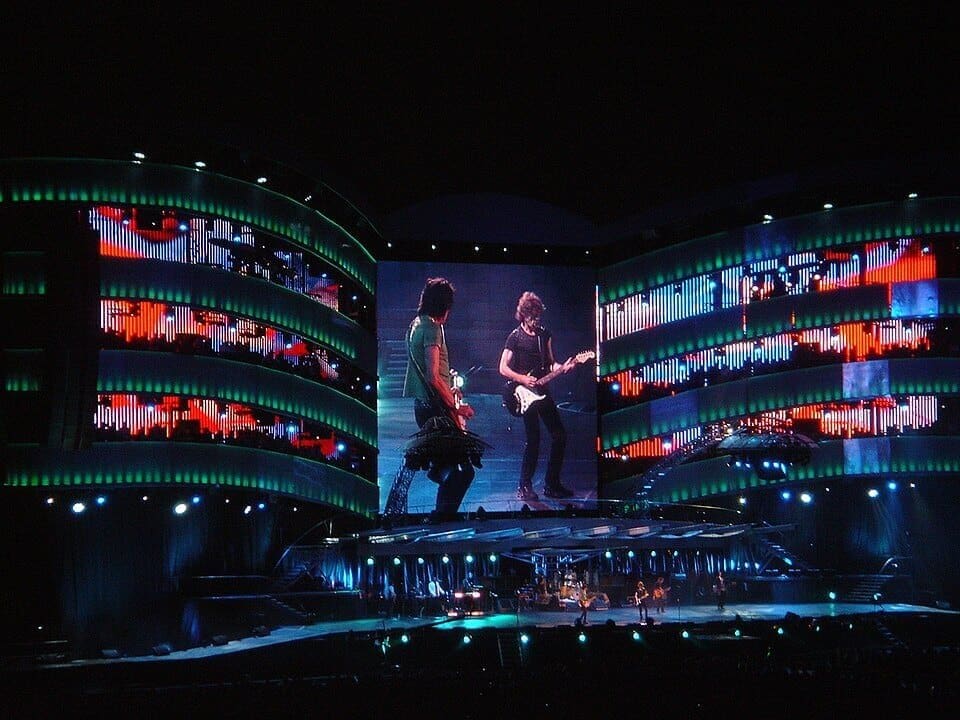
For a band that has been touring for over sixty years, logistics have evolved from cramped vans to global aviation. During The Rolling Stones‘ A Bigger Bang Tour; which remains one of the highest-grossing tours of its era; moving the stage across continents required unprecedented transport solutions. The sheer size of the operation forced the production to completely rethink how a rock concert moves globally.
The custom-built stage was so structurally massive; featuring huge asymmetrical balconies built directly into the set to house VIP fans; that traditional ocean freight was too slow to maintain the tour’s momentum across global legs. The logistics coordinators had to calculate the exact weight distribution of steel trusses and video panels to meet strict transportation safety standards, treating a rock concert exactly like an international military logistics deployment. The sheer cost of transporting the sprawling steel architecture across the Atlantic routinely dwarfed the actual cost of the stage fabrication itself.
Renaissance World Tour, Beyoncé

During the Renaissance World Tour, Beyoncé integrated highly advanced industrial automation into her live performance. When the global superstar kicked off her 57-date tour in Stockholm, fans were stunned by a futuristic set design that featured pyrotechnics, disco balls, and a shiny metallic tank. But the most striking element occurred during the tracks “COZY” and “ALIEN SUPERSTAR”, where Beyoncé interacted with giant moving robots.
These were not standard stage props; they were highly calibrated industrial manufacturing robots typically used for assembling automobiles. Because these robotic arms operate with dangerous amounts of torque and speed, they had to be extensively reprogrammed by specialized engineers to recognize human proximity safely. The stage floor was mapped with microscopic precision. If a dancer or the artist stepped even a fraction of an inch outside their designated safety zone, the robots were programmed to trigger a hard, emergency stop to prevent fatal blunt-force trauma. The choreography was not just a dance routine; it was a strictly enforced safety protocol executing flawlessly in real-time.
Ed Sheeran Mathematics Tour

Ed Sheeran is traditionally known for performing solo with a loop pedal, but his Mathematics Tour placed him in the center of a massive, 360-degree stadium setup that revolutionized stage engineering. Because he performs alone, the central stage had to do the heavy lifting to ensure he engaged with the entire stadium; a challenge solved by Technical Directors at Wonder Works.
The intimate set-up consisted of a central revolve stage surrounded by six 30 meter high masts. These masts, made from 7.5 tonnes of truss, supported a complex cable net system that allowed a staggering 55 tonnes of kit to be suspended directly above the stage. This pioneering design eliminated the need for a standard roof system, drastically improving sight lines for fans. Suspended within this cable net was the “halo,” a 21 meter diameter circular transparent LED screen, which housed 18 chandeliers made from Sceptron LED strips. This was the first time a touring cable net on this scale had ever been produced; a feat of engineering that took just 4 days to build on each site.
Music of the Spheres World Tour, Coldplay

For their Music of the Spheres World Tour, Coldplay made a massive, highly publicized commitment to sustainability, creating a blueprint for how massive events can reduce their carbon footprint. One of the most fascinating features was the implementation of kinetic dancefloors provided by Energy Floors.
When 10.3 million fans attended the record-breaking tour, they were actively generating electricity. The production installed Energy Centres consisting of 44 sustainable kinetic dancefloor tiles and 15 stationary bikes. The floor tiles were custom made with a top layer of recycled plastics to resist intense wear and tear. Every night, fans stepped onto these floors, transforming their physical movement into measurable electricity; if each fan generated just 5-10 watts, the cumulative energy could power hundreds of homes for days. This required stagehands to effectively string miles of custom DC wiring underneath the stadium floor, routing the disparate trickles of kinetic power back to a centralized battery bank before the show even started.
After Hours til Dawn Tour, The Weeknd

For the After Hours til Dawn Tour, The Weeknd brought a crumbling, post-apocalyptic cityscape to the stadium floor. Designed by the celebrated Es Devlin and aided by Stageco US and TAIT, the set was not just a flat backdrop; it was a fully three-dimensional, forced-perspective skyline constructed from brutalist architectural elements.
The main stage showcased a row of 17 custom-carved, “semi-destroyed” buildings, including a ruined replica of Toronto’s CN Tower. To support this massive weight, Stageco built a custom sub-deck. The entire operation required 17 trailers of black steel per leapfrogging system, backed by an enormous 55m wide x 15m tall video screen. Because stadiums have varying shapes, pitch lengths, and weight limits on their field turf, the 17 custom-built scenic buildings were designed by TAIT for rapid, modular assembly. It took dozens of stagehands working with specialized cranes to lock the sprawling post-apocalyptic city into a rigid steel sub-frame to prevent it from collapsing during high winds.
M72 World Tour, Metallica

For their M72 World Tour, Metallica reinvented the heavy metal stadium experience by pushing the stage to the center of the field in a massive 120-foot wide ring design. The famous “snake pit” allowed fans to be entirely enclosed by the stage; but the real marvel was happening at the absolute perimeter of the stadium.
Because the band was performing in the round, traditional follow spot operators perched in the rafters were no longer viable or safe. Lighting designer Rob Koenig deployed an 8-way RoboSpot system alongside 16 high-powered Robe iFORTE LTX Follow Spots. The secret? The operators controlling the spotlights illuminating James Hetfield and Lars Ulrich were not actually in the lighting towers. The RoboSpot BaseStations were located completely out of sight under the grandstands. By utilizing tracking zoom parameters from these remote bunkers, operators safely executed near throws of 14 meters and long throws up to 50 meters, ensuring the band was perfectly lit for live camera feeds without requiring any crew members to work at dangerous heights during the chaotic metal performance.
Lady Gaga’s The Chromatica Ball

Lady Gaga’s The Chromatica Ball was a masterclass in austere, brutalist design. The singer explicitly noted on Instagram that the stage drew inspiration from brutalist architecture and raw materials, aiming to create a “savage and hard” visual exploration of trauma and healing. The aesthetic featured stark gray concrete textures, sharp angles, and an imposing, almost oppressive sense of scale that critics compared to a nightmarish Soviet dystopia.
The hidden engineering secret behind this stage was its fire safety compliance. The set prominently featured actual flamethrowers which provided pyrotechnic effects alongside dancers and Gaga herself. Because the brutalist “concrete” slabs and secondary piano stages were actually fabricated from lightweight touring materials coated to look like heavy stone, every single piece of the set had to be treated with aviation-grade intumescent fire retardant. The architectural brutalism was not just an aesthetic choice; it was a structural necessity engineered to safely house the immense heat output of the industrial-grade pyrotechnics.
Pink Summer Carnival

Pink is globally recognized for her breathtaking aerial acrobatics during her Summer Carnival stadium shows. She regularly flies across the entire length of the stadium, singing completely live while suspended over the upper decks.
The hidden reality of this stunt is the terrifying amount of mathematical load balancing required. Stadium roofs are engineered to hold their own static weight; they are not inherently designed to support a dynamic, high-velocity cable system pulling hundreds of pounds of moving tension. To achieve her signature flight over the crowd during the song “So What,” the production utilized a specialized four-point performer flying rig controlled by the highly advanced TAIT Navigator Automation Platform. Months before the tour, structural engineers had to conduct finite element analysis on the roof trusses of every venue. The automation platform mathematically calibrated the tension loads in real-time to ensure the stadium’s steel beams would not structurally fail under the dynamic velocity of Pink’s flight path.
Guns N’ Roses Not In This Lifetime… Tour

When Guns N’ Roses embarked on the Not In This Lifetime… Tour, it spanned 175 shows and grossed over $584.2 million, ultimately becoming the fourth-highest-grossing concert tour of all time. Behind the reunited classic lineup of Axl Rose, Slash, and Duff McKagan was a logistics operation that required military-level convoy management.
To transport the colossal steel stage, video walls, and sound reinforcement systems, the tour utilized an armada of heavy-load semi-trucks for the North American legs. The secret logistical nightmare was route planning. A massive convoy of trucks cannot simply follow standard GPS directions. The tour’s logistics coordinators had to map out routes that accounted for bridge weight limits, highway overpass heights, and municipal noise ordinances. If the convoy took a wrong turn or encountered a low bridge, the resulting traffic jam could easily delay the load-in process and jeopardize a multimillion-dollar show, transforming a rock reunion into a catastrophic transit failure.
Harry Styles’ Together, Together Tour

For Harry Styles’ massive worldwide tours, the staging required a delicate balance between stadium-scale visibility and intimate crowd interaction. The solution for tours like the Together, Together run was a brightly colored, multi-tiered modular stage featuring extensive walkways and bridges extending into the crowd.
The hidden detail of this stage engineering was how rapidly it had to be altered due to physical logistics and audience feedback. During the European kickoff in Amsterdam, the production team faced massive backlash regarding obstructed views caused by the stage bridges. Because the stage was highly modular, the crew did not have to scrap the multimillion-dollar set. The official Harry Styles HQ released a statement confirming they were actively working to make structural adjustments to improve visibility while keeping within strict safety codes and local compliance. The modularity allowed engineers to literally unbolt and lower the obstructing bridges overnight, proving that stadium sets must be flexible enough to be redesigned mid-tour.
Muse Simulation Theory Tour

Muse has always pushed the boundaries of live science fiction. During their Simulation Theory Tour, they introduced a massive, skeletal, cyborg-like visual aesthetic that relied heavily on automation.
The secret to keeping this chaotic visual feast synchronized was algorithmic stage tracking. Adding to the dramatic atmosphere and playing up the surveillance theme, the production deployed an extensive BlackTrax 3D-tracking system featuring 38 infrared cameras. The band members and performers wore hidden infrared emitters embedded in their costumes. These 38 tracking cameras read the emitters and fed the positional data in real-time to the primary consoles, allowing for visual effects, sound, and light cues to automatically track the band members as they moved across the stage. It completely eliminated human error and allowed for perfectly synchronized, split-second technical blackouts.
Trans-Siberian Orchestra

While traditionally an arena act, the sheer scale of the Trans-Siberian Orchestra‘s production rivals the biggest stadium tours in history. They are known for their elaborate concerts, which feature a live string section, moving trusses, and mind-bending effects synchronized to music.
The unbelievable secret behind their show is the rigid timecode synchronization. The TSO production does not rely on a lighting director pressing buttons to the beat of the music. Every single lighting fixture, custom laser design, and pyrotechnic blast is hardcoded into a master timecode track synchronized to the millisecond with the band’s click track. If the drummer speeds up or slows down by even a fraction of a second, the entire pyrotechnic display could fire out of sync, potentially creating a massive safety hazard. The band is essentially playing inside a highly volatile, rigidly programmed computer matrix where mathematical precision is a matter of physical safety.
Biggest Stadium Tours in History Quick Reference Summary Table
| # | Artist | Tour Name | Defining Engineering / Logistical Secret |
|---|---|---|---|
| 1 | U2 | 360° Tour | A 190-ton steel structure requiring three identical setups to leapfrog cities, transported by up to 200 trucks. |
| 2 | Taylor Swift | The Eras Tour | A hollow sub-stage mechanical transit system and a modified janitor’s cart used for undetected stage entrances. |
| 3 | Rammstein | Europe Stadium Tour | A 2.2 million-watt PA system and private diesel generators creating a localized power grid just for extreme pyrotechnics. |
| 4 | The Rolling Stones | A Bigger Bang Tour | Loading 154,000 pounds of equipment onto Boeing 747 cargo planes requiring military-grade weight distribution logic. |
| 5 | Beyoncé | Renaissance World Tour | Automobile manufacturing robotic arms recalibrated with microscopic precision to prevent fatal blunt-force trauma to dancers. |
| 6 | Ed Sheeran | Mathematics Tour | A pioneering 55-tonne touring cable net system eliminating a standard roof and supporting a massive rotating stage. |
| 7 | Coldplay | Music of the Spheres World Tour | 44 kinetic dancefloor tiles that convert fan movement into localized DC power through miles of custom sub-floor wiring. |
| 8 | The Weeknd | After Hours til Dawn Tour | 17 modular brutalist buildings carved from lightweight foam requiring customized cranes and a rigid steel sub-frame. |
| 9 | Metallica | M72 World Tour | An 8-way RoboSpot system hidden under stadium grandstands allowing safe, automated follow spot tracking in the round. |
| 10 | Lady Gaga | The Chromatica Ball | Faux-concrete brutalist staging treated with aviation-grade fire retardant to house 15 custom industrial flamethrowers. |
| 11 | Pink | Summer Carnival | Advanced finite element analysis of stadium roofs and a TAIT Navigator Automation Platform to manage high-velocity aerial load balancing. |
| 12 | Guns N’ Roses | Not In This Lifetime… Tour | A convoy of heavy-load semi-trucks navigating complex municipal limits to move a $584.2 million production. |
| 13 | Harry Styles | Love on Tour | Rapidly deployable, highly modular flooring and bridges that were redesigned mid-tour to fix audience sightlines. |
| 14 | Muse | Simulation Theory Tour | Infrared emitters tied to a BlackTrax tracking system to algorithmically automate lighting without human operators. |
| 15 | The Trans-Siberian Orchestra | Winter Tours | Every single laser, light, and pyrotechnic blast hardcoded to a millisecond-perfect master timecode tied to a click track. |
Frequently Asked Questions
How much does a massive stadium tour stage cost to build? Custom stadium stages can cost anywhere from $15 million to over $40 million just in research, development, and structural fabrication. The engineering required to make them safely transportable and weather-resistant drives the budget far beyond standard construction costs.
How long does it take to set up a stadium stage? For the biggest concert tours, the load-in and construction process typically takes between four and seven days. This requires highly specialized steel crews, electricians, and riggers working around the clock in coordinated shifts.
Where do the artists and crew sleep during these massive tours? While headlining artists usually fly privately and stay in luxury hotels, the massive crew of riggers, drivers, and technicians often sleep in specialized sleeper buses. These buses feature tightly stacked bunks and travel overnight to ensure the crew arrives at the next venue by dawn.
Why do artists need multiple identical stages? Stadium stages take days to build but a tour schedule often requires shows every two or three days. To solve this, productions utilize “leapfrogging” logistics; building Stage B in the next city while the artist is actively performing on Stage A, ensuring no delays in the schedule.


