



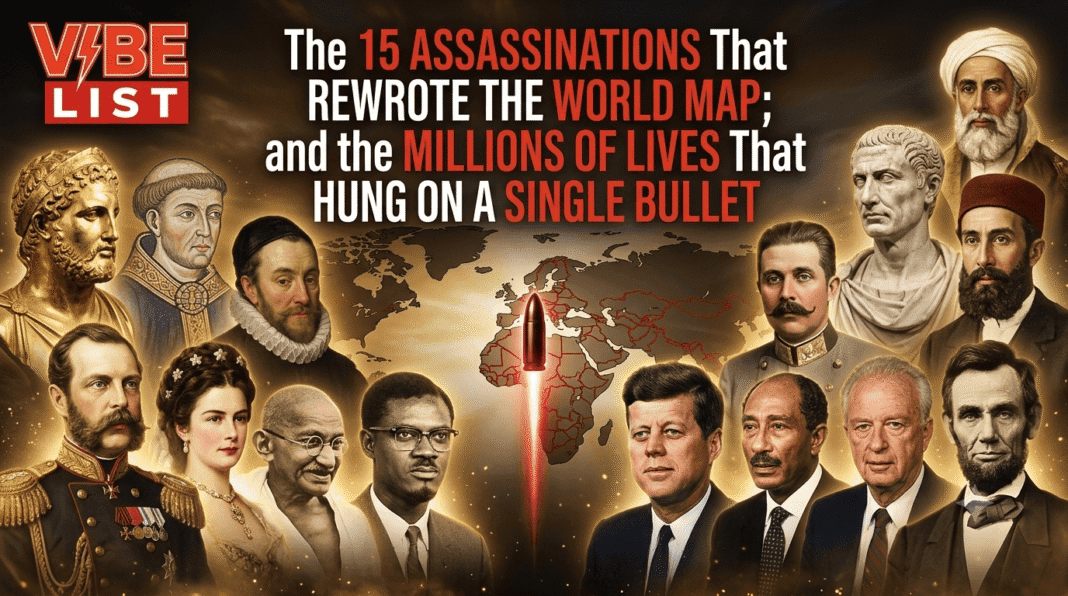
Twenty-three stab wounds on a marble floor and a five-hundred-year-old republic dies in an afternoon. One bullet in Sarajevo and twenty million are dead within four years. A sword stroke at Karbala and two billion people still mourn the victim fourteen centuries later. A .44-caliber derringer in a theater box and Black Americans wait another hundred years for the rights they were promised. One wrong turn by a driver in 1914 and four empires collapse before the decade is out. None of these killers won. Every one of them changed the world more than the person they killed ever could have.
Twenty-three stab wounds on a marble floor and the Roman Republic dies with the man who wanted to be king. One bullet in Sarajevo and twenty million people die within four years. A sword stroke at Karbala in 680 CE and Islam splits into two branches that still shape Middle East geopolitics fourteen centuries later. A single .44-caliber derringer fired in a theater box and Reconstruction loses its last champion before the play is done. One rifle shot from across a Memphis street and 125 American cities burn within seven days. None of these killings were inevitable. All of them redirected the lives of millions; sometimes billions; of people who never knew the killer’s name.
Political assassination is the most concentrated form of historical disruption. Wars unfold over years. Revolutions build across decades. Assassination compresses all that potential energy into a single act: one person falls, one seat empties, one set of plans dies while a cascade of consequences races outward in every direction and nobody can stop it.
This is not a list of the most notable assassinations; although several entries here are well known. It is a ranking of the fifteen assassinations that produced the most measurable downstream effects: the killings that realigned borders, caused wars, destroyed empires, ruined peace negotiations, divided religions, and changed the way the greatest number of people lived for the longest stretch of time. Some of these impacts struck instantly and catastrophically. Others unfolded gradually over centuries in ways the killers could never have predicted.
Some entries in this ranking appear on no other list. Others will be familiar from every “top 10” list on the internet. The Vibe List’s method for historical rankings emphasizes long-term structural effect over sensational drama. A brilliant story that produces no long-term structural change scores lower than a forgotten killing that permanently altered the political or religious architecture of the world.
How We Ranked These Assassinations
How we ranked this: each entry was evaluated across multiple criteria, including death toll from resulting conflicts, territorial boundaries redrawn, duration of resulting instability, number of lives directly affected, and long-term structural impact; weighted to reflect what matters most for assessing enduring historical consequences. The end product is a ranking that recognizes the empirical data but is ultimately determined by Vibe List editorial judgment. This is our list, built on evidence, driven by perspective.
The weighting framework combines five dimensions. Death toll: measures the total number of deaths resulting from conflicts, wars, or violence triggered by the assassination. Territorial and political restructuring: measures borders redrawn, governments toppled or fundamentally altered, and systemic changes to governance. Downstream instability duration: measures the years or centuries over which the assassination’s effects persisted. Population affected: estimates the number of people whose daily lives were substantially changed. Enduring structural legacy: assesses whether the assassination’s effects remain identifiable in today’s geopolitical, religious, or legal structures. No single criterion dominates; the ranking reflects the weighted totality of all five.
15. Philip II of Macedon (336 BCE)
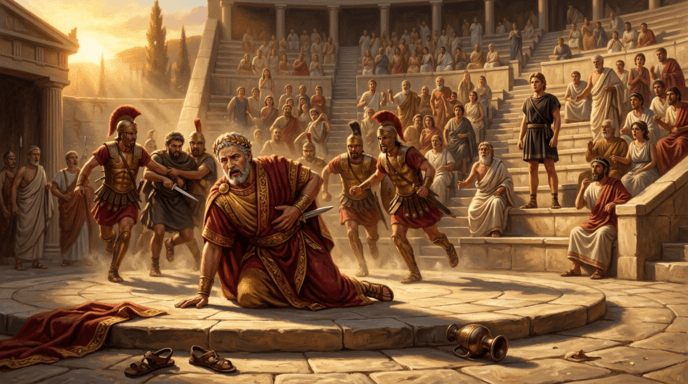
At Aegae in 336 BCE, Philip II of Macedon was stabbed to death by Pausanias of Orestis, one of his bodyguards, while attending celebrations at the ancient theatre of Aegae. For two decades, Philip had transformed Macedonia from a fractured backwater into Greece’s leading military force. At the time of his death he had united the Greek city-states under Macedonian leadership through the League of Corinth and was planning an invasion of the Persian Empire; the most ambitious military campaign the Greek world had ever contemplated.
Philip’s death put his twenty-year-old son on the throne. His son would become Alexander III; commonly known as Alexander the Great; who inherited both his father’s army and his father’s invasion plans.
It is impossible to determine whether Alexander would have accomplished what he did had Philip lived longer. Philip was a brilliant military commander in his own right, and some historians believe he would have conquered Persia successfully. Others argue that Alexander’s unique combination of recklessness, tactical genius, and charisma produced results Philip could never have matched. Whatever the case, there is no doubt that Philip’s assassination accelerated the process. A young and untested king who needed to prove himself conquered territory from Greece to northwest India in thirteen years, dispersed Greek language and culture across Asia and Africa within three centuries of Alexander’s death, and created the cultural foundation on which texts such as the New Testament would later be composed in Greek rather than Aramaic.
Philip created the machine. The assassination handed Alexander the key to go farther and faster than anyone anticipated.
14. Thomas Becket (1170)
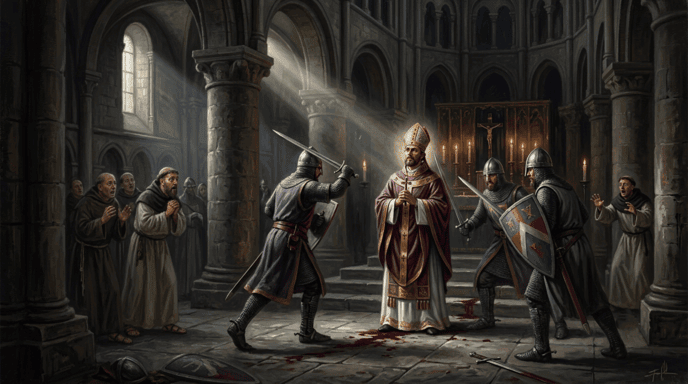
On December 29, 1170, Thomas Becket, Archbishop of Canterbury, was murdered by four knights loyal to King Henry II of England inside Canterbury Cathedral. Becket fell on the stone floor of Canterbury Cathedral’s northwest transept. The murder was one chapter in a multi-decade conflict between Henry and Becket over the limits of royal authority against the Church’s autonomy.
Henry suffered greatly in the immediate aftermath. The murder outraged Christian Europe; Henry faced the threat of excommunication from Pope Alexander III. In 1174, Henry walked barefoot through Canterbury while monks whipped him publicly as penance at Becket’s tomb.
Becket was canonized by Pope Alexander III within three years of his death.
While the immediate political consequence for Henry was disastrous, the structural impact was far greater. Becket’s murder established a precedent that constrained English monarchs for centuries: any attempt by English kings to eliminate their clerical opponents would produce severe domestic and international consequences. Canterbury became one of Europe’s most important pilgrimage sites after Becket’s death; so popular that Geoffrey Chaucer wrote The Canterbury Tales nearly two hundred years later; a work set on a pilgrimage to Becket’s shrine. The conflict between royal authority and Church independence that Becket’s death dramatized remained a central fault line in English and European politics for centuries before the Protestant Reformation.
13. William the Silent (1584)
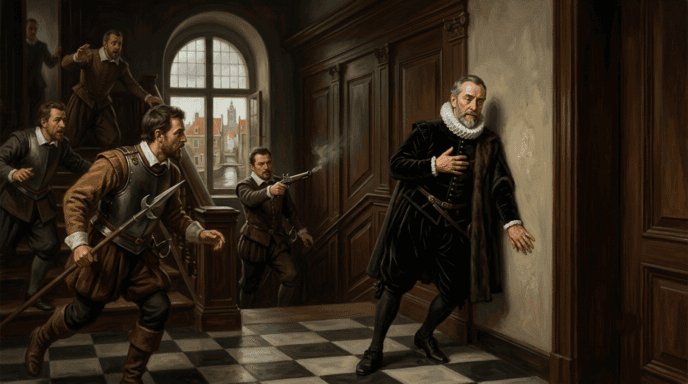
On July 10, 1584, William I; also known as William the Silent; Prince of Orange, was shot at his home in Delft by Balthasar Gérard, a French Catholic zealot who had been offered a bounty by King Philip II of Spain. William had led the Dutch revolt against Spanish Habsburg rule for years, and Philip II had placed a bounty on his head.
William’s murder is widely cited as the first assassination of a head of state carried out with a handgun. It also prolonged and intensified the Dutch fight for independence. William’s sons continued the struggle for decades until the Dutch Republic finally secured formal recognition via the Treaty of Westphalia in 1648.
In the decades following William’s assassination, the Dutch Republic emerged as Western Europe’s wealthiest and most commercially advanced nation-state by the early seventeenth century; founded the Dutch East India Company; pioneered modern financial instruments including the stock exchange; and established colonies on three continents from Indonesia to South Africa to New Amsterdam (now New York City). The Dutch Republic also articulated an idea that would later shape the United States Declaration of Independence: that a people can lawfully revolt against a tyrannical sovereign and establish their own republic, as set out in the 1581 Act of Abjuration that William championed.
William the Silent’s assassination did not end the Dutch revolt. Instead, it demonstrated that the revolution had grown beyond any single leader; a realization that increased the danger for those opposing it, not diminished it.
12. Tsar Alexander II (1881)
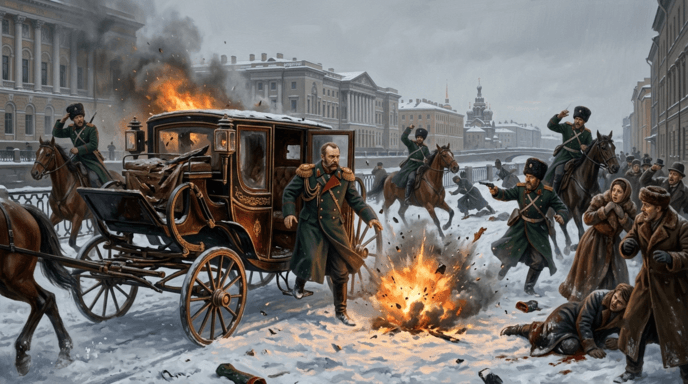
On March 13, 1881, Tsar Alexander II was assassinated by Ignacy Hryniewiecki, a member of Narodnaya Volya, using a bomb near his carriage during his trip through St. Petersburg. Over the years preceding his death, Alexander II had survived numerous assassination attempts.
On the day of his death, Alexander was returning from a military review when a first bomb exploded under his carriage but failed to seriously injure him. After stepping out to check on the injured bystanders, Alexander was struck by a second bomb thrown at his feet, which shattered both legs. He died hours later at the Winter Palace.
Alexander II was among the most reform-minded tsars in Russian history. He emancipated Russia’s serfs in 1861, reformed the judicial system, expanded regional governance through the creation of zemstvos (elected local assemblies), and was reportedly preparing to sign a constitution on the day he was killed.
The assassination produced the precise opposite of what its perpetrators intended. Alexander II’s son, Alexander III, reversed virtually all of his father’s reforms, imposed severe censorship, expanded the secret police, launched aggressive Russification campaigns against minorities, and triggered anti-Jewish pogroms across the Russian Empire that drove mass emigration of Jews to Western Europe and North America.
The harsher policies instituted by Alexander III and his son Nicholas II laid the groundwork for the Russian Revolution, which erupted 36 years after Alexander II’s assassination. The men who killed Alexander II believed they were accelerating Russia’s liberation. They actually delayed it by decades and guaranteed it would arrive in a far more violent form than they ever envisioned.
11. Empress Elisabeth of Austria (1898)
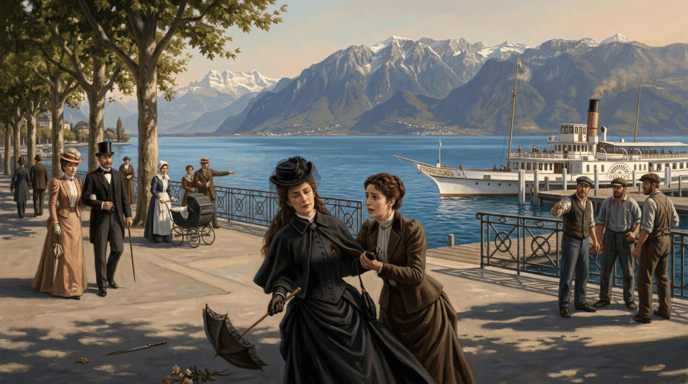
Empress Elisabeth (“Sisi”) of Austria was stabbed in the chest with a sharpened needle file by Luigi Lucheni, an Italian anarchist, on September 10, 1898, while strolling along Lake Geneva in Switzerland. Sisi was sixty years old and had spent much of the previous decade traveling restlessly across Europe, shadowed by grief over the suicide of her son, Crown Prince Rudolf, at Mayerling in 1889.
When Lucheni learned that his original target had changed plans, he selected Elisabeth as a substitute simply because she was an accessible member of a reigning dynasty. As an adherent of anarchist “propaganda of the deed,” Lucheni believed that killing any high-profile figure would spark revolutionary awareness among ordinary citizens.
Elisabeth’s assassination accelerated Austria-Hungary’s slide toward catastrophe sixteen years later. With Elisabeth gone, Emperor Franz Joseph lost one of the few voices that had sometimes tempered his rigid nature. Internal divisions within Austria-Hungary deepened without Elisabeth’s moderating presence, as tensions mounted between Austria and Hungary, between Slavic populations and their German-Magyar rulers, and between the military establishment and civilians. By the time Archduke Franz Ferdinand (Franz Joseph’s nephew and eventual heir) was assassinated in Sarajevo in 1914, Austria-Hungary had been an unstable powder keg for more than a decade; Elisabeth’s death had removed one of the few figures who might have defused it.
10. Mahatma Gandhi (1948)
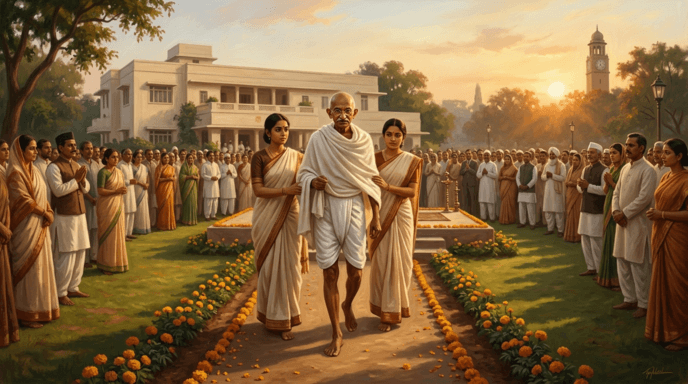
On January 30, 1948, Mahatma Gandhi was shot three times at close range by Nathuram Godse, a Hindu nationalist and member of the Hindu Mahasabha, while attending a prayer meeting at Birla House in New Delhi. Gandhi was 78 years old. In the final months of his life, Gandhi had been working to end the violent sectarian riots that erupted after the partition of India and Pakistan in August 1947. Those riots killed an estimated one to two million people and displaced roughly fifteen million more.
Godse believed Gandhi had made too many concessions to Muslim leaders during the partition negotiations. Gandhi’s assassination sent shockwaves throughout India and around the world. Yet the assassination paradoxically reinforced the democratic, secular vision Gandhi had championed. Indian Prime Minister Jawaharlal Nehru delivered a broadcast to the nation via radio, stating “The light has gone out of our lives, and there is darkness everywhere.”
In response to the widespread mourning for Gandhi, the Indian government temporarily banned the RSS and largely suppressed far-right Hindu nationalism for nearly four decades. Gandhi’s martyrdom solidified his status as the father of Indian independence and enshrined the principles he defended; democracy, secularism, and non-violence; into India’s Constitution, adopted in 1950. Whether India has continued to uphold those values as Gandhi intended remains one of the country’s most contentious political questions.
9. Patrice Lumumba (1961)
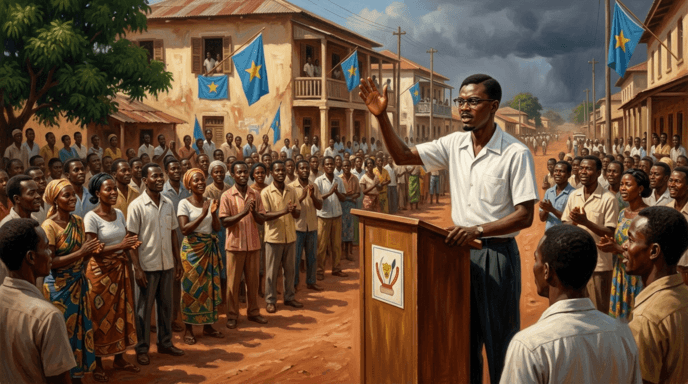
On January 17, 1961, Patrice Lumumba; the first democratically elected Prime Minister of the Democratic Republic of the Congo; was executed by firing squad in Katanga Province. He had served barely two months before being ousted in a coup backed by Belgium and the CIA. He was 35 years old.
The assassination of Lumumba is one of the most significant politically motivated killings of the Cold War. The Congo was then the world’s largest producer of cobalt and contained vast reserves of uranium; uranium mined at the Shinkolobwe mine in southern Katanga (Haut-Katanga) had been used in the atomic bombs dropped on Hiroshima and Nagasaki. The United States and Belgium viewed Lumumba’s pan-African nationalism and willingness to accept Soviet aid as existential threats to Western control of these resources.
In 2001, a Belgian parliamentary commission formally admitted that Belgium bore “moral responsibility” for the death of Lumumba. In 2002, Belgium officially apologized to the Congolese people.
As a result of Lumumba’s death, a series of events unfolded that affected not only the Congo but also other African states and developing countries. After Lumumba’s death, his successor Mobutu Sese Seko ruled the Congo (renamed Zaire) as a kleptocratic dictatorship for 32 years. Mobutu is estimated to have stolen roughly $5 billion from one of the most resource-rich nations on earth while millions of his citizens lived in poverty.
Mobutu’s eventual downfall created chaos that fueled both the First and Second Congo Wars. Together they caused an estimated 5.4 million deaths between 1996 and 2003; more than any conflict since World War II. Many of those deaths trace back to the assassination of a 35-year-old prime minister in Katanga in January 1961.
8. John F. Kennedy (1963)
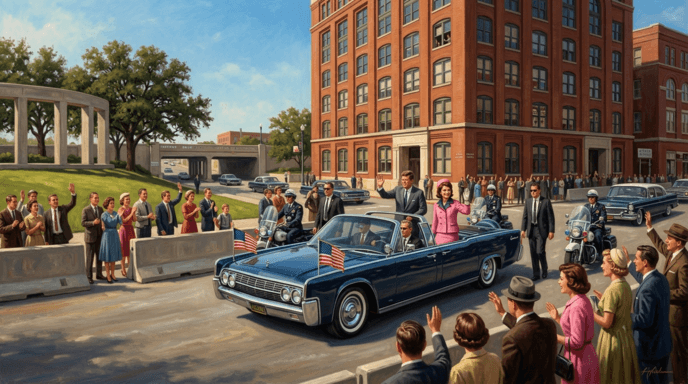
On November 22, 1963, President John F. Kennedy was shot and killed while riding in a motorcade through Dealey Plaza in Dallas, Texas. Lee Harvey Oswald fired from the sixth floor window of the Texas School Book Depository building. Kennedy was 46 years old and had served as President for 1,036 days.
Kennedy’s successor, Lyndon B. Johnson, channeled the nation’s grief into legislative momentum for bills Kennedy had struggled to pass. The most consequential legislation to emerge from this period was the Civil Rights Act of 1964 and the Voting Rights Act of 1965. Whether or not Kennedy could have successfully passed these historic pieces of legislation absent his death is widely considered to be one of America’s most debated historical counterfactuals.
Johnson explicitly referenced Kennedy in his speeches as he lobbied Congress for passage of this legislation. Johnson’s decision to escalate U.S. involvement in Vietnam; while Kennedy had authorized military advisers to South Vietnam; proceeded without Kennedy’s documented reservations about expanding America’s role in Southeast Asia. By 1968, more than 500,000 American soldiers were stationed in Vietnam. Ultimately, the Vietnam War killed an estimated 58,220 American servicemen and between two and three million Vietnamese civilians.
Kennedy’s death not only changed America’s foreign policy but transformed how Americans thought about politics. A majority of Americans polled in the decades since have believed that forces beyond Oswald were involved in Kennedy’s death; a conviction that; while long debated by historians; fueled a broader cultural phenomenon. Kennedy’s assassination; combined with other political killings of the era; accelerated the rise of conspiracy culture in American public life. That phenomenon has grown steadily and now touches virtually every dimension of American politics, from cable news to social media to presidential campaigns.
7. Martin Luther King Jr. (1968)
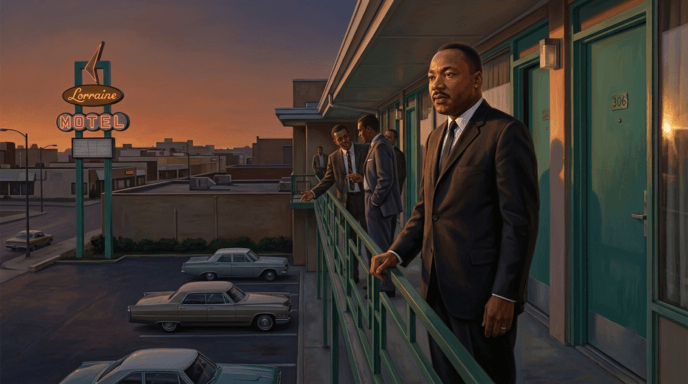
Dr. Martin Luther King Jr. was shot on April 4, 1968, on the balcony at the Lorraine Motel in Memphis, Tennessee, by James Earl Ray firing one .30-06 caliber rifle round from a rooming house located across the street. King was 39 years old.
Immediately after King’s assassination, rioting erupted in more than 125 cities across the United States. Fires burned within sight of the White House in Washington, D.C. Federal troops were deployed to several cities to restore order. The violence resulted in 43 deaths and $100 million in damages. President Johnson directed flags to fly at half-mast nationwide, and on April 11, 1968; exactly one week after King’s death; Johnson signed the Fair Housing Act into law after years of congressional obstruction.
King’s assassination forever split the American civil rights movement. With King gone, more militant voices filled the vacuum across multiple segments of the movement. The Black Power movement gained momentum rapidly as many Black activists sought alternatives to nonviolent protest. The fragile coalition of Black churches, liberal whites, labor unions, and student organizations that had defined earlier phases of the movement never fully reassembled.
Additionally, King’s assassination profoundly impacted American electoral politics. Following King’s assassination and the widespread urban unrest of 1968, Richard Nixon won the presidential election on a “law and order” platform that appealed largely to white voters unsettled by the pace of racial change. Since then, racial justice and its political backlash have remained fixtures of every presidential campaign.
6. Anwar Sadat (1981)
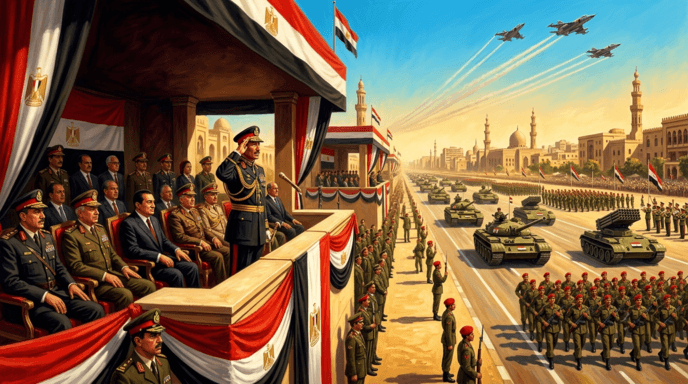
Egyptian President Anwar Sadat was assassinated on October 6, 1981, by members of Egyptian Islamic Jihad who opened fire while he sat in the reviewing stand during a military parade commemorating Egypt’s crossing of the Suez Canal in the October War of 1973. Lieutenant Khalid Islambouli led the attack, shouting “I have killed Pharaoh!”
Sadat had signed a peace agreement with Israeli Prime Minister Menachem Begin at Camp David in 1978, marking the first peace treaty between an Arab state and Israel; an achievement for which Sadat and Begin shared the Nobel Peace Prize. The peace agreement sparked outrage across the Arab world. Egypt was subsequently expelled from the Arab League. Sadat faced intensifying domestic opposition from Islamist organizations that viewed his negotiations with Israel as treasonous.
Sadat’s successor, Hosni Mubarak; who was seated beside Sadat during the attack and was himself wounded; upheld the peace agreement with Israel but governed Egypt under emergency law for thirty consecutive years, using that authority to repress dissent, restrict speech, and detain opponents without charge.
Sadat’s assassins were tried and executed, but the networks behind them survived and evolved into broader jihadist cells, with some figures connected to the assassination later joining Osama bin Laden’s al-Qaeda. Scholars have traced a direct ideological lineage from the networks behind Sadat’s killing in 1981 to the attacks of September 11, 2001.
The bullets that killed Anwar Sadat did not merely end a presidency; they triggered a cascade of radicalization that shaped global security for decades.
5. Yitzhak Rabin (1995)
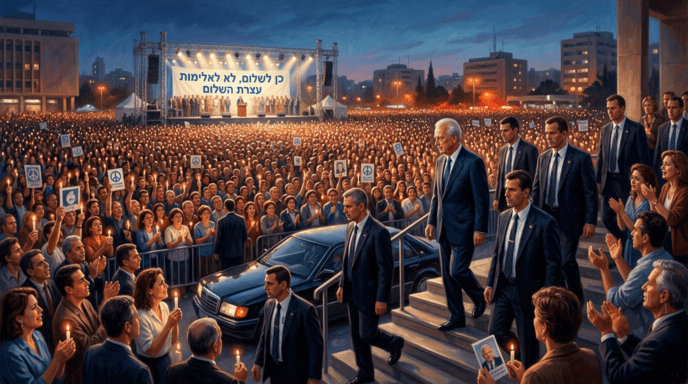
Israeli Prime Minister Yitzhak Rabin was shot twice in the back by Yigal Amir; a right-wing Israeli law student; immediately after participating in a peace rally at Kings of Israel Square (since renamed Rabin Square) in Tel Aviv on November 4, 1995. Rabin was seventy-three years old at the time.
On September 13, 1993, at the White House, Rabin signed the Oslo Accords with PLO Chairman Yasser Arafat, providing for limited Palestinian self-governance in the Gaza Strip and Jericho and establishing a framework for the eventual creation of an independent Palestinian state alongside Israel; the two-state solution. The agreements earned Rabin, Arafat, and Israeli Foreign Minister Shimon Peres the joint Nobel Peace Prize in 1994. They also made Rabin a target for Israeli right-wing extremists who opposed withdrawal from occupied territories.
When asked why he killed Rabin, Amir said he believed the Oslo agreements surrendered sacred Jewish land. Asked whether removing Rabin would destroy the peace process, Amir said yes.
Amir proved prophetic. Rabin’s assassination, combined with a wave of Hamas suicide bombings in early 1996, shifted Israeli public opinion decisively against the peace process and helped elect Benjamin Netanyahu, whose campaign centered on opposing the Oslo Accords. The peace process stalled, floundered through failed talks at the Camp David Summit in 2000, and collapsed with the outbreak of the Second Intifada. Rabin’s assassination; as the BBC has documented; inflicted mortal wounds on the Oslo process.
Three decades later, no comparable peace framework exists between Israelis and Palestinians, even though a two-state solution remains the official goal of international diplomacy.
The consequences of Yigal Amir’s two bullets appear daily in every dispatch from the Middle East.
4. Abraham Lincoln (1865)
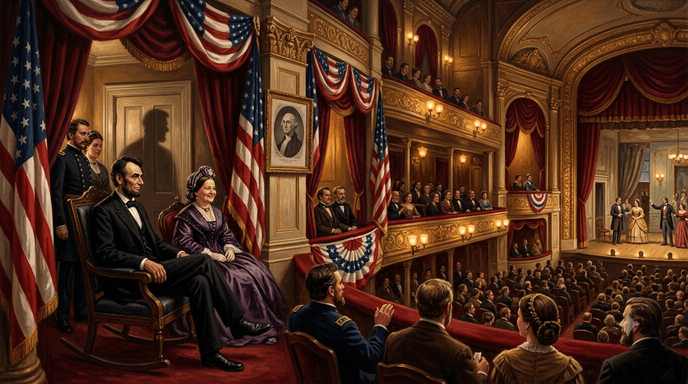
Five days after Robert E. Lee surrendered at Appomattox, marking the end of the Civil War, President Abraham Lincoln was shot in the head by John Wilkes Booth while watching a play at Ford’s Theatre in Washington, D.C. Lincoln died early the next morning at 7:22 a.m. After Lincoln’s death, Secretary of War Edwin M. Stanton reportedly said: “Now he belongs to the ages.”
The timing of Lincoln’s death was the cruelest detail. In the final weeks of his life, Lincoln had been developing plans for Reconstruction; bringing together again the former Confederate states and protecting the rights of the four million freed slaves. Lincoln’s vision for Reconstruction, articulated in his last public speech on April 11, 1865, combined a conciliatory approach toward the South with insistence that freed Black men receive the vote.
Lincoln’s successor, Andrew Johnson; a Tennessee Democrat added to the Republican ticket for balance; had no interest in advancing racial equality and routinely vetoed legislation designed to protect the rights of freed Black men. Johnson gave the former Confederate states wide latitude, allowing them to reassert control and pass Black Codes that imposed near-slavery conditions on freed Black people.
These consequences were felt for over a century. Historians broadly agree that the absence of Lincoln’s political skill and moral authority contributed to Reconstruction’s failure. Johnson’s leniency toward the South and his vetoing of civil rights protections enabled the passage of Jim Crow laws across the southern United States. The Thirteenth, Fourteenth, and Fifteenth Amendments were ratified, but each was meaningfully enforced for barely a decade before federal commitment collapsed. The promise of full citizenship for Black Americans was denied for nearly a century, until the passage of civil rights legislation in the 1960s; a cause for which Dr. Martin Luther King Jr. ultimately gave his life.
Booth believed he was avenging the Confederacy. What he actually accomplished was keeping the wounds of slavery open for another hundred years.
3. Archduke Franz Ferdinand (1914)
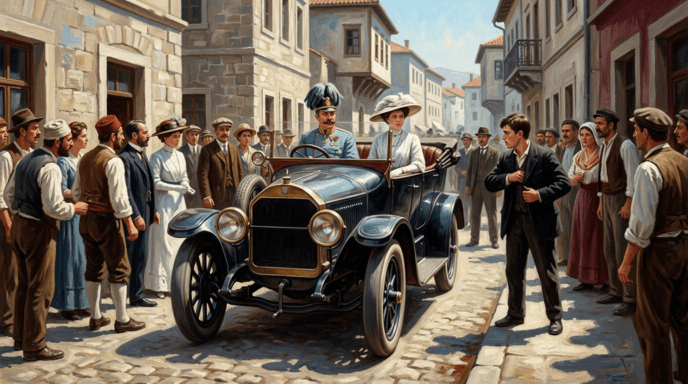
Archduke Franz Ferdinand of Austria and his wife, Sophie, were shot and killed by Gavrilo Princip; a nineteen-year-old Bosnian Serb nationalist; in Sarajevo on June 28, 1914. The assassination succeeded partly because of a navigation error; the driver took a wrong turn and stopped to reverse, placing the archduke’s open car directly in front of Princip. One wrong turn created the twentieth century.
One month later, on July 28, 1914, Austria-Hungary declared war on Serbia. Within weeks, alliance obligations dragged Russia, Germany, France, Britain, and eventually the Ottoman Empire into a conflict that no government had intended and none could stop. In total, World War I killed approximately 8.5 million soldiers and more than 13 million civilians; a combined death toll exceeding twenty million.
World War I reshaped far more than casualty statistics. Four empires collapsed: the Russian, Ottoman, Austro-Hungarian, and German. The Treaty of Versailles imposed punishing terms on Germany, fueling the economic despair and nationalist resentment that Adolf Hitler later exploited. The Ottoman Empire’s collapse also redrew the Middle East along borders imposed by European powers with little regard for ethnic or religious realities on the ground; fault lines that still run through Iraq, Syria, Lebanon, and Palestine today. The Russian Revolution of 1917; itself a consequence of the war; produced the Soviet Union and set the stage for the Cold War and nuclear standoff that defined the second half of the twentieth century.
Two bullets fired from an FN Model 1910 pistol by a teenager who had failed his exams set off a chain of events that killed over 100 million people across two world wars and redefined the geography of nearly every continent on Earth.
2. Julius Caesar (44 BCE)
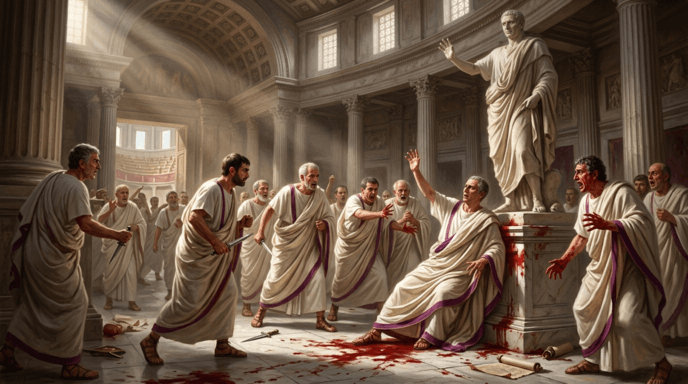
On March 15, 44 BCE; the Ides of March; Julius Caesar was stabbed twenty-three times by a group of Roman senators; known as the Liberatores; on the floor of the Theatre of Pompey. The assassins included Marcus Junius Brutus and Gaius Cassius Longinus. They thought they were saving Rome from a dictator.
They did not restore the Republic. They destroyed it. The power vacuum left by Caesar’s death ignited a series of civil wars; first between Caesar’s allies and his assassins, then among the allies themselves. Mark Antony delivered a funeral oration that turned public opinion decisively against the conspirators. Caesar’s adopted heir, Octavian, raised a private army at eighteen, formed the Second Triumvirate with Antony and Lepidus, and systematically eliminated his rivals. At Philippi in 42 BCE, Brutus and Cassius were defeated by Octavian and Antony; both conspirators took their own lives.
Octavian defeated Antony and Cleopatra at the Battle of Actium in 31 BCE and in 27 BCE assumed the title Augustus. With that act, the Roman Republic; which had endured for nearly five hundred years; ceased to exist. The Roman Empire that replaced it lasted another five centuries in western Europe and fifteen centuries in eastern Europe, leaving a legacy of law, language, and governance that underpins Western civilization to this day. Every empire ranked in this Vibe List was shaped, directly or indirectly, by how Rome governed itself after Caesar’s murder.
Twenty-three dagger wounds on a marble floor killed a republic. An empire rose from that floor whose influence lives in your language, your laws, and your calendar.
1. The Prophet’s Grandson; Hussein ibn Ali (680 CE)
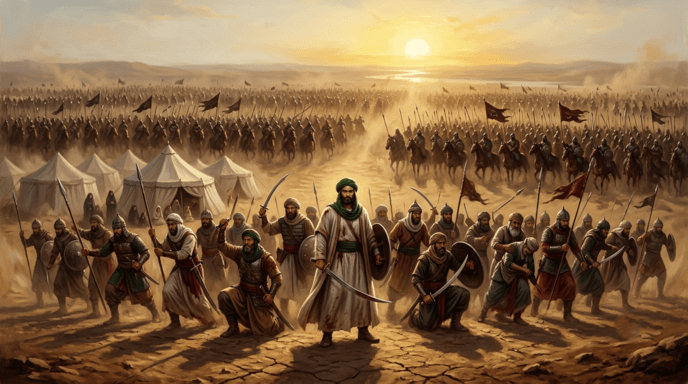
On October 10, 680 CE, Hussein ibn Ali; grandson of the Prophet Muhammad; was killed alongside most of his family and seventy-two followers by forces loyal to the Umayyad Caliph Yazid I at Karbala, in modern-day Iraq. Hussein had refused to pledge allegiance to Yazid, whom he viewed as an illegitimate ruler, and traveled to Karbala with only a small band of supporters. His party was cut off from water for days before being overwhelmed in what amounted to a massacre rather than a battle.
Some readers may question the inclusion of a battlefield death on an assassination list. The Vibe List includes this event deliberately: Hussein’s death at Karbala was a targeted, politically motivated killing of a specific individual; his elimination was the explicit objective of the military action. By virtually every functional definition, Hussein’s death at Karbala constitutes an assassination carried out through military force.
The consequences of Hussein’s death at Karbala dwarf those of every other assassination on this list.
Hussein’s death at Karbala became the foundational trauma of Shia Islam. The schism between Sunni and Shia Muslims had its origins in the succession dispute following Muhammad’s death in 632 CE, but Karbala made the division permanent and visceral. What had begun as a political disagreement over leadership transformed after Karbala into a theological and emotional rupture that has shaped the Islamic world for more than fourteen centuries.
Today, approximately two billion Muslims represent roughly 26 percent of the world’s population. Governance disputes and foreign policy across much of Asia, Africa, and the Middle East still carry the imprint of the Sunni-Shia divide born at Karbala. The Iranian Revolution of 1979 drew heavily on Karbala imagery to mobilize popular support. The Iran-Iraq War of 1980 to 1988; fought partly along sectarian lines traceable to Karbala; killed an estimated 500,000 people, with total casualties reaching as high as one million. Sectarian tensions rooted in the Karbala schism continue to fuel conflict in Syria, Yemen, Lebanon, Bahrain, and Iraq.
Each year, tens of millions participate in Ashura commemorations around the world; no other single killing in human history has been mourned by so many people for so many centuries.
The swords that struck Hussein on the plains of Karbala did not merely kill a man. They fractured an entire religion; and the fracture shapes the geopolitical reality of the twenty-first century as visibly as it shaped the seventh.
Assassinations That Changed History; At a Glance
| Rank | Victim | Year | Assassin | Immediate Consequence | Estimated Lives Affected | Enduring Legacy |
|---|---|---|---|---|---|---|
| 15 | Philip II of Macedon | 336 BCE | Pausanias of Orestis | Alexander inherits throne and invasion plans | Tens of millions (Hellenistic world) | Greek cultural diffusion across three continents |
| 14 | Thomas Becket | 1170 | Four knights of Henry II | Henry II publicly humiliated; Becket canonized | Millions (medieval Christendom) | Church-state separation precedent in England |
| 13 | William the Silent | 1584 | Balthasar Gérard | Dutch revolt continues without its leader | Hundreds of millions (colonial legacy) | Dutch Republic; modern finance; Act of Abjuration |
| 12 | Tsar Alexander II | 1881 | Ignacy Hryniewiecki (Narodnaya Volya) | Reforms reversed; repression intensified | Hundreds of millions | Russian Revolution; Soviet Union; Cold War |
| 11 | Empress Elisabeth of Austria | 1898 | Luigi Lucheni | Austria-Hungary loses moderating voice | Hundreds of millions (World War I) | Accelerated Austria-Hungary’s path to 1914 |
| 10 | Mahatma Gandhi | 1948 | Nathuram Godse | Secular democratic vision enshrined in Indian Constitution | 1.4 billion (India) | Gandhi’s principles codified; Hindu nationalism suppressed for decades |
| 9 | Patrice Lumumba | 1961 | Belgian-backed firing squad | Mobutu dictatorship; Congo Wars | Tens of millions (Central Africa) | 5.4 million dead in Congo Wars; ongoing instability |
| 8 | John F. Kennedy | 1963 | Lee Harvey Oswald | Civil rights legislation passed; Vietnam escalated | Hundreds of millions | Civil Rights Act; Vietnam War; conspiracy culture |
| 7 | Martin Luther King Jr. | 1968 | James Earl Ray | 125-city riots; Fair Housing Act signed | Hundreds of millions | Civil rights coalition fractured; racial politics reshaped |
| 6 | Anwar Sadat | 1981 | Khalid Islambouli (Egyptian Islamic Jihad) | Mubarak 30-year emergency rule | Hundreds of millions | Jihadist networks leading to 9/11 |
| 5 | Yitzhak Rabin | 1995 | Yigal Amir | Oslo peace process collapses | Tens of millions (Middle East) | No viable Israeli-Palestinian peace framework since |
| 4 | Abraham Lincoln | 1865 | John Wilkes Booth | Reconstruction derailed; Andrew Johnson presidency | Tens of millions (United States) | Jim Crow laws; century of delayed civil rights |
| 3 | Archduke Franz Ferdinand | 1914 | Gavrilo Princip | World War I | 100+ million (two world wars) | Four empires fell; modern Middle East borders drawn |
| 2 | Julius Caesar | 44 BCE | Brutus, Cassius, and the Liberatores | Roman Republic destroyed; civil wars | Billions (Western civilization) | Roman Empire; Western law, language, governance |
| 1 | Hussein ibn Ali | 680 CE | Forces of Yazid I | Sunni-Shia schism becomes permanent | 2 billion (global Muslim population) | 1,400+ years of sectarian division; ongoing conflicts |
Frequently Asked Questions
What assassination resulted in the greatest number of immediate deaths?
Archduke Franz Ferdinand’s assassination set off World War I, which killed approximately 8.5 million soldiers and more than 13 million civilians; over twenty million deaths in total. When longer-term consequences are included; World War II, the Russian Revolution, and the redrawing of the Middle East; the total death toll traceable to Princip’s bullets exceeds 100 million.
Why is the Battle of Karbala included as an assassination?
Hussein ibn Ali’s death at Karbala in 680 CE was a targeted, politically motivated killing in which the removal of a specific individual was the explicit objective of military action. Although it occurred during battle, it meets every definitional criterion for political assassination: a political figure removed through deliberate, targeted violence.
Which assassination produced consequences most directly affecting the contemporary United States?
Abraham Lincoln’s assassination arguably generated more lasting consequences for daily life in America than any other killing on this list. By removing the president most committed to meaningful Reconstruction, Booth’s bullet enabled Jim Crow segregation across the South and delayed full civil rights for Black Americans until the 1960s.
Were any of these assassinations successful in accomplishing the objectives which drove the assassins?
One clear example stands out: Yigal Amir assassinated Yitzhak Rabin in 1995 with the stated intent of destroying the Oslo peace process, and the process collapsed within several years. Every other assassination on the list produced outcomes directly opposite to what the assassins intended.
What is the oldest assassination on this list?
The assassination of Philip II of Macedon in 336 BCE is the oldest entry on this list.
Which assassination produced the most enduring consequences?
Hussein ibn Ali’s death at Karbala in 680 CE generated the Sunni-Shia divide, which has influenced geopolitics across the Middle East, South Asia, and Africa for over fourteen centuries; with no sign of resolution.
This content is for informational and educational purposes only. It does not constitute professional historical, political, or legal advice.