

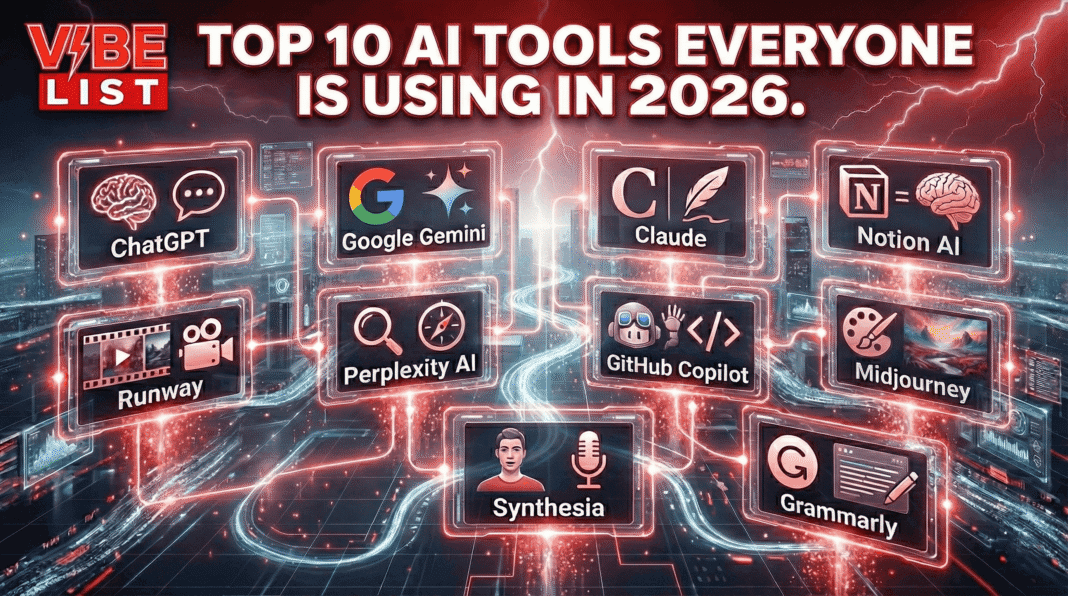
900 million weekly users for a chatbot that hallucinates 37 percent of the time. 750 million monthly users for an AI assistant most people don’t realize they’re using. A $500 million company with 160 employees and zero investors. 46 percent of all code on the world’s largest development platform, written by a machine. None of these tools won because they were the smartest; they won because they were already inside the software you opened this morning.
Disclosure: This article is independently produced editorial content. No vendor reviewed, approved, or paid for inclusion. Tool selections were determined solely by the criteria described in the methodology section below.
“Everyone is using AI” is a sentence that has been circulating in keynote speeches and LinkedIn posts for over a year now. The sentiment was widespread enough to become a cliché. AI will not replace you; but someone using AI will. The Intuit QuickBooks Small Business Insights survey, released in mid-2025, found that 68% of U.S. small businesses say they are using AI regularly. This is up from 48% last year. However, a majority of those businesses do not have a formal AI strategy. People are using AI tools as if they are pocket calculators. They give very little thought to what type of calculator they are using, or whether they should blindly trust the output.
The lack of discrimination is bad news for 2026. The gap between well-engineered AI products and half-baked experiments disguised as products is wider today than it has ever been. Many of the tools listed here process billions of tokens daily, and many have passed enterprise procurement reviews at some of the world’s largest corporations. Other tools you may find in the wild are wrappers around third-party APIs, and when scrutinized, they will fail. Knowing the difference matters more than knowing the brand name. This guide will look at ten AI tools that have earned their place through verifiable adoption, independently documented capabilities, and real-world integration into the way millions of people work. It will also look at what each tool gets wrong. Because no honest assessment of any technology can ignore the flaws.
How We Chose The Tools?
We looked at four criteria to choose which tools made the list. The first criterion was documented user bases or enterprise penetration supported by public filings, earnings calls, or reputable third party analytics. The second criterion was diversity of real-world application. If a tool only works brilliantly in one niche but has limited use beyond that niche, then it did not make the list. The third criterion was quality of workflow integration. A tool that requires you to leave your workspace to use it faces a steeper adoption curve than a tool that is embedded in software you already open every morning. The fourth criterion was independent verification outside vendor marketing materials.
A few tools almost made the list. These include Cursor, DeepSeek, Adobe Firefly, and OpenAI’s Sora. Additionally, there are open source alternatives such as Meta’s Llama, Stable Diffusion, and FLUX. Where relevant, these are discussed below.
1. ChatGPT: Dominating Market Share Due to Its Distribution, Not Quality
Category: General-Purpose AI Assistant Vendor: OpenAI (San Francisco, CA) Pricing: Free Tier Available; ChatGPT Plus at $20/month; Team and Enterprise Tiers Available
On February 27th, 2026, OpenAI announced that ChatGPT had reached 900 million weekly active users. This represents over 50 million paid consumer subscribers. As OpenAI said in its official announcement: “ChatGPT is where people start with AI, with more than 900M weekly active users, and we now have more than 50 million consumer subscribers.” This statement was reported by Newsweek, TechCrunch, and The Economic Times. This represents one of the fastest adoption curves in the history of consumer software.
However, market share tells a different story than raw user counts. According to Similarweb data compiled in January 2026, ChatGPT’s share of the global AI chatbot market was approximately 65–75 percent, depending on how it is measured. This is down from roughly 87 percent in January 2025. Several analyses published by Vertu, First Page Sage, and Sedestral in early 2026 place the figure at 64–68 percent for web traffic share. The decline is relative, not absolute. ChatGPT’s total usage continues to grow. But competitors are growing faster.
What makes ChatGPT resilient is not the chat interface itself. It is the ecosystem. ChatGPT is embedded in browsers, mobile operating systems, enterprise software stacks, and dozens of third-party applications. This type of integration creates friction for anyone considering a switch. The platform generates long-form content, creates and analyzes images through its DALL-E integration, interprets code, and automates workflows through Custom GPTs and a growing constellation of plugins.
What ChatGPT Still Gets Wrong. Hallucination remains a structural weakness. A May 2025 investigation by the New York Times found that OpenAI’s newer reasoning models were producing incorrect information more frequently than their predecessors. The company acknowledged a hallucination rate of 37.1 percent on its SimpleQA benchmark when GPT-4.5 launched in February 2025, as reported by Forbes. A November 2025 study by StudyFinds found that ChatGPT fabricated 20 percent of academic citations and introduced errors into 45 percent of real references. For casual drafting and brainstorming, these rates may be acceptable. For legal filings, medical information, or financial analysis, they are not.
How to Get the Most Out of It. Provide context; a document, a dataset, a clearly defined problem statement. The quality of ChatGPT’s output is directly related to the specificity of the input. Vague prompts produce vague results. Detailed prompts produce output worth keeping.
2. Google Gemini: The Quiet Takeover Inside Your Inbox

Category: Integrated AI Assistant (Workspace and Mobile) Vendor: Google (Alphabet Inc., Mountain View, CA) Pricing: Included with Google Workspace Plans; Gemini Advanced Available with Google One AI Premium at $19.99/month
Google’s approach to Gemini is not to build a destination. It is to make AI invisible; to make intelligence part of the tools hundreds of millions of people already use every day.
In Alphabet’s Q4 2025 earnings call, CEO Sundar Pichai said: “Our Gemini App now has over 750 million monthly active users. We’re also seeing significantly higher engagement per user, especially since the launch of Gemini 3 in December.” He added that Gemini 3 Pro had seen “the fastest adoption of any model in our history.” Those remarks, posted on the official Google Blog, describe an AI product that has quietly become one of the most widely used on the planet.
Gemini-powered features now operate inside Gmail, Docs, Sheets, Slides, and Meet. On February 17th, 2026, Google released new adoption and usage metrics within the Google Workspace Admin Console, giving enterprise administrators granular visibility into how their organizations are actually using AI capabilities. This is not an experiment. This is infrastructure.
The mobile picture matters even more. According to Fortune, citing data from Apptopia, ChatGPT’s share of the mobile AI app market fell from 69.1 percent in January 2025 to 45.3 percent in January 2026. Over the same period, Gemini’s mobile share climbed from 14.7 percent to 25.2 percent. The takeaway is straightforward. Most people will not deliberately switch to a new AI tool. They will use whatever is already embedded in the application they have open. Google understood this before anyone else.
What Gemini Still Gets Wrong. Gemini’s hallucination rates have not improved at the pace of competitors. Discussions on Reddit and independent benchmark analyses from early 2026 note that the gap between Gemini’s accuracy and that of top-performing competitors remains meaningful, particularly for complex reasoning tasks. The product’s tight coupling to Google’s ecosystem is both a strength and a limitation. Users outside the Google Workspace orbit receive a less compelling experience.
3. Claude: The Work That Demands Precision
Category: Advanced Reasoning and Long-Context AI Assistant Vendor: Anthropic (San Francisco, CA) Pricing: Free Tier Available; Claude Pro at $20/month; Team and Enterprise Tiers Available
Anthropic releasedClaude Opus 4.6 on February 5th, 2026. The technical specifications are substantial: a 200,000-token standard context window, a 1-million token context window (in beta at launch, which became generally available on March 13th, 2026), and a maximum output of 128,000 tokens; double the previous limit. All figures are confirmed by Anthropic’s documentation, its announcement post, and coverage from TechCrunch and CNBC.
These numbers translate into concrete capability. Users can submit entire codebases, stacks of legal contracts, or dozens of academic papers in a single request and receive structured, cohesive analysis in return. Anthropic’s enterprise features, including agent coordination and extended thinking, position Claude as a tool of choice for legal review, policy analysis, research synthesis, and complex technical work.
Opus 4.6 is available through AWS Bedrock, Google Cloud Vertex AI, and Microsoft Azure via Microsoft Foundry. Seeking Alpha reported in January 2026 that Anthropic CEO Dario Amodei attributed approximately 80 percent of the company’s business to enterprise customers, with adoption spanning Fortune 100 companies across all three major cloud platforms; although Anthropic has not released independently verified adoption figures.
The AI market is dividing along a distinct axis. ChatGPT competes based on breadth and accessibility. Claude competes based on depth; the ability to reason about, analyze, and produce structured output from large volumes of complex material. Professionals working with high-value documents who require precision over ease of use will find this division significant.
What Claude Still Gets Wrong. Claude’s smaller consumer footprint means fewer third-party integrations, fewer plugins, and less ecosystem stickiness, making it easier for users to switch. Anthropic’s conservative approach to safety, while admirable, can result in over-refusal. The model often declines tasks that are obviously safe, and despite its enterprise strength, public user adoption metrics remain opaque compared to ChatGPT and Gemini’s well-documented figures.
4. Midjourney: $500 Million in Revenue, Zero Venture Capital, and a Pile of Lawsuits

Category: AI image generation Vendor: Midjourney, Inc. (San Francisco, CA) Pricing: Plans from $10/month (Basic) to $120/month (Mega)
MidjourneyV7 launched on April 3, 2025; confirmed by TechCrunch and Midjourney’s own documentation. This release offered much improved texture rendering, more compelling renderings of human anatomy (a longstanding major failing for image generators), and stronger interpretive ability for both text and image-based prompts.
The business metrics are the real shockers here. According to DemandSage and About Chromebooks, Midjourney has around 20 to 21 million registered users on its Discord server, with daily active users swinging between 1.2 million and 2.5 million. Quantumrun Foresight says annual revenue was an estimated $500 million in 2025; generated entirely through subscriptions and without venture capital funding. The company remains entirely self-funded and employs approximately 160 people.
Content creators, designers, marketers, and architects now use Midjourney as an essential part of their visual toolkit; for ideation, moodboarding, brand exploration and testing, and rapid concept iteration. Things that in the past required days of waiting for stock images or freelance deliverables now happen in minutes.
What Midjourney still gets wrong. The most significant issue is the ongoing copyright litigation. In June 2025, Disney and Universal sued Midjourney in federal court in the Central District of California for direct and secondary copyright infringement; reported by NPR, The Guardian, and the Copyright Alliance’s year-in-review. A separate class-action suit by artists against Midjourney, Stability AI, and Runway AI is also making its way through the courts. These cases, also unresolved in March 2026, raise unresolved questions about the legality of training image generation models on copyrighted material. Midjourney has not publicly said how much of its training data is made up of copyrighted works.
For teams considering these tools, it’s important to note that options like Adobe Firefly only draw from licensed content in the Adobe Stock library, and open-source options like Stable Diffusion and FLUX are transparent about their training data.
5. Runway: Cinematic AI Video, With Important Caveats
Category: AI video generation and editing Vendor: Runway AI, Inc. (New York, NY) Pricing: Free tier with limited monthly credits; Standard at $12/month; Pro at $28/month; Unlimited at $76/month
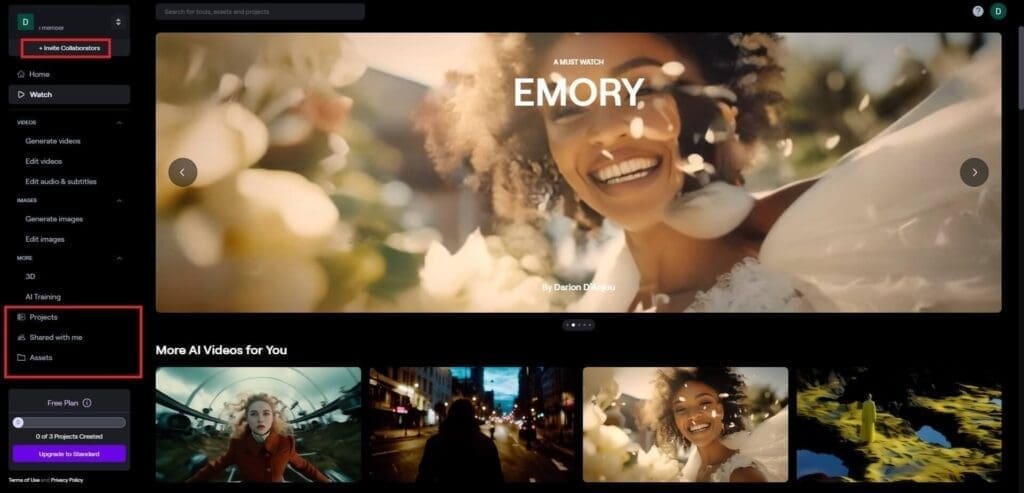
Gen-3 Alpha came out in June 2024. Gen-4.5 followed on December 1, 2025, with Runway describing it on its official research page as “the world’s top-rated video model.” Between them, the models let you generate video from text, or from an image. You can animate photos, remove backgrounds, follow tracks, and more; and all with AI.
Marketers, independent creators, and production companies use Runway for professional looking video content without the need for a production crew or post production turnaround. What was once a resource-based competitive advantage; the ability to afford a film crew; has been partially commoditized, giving a single creator the ability to produce B-roll, scenery, and other secondary footage that looks like it comes from mid-tier production houses.
Runway is great at supplementary content; transitions, ambiance, atmosphere. Where it falls short is in talking-head content, narrative storytelling, and projects that call for human authenticity. Knowing where that boundary is the difference between using the tool correctly and asking it to be something it is not designed to be.
What it still gets wrong. Same as the previous category: Runway, along with Midjourney and Stability AI, is a named defendant in the class-action copyright infringement suit filed by artists. The outcome of that litigation will help define the legal framework for every AI video tool. As for Gen-4.5, the output is visually stunning but still shows artifacts in tricky, complex scenes involving multiple human subjects in motion; in short, it is improving rapidly, but is not yet ready to replace the camera in scenarios that demand genuine physicality and quick movement.
6. Perplexity AI: The Answer Engine Under Legal Siege

Category: AI-powered search and research Vendor: Perplexity AI, Inc. (San Francisco, CA) Pricing: Free tier; Perplexity Pro at $20/month or $200 a year
Traditional search engines return a list of links, then leave the user to figure out how many of those links are not dead and which ones tell the whole story. Perplexity returns an integrated answer with inline citations. That simple difference has attracted a large and growing user base; just how large varies depending on who you ask. WIRED, citing Similarweb data from February 2026, pegged the total monthly active users across web and mobile at just over 60 million. DemandSage, using a different slice of Similarweb data, reported 45 million in February 2026. AI CERTs attempted to reconcile the discrepancy by cross-referencing Apptopia data directly. The honest answer seems to be somewhere between 45 and 60 million monthly active users; it’s a big number no matter where in that range the actual figure falls.
The query volume figures are more reliably documented. Bloomberg reported that Perplexity CEO Aravind Srinivas said at the Bloomberg Tech Summit in June 2025 that the platform processed 780 million search queries in May 2025, and was growing at greater than 20 percent month-on-month; as also reported by TechCrunch and Search Engine Land. The company made more than $100 million in subscription revenue for 2025, and was valued at $20 billion following a $200 million funding round in September 2025 (Reuters).
Perplexity’s big differentiator is transparency: many AI tools synthesize answers without attribution, but Perplexity allows you to click on an answer’s citations so you know where the information comes from.
What Perplexity gets wrong: The legal situation is severe; the New York Times sued the company in December 2025, the latest high-profile publisher to join similar lawsuits alleging copyright infringement (NPR, Bloomberg Law, WIRED). Amazon won a temporary court injunction against the Perplexity Comet AI browser in March 2026, barring it from scraping its website (CNBC). Perplexity is winding down its advertising program as of February 2026, citing user trust as the reason (FT); for a product built on synthesizing other people’s content, these risks are not peripheral. They are fundamental.
7. GitHub Copilot: Writing Half the Code, for Better and Worse
Category: AI-based code generation and developer assistance Vendor: GitHub (Microsoft Corporation, Redmond, WA) Pricing: Free tier with limited number of completions; Copilot Pro $10/month; Business $19/user/month; Enterprise $39/user/month
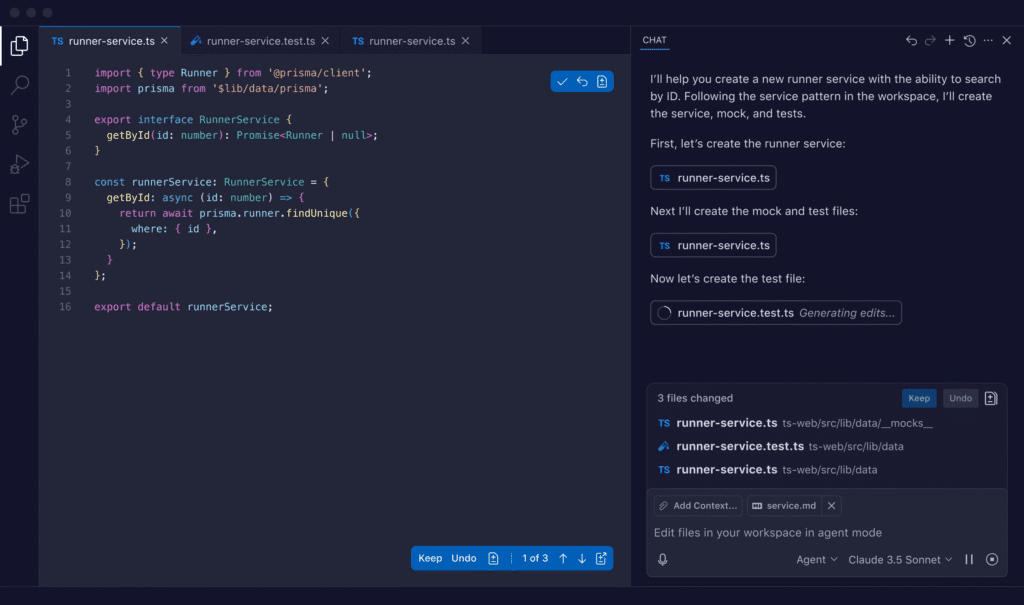
The numbers are staggering and well known. According to Quantumrun Foresight, on average GitHub Copilot generates 46 percent of all code written by developers using it, with Java developers reaching as high as 61 percent. Microsoft announced 20 million cumulative users as of July 2025, a figure that increased to 26 million by October 2025, as reported by CNBC. Microsoft’s FY26 Q2 earnings call on January 28, 2026, disclosed 4.7 million paid subscribers, an increase of 75 percent year on year. Overall, around 90% of Fortune 100 companies use the platform.
GitHub’s 2025 Octoverse Report said nearly 80 percent of all new developers on GitHub tried Copilot within their first week; AI-assisted coding is no longer optional for new developers, it’s the default entry point.
A disclosure from Microsoft CEO Satya Nadella in April 2025 that “I’d say maybe 20%, 30% of the code that is inside of our repos today and some of our projects are probably all written by software.” That disclosure, reported by CNBC, drives home how embedded this technology is even inside the very companies that build it.
What Copilot still gets wrong. Acceptance rate tells a different story than generation rate. Research published in Communications of the ACM found that developers accept only about 27% of suggestions GitHub Copilot makes. The best programmers think of Copilot as a first draft generator, and review and refactor before pushing to production.
Security is still a concern. In March 2025, GitGuardian uncovered a number of security threats, including secrets leakage, insecure code suggestions, and potential licensing challenges from code that may inadvertently reproduce portions of repositories under restrictive licenses like GPL. A serious vulnerability (CVSS 9.6) in GitHub Copilot Chat that allowed the silent exfiltration of source code was discovered in June of 2025, as LegitSecurity reported. Other competitors are catching up: Cursor has surpassed a million daily active users and 360,000 paying customers as of early 2026, according to BuilderLab.ai. Tabnine, Amazon Q Developer (formerly CodeWhisperer), and Replit’s AI tools have substantial user bases and appeal to developers who prefer a less agentic approach to AI-assisted coding, according to The Economic Times.
8. Notion AI: Intelligence Inside the Workspace
Category: AI tools for productivity and knowledge management Vendor: Notion Labs, Inc. (San Francisco, CA) Pricing: Free tier; Plus $10/user/month; Business $18/user/month; AI is an add-on in Business and Enterprise plans
Notion was the OS for knowledge workers, start-ups, and project teams before AI came along. The decision to embed intelligence directly into the platform, rather than requiring users to copy content into a separate tool, is one that matters. The company announced in September of 2024 that it had surpassed 100 million users around the world. More than half of Fortune 500 use Notion for team workflows. By September 2025, annualized revenue exceeded $500 million, spurred by AI features, per CNBC, which ranked Notion 34th on its 2025 Disruptor 50 list.
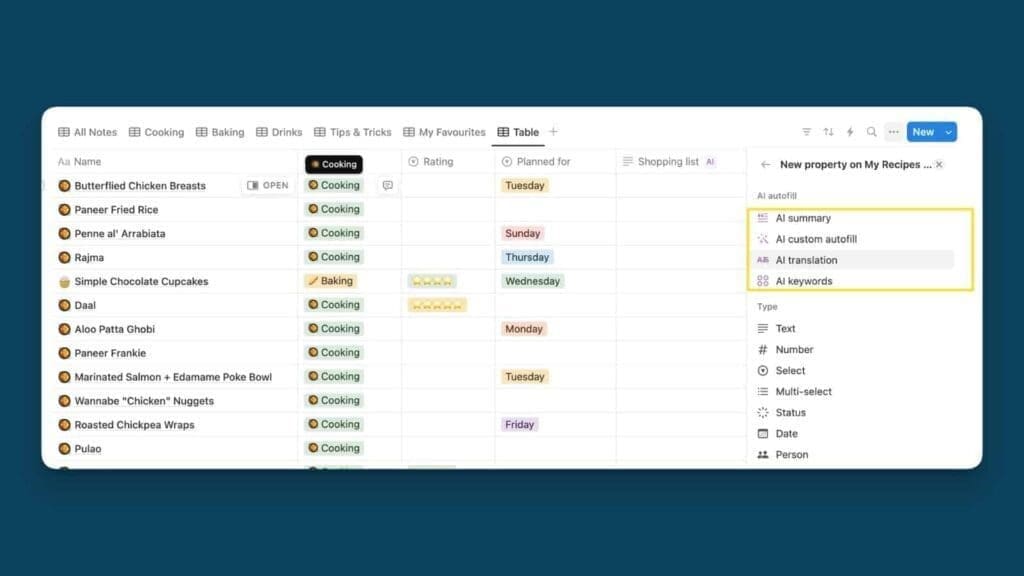
What Notion AI does: meeting note summaries, content planning, task breakdowns, brainstorming, workflow automation.
Why it matters: The “AI” isn’t what makes it valuable: it’s where the AI lives. People already keep notes, projects, docs, and meeting records inside Notion, so if AI capability can operate directly on that data, it saves the effort of toggling between workspace and chatbot. That toggling sounds trivial in isolation. Multiply it by teams and by weeks and months, and the time savings add up.
What it still gets wrong: Notion’s AI features, being tightly woven into the Notion ecosystem, are dead in the water at any organization where the knowledge doesn’t live inside Notion already; in Confluence, or SharePoint, or Google Drive, for example. And for writing code, synthesizing research, or creating images, it is much less powerful than purpose-built tools; its best use is as an intelligence layer for a user’s existing Notion workflow, rather than an all-purpose assistant.
9. Synthesia: AI Avatars at Enterprise Scale, With Deepfake Questions Attached
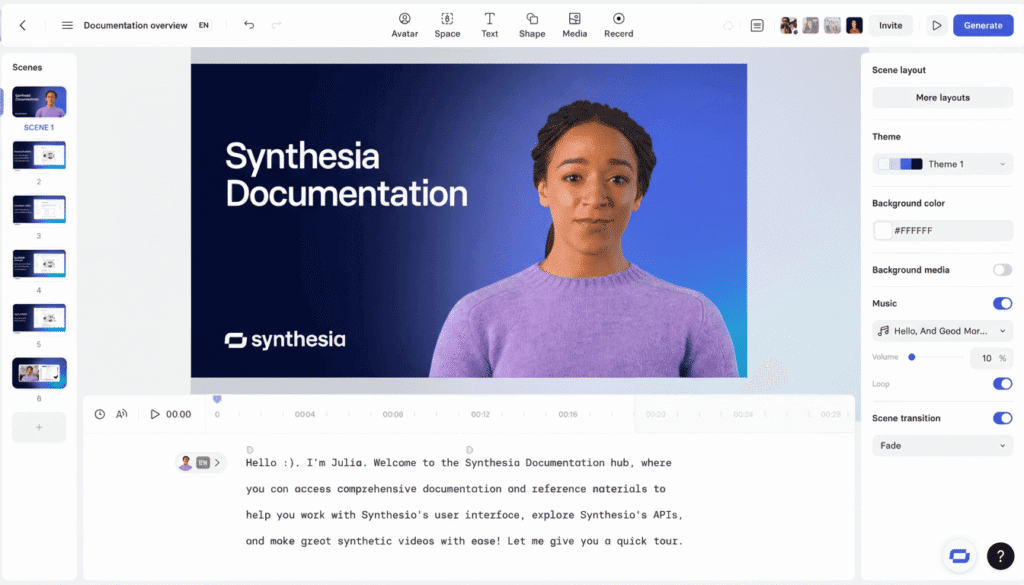
Category: AI Avatar video generation Vendor: Synthesia Ltd. (London, United Kingdom) Pricing: Starter at $18/month; Creator at $64/month; Enterprise pricing custom
AI-generated video presenters sounded gimmicky two years ago. They don’t anymore. Synthesia has over 65,000 business customers globally, according to Fortune’s June 2025 reporting; more than 90 percent of the Fortune 100 use it, as of January 2026’s Series E announcement.
The finances say this is a serious business. Synthesia hit $100 million in ARR as early as April 2025, according to CNBC and disclosures from the company itself. By Jan 2026, CNBC reports $150 million in ARR for Synthesia, with projections for 2026 exceeding $200 million; in the same month, Synthesia raised $200 million in a Series E round at $4 billion valuation, led by Google Ventures and with NVIDIA’s venture arm on board, according to TechCrunch, the Wall Street Journal, and Synthesia’s own announcement. Use cases are mainly internal training, onboarding, multilingual corporate messaging, and marketing explainers. Teams focused on training have to continually update content, and onboarding materials can quickly become outdated. Synthesia compresses the production cycle from weeks and thousands of dollars to hours and a fraction of the cost.
What’s still wrong with Synthesia. The same architecture that enables branded avatar creation also powers deepfakes. The company is investing serious resources in safety (verifying consent from someone creating an avatar, content moderation systems described on the ethics page), but the regulatory landscape around that is tightening. Per Duke University researcher Nita Farahany, the U.S. saw 15 deepfake-related laws enacted in 2023, 80 in 2024, and over 25 in the first half of 2025. For brand storytelling and customer-facing brand campaigns, actual people have more authenticity and a greater emotional breadth than avatars do.
10. Grammarly: Writing Enhancement, a Billion-Dollar Rebrand, and a Lawsuit
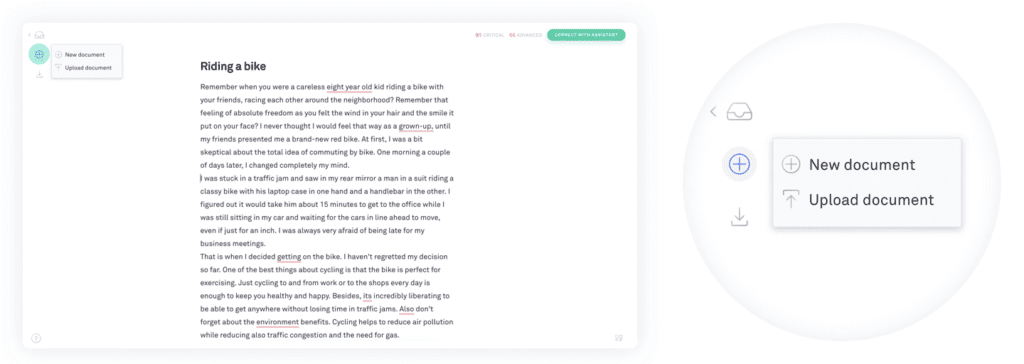
Category: AI writing assistance and communication enhancement Vendor: Superhuman (formerly Grammarly, Inc.; San Francisco, CA) Pricing: Free tier available; Grammarly Premium at $12/month; Business at $15/user/month
Grammarly has been around for so long that people forget that it uses AI. In 2026, the product is much more than a spelling check. It has tone adjustment, full paragraph rewrite, contextual suggestions, and GrammarlyGO generative features that assist users in writing drafts, not just correcting their writing.
On October 29, 2025, the company announced a rebrand to Superhuman, combining the Grammarly writing tool, the Superhuman email client that it had purchased, and a new AI assistant called Superhuman Go into a unified productivity suite. The rebrand officially launched on November 5, 2025. The Grammarly product continues to be sold under its well-known brand name within this larger platform. Details were reported by TechCrunch, Fast Company, and Mashable.
More than 40 million people and 50,000 organizations use Grammarly, and teams in 96 percent of Fortune 500 companies depend on the platform, based on the company’s own numbers. Grammarly occupies a unique niche: enhancement, not automation. For professionals who want to improve the clarity of their writing without surrendering their voice to a chatbot, that difference matters.
What Grammarly still gets wrong. Grammarly was hit with a class-action lawsuit and received massive public backlash in March 2026 for its “Expert Review” feature. This feature provided AI-generated editing suggestions that appeared to come from named, real-world authors and journalists, without their permission. WIRED, the BBC, Mashable, and The Guardian all covered the controversy. Grammarly turned off the feature on March 11, 2026. This event shows a tension at the core of AI writing tools: the boundary between augmenting a user’s voice and stealing someone else’s voice is narrower than it seems.
The Regulatory Horizon: What None of These Tools Can Ignore
Any genuine examination of the top AI products in 2026 cannot occur without recognizing the regulatory and legal climate reshaping the industry in real time.
The EU AI Act became enforceable on August 1, 2024. Its provisions classify AI systems by their level of risk and establish increasingly strict obligations, from transparency requirements for low-risk tools to comprehensive compliance regimes for high-risk tools, as explained by the European Commission and law firms such as Baker McKenzie and DLA Piper. Most of the productivity tools on this list fall outside the Act’s high-risk classifications, though they remain subject to general EU law. But tools used for hiring decisions, credit assessments, or law enforcement must comply with the Act.
Copyright litigation is the other tectonic force. The New York Times vs. OpenAI, Disney and Universal vs. Midjourney, artists’ class actions against Stability AI and Runway, publishers vs. Perplexity; these cases; combined with more than 70 other lawsuits currently in courts as of early 2026, according to the Copyright Alliance’s 2025 year-in-review; will determine whether the training practices on which generative AI was built are legally valid. The Copyright Alliance’s 2025 year-in-review stated that the dominant resolution trend during 2025 was settlement and licensing agreements. The alliance predicts that more settlements will follow in 2026.
Enterprise buyers must demand that their AI vendors answer questions such as: Where did the training data come from? What compliance certifications are in place? and what happens to an organization’s data once it goes into the model’s pipeline? All tools listed here include enterprise-level plans that provide security, compliance, and administrative controls. However, “enterprise-level” is not synonymous with “risk-free.”
Three Structural Patterns Worth Learning
There are commonalities that explain why some platforms succeed while others fail.
The first is integration over isolation. The platforms that are winning are integrating into existing workflows. Gemini is integrated into Google Workspace. Copilot is integrated into Visual Studio Code. Notion AI is integrated into Notion. Grammarly is integrated into your web browser. When a user has to leave their workspace to use an AI tool, adoption drops sharply.
The second is multimodal capability. Text alone is insufficient. Successful platforms operate across text, images, video, code, and data. A marketer who needs copy, graphics, and videos from three separate tools is at a disadvantage compared to someone who can get two or three of those capabilities through a single workflow.
The third is enterprise trust. Compliance frameworks, security certifications, data privacy guarantees, and administrative controls are driving adoption decisions at scale in ways that consumer reviews never capture. Synthesia’s 90 percent penetration of Fortune 100 companies did not occur because individuals enjoyed the free trial. It occurred because the platform passed enterprise procurement review; a much higher threshold than consumer popularity.
Notable Tools That Nearly Made the List
Cursor has become the most formidable competitor to GitHub Copilot, with one million daily active users and 360,000 paying customers as of early 2026. On March 2026, Bloomberg reported that Cursor generated more than $2 billion in annualized revenue. Cursor focuses on deep-agential coding capabilities that appeal to developers looking for more than just auto-complete.
DeepSeek attracted considerable interest in early 2025 for producing model performance competitive with that of leading AI labs at significantly lower cost, challenging the conventional wisdom about the capital intensity of cutting-edge AI development.
Adobe Firefly continues to develop its generative image and video capabilities as part of the Adobe Creative Cloud ecosystem. Its use of exclusively licensed training data from Adobe Stock makes it a lower risk option for teams concerned with copyright exposure.
OpenAI’s Sora brought text-to-video generation to the ChatGPT universe, although as of early 2026 it remained in more limited availability relative to Runway’s already established pipeline.
Meta’s Llama models represent open-source options for organizations that wish to have complete control over their AI stack. Llama is not a consumer product in the same way as the tools listed above; however, it represents the base layer of an increasing number of enterprise deployments.
One-Week Action Plan
This is intentionally simple.
Choose two tools from this list. Choose one tool to use for your primary output; writing, coding, design, or research. Choose the other tool to support that output; editing, note-taking, video production, or search. Use both tools for one full week of work. Do not treat either as an experiment. Use them as tools you rely upon, as if you had been using them for months.
The competitive advantage in 2026 is not access to AI. Everyone has access. The advantage is understanding which tool to choose, when to choose it, and the type of input that produces output worthy of preserving. That is a skill. Like all skills, it grows only through intentional repetition and practice.
Quick Comparison: All 10 AI Tools at a Glance
| # | Tool | Category | Vendor | Key Adoption Metric | Pricing Starts At | Primary Strength | Key Limitation / Risk | Enterprise Penetration |
|---|---|---|---|---|---|---|---|---|
| 1 | ChatGPT | General-Purpose AI Assistant | OpenAI (San Francisco, CA) | 900 M weekly active users; >50 M paid subscribers | Free; Plus $20/mo | Massive ecosystem & third-party integration; broadest consumer reach | 37.1% hallucination rate (SimpleQA); 20% fabricated citations; market share declining to 65–75% | Team & Enterprise tiers available |
| 2 | Google Gemini | Integrated AI Assistant (Workspace & Mobile) | Alphabet (Mountain View, CA) | 750 M+ monthly active users; mobile AI share 25.2% | Included with Workspace; Advanced $19.99/mo | Invisible integration into Gmail, Docs, Sheets, Meet; fastest-growing mobile AI app | Hallucination gap vs. top competitors on complex reasoning; limited value outside Google ecosystem | 8 M+ paid Gemini Enterprise seats across 2,800+ companies |
| 3 | Claude | Advanced Reasoning & Long-Context Assistant | Anthropic (San Francisco, CA) | ~80% of revenue from enterprise; Fortune 100 adoption via AWS, GCP, Azure | Free; Pro $20/mo | 1 M-token context window; 128K-token output; precision on legal, policy & research work | Smaller consumer footprint; fewer third-party integrations; safety over-refusal on safe tasks | Available on AWS Bedrock, Google Vertex AI, Microsoft Foundry |
| 4 | Midjourney | AI Image Generation | Midjourney, Inc. (San Francisco, CA) | 20–21 M registered Discord users; $500 M 2025 revenue | Basic $10/mo | Industry-leading aesthetic quality; entirely self-funded with zero VC; ~160 staff | Copyright litigation (Disney/Universal, artists’ class action); opaque training-data provenance | Subscription-based; no formal enterprise tier disclosed |
| 5 | Runway | AI Video Generation & Editing | Runway AI, Inc. (New York, NY) | Gen-4.5 ranked #1 on Artificial Analysis Text-to-Video benchmark (1,247 Elo) | Free tier; Standard $12/mo | Top-rated video model; cinematic B-roll, transitions & ambiance | Artifacts in multi-subject motion; named defendant in artists’ copyright class action | Enterprise plan available; select early-access partners |
| 6 | Perplexity AI | AI-Powered Search & Research | Perplexity AI, Inc. (San Francisco, CA) | 45–60 M monthly active users; 780 M queries/mo (May 2025) | Free; Pro $20/mo | Inline-cited answers; transparent sourcing; $20 B valuation | NYT copyright lawsuit (Dec 2025); Amazon injunction (Mar 2026); advertising program abandoned | $100 M+ subscription revenue (2025); enterprise plans available |
| 7 | GitHub Copilot | AI Code Generation & Developer Assistance | GitHub / Microsoft (Redmond, WA) | 26 M users; 4.7 M paid subscribers; generates 46% of code | Free tier; Pro $10/mo | Embedded in VS Code; 80% of new GitHub devs use within first week; 90% of Fortune 100 | Only 27% suggestion acceptance rate; CVSS 9.6 vulnerability (Jun 2025); licensing & insecure-code risks | Enterprise $39/user/mo; 90% Fortune 100 adoption |
| 8 | Notion AI | Productivity & Knowledge Management | Notion Labs, Inc. (San Francisco, CA) | 100 M+ users; >50% of Fortune 500; $500 M+ revenue | Free; Plus $10/user/mo | AI operates directly on existing workspace data; no context-switching needed | Useless outside the Notion ecosystem; weaker than purpose-built tools for code, images, or research | Business & Enterprise tiers; #34 on CNBC Disruptor 50 (2025) |
| 9 | Synthesia | AI Avatar Video Generation | Synthesia Ltd. (London, UK) | 65,000+ business customers; $150 M ARR (Jan 2026) | Starter $18/mo | Enterprise-scale avatar video; training, onboarding & multilingual content | Deepfake regulatory risk (95+ U.S. deepfake laws in 2023–2024); avatars lack human authenticity | >90% of Fortune 100; $4 B valuation (Series E, Jan 2026) |
| 10 | Grammarly (Superhuman) | AI Writing Assistance & Communication | Superhuman, formerly Grammarly, Inc. (San Francisco, CA) | 40 M+ users; 96% of Fortune 500; 50,000+ organizations | Free; Premium $12/mo | Enhancement over automation; tone adjustment, rewriting & GrammarlyGO generative features | Class-action lawsuit over “Expert Review” (Mar 2026); feature disabled Mar 11, 2026 | Business $15/user/mo; Enterprise tier available |
| — | Honorable Mentions | Cursor — 1 M daily active users, 360K paying customers, $2 B+ annualized revenue (Bloomberg, Mar 2026). DeepSeek — Competitive model performance at significantly lower cost; disrupted cost assumptions in early 2025. Adobe Firefly — Exclusively licensed training data from Adobe Stock; lower copyright risk. OpenAI Sora — Text-to-video within ChatGPT ecosystem; limited availability vs. Runway. Meta Llama — Open-weight models for full-stack AI control; enterprise deployment base layer. Amazon Q Developer — AI coding assistant (formerly CodeWhisperer); alternative to Copilot. Tabnine & Replit AI — Less agentic coding options for developers preferring lighter tooling. | ||||||
Frequently Asked Questions
What is the most commonly used AI tool in 2026?
ChatGPT continues to be the most-used AI tool globally, with approximately 900 million weekly active users as of late February 2026. However, ChatGPT’s market share of the overall AI chatbot space has decreased to approximately 65 to 75 percent (dependent on the source) from approximately 87 percent in January 2025. Google Gemini is growing quickly, and has reached 750 million monthly active users. This growth is largely due to its integration into Google Workspace and Android.
Which AI tool is best for writing in 2026?
That depends on the type of writing. ChatGPT and Claude are strong for creating drafts of longer documents, reports, and analysis; Claude is stronger when working with large amounts of source material. Grammarly (now part of the Superhuman suite) is still the leading choice for editing, adjusting tone, and polishing existing writing without completely AI-generating it. For research that contributes to writing, Perplexity provides source-cited and citation-supported answers.
Does GitHub Copilot generate more value for money than it costs in 2026?
For professional developers, the evidence indicates that yes. Copilot generates approximately 46 percent of code for active users and has been adopted by 90 percent of Fortune 100 companies. Research published in Communications of the ACM indicated that developers only accepted about 27 percent of Copilot’s suggestions. The most successful users consider Copilot as a starting point, not a stopping point; therefore, they review and refactor before deploying. Auditing AI-generated code for security is also required; independent analyses have shown that AI-generated code may contain insecure code patterns, and/or pose risks related to licensing.
Are these AI tools safe for use in an enterprise?
Each of the tools listed here offers an enterprise plan with security, compliance, and administrative controls. Claude is offered through AWS Bedrock, Google Cloud Vertex AI, and Microsoft Azure. GitHub Copilot offers a dedicated enterprise license. Synthesia claims adoption by more than 90 percent of Fortune 100 companies, and Notion claims adoption by more than 50 percent of Fortune 500 companies; both figures suggest these tools have passed institutional procurement and security review. However, the EU AI Act’s comprehensive compliance regime for high-risk AI systems takes full effect on August 2, 2026. Therefore, enterprise buyers should assess how these tools comply with the Act’s requirements.
What AI tools are the best for video production in 2026?
Runway is the leading platform for general creative and marketing video applications, particularly B-roll and supplemental video. Synthesia is the leading platform for avatar-based video, particularly for internal training, onboarding, and multilingual corporate content. The two platforms serve different purposes and are complementary rather than direct competitors. Runway faces active copyright litigation, and Synthesia faces increasing regulatory scrutiny around deepfake legislation; enterprise buyers should monitor both.