


A $5 pastry resold for $100 on Craigslist before 8 a.m. A single TikTok video viewed 120 million times that triggered an international pistachio shortage. A charred, crust-less cheesecake requiring six ingredients that conquered Instagram by breaking every rule of food photography. A three-ingredient coffee recipe that became the most-searched recipe on Earth during the loneliest month in modern history. A $4.61 billion matcha market built one green latte at a time. None of these desserts broke the internet because they tasted the best; they broke it because they were impossible not to film.
Why Some Desserts Go Viral and Most Don’t
Why do only a few desserts go viral? Millions of desserts exist. Thousands get shared on social media every day. Yet only a handful ever achieve true viral status, and the difference between a global sensation and a week-long blip goes well beyond taste.
A Coffeeness study analyzing viral TikTok dessert data found that the highest-performing viral desserts share several visual traits: bold color, visible texture contrast, dramatic presentation, and a preparation method that translates well to short-form video. But visuals alone do not explain breakout success. The desserts that cross from trending to truly viral tend to combine those visual hooks with:
- Scarcity and demand
- Cultural storytelling
- Sensory novelty
- Emotional resonance
These factors overlap constantly. A culturally rooted dessert that most Western consumers have never encountered carries built-in scarcity, which drives curiosity, which feeds the algorithm.
Desserts are also among the most photographed foods on the planet, so the ones that break through tend to be engineered — intentionally or not — for the camera before the fork. Every entry below rode at least two of these drivers simultaneously, and most rode all four. Here are the 15 that broke the internet hardest.
1. The Cronut: The Pastry That Invented the Modern Dessert Line
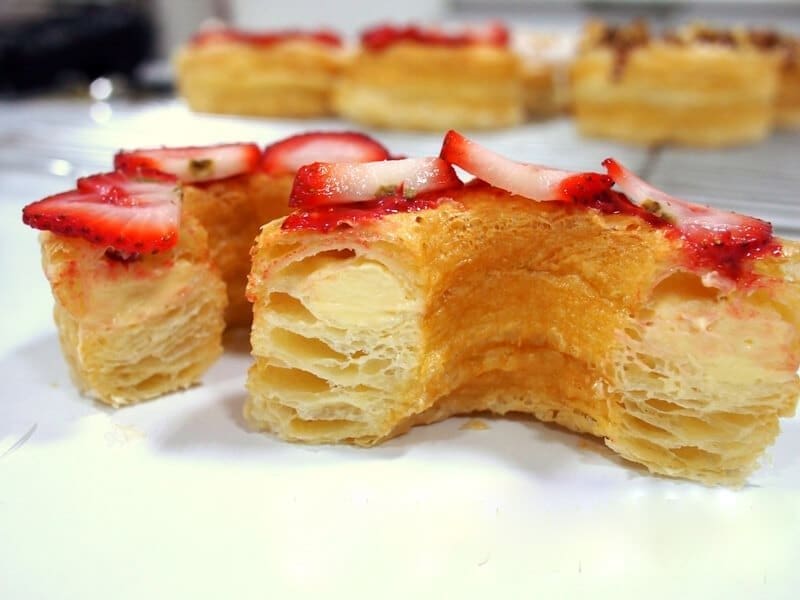
The Cronut is arguably the first modern dessert to go viral. On May 10, 2013, French pastry chef Dominique Ansel introduced the Cronut — a croissant-doughnut hybrid — at his small SoHo bakery in New York City.
Ansel had spent over two months testing recipes and lamination techniques, but nothing prepared him for what happened next.
Priced at $5 apiece, each Cronut consisted of laminated croissant dough that was sheeted, proofed, fried in grapeseed oil, filled with cream, and glazed. The cross-section revealed flaky, concentric layers that were practically designed for a camera lens.
When Grub Street published its first feature on May 9, 2013 — one day before the Cronut even went on sale — the piece ignited a frenzy. Food blogs exploded with photos and stories of people lining up for hours outside Ansel’s bakery.
Within weeks, website traffic to the bakery surged by more than 300 percent. Customers waited in lines exceeding two hours before the 8 a.m. opening, and a black market sprouted on Craigslist where Cronuts resold for upwards of $100 each.
The Cronut quickly became a global phenomenon. Timemagazine named it one of its 25 Best Inventions of 2013 — the only food item on a list that included the Oculus Rift and driverless-car technology. Today, Ansel still limits production to roughly 300–350 Cronuts per day, with a new flavor each month.
The Cronut was not just the first dessert to demonstrate what a single food item could accomplish in the age of Instagram; it wrote the playbook every viral dessert since has followed. Limit supply. Let the line become the marketing. Design the product to be photographed before it is eaten. Rotate flavors monthly so the conversation never dies. Every two-hour dessert line anywhere in the world today traces its DNA directly back to a SoHo bakery in the spring of 2013.
2. Dubai Chocolate: The Pregnancy Craving That Caused a Global Pistachio Shortage

In 2021, British-Egyptian entrepreneur Sarah Hamouda developed a pregnancy craving for something that did not exist yet: a thick chocolate bar stuffed with shredded kataifi pastry, pistachio cream, and tahini. She launched FIX Dessert Chocolatier as a side hustle from her Dubai home, naming it FIX because it stands for “freaking incredible experience.”
Hamouda spent weeks perfecting each bar’s handmade decorations — painting colorful designs by hand. FIX operated quietly for two years until, in late 2023, food influencer Maria Vehera filmed an ASMR TikTok of herself eating a FIX bar in her car. To date, Vehera’s video has been viewed over 120 million times, perThe Guardian. Her reaction inspired hundreds of copycat videos. Overnight, FIX’s daily orders skyrocketed from single digits to 500, selling out within minutes on Deliveroo every afternoon.
FIX created such enormous demand for pistachios — an essential ingredient in its green filling — that it triggered international shortages. Prices for pistachio kernels rose from $7.65 per pound to $10.30 per pound in under a year. Iran shipped 40 percent more nuts to the UAE in six months than it had in the previous twelve. Major chocolate companies including Lindt and Läderach rushed to develop their own pistachio chocolates. Shake Shack and Crumbl launched Dubai-inspired chocolate treats. Some stores reportedly began rationing pistachio-based chocolate purchases.
Dubai Chocolate may be the most influential viral dessert of the last decade — not for the bar itself, but for what it proved. A single TikTok video can disrupt global agricultural supply chains. One woman’s pregnancy craving in her kitchen rerouted pistachio shipments between the U.S. and Iran.
3. Basque Burnt Cheesecake: The Ugly Dessert That Took Over the World

Everything about Basque burnt cheesecake was wrong for social media success. There was no crust. Its surface was intentionally scorched black. The middle was essentially soft-set pudding instead of cake. Black food does not typically photograph well.
Yet it became one of the most widely copied desserts on the planet over the last decade.
Basque burnt cheesecake originated at La Viña, a pintxos bar in San Sebastián, Spain. In the early 1990s, the Rivera family poured time and resources into developing a new tarta de queso recipe. The epiphany came when they removed the biscuit base altogether. As Santiago Rivera, La Viña’s current owner, told Resy in a 2018 interview: “The biscuit base doesn’t generally bring anything special. If you use it, you run into stumbling blocks, but if you do away with it, the cheesecake will be much more creamy and soft.”
For almost twenty years, Basque burnt cheesecake remained unknown outside local circles. Then travel bloggers began writing about San Sebastián, and the city turned into a food-tourism hotspot seemingly overnight. Today, Basque burnt cheesecakes appear on menus from Istanbul and Kuala Lumpur to Melbourne, Brooklyn, and Tokyo. When Bon Appétitpublished its Basque Burnt Cheesecake recipe in January 2019, the trend accelerated exponentially. After COVID-19 lockdowns began, millions of home cooks turned to a recipe that required just six ingredients and a very hot oven.
Resycalled it “the banana bread of lockdown 3.0.”
Today it comes in dozens of variations: ube-flavored versions in Filipino-American bakeries, black truffle in Sydney, matcha in the San Francisco Bay Area, and Da Hong Pao tea in Singapore.
Basque burnt cheesecake proves that virality does not require prettiness. In a culture obsessed with pastel palettes and perfectly composed photos, this ugly, charred, wobbly, crust-less monstrosity succeeds precisely because it looks like something someone actually made in their own kitchen. It is the opposite of everything Instagram rewards — and it conquered Instagram anyway.
4. Crumbl Cookies: How Two Cousins Built an Empire Around Baking Cookies They Didn’t Know How to Bake

In November 2017, cousins Jason McGowan and Sawyer Hemsley founded Crumbl Cookies. Neither McGowan nor Hemsley had professional baking experience. They watched YouTube baking tutorials and got started immediately, opening their first location in Logan, Utah, while Hemsley was still attending Utah State University.
Within seven years, Crumbl grew into an empire with over 1,071 franchised locations across North America. System-wide sales surpassed $1 billion. In January 2025, Reuters reported that Crumbl was exploring an acquisition deal potentially worth $2 billion.
Crumbl’s success cannot be attributed solely to its cookies but rather to the content machine built around them. Crumbl currently boasts over 10 million followers on TikTok, surpassing the combined follower count of Starbucks, Dunkin’, and Krispy Kreme. More than 107 million TikTok videos reference Crumbl. The weekly flavor rotation — announced on Sundays when all stores close — turns cookie buying into an event. These oversized four-inch cookies, approaching 1,000 calories each, were practically designed to be unboxed, reviewed, and debated on camera.
The model is not without problems. Average same-store sales fell from roughly $1.84 million per year in 2022 to roughly $1.16 million per year in 2023. Seven franchise locations closed for the first time ever. To counter the trend, Crumbl introduced non-cookie desserts in early 2024 and slowed its rate of new openings.
The same viral cycle that propelled the brand now threatens to erode it. Crumbl proved that social media velocity can build a dessert company on novelty rather than culinary innovation. The cookies are fine — big, sweet, photogenic. But the real product is the weekly content cycle: anticipation, reviews, unboxing videos. Whether that model is sustainable without perpetual novelty is the $2 billion question.
5. Tanghulu: The Street Snack From China’s Past That Conquered TikTok After Eight Centuries

Tanghulu is fresh fruit skewered on sticks and dipped into hot, caramelized sugar syrup, then rapidly cooled until the coating hardens into a translucent, glass-like shell. The snack dates back to the Song Dynasty (960–1279 AD). Legend holds that when a Song Dynasty emperor’s favorite concubine fell ill, she recovered after eating nothing but candied hawthorn berries for two weeks. The name tanghulu (糖葫芦) translates roughly to “sugar gourd,” a reference to the calabash gourd shape the skewered berries resemble.
For generations in northern China, tanghulu was a seasonal street-food staple — bright red hawthorn berries on sticks, sold from carts and market stands. As Chinese communities spread throughout Asia — Korea, Japan, Taiwan, and Singapore — tanghulu traveled with them. But it was not until TikTok that tanghulu became a global sensation.
Modern makers have expanded the fruit roster to include strawberries, grapes, tangerines, pineapple, and even marshmallows. The combination of textures and sounds — the sharp crack of the sugar shell followed by cold, juicy fruit underneath — proved irresistible to TikTok audiences. K-pop amplified the trend further: BLACKPINK’s Jennie appeared eating tanghulu in the Netflix documentary BLACKPINK: Light Up the Sky, and footage of Jennie and fellow member Jisoo making tanghulu together pushed the snack toward a global audience.
Anthropologist Nancy N. Chen of UC Santa Cruz explained toBon Appétit why hawthorn berries have been consumed for centuries in traditional Chinese medicine: the fruit contains compounds associated with improved digestion, heart health, and circulation.
Tanghulu’s global breakout was driven by its appearance — colorful fruit glistening under a shell of spun sugar is a visual feast on any screen — and its ASMR-perfect crunch. Few desserts offer that combination of visual pop, auditory satisfaction, and genuine cultural depth in a single bite.
6. Dalgona Coffee: The Lockdown Dessert-Drink That Conquered Quarantine

It was early 2020 and the world was locked down. Billions of people were stuck inside. During this time, a simple three-ingredient recipe exploded. Instant coffee, sugar, hot water — hand-whipped into a thick, golden-brown foam and spooned over chilled milk. The internet dubbed it dalgona coffee.
The name “dalgona” came from a Korean honeycomb toffee candy that the whipped foam resembled. The recipe itself, however, did not originate in Korea — beaten coffee has been a tradition in India and Pakistan for generations. South Korean actor Jung Il-woo encountered a version in Macau and shared the experience on Korean television. From there, the recipe went viral on TikTok. The reason was obvious: three ingredients and nothing more than a whisk. The whipping process itself made for compelling visuals.
Dalgona coffee is unique because it blurs the line between dessert and beverage. The whipped foam tastes like sweet, bitter coffee candy. Dalgona coffee became the most-searched recipe on Google during the first week of April 2020. Hundreds of millions of people viewed dalgona coffee recipes across TikTok and Instagram. Restaurants that had shuttered their dining rooms began offering dalgona coffee kits for customers to prepare at home.
The fad faded once lockdowns lifted, but dalgona coffee proved something lasting: during a pandemic, a food trend can ignite faster than any marketing campaign ever could.
7. Mochi Ice Cream: The Japanese Convenience-Store Treat That America Adopted

Mochi has been a cornerstone of Japanese cuisine since the Heian period (794–1185 AD), serving simultaneously as food, ceremonial object, and spiritual offering. Mochi ice cream — a ball of ice cream wrapped in pounded glutinous rice dough — is far newer, and its adoption by American consumers is a textbook case of how a specialty product goes mainstream.
Trader Joe’s helped popularize mochi ice cream by stocking several flavors at impulse-buy prices, removing the need to visit an Asian specialty market. TikTok accelerated the shift further: users filmed taste tests, ranked flavors, and introduced millions of followers to the sensation of biting through chewy rice dough into cold ice cream beneath.
Beyond ice cream, mochi doughnuts, mochi waffles, and mochi brownies have become regular menu items at cafés in Los Angeles, San Francisco, New York City, and London. Japan’s convenience-store dessert culture has itself become a tourism draw, with visitors from around the world making pilgrimages to 7-Eleven and Lawson locations in Tokyo specifically for their dessert aisles.
Mochi ice cream succeeded in the West for one reason above all others: it introduced a mouthfeel that Western desserts simply did not offer. The elastic, chewy resistance of glutinous rice dough was not just another flavor — it was another sensation entirely. In a market saturated with variations on cake, cookies, and scooped ice cream, a new texture was what separated mochi from everything else.
8. Ube Everything: The Filipino Purple Yam That Turned the World Purple
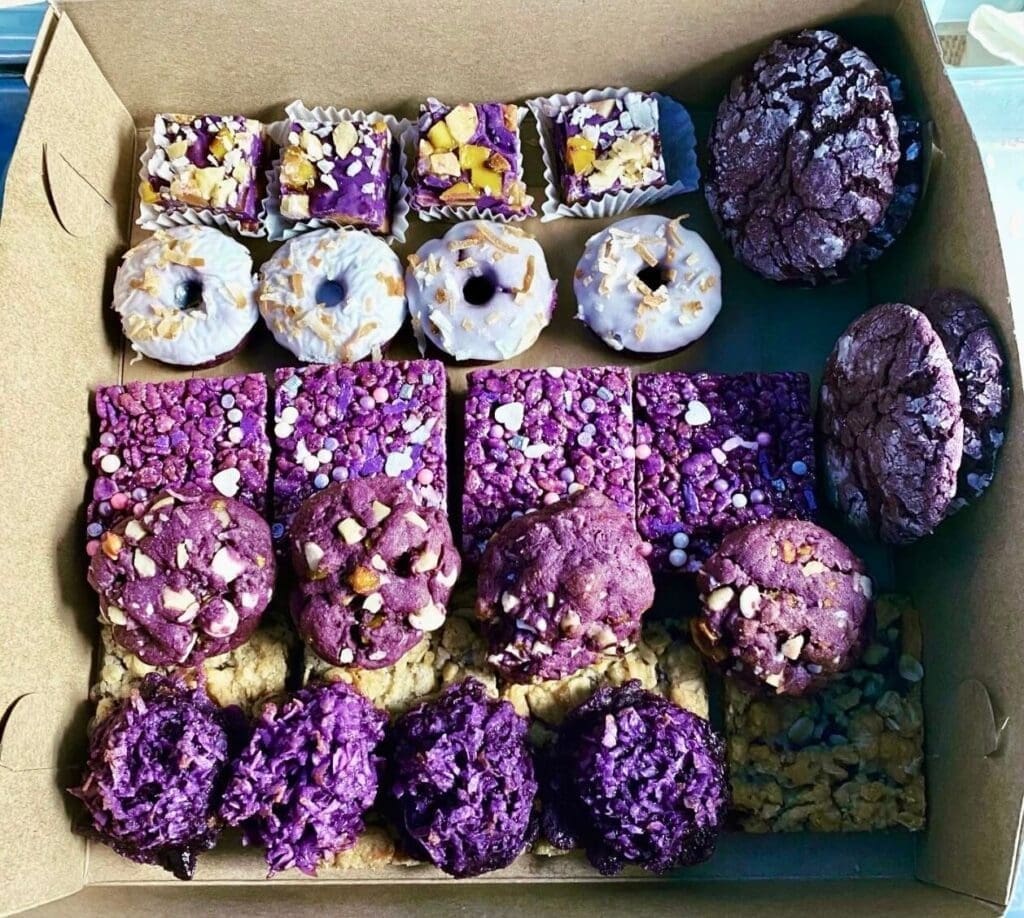
Ube (pronounced OO-beh) is a purple yam native to the Philippines. For generations, ube has been a fundamental part of Filipino desserts — ube halaya (purple yam jam), ube ice cream, ube ensaimada (Filipino sweet bread), and ube cake. Within the Philippines, ube has always been ubiquitous — as common as vanilla is in Western baking.
Once social media recognized ube’s vibrant purple hue, the spread was rapid. Unlike artificially colored foods, ube produces a naturally brilliant purple that photographs beautifully. As Filipino-American bakers and chefs began posting their ube creations online, the ingredient crossed from niche ethnic-grocery item to global food trend. CNN reported that worldwide demand for ube has skyrocketed, with the yam appearing in cafés in New York City, bakeries in Sydney, and even beauty retailers in London. According to The Food Institute, ube has appeared in products as diverse as latte kits, mochi pancake mix, waffles, and martinis.
The trend has not been without friction. Some Filipino food writers and chefs have raised concerns about cultural appropriation — that the ube craze risks erasing the ingredient’s rich history while the cuisine it comes from remains underrepresented in major food media. When Trader Joe’s released an ube ice cream without clearly identifying its Philippine roots, the backlash was swift. The debate around ube has become one of the clearest examples of how viral food trends intersect with questions of cultural identity.
9. Japanese Soufflé Pancakes: The Wiggle That Sparked Millions of Videos

Japanese soufflé pancakes stand three to four inches tall, impossibly fluffy, and they wiggle when you tap them. Structurally, they are closer to a baked meringue than a typical American flapjack. To build them, cooks whip egg whites to stiff peaks, fold them into a batter, then cook the mixture slowly in covered ring molds on a low-heat griddle.
There is some debate over whether Japanese soufflé pancakes first appeared in Japan or were created by a chef at Cream Pot in Waikiki, Hawaii. Regardless of origin, soufflé-pancake cafés gained massive attention and became viral sensations. The key factor was the wiggle — captured in slow-motion video and posted millions of times — plus the ASMR-worthy sound of a fork pressing through the pillowy surface.
Soufflé-pancake cafés have opened in Toronto, New York City, London, and throughout Southeast Asia. Their appeal to operators is paradoxical: the pancakes demand genuine skill — nailing the meringue, controlling griddle heat, preventing collapse — yet generate enormous social-media engagement for every successful stack.
Japanese soufflé pancakes proved that texture alone can drive a food trend regardless of flavor profile. The taste is pleasant — mildly sweet, slightly eggy, very light. People, however, do not wait in long lines for the taste. They wait for the wiggle.
10. Mirror Glaze Cakes: How One Pastry Chef Turned Instagram Into a Gallery

Russian pastry chef Olga Noskova had been sharing photos of her creations on Instagram for months when, on May 12, 2016, she woke up to find her account had exploded — jumping from 34,000 followers to 300,000 overnight after BuzzFeed and Bored Panda featured her work. Each photo showcased cakes with mirror-like coatings so flawless they reflected light like polished glass. The internet lost its collective mind.
Mirror glazing is an older French technique — gelatin, sugar, water, condensed milk, and chocolate are combined, heated, and poured over a frozen mousse cake to produce a flawless, reflective finish. As Tasting Tablereported, French entremet bakers had used the method for decades, but Noskova was the first to make it a visual spectacle for a mass audience. She poured multiple layers of colored glaze simultaneously, creating galaxy patterns, marble effects, and whatever artistic vision she had in mind.
Mirror glaze cakes became one of the most-posted food categories on Instagram, spawning thousands of home-baker attempts with wildly varying results. The trend is now widely credited with accelerating a larger shift: Instagram evolved from a place where people happened to photograph food into a platform where food was designed to be photographed.
11. Freakshakes: The Milkshake Arms Race

A freakshake is, at its core, a milkshake buried under a ridiculous mountain of toppings. The first one was created in 2015 by Pâtissez, a small café in Canberra, Australia. The formula was dead simple: pour milkshake into a tall glass, then pile on entire slices of cake, doughnuts, candy bars, brownie chunks, whipped-cream towers, and caramel drizzle until the glass is almost too heavy to lift.
The Guardianreported that freakshakes crossed from Canberra to England by 2016. From there, the trend exploded as cafés and restaurants alike began serving them.
The freakshake was never really about the milkshake. It was about the display. The moment one arrived at your table, every phone within line of sight came out simultaneously.
Freakshakes typified a particular era of food culture — the mid-2010s Instagram peak — when excess was the ultimate aesthetic. Nobody was counting calories. Structural integrity mattered less than presentation. Freakshake culture has faded as post-pandemic tastes shifted toward minimalism, but its core principle survives in every dessert designed today with more attention paid to the arrival moment than to the eating experience.
12. Cake Pops: The Blog Post That Launched a Billion-Dollar Category

In 2008, Angie Dudley — the Atlanta-based blogger behind Bakerella — published a post about crumbling cake, shaping it into balls, coating them in chocolate, and mounting them on lollipop sticks. The concept was simple. The execution was irresistibly photogenic. The post went viral.
Dudley soon found herself demonstrating cake pops on The Martha Stewart Show. According to CNBC, her creation “sparked a mini-revolution in baking.” Starbucks then placed cake pops in stores nationwide, cementing the idea in the minds of millions who had never visited a food blog.
Cake pops were perfectly suited for parties, weddings, and corporate events — small, customizable, and available in virtually unlimited flavor-and-decoration combinations.
Cake pops represent an early model of dessert virality — pre-TikTok, pre-Instagram — and serve as an intermediate step between blog-era food culture and the modern social-media era. A single inventive home baker with a great idea and a blog changed the dessert landscape permanently.
13. Rolled Ice Cream: The Street Performance Disguised as Dessert

Rolled ice cream — known as I-Tim-Pad (“stir-fried ice cream”) in Thailand — has existed as a street food since around 2009. The method involves pouring a liquid ice-cream base onto a metal plate chilled to roughly −30°C, chopping in mix-ins live, spreading the mixture flat, and scraping it into tight cylindrical rolls.
Because every order is made live, the preparation itself is mesmerizing — and endlessly filmable. Rolled ice-cream shops began appearing across North America by 2015, and within two years they could be found in most major U.S. cities.
The finished product — ice cream in cylindrical rolls rather than scoops — tastes no different from traditionally served ice cream. People pay for the show. Rolled ice cream is a dessert whose primary product is the act of its own creation. That realization — that making a dessert can be worth more than eating it — may be the central idea of the entire viral-dessert era.
14. Pastel de Nata: The Monastery Secret That Went Mainstream

The pastel de nata is not new. Monks at the Jerónimos Monastery in Lisbon’s Belém district created the custard tart centuries ago, using leftover egg yolks from the production of laundry starch. When Portugal dissolved its monasteries in 1834, a former monk began selling the pastries at a small shop next door. That shop — Pastéis de Belém — has been operating since 1837, and to this day, only a handful of people know the original recipe at any given time.
What has changed dramatically in recent decades is not the pastry — it is Lisbon. Cheap flights, digital nomads, and social-media promotion turned the city into one of Europe’s hottest destinations, and the pastel de nata became its edible icon. Eaterreports that the trend has a darker side: wherever tourists queue for hot egg tarts, local rents climb and residents are pushed out.
Simultaneously, nata cafés have opened in London, Sydney, Toronto, and across Asia. The appeal is universal: a crispy pastry shell containing warm custard with characteristic burnt blisters on top, dusted with powdered sugar and cinnamon. A decade of travel photography across social media, combined with wave after wave of Lisbon food journalism, propelled this centuries-old pastry back into the international spotlight.
15. Matcha Desserts: The Green Wave That Became a $4 Billion Industry

Matcha has been enjoyed in Japan for centuries as part of traditional tea ceremonies. Its transformation from ceremonial drink to global dessert ingredient, however, is a distinctly 21st-century phenomenon.
According to Polaris Market Research, the global matcha market reached approximately $4.61 billion in 2025 and is projected to grow at 7.8 percent annually through 2034. Tastewise data shows matcha menu items growing at over 30 percent year-over-year. The ingredient now appears in everything from ice cream and lattes to cheesecake, tiramisu, croissants, macarons, and mochi — with hundreds of other applications and counting.
Three factors fueled matcha’s rise. First, its vivid green stands out against the white backgrounds and neutral tones that dominate food photography. Second, its flavor — earthy, slightly bitter, subtly sweet — is distinctive without being alienating. Third, matcha carries a perceived health halo thanks to its antioxidant properties and its association with broader wellness trends.
Unlike the Cronut or Dubai chocolate, which exploded overnight on novelty alone, matcha built its dominance gradually over roughly a decade — through café culture, wellness trends, Japanese food tourism, and the simple visual fact that a bright green dessert stands out in a world of brown and beige.
Comparison Table: 15 Viral Desserts at a Glance
| # | Dessert | Origin | Viral Year | Primary Platform | Core Viral Mechanic | Key Stat |
|---|---|---|---|---|---|---|
| 1 | Cronut | New York City, USA | 2013 | Blogs / Instagram | Scarcity + line culture + photography | $5 pastry resold for $100+; Time’s 25 Best Inventions 2013 |
| 2 | Dubai Chocolate | Dubai, UAE | 2023 | TikTok | ASMR video + supply chain disruption | 120M+ TikTok views; pistachio prices $7.65→$10.30/lb |
| 3 | Basque Burnt Cheesecake | San Sebastián, Spain | ~2019 | Instagram / Blogs | Ugly-delicious aesthetic + simplicity | 6 ingredients; “banana bread of lockdown 3.0” |
| 4 | Crumbl Cookies | Logan, Utah, USA | 2020–2022 | TikTok | Weekly rotation + unboxing content | 10M+ TikTok followers; $1B+ system-wide sales |
| 5 | Tanghulu | Northern China | 2023–2024 | TikTok | ASMR crunch + visual color | Song Dynasty origin (960–1279 AD); K-pop amplified |
| 6 | Dalgona Coffee | South Korea / Macau | 2020 | TikTok / Instagram | Lockdown simplicity + 3 ingredients | Most-searched Google recipe, April 2020 |
| 7 | Mochi Ice Cream | Japan | 2020–2022 | TikTok | Novel mouthfeel + taste-test format | Heian period origin (794–1185 AD); Trader Joe’s mainstream push |
| 8 | Ube Everything | Philippines | 2021–2023 | Instagram / TikTok | Natural purple color + cultural storytelling | Worldwide demand surge; cultural appropriation debate |
| 9 | Japanese Soufflé Pancakes | Japan | 2018–2020 | YouTube / TikTok | Jiggle slow-motion video | 3–4 inches tall; people wait for the wiggle |
| 10 | Mirror Glaze Cakes | Russia / France | 2016 | Visual spectacle + artistic skill | Noskova: 34K→300K followers overnight (May 2016) | |
| 11 | Freakshakes | Canberra, Australia | 2015–2016 | Excess as aesthetic + arrival moment | Created by Pâtissez; spread globally by 2016 | |
| 12 | Cake Pops | Atlanta, USA | 2008–2011 | Blog / TV | Customizable + party format | Bakerella blog to Starbucks nationwide; “mini-revolution in baking” |
| 13 | Rolled Ice Cream | Thailand | 2015–2017 | YouTube / Instagram | Live performance + visual process | Known as I-Tim-Pad; −30°C metal plate prep |
| 14 | Pastel de Nata | Lisbon, Portugal | 2015–2020 | Instagram / Travel blogs | Tourism + heritage + photography | Secret recipe known by only a handful; since 1837 |
| 15 | Matcha Desserts | Japan | 2015–present | Instagram / Café culture | Color contrast + health halo + slow build | $4.61B global market (2025); 7.8% annual growth |
Frequently Asked Questions
What is the most viral dessert of all time?
The Cronut, launched by Dominique Ansel in May 2013, is widely considered the first dessert to achieve true internet-era virality. It produced lines exceeding two hours, a black market on Craigslist, and was named one of Time magazine’s 25 Best Inventions of 2013 — just months after its introduction.
Why did Dubai chocolate become so popular?
Dubai chocolate exploded after a TikTok ASMR video of food influencer Maria Vehera eating a FIX Dessert Chocolatier bar surpassed 120 million views. The combination of crunchy kataifi pastry, creamy pistachio paste, and thick chocolate created a sensory experience that translated perfectly to short-form video.
What is common among TikTok viral desserts?
The common threads among viral TikTok desserts include bold color, unique textures, a visible preparation process, and an overall presentation that creates a “satisfying” or ASMR-friendly viewing experience. Desserts that introduce novelty through cultural fusion or provide a sensory contrast to familiar sweets tend to outperform.
Are viral desserts actually good?
Some viral desserts are genuinely world-class — Basque burnt cheesecake and pastel de nata carry centuries of culinary history behind them. Others ride popularity more than quality. Viral success and actual excellence are independent variables: a dessert can score high on both, low on both, or anywhere in between.
Which trending viral dessert will come next?
Based on 2026 trend data, the next wave of viral desserts gaining traction includes pistachio-based everything (riding the Dubai chocolate wave), Japanese-style two-ingredient cheesecakes, and savory-sweet hybrids such as miso caramel and tahini chocolate. The next true breakout will likely combine a new visual hook, a compelling backstory, and a texture that films well on a phone.
Can I still buy a Cronut today?
Dominique Ansel Bakery, located at 189 Spring Street in SoHo, New York City, still produces Cronuts daily with a new flavor each month. The bakery caps daily output at roughly 350 units, and lines before the 8 a.m. opening regularly reach 60 to 100 people deep.


